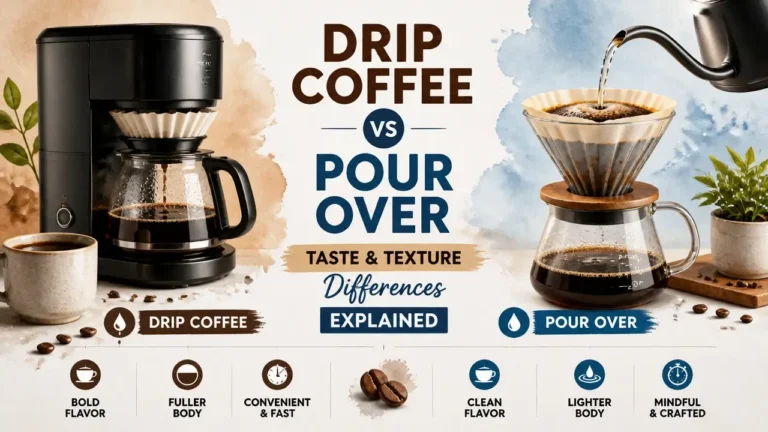

Automatic drip coffee trades control for consistency: a showerhead and heating element do the thinking, delivering a balanced, full-bodied cup with minimal effort. Pour over flips that equation entirely.
With a gooseneck kettle in hand, you control flow rate, contact time, and the bloom. Every variable bends to your decision-making, pulling clarity and brightness from the grounds that a drip machine simply wasn’t designed to chase. Same beans, same grinder: wildly different cups.
How Flow, Temperature, and Contact Time Shape Your Coffee
Drip vs pour over isn’t really a debate about machines: it’s a debate about which set of physical forces you’re handing control to. Every sensory difference you’ve noticed between a clean, bright pour-over and a smooth, rounded drip cup, traces back to three percolation variables: flow rate, temperature stability, and contact time. Master all three, and you can build any cup profile you want. Let real-world equipment take shortcuts, and the cup tells on itself.
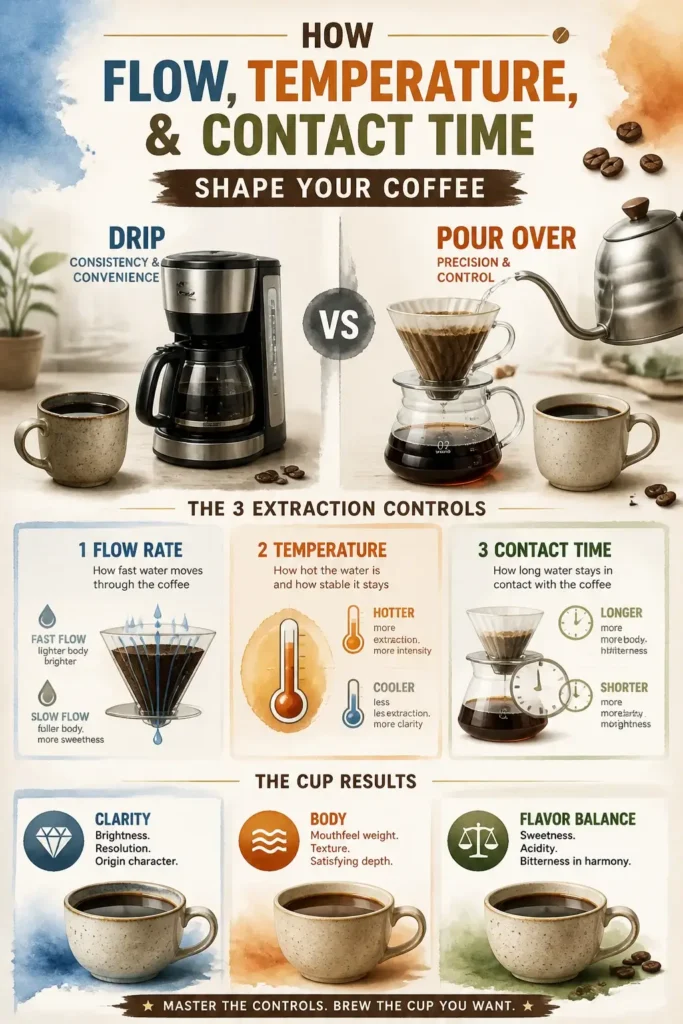
Before we can talk about how drip and pour-over pull these levers differently, we need a shared language for what’s actually in the cup.
Clarity is the quality that lets origin character come through: the brightness, the fruit notes, the sense that you’re tasting a specific place. It’s not thinness. It’s resolution. Body is mouthfeel weight, that coating texture that makes a cup feel substantial on the tongue. And flavor balance is how sweetness, acidity, and bitterness integrate: whether they argue with each other or settle into something coherent.
These three attributes aren’t aesthetic preferences. They’re direct outputs of the physics happening inside the brew bed.
Flow Rate and Turbulence in the Brew Bed
Flow rate is the most misunderstood of the three variables, because people think of it as just “how fast water moves.” What it actually governs is uniformity of extraction: whether every coffee particle gets the same quality of contact with water.
When water hits a brew bed with controlled, variable turbulence (the way a skilled hand with a gooseneck kettle delivers it), it agitates the grounds just enough to prevent channeling. Channeling: is what happens when water finds a weak path through the puck, and punches straight through, over-extracting that narrow lane while leaving the rest of the bed under-extracted. It also keeps fine particles from migrating to the bottom and clogging the bed, which would slow the flow and muddy the cup.
The result of that controlled agitation is high clarity. The extraction is even, so the delicate volatile compounds that carry origin character survive intact instead of getting buried under the off-notes that uneven extraction produces.
A fixed or pulsed showerhead (the mechanism most drip machines use) distributes water more uniformly across the surface, but with less targeted agitation. That gentler contact creates a more blended, rounded extraction. Less turbulence means fewer fines disturbed, a slightly heavier particle load in the cup, and a profile that leans toward body over brightness. Neither approach is wrong. They’re just solving for different things.
Why Temperature Stability Changes Everything
The 195-205°F window isn’t arbitrary. That’s the thermal range where the desirable soluble compounds: the sugars, the acids, the aromatic molecules: dissolve readily into water. Drop below it and you’re under-extracting: the cup tastes sour, flat, incomplete. Push above it and you’re scorching delicate compounds and accelerating the extraction of harsh, astringent molecules that should stay in the grounds.
What matters as much as hitting that window, is staying in it. A brewer that starts at 200°F and drifts down to 185°F mid-brew isn’t just losing temperature: it’s changing the extraction chemistry in real time. The early part of the brew extracts one set of compounds; the cooler tail extracts a different, less desirable set. The cup that results has muddy balance and muted clarity, not because the coffee was bad, but because the thermal profile was inconsistent.
This is actually where recent research adds a useful wrinkle. Chahan Yeretzian, Professor and Head of the Coffee Excellence Center at ZHAW (Zurich University of Applied Sciences), found something counterintuitive:
“The concept of ‘extract chilling’ did not exist before 2021. It was discovered at the Coffee Excellence Center at ZHAW. We realised that the intensification of a coffee’s sensory profile when extracting with colder water (90°C) compared to water at 96°C is because you can retain more volatile compounds.”
That finding doesn’t contradict the 195-205°F principle, it refines it. Temperature stability still matters enormously. What Yeretzian’s work reveals is that the ceiling of that window isn’t always optimal for clarity-driven cups, because higher heat drives off the volatile aromatics that carry brightness and origin character before they make it into your cup. A steady profile at the lower end of the window can actually preserve more of what makes a coffee interesting.
Contact Time, Strength, and Texture
Contact time is the variable that most directly controls the weight of the cup. Shorter contact (the 2-4 minute range a well-executed pour-over targets) means water moves through the bed efficiently, picking up a selective cut of solubles and carrying them through. The result is a lighter, more tea-like texture with higher perceived clarity, because the extraction stops before the heavier, more slowly dissolving compounds have time to contribute.
Longer contact time, which a drip machine’s programmed brew cycle can stretch toward 5-8 minutes depending on batch size, gives water more time with the grounds. More soluble mass makes it into the cup. That increases body, rounds out the acidity, and blends the flavor components into a more unified, comfortable profile. It’s not over-extraction, it’s a different extraction target.
The relationship between these three variables is what makes coffee brewing genuinely complex. Flow rate affects how evenly the contact time is distributed across the bed. Temperature determines which compounds are available to dissolve during that contact window. Contact time controls how much of those compounds actually make it into the cup. Change one, and the other two respond.
Any brewer that holds all three variables steady and precise can, in theory, produce any cup profile on the spectrum from crystalline clarity to deep, rounded body. The real question is which piece of equipment actually does that in your kitchen, under your morning conditions, and that’s exactly where the drip vs pour-over comparison gets interesting.
How Drip and Pour-Over Actually Shape Your Cup
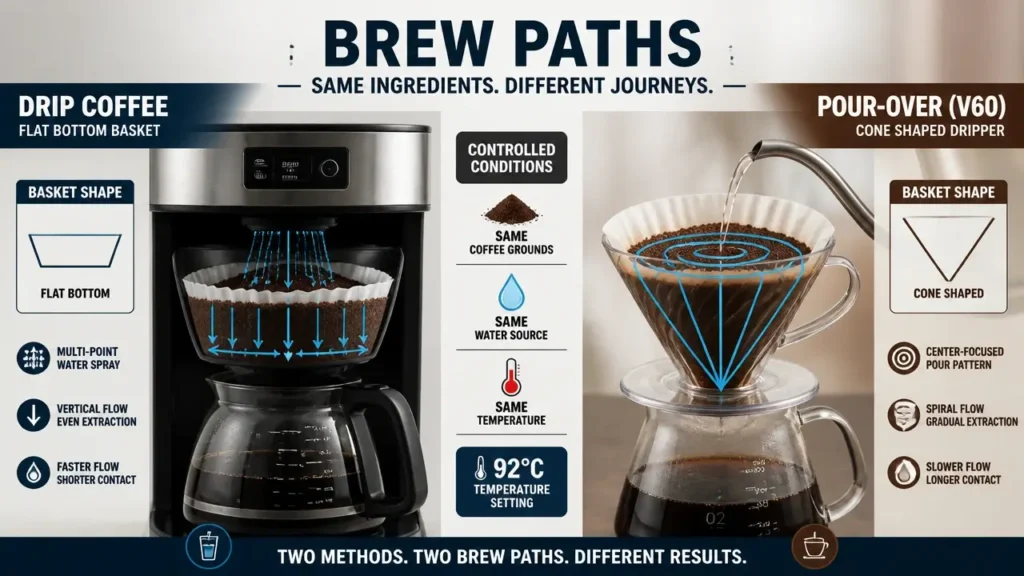
Both methods pour hot water over grounds, but that’s where the similarity ends. The mechanical gap between a fixed showerhead and a gooseneck kettle is wide enough to produce two cups that taste like they came from different beans, and that gap only grows wider as your machine ages.
Water Dispersion and Temperature: The Mechanical Divide
Precisely controlled gooseneck kettles give pour-over brewers something no drip machine offers by design: the ability to place water exactly where the bed needs it, at the exact moment it needs it, with the exact flow rate that keeps extraction even. You’re not guessing: you’re steering.
A drip machine’s showerhead works on a fixed pattern. The classic 9-hole Moccamaster design and the wider 29-hole arrays on higher-end models both distribute water automatically, but “automatic” doesn’t mean “even.” If one hole clogs from mineral buildup, that section of the bed goes dry. Water finds the path of least resistance, punches through the saturated zones, and you get over-extracted bitterness, sitting right next to under-extracted sourness in the same cup. The machine had one job, and scale quietly took it away.
Temperature tells a similar story. A variable-temperature kettle holds your set point: 200°F stays 200°F from first pour to last. A drip machine relies on a thermostat and heating element that were calibrated on day one. Budget models often can’t even reach 195°F, the floor for proper extraction. SCA-certified machines guarantee ≥92°C (about 197°F) at the spray head, but that certification reflects lab conditions on a new unit, not your machine after 18 months of daily use and no descaling. The thermostat drifts. The water lines narrow with scale. The pump works harder to move the same volume. None of that shows up on the badge.
| Dimension | Drip Coffee | Pour-Over | What It Means for Your Cup |
|---|---|---|---|
| Water dispersion | Fixed showerhead pattern; uneven hole coverage or low pump pressure creates dry pockets | Gooseneck kettle places water precisely; brewer controls flow rate, pattern, and agitation | Drip favors convenience; pour-over favors precision, and the difference changes extraction consistency |
| Temperature stability | Thermostat and heating element drift over time; cheaper models often can’t reach 195°F | Freshly heated kettle water; brewer controls starting temp and pour timing directly | Drip depends on equipment health; pour-over depends on the brewer’s discipline |
| Failure points | Scale buildup, thermostat drift, clogged spray heads, pump degradation: all silent and cumulative | Poor grind, rushed pouring, skipped bloom, uneven distribution: all visible and correctable | Drip fails mechanically; pour-over fails operationally. One requires a part; the other requires practice |
| Certification blind spots | SCA/ECBC badges reflect manufacturer-paid lab testing, not real-world longevity or distribution evenness | No badge system; performance is directly visible in technique and extraction results | Labels can obscure what actually matters: how the water hits the bed this morning, in your kitchen |
The certification blind spot deserves a moment. An SCA badge signals that a machine met a parameter threshold under controlled conditions: it doesn’t guarantee your cup stays that way. User reports on the Moccamaster, a $350 machine with a loyal following, show that its 9-hole showerhead can channel unevenly enough that a manual V60 with a $40 plastic cone pulls a more balanced extraction. The badge didn’t lie. It just didn’t tell the whole story.
The specialty coffee publication, Perfect Daily Grind puts the channeling problem plainly:
“Channelling is the result of unevenly distributed grounds; it causes the water to channel through certain sections of the coffee bed, over-extracting there, and not extracting or under-extracting in other sections. The deep angle on some pour over devices, like the Chemex and the V60, makes it more difficult to evenly distribute coffee grounds. This can result in an unbalanced brew with jarring notes.”
Channeling isn’t exclusive to drip, pour-over’s steep-walled devices carry their own distribution risk. But the difference is who’s responsible. In pour-over, you caused it, which means you can fix it tomorrow morning.
Extraction Dynamics, Sensory Outcomes, and Hardware
Extraction dynamics in pour-over follow a deliberate three-act sequence: bloom, pulse pouring, and drawdown. Each stage has a job. The bloom (saturating the grounds with a small amount of water and waiting 30–45 seconds), drives degassing, releasing CO2 that would otherwise create a barrier between water and coffee solids. Pulse pouring maintains an even water level above the bed, controlling agitation and keeping extraction uniform. Drawdown, the final drain, where the last of the dissolved compounds leave the bed cleanly.
Drip skips act one entirely. Most machines have no bloom phase. Water flows continuously from the start, and the CO2 from fresh beans pushes back against extraction instead of escaping first. For a medium-dark roast that’s been resting for two weeks, this matters less. For a light roast pulled three days off the roaster, it can leave the cup flat and underdeveloped, because the gases won the fight.
That mechanical difference shows up directly in the sensory outcome:
- Pour-over produces high flavor clarity, bright acidity, and a light-to-tea-like body. Single-origin light roasts, the ones where you’re paying for floral or stone-fruit notes, show best here. The extraction is surgical enough to keep those delicate compounds intact and separated.
- Drip coffee delivers a rounded, integrated cup with medium-to-heavy body, and pronounced sweetness and chocolate depth. Medium-to-dark roasts and breakfast blends are at home here. The longer thermal mass and continuous flow blend the flavor compounds together rather than isolating them. That’s not a flaw: it’s the design.
The caveat on drip body: poor water distribution can create a “muddy” texture that mimics body but is actually suspended fines and uneven extraction. True body comes from dissolved solids; muddy texture comes from a compromised bed. They feel similar in the mouth but taste very different when you slow down and pay attention.
There’s also a hardware floor for each method. Pour-over demands a quality burr grinder, blade grinders produce an inconsistent particle size that makes even the best technique irrelevant, and a gooseneck kettle for flow control. That’s a real upfront investment, but it’s a one-time purchase of tools that don’t degrade the way a machine does. Drip quality is machine-dependent, and most home models sit well below specialty standards, regardless of price tier.
The hidden material failure in cheap drip machines is worth knowing: near-boiling water runs through plastic components every single morning. Sustained exposure to 195°F+ degrades those plastics: micro-cracks, residue buildup, subtle flavor taint that a ceramic or glass pour-over cone never introduces. It’s not a defect that shows up on day one. It’s a slow drift that you might not notice until you brew a pour-over at a friend’s house and wonder why their coffee tastes cleaner.
Here’s a field demonstration that puts the extraction sequence side by side: bloom, pulse pours, and drawdown against a drip machine’s fixed spray cycle:
Pour-over’s only consistent failure: the brewer. Channeling from a rushed pour, an uneven grind, a skipped bloom, these are real, but every one of them is repairable with practice, not a parts order. That’s the core asymmetry: drip shifts the burden to the machine, and machines wear out. Pour-over shifts it to you, and you can get better every morning.
The Verdict: Pour-Over Precision or Drip Comfort
The right brewer isn’t the one with the best specs sheet: it’s the one that matches what you actually want in your cup and what you’re honestly willing to do on a Tuesday morning when you’re half-asleep.
Both methods can make outstanding coffee. The question is which set of trade-offs you’re signing up for.
Flavor Preferences and Your Morning Ritual
Distinct flavor preferences are the first honest filter here, and they point clearly in one direction or the other before you even consider budget or batch size.
If what you love about a great black cup is clarity: that tea-like brightness where you can taste stone fruit or jasmine in a light roast from Ethiopia or Colombia, pour-over is your method. It’s built for that. The manual pour gives you direct control over water distribution and contact time, which means the coffee’s origin character comes through clean and unmuddied. The persona here is someone who brews one or two cups at a time, gravitates toward high-elevation light roasts, and doesn’t mind investing in a gooseneck kettle and a solid burr grinder. The 4-minute ritual, it’s not a tax: it’s the point. You’re not just making coffee; you’re reading it.
Andy Sprenger, owner of Sweet Bloom Coffee Roasters in Colorado, puts it plainly:
“The premium paid for higher‑end coffees these days effectively demands these coffees be brewed one cup at a time. Imagine finding a US $80/lb Gesha on batch.”
That’s not snobbery: it’s physics. A delicate, complex Gesha gets lost in a drip machine’s rounded extraction profile. Pour-over’s clarity is the only way to hear what that coffee is actually saying.
Drip coffee tells a different story, and it’s a good one. If your priority is body: that smooth, chocolatey, full-feeling cup that holds up with milk or just sits comfortably on its own, and you’re making coffee for a household of two to four people before anyone’s really awake, drip is the honest answer. Medium-dark roasts and comfort blends are where drip machines shine, because the method’s rounded extraction profile suits them perfectly. Pair a quality machine (SCA-certified is a reasonable baseline for temperature consistency) with a proper grind size, and you get a reliably good cup with almost no active effort.
But maintenance is where the drip persona has to be honest with itself. Pour-over cleanup is a 30-second rinse of ceramic or glass. A drip machine needs weekly descaling, regular deep cleaning of the reservoir and showerhead to prevent mold, and plastic components that degrade and need replacing every two to three years. That’s not a dealbreaker: it’s just a calendar item. The problem: the machine hides its own degradation until the cup quietly gets worse and you don’t know why.
A 2025 AO World survey of UK coffee drinkers found that 15% of respondents descale their drip machine less than once a month, despite monthly descaling being the standard recommendation. Another 23% didn’t even know the recommended frequency existed. That’s not laziness: it’s a design problem. The machine hides its own degradation until the cup quietly gets worse and you don’t know why.
There’s also a durability dimension worth naming. A ceramic dripper and a stainless-steel burr grinder don’t degrade. Their performance in year five is the same as year one. A plastic-heavy drip machine slowly loses its edge: temperature consistency drifts, seals wear, the showerhead calcifies. For anyone who prizes long-term consistency, that gap matters more than the upfront price difference.
Hybrid Options and the Long-Term Commitment
Some machines try to bridge both worlds. The Breville Precision Brewer, for example, offers adjustable bloom time, water temperature, and flow rate, genuine engineering concessions to pour-over logic inside a drip format. If you want batch volume but care about extraction quality, machines like this are worth the premium. Just go in clear-eyed. The sealed showerhead and plastic-contact constraints, don’t disappear. You’re narrowing the gap, not closing it.
If you already own a basic drip machine and don’t want to replace it, there’s a practical workaround for its two biggest structural flaws: cold-start temperature and no bloom. Before you hit the brew button, pour about 200ml of just-off-boil water directly over the grounds and let them sit for 30 seconds. That manual pre-infusion: it brings the bed up to extraction temperature before the machine’s heating element takes over, and it degasses the coffee so water can penetrate evenly when the full brew starts.
This matters more than it sounds. Research published in Foods (MDPI, 2025) found that brews incorporating a pre-infusion bloom step showed higher concentrations of aromatic esters, caffeine, and chlorogenic acids compared to no-bloom cycles, meaning both overall extraction yield and volatile flavor compound retention improve when you give the coffee that initial contact window. The bloom, these are not a ritual quirk. It’s the mechanism that lets water reach every particle before channeling sets in.
After the manual bloom, start the machine as normal. Clean the showerhead afterward, wet grounds sitting in a warm, enclosed space are exactly where you don’t want mold to develop.
The final call is simpler than all the physics makes it sound. Choose pour-over if you treat coffee as a craft, brew in small batches, and are willing to trade two minutes of active attention for the highest ceiling of flavor transparency your beans can offer. Choose drip if your priority is feeding multiple people with a smooth, forgiving brew, and you’re prepared to treat descaling and deep cleaning as a non-negotiable calendar item, not something you’ll get to eventually.
Neither method fails you. Neglect does.
Key Takeaways on Drip vs Pour Over
- Flow rate controls extraction evenness, not just speed — channeling from poor dispersion ruins clarity faster than temperature drift.
- SCA certification doesn’t guarantee real-world evenness; many certified drip machines still channel compared to a manual pour-over.
- A skipped bloom on freshly roasted light roasts leaves CO2 competing with water, producing a flat, underdeveloped cup.
- Drip machine degradation is silent — descaling alone won’t fix drifting thermostats, worn pumps, or micro-cracked plastic components.
- Pour-over errors like uneven pouring are fixable with practice; a failing drip machine requires parts, not technique.
Frequently Asked Questions About Drip vs Pour Over
Q: Is the 15-15-15 rule a reliable shortcut for pour-over beginners?
A: The 15-15-15 rule—15g coffee, 15-second bloom, 15:1 water ratio—offers a rough starting point but ignores grind size and roast level. Aggressive dark roasts often need coarser grinds and shorter blooms; light roasts demand the opposite. It’s a decent crutch, not a recipe, and can lead to sour or bitter cups if followed blindly.
Q: Does drip coffee’s paper filter remove more cafestol than a metal pour-over cone?
A: Yes. Paper filters trap most cafestol, a diterpene linked to LDL cholesterol increases, while metal filters let it pass through into the cup. So drip coffee with paper is generally a lower-cafestol choice than pour-over setups using reusable metal cones. This doesn’t make metal-filter brew unhealthy for everyone, but it’s a documented difference worth knowing if you monitor cholesterol.
Q: Will descaling an old drip machine fully restore its original flavor profile?
A: Descaling removes mineral buildup from the water lines, but it can’t reverse thermostat drift, pump wear, or the slow leaching from degraded plastic components. You might notice temporary improvement after descaling, but an aging machine’s thermal inconsistency and material taint will still dull clarity compared to its factory-fresh state.
Q: Why does drip coffee left on the hot plate turn bitter within an hour?
A: The hot plate keeps the coffee near brewing temperature, continuing the extraction of bitter and astringent compounds long after the brew cycle finishes. Even after you remove the grounds, residual fines and dissolved solids keep reacting. It’s effectively over-extraction in slow motion, which a pour-over’s immediate dispense avoids.
Q: Can the type of paper filter change drip coffee clarity as much as pour-over technique?
A: Absolutely. Thicker, slower-flowing filters trap more oils and micro-fines, stripping body and muting clarity, while faster, thinner papers let through more sediment and flavor. In drip machines, the fixed showerhead can’t compensate; pour-over technique can somewhat adjust, but the filter’s porosity sets the baseline for what ends up in the cup.
Q: What’s the real trade-off between a SCA-certified drip brewer and a pour-over for bright light roasts?
A: The SCA badge ensures the machine hits temperature and contact time benchmarks, but it doesn’t guarantee even water distribution or a pre-infusion bloom. For bright, high-elevation light roasts where clarity is paramount, a pour-over’s manual agitation and degassing step consistently outperform, even against some certified brewers that still channel.
References
- How Does Water Temperature Affect Coffee Extraction? – perfectdailygrind.com
- Drip vs Immersion Brewing: A Battle of Two Methods – perfectdailygrind.com
- Customers Won’t Wait Forever for a Pour Over – perfectdailygrind.com
- Almost 1 in 6 Brits clean their coffee machine less than once a month despite hidden health risks – ao-world.com
- Pre-Infusion Bloom and Coffee Extraction Study – mdpi.com