


A Crater Lake Hazelnut Espresso Vodka cocktail is not a vodka espresso martini with a spirit swap. Substituting bourbon for neutral vodka changes the thermodynamic profile, the tannin load, and the emulsion physics of the entire drink. Handle it like a simple 1:1 replacement and the oak overwhelms the coffee before the foam even sets.
Done correctly, the hazelnut liqueur’s oils bridge the bourbon’s barrel astringency into toasted praline. The espresso’s CO2 and lipids lock into the cavitation micro-bubbles during the shake. The crema holds. Here is exactly how to get there.
Just as finding the right coffee requires exploring top coffee bean recommendations, achieving cocktail perfection demands precision in every ingredient.
Key Takeaways on Crater Lake Hazelnut Espresso Vodka Recipe Perfection
- Crater Lake Hazelnut Espresso Vodka at 0.75 oz acts as a fatty lipid bridge that softens 90-100 proof bourbon’s wood tannins into toasted praline rather than masking them.
- The golden ratio is 1.5 oz bourbon, 0.75 oz Crater Lake Hazelnut Espresso Vodka, 1 oz rested espresso, 0.25 oz 2:1 demerara syrup, 2 drops 20% saline solution.
- Rest the espresso shot for 90 seconds before adding to the shaker; hot espresso on ice melts up to 35% of chilling ice prematurely and collapses crema CO2.
- A 15-second horizontal hard shake at maximum force is the minimum threshold for hydrodynamic cavitation and a stable 3mm crema layer.
- Two drops of 20% saline solution suppress chlorogenic acid bitterness and allow hazelnut pyrazine aromatics to come forward without adding sweetness.
The Whiskey Substitution Formula: Why Bourbon Meets Crater Lake Hazelnut Espresso Vodka
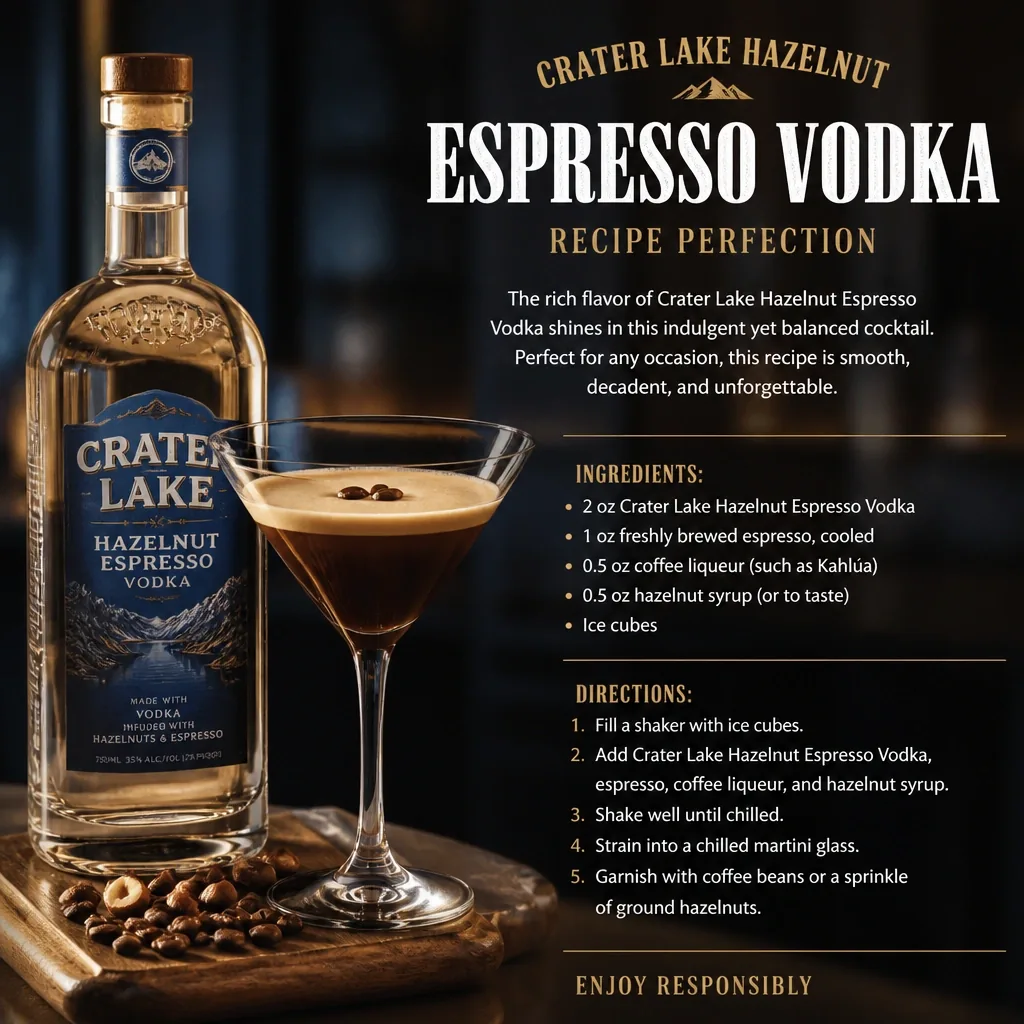
Standard espresso martini recipes use 80-proof neutral vodka because neutral spirits carry alcohol and nothing else. They do not introduce competing flavor compounds, tannin loads, or barrel chemistry. Substituting bourbon changes all three of those variables simultaneously, and most recipe guides ignore the consequences.
90-100 proof bourbon contains vanillin extracted from charred American oak, lignin-derived wood tannins, and caramel sugars from the Maillard reaction during barrel contact. These compounds are not passive. In a cocktail with fresh espresso, bourbon’s wood tannins bind to chlorogenic acid compounds in the coffee and amplify the astringent, drying sensation on the palate. At 90-plus proof, this is detectable. At 80 proof with a short stir, it is a background note. At 90-100 proof with a hard shake, it is the dominant finish.
Crater Lake Hazelnut Espresso Vodka resolves this by contributing hazelnut-derived fatty oils and natural roasted nut aromatics that occupy the same palate space as bourbon’s harsh wood tannins. The hazelnut lipids coat the same taste receptor sites that tannins target, softening the astringency into a toasted praline note without masking the bourbon’s oak backbone entirely. It functions as an aromatic and fatty bridge, not a flavoring agent layered on top.
Flavor Architecture: Balancing Whiskey Tannins With Hazelnut Oils
The interaction between spirit, hazelnut liqueur, and espresso follows predictable chemistry. This matrix shows the flavor outcome by spirit type when paired with Crater Lake Hazelnut Espresso Vodka and fresh double espresso:
| Spirit | Tannin Load | Hazelnut Interaction | Espresso Integration |
|---|---|---|---|
| Neutral vodka (80 proof) | None | Hazelnut dominates | Clean, one-dimensional sweetness |
| High-rye bourbon (90-100 proof) | High (spice-forward) | Hazelnut softens tannins into praline | Balanced: coffee and spirit compete equally |
| Wheated bourbon (90-94 proof) | Medium (rounded) | Hazelnut amplifies confectionery sweetness | Dessert-forward; coffee recedes |
| Straight rye (90-100 proof) | High (black pepper, anise) | Hazelnut adds nut-spice contrast | Bold: coffee and rye co-dominant |
Selecting the Right Whiskey
High-rye bourbon (Woodford Reserve, Four Roses Single Barrel, Bulleit) delivers peppery baking spice at 20-35% rye content. That spice cuts through the hazelnut’s sweetness and prevents the drink from tipping into dessert territory. The resulting cocktail reads as sophisticated and balanced rather than candy-sweet.
Straight rye whiskey (Rittenhouse 100, Pikesville, WhistlePig 10) brings higher tannin load and black pepper sharpness. Paired with Crater Lake Hazelnut Espresso Vodka, the rye’s anise notes echo the espresso’s dark roast bitterness rather than fighting it. Choose rye when you want maximum spirit presence with coffee as a supporting character.
Wheated bourbon (Maker’s Mark, Larceny) produces a softer, rounded build where the hazelnut sweetness expands rather than being constrained by grain spice. Correct for readers who prefer a dessert-style cocktail, but the coffee clarity is lower.
The Golden Dosing Ratio
The baseline build: 1.5 oz bourbon or rye (90-100 proof), 0.75 oz Crater Lake Hazelnut Espresso Vodka, 1 oz fresh double espresso, 0.25 oz rich demerara simple syrup (2:1), 2 drops 20% saline solution.
The hazelnut vodka at 0.75 oz sits below the spirit as a modifier rather than competing as a co-base spirit. Increasing it past 1 oz shifts the drink into liqueur-dominated territory where the bourbon disappears. Decreasing below 0.5 oz loses the bridging function and lets the tannins run unchecked.
Shaken Cold vs Steamed Hot: The Espresso Martini and Irish Coffee Divide
The instinct to conflate whiskey-coffee cocktails is understandable and consistently wrong. An espresso martini and an Irish coffee are mechanically opposite drinks.
Temperature and Thermodynamic Contrasts
| Attribute | Whiskey Espresso Martini | Irish Coffee |
|---|---|---|
| Serving temperature | 28-32°F (sub-freezing) | 140-160°F (pre-heated mug) |
| Coffee preparation | Pulled espresso, rested 90 sec | Hot brewed filter coffee |
| Aeration method | Hydrodynamic cavitation (shake) | None |
| Dairy | None | Heavy cream floated on surface |
| Spirit integration | Emulsified into the liquid | Layered beneath cream |
| Glassware | Stemmed coupe or martini glass | Pre-heated toddy mug |
The structural difference is not aesthetic. Shaking hot coffee inside a sealed Boston shaker creates a pressure chamber. Steam from hot liquid in a sealed metal tin cannot vent. The vapor pressure builds until the tin fails violently or the seal blows on opening, spraying scalding liquid. Beyond the safety failure, hot coffee poured over cocktail ice melts 30-40% of the ice mass before the shake begins, producing a diluted base before the first calorie of chilling work occurs.
Dairy Float vs Crema Emulsion
Irish coffee’s heavy cream layer is un-whipped dairy floated gently across the back of a bar spoon onto hot coffee. It sits on the surface by density difference alone and does not integrate into the drink. You drink through the cream.
An espresso martini’s crema is not dairy at all. It is an emulsion of the espresso shot’s CO2 micro-bubbles trapped inside coffee lipids, stabilized by alcohol surface tension during the shake. Adding any dairy to the shaker destroys this emulsion: milk proteins coat the CO2 bubble surfaces, the lipid matrix collapses, and the crema never forms. The drinks share only the words “whiskey” and “coffee.” Everything else is a different physics problem.
Glassware and Presentation
The espresso martini goes into a chilled stemmed coupe or martini glass. The stem keeps your hand’s heat from warming the drink. The wide bowl allows the crema to spread and hold across the full surface diameter. Serve immediately; the crema is at its densest in the first 2-3 minutes.
Irish coffee goes into a pre-heated tempered glass mug, warmed with hot water before filling, to prevent the hot coffee from cracking the glass on contact and to extend the drink’s serving temperature window.
Delicate presentation and thermal preservation matter just as much for dessert-leaning profiles as they do when recreating a starbucks vanilla iced coffee at home.
Essential Ingredients, Tools, and Pre-Shake Thermodynamics
Three variables in the setup phase determine whether the shake succeeds or fails before the tin is sealed.
The 90-Second Espresso Rest
Pull a double espresso at a 1:2 ratio (18g in, 36g out). Set it aside for 90 seconds. Do not stir it, do not refrigerate it, do not add anything to it yet.
This rest serves two purposes. First, the crema is actively volatile for about 60-90 seconds after extraction: CO2 is still migrating out of solution and the lipid matrix is stabilizing. Introducing this turbulent shot directly to ice collapses the CO2 prematurely and produces a thinner, less stable crema during the shake. Second, a 200°F espresso shot poured directly onto shaker ice melts a disproportionate mass of ice before chilling even begins. At 90 seconds, the shot temperature drops to approximately 140-160°F, reducing the thermal shock and protecting up to 35% of your chilling ice from premature melt.
Barware Selection
A two-piece Boston shaker is the only appropriate tool. Its large internal volume provides room for kinetic ice ricochet during the shake, and the separate tins allow a clean, controlled seal that does not freeze shut the way cobbler shaker lids do. You also need a Hawthorne strainer and a fine-mesh conical sieve for double-straining.
Ice selection matters mechanically. Dense, solid 1-inch cubes or cocktail ice bags provide sufficient mass for kinetic impact during the shake without the excess surface area of hollow freezer tray cubes. More surface area means faster melt rate during the shake itself, which over-dilutes the cocktail before cavitation completes.
Flavor Modifiers
Rich demerara simple syrup (2:1) adds sweetness without the flat profile of white sugar. Demerara’s unrefined molasses notes complement both bourbon’s caramel and the hazelnut vodka’s toasted nut character.
Saline solution at 20% (1 part salt dissolved in 4 parts water by weight) is the least-obvious and most impactful modifier. Two drops added to the shaker before sealing. Sodium ions selectively block the taste receptors most sensitive to bitter chlorogenic acid compounds, the primary source of harsh bitterness in coffee. Blocking those receptors allows the hazelnut pyrazine aromatics and espresso’s roasted nut volatiles to come forward without sweetening the drink. The cocktail does not taste salty. It tastes less bitter and more coffee-forward.
Beyond simple syrup, mastering cold extraction profiles and unrefined sweetness principles is equally essential when experimenting with a brown sugar shaken espresso.
Step-by-Step Guide: Crafting the Cold-Shaken Whiskey Espresso Martini
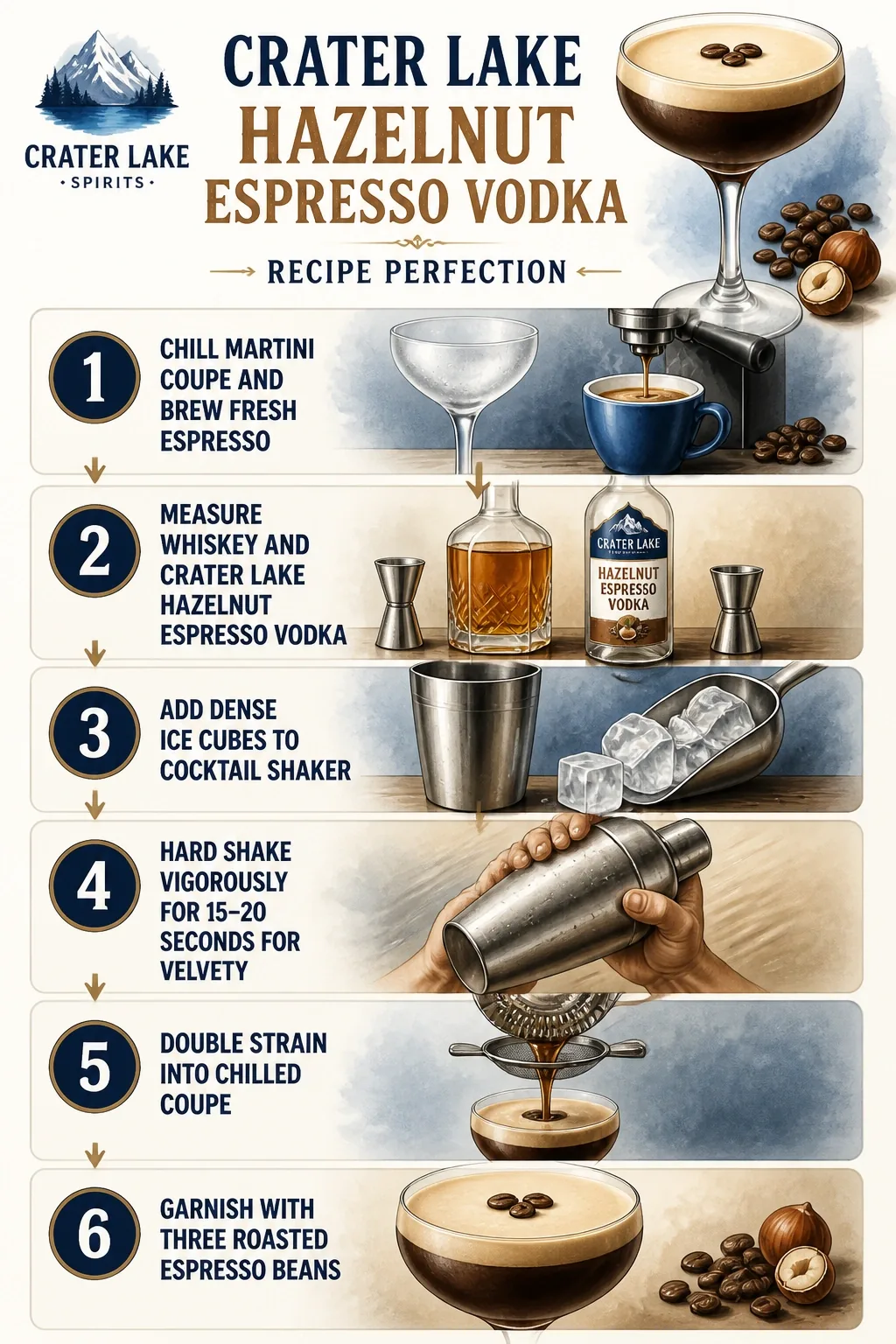
The full recipe: 1.5 oz bourbon or rye (90-100 proof), 0.75 oz Crater Lake Hazelnut Espresso Vodka, 1 oz fresh double espresso (rested 90 seconds), 0.25 oz rich demerara syrup (2:1), 2 drops 20% saline solution.
Steps 1-3: Precise Dosing, Ice Packing, and Shaker Sealing
Step 1: Chill the coupe. Fill your coupe or martini glass with ice water and set it aside. This step takes 30 seconds and is the difference between a crema that holds for 4 minutes and one that collapses in 90 seconds from warm glass contact.
Step 2: Pull the espresso and rest it. Extract your double shot at 1:2 ratio. Set a timer for 90 seconds. Use those 90 seconds to measure and add to the larger Boston tin: the demerara syrup first, then the saline drops, then the Crater Lake Hazelnut Espresso Vodka, then the bourbon. Add the rested espresso last.
Step 3: Pack the ice and seal the shaker. Fill the smaller Boston tin three-quarters full with dense solid ice. Seat the larger tin on top at a slight angle, then press firmly to seal. The seal should be tight enough that tipping the shaker upside down produces no drips.
Steps 4-6: High-Velocity Aeration, Double-Straining, and Bean Garnish
Step 4: The 15-second hard shake. Hold the shaker horizontally with both hands, one on each tin. Shake with maximum force for exactly 15 seconds, driving the ice back and forth in a piston motion rather than a rotational swirl. The horizontal axis creates higher ice velocity and stronger impact against the liquid surface, generating the hydrodynamic cavitation that traps micro-bubbles inside the espresso lipids. A short shake or a gentle shake does not produce sufficient bubble density for a stable crema layer.
Step 5: Double-strain. Dump the ice water from the chilled coupe. Hold the Hawthorne strainer over the shaker opening and the fine-mesh sieve between the shaker and the glass. Pour through both simultaneously. The Hawthorne catches ice chunks; the fine mesh catches micro-ice shards that would melt into the crema surface and destabilize it within 60 seconds.
Step 6: Garnish. Float three roasted espresso beans on the crema surface in a triangle arrangement. The beans are aromatic: their surface oils volatilize as you drink, extending the coffee aroma experience through the sip. Serve within 30 seconds of pouring.
Achieving that velvety, persistent microfoam head through vigorous mechanical agitation shares structural parallels with the gas-infused cascading texture found in methods like How to Make Nitro Cold brew.
Quality Benchmarks
A correctly built cocktail has a crema layer at least 3mm thick that does not show the liquid below for the first 3-4 minutes. Temperature at the glass should be at or below 32°F. The aroma reaching the nose before the sip is roasted hazelnut and dark coffee with a faint bourbon caramel note underneath.
Troubleshooting Common Flaws: Flat Foam, Over-Dilution, and Palate Imbalance
Fixing Thin Crema
Root cause 1: Stale espresso beans. Beans more than 4 weeks from roast date have lost the dissolved CO2 that crema bubbles depend on. Fresh beans, roasted within the past 2-4 weeks, are non-negotiable. There is no technique fix for stale coffee.
Root cause 2: Espresso poured directly onto ice without resting. A hot shot placed directly on shaker ice collapses the crema CO2 before the shake even starts. Follow the 90-second rest without exception.
Root cause 3: Insufficient shake force or duration. Less than 15 seconds at full force does not generate the cavitation bubble density needed for a stable foam layer. If your crema is thin, shake harder and longer before adjusting any ingredients.
Correcting Palate Imbalance
Drink finishes harsh and astringent: The bourbon tannins are overrunning the hazelnut bridge. Increase Crater Lake Hazelnut Espresso Vodka to 1 oz and reduce bourbon by 0.25 oz, or add 1 additional drop of saline solution.
Drink tastes sweet and one-dimensional: The hazelnut is dominating. Reduce the hazelnut vodka to 0.5 oz, increase bourbon to 1.75 oz, and verify you are using a high-rye expression rather than a wheated bourbon.
Drink is sour or tart: The espresso was under-extracted or the beans were too light-roasted. A medium-dark roast pulled at 18-22% extraction yield (TDS 8-10%) is the correct range for this cocktail. Nordic light roasts carry malic and citric acidity that clashes against bourbon’s oak without any sweetness buffer.
Rescuing Over-Diluted Drinks
Over-dilution is caused by three specific errors: shaking longer than 20 seconds, using hollow freezer tray ice with high surface area, or using warm bar tools that transfer heat into the shaker during the shake itself. Pre-chill the Boston tins in the freezer for 5 minutes before assembly. Use dense solid ice. Keep the shake to 15 seconds precisely. If the finished cocktail is visibly thin and tastes watery, there is no recovery in the glass; the next build requires the tool and ice corrections applied before the shake begins.
Frequently Asked Questions About Crater Lake Hazelnut Espresso Vodka Recipe Perfection
Can I use Crater Lake Hazelnut Espresso Vodka as the only spirit without adding bourbon?
Yes, but the drink becomes liqueur-forward and loses the structural backbone that bourbon’s proof and barrel character provide. The cocktail tastes like sweetened hazelnut coffee rather than a spirit-forward martini. Using it as the sole spirit is appropriate for a lower-alcohol, dessert-style build; for a craft cocktail, use it as a 0.75 oz modifier alongside a full-proof bourbon or rye.
Why does my espresso martini foam collapse immediately after pouring?
Either the espresso beans are stale (more than 4 weeks from roast), the shot was poured onto ice without the 90-second rest, or the shake was too short or too gentle. These three causes account for nearly all crema collapse. Fix all three together: fresh beans, 90-second rest, 15 full seconds of maximum-force shaking.
Can I use cold brew concentrate instead of fresh espresso?
Cold brew concentrate produces no crema because it has no dissolved CO2. The cocktail will taste correct but will be completely flat with no foam layer. Fresh espresso pulled under 9 bars of pressure is the only coffee source that generates crema. Cold brew is not a substitute in this application.
Is the saline solution really necessary?
It is not mandatory, but it is the single-ingredient change that produces the most noticeable flavor improvement. Two drops of 20% saline solution cost nothing and take three seconds. The sodium ion suppression of bitter receptors allows the hazelnut and roasted coffee notes to come forward clearly. Build the cocktail once without it, then once with it, and the difference is apparent immediately.
What is the difference between using high-rye bourbon versus straight rye whiskey?
High-rye bourbon (20-35% rye grain) delivers peppery baking spice balanced by corn sweetness and barrel caramel. Straight rye whiskey (51%+ rye) carries black pepper, anise, and higher tannin load with less sweetness from the grain. Bourbon produces a more balanced, approachable cocktail. Straight rye produces a bolder, more spirit-forward drink where the whiskey and coffee share equal weight. Both work; the choice depends on how prominent you want the spirit character relative to the coffee and hazelnut.
References
- Bendistillery | Crater Lake Hazelnut Espresso Vodka Specifications & Tasting Notes | craterlakespirits.com
- CoffeeFactz | Crater Lake Hazelnut Espresso Vodka Recipe Perfection | coffeefactz.com
- Zareflytrap | Crater Lake Hazelnut Espresso Vodka Recipes & Mixology Guide | zareflytrap.com
- Difford’s Guide | Espresso Martini Cocktail History, Cavitation & Technique | diffordsguide.com
