
Caffeinated coffee hits your system like a small stress event: epinephrine surges, blood sugar climbs, and insulin sensitivity drops within the hour. That acute penalty is real, measurable, and dose-dependent.
Yet lifelong drinkers show meaningfully lower rates of type 2 diabetes, and controlled trials confirm modest fat loss independent of any insulin improvement. The protection isn’t coming from better signaling: it’s coming from somewhere else entirely, and the distinction changes everything about how you use your morning cup.
Yet lifelong drinkers show meaningfully lower rates of type 2 diabetes, and controlled trials confirm modest fat loss independent of any insulin improvement, largely driven by the protective mechanisms of bioactive compound groups found in every brew.
Beyond its metabolic footprint, moderate intake is also associated with cardiovascular benefits and blood pressure regulation over the long term.
To fully understand how these physiological mechanisms balance out over a lifetime, explore the definitive guide for health.
Right After You Drink Coffee, Your Blood Sugar Climbs
Caffeine, a potent adrenal stimulant, raises blood sugar by triggering a cascade of epinephrine and cortisol that signals your liver to release stored glucose while simultaneously making your muscle cells less responsive to insulin. Think of it this way: your system reads caffeine the same way it reads a threat. Stress hormones flood in, your liver dumps fuel into the bloodstream, and your muscles, the main place where glucose gets cleared, suddenly stop listening to insulin’s knock at the door.
That’s not a metaphor. It’s the actual sequence. Epinephrine hits first, within minutes, telling the liver to break down glycogen into glucose. Cortisol follows, and it works at the cellular level: it reduces the number of insulin receptors your muscle cells display on their surface. Less receptor exposure means less glucose uptake, even when insulin is present. The result is elevated blood sugar that lingers well past your last sip.
The numbers are measurable. A randomized crossover study in Diabetes Care found that 250 mg of caffeine (roughly what you’d get in a large mug of brewed coffee) raised the post-meal glucose excursion by an average of 9% over the first two hours after eating, compared to a placebo. That’s in healthy adults. Not people with diabetes. Not people who are metabolically compromised. Ordinary, healthy people saw a near-10% spike just from caffeine alone.
That finding was reinforced by researchers studying breakfast beverages more broadly. The breakfast beverage insulinemic response study noted:
“Among different beverage types, glucose AUC was higher for coffee versus water… Insulin AUC was higher for coffee…”
Higher insulin output alongside higher glucose is the body working harder just to manage what caffeine stirred up, not a sign of better metabolic function.
The morning cup hits harder than you’d expect. Cortisol follows a natural daily rhythm, peaking in the first hour after you wake up, a pattern called the cortisol awakening response. When you drink coffee during that window, you’re layering caffeine-driven cortisol on top of cortisol that’s already elevated. The glucose spike doesn’t just add: it compounds. For someone with type 2 diabetes who already wakes up with elevated fasting blood sugar (a problem called dawn phenomenon), that first morning coffee can push glucose into a range that takes hours to recover from.
So is coffee bad for insulin sensitivity? Acutely, yes: the evidence is clear on that. But “acutely” is doing a lot of work in that sentence. This is a short-term hormonal response, not a structural change in how your cells function. The story looks very different when you zoom out to what happens with regular, long-term coffee consumption, and that’s the part most people never hear.
There’s also a context where this glucose spike is working for you, not against you. During exercise, your muscles are actively contracting and pulling glucose out of the bloodstream through a separate, insulin-independent pathway. If caffeine releases extra fuel right before or during a workout, those working muscles can use it directly. A CGM spike mid-run doesn’t mean your metabolism is struggling: it means the fuel delivery system is running ahead of demand, and your muscles are about to catch up.
Long-term insulin sensitivity doesn’t improve much with daily coffee, but your diabetes risk still drops
Chronic daily coffee intake is associated with a 6–9% lower risk of type 2 diabetes per cup, yet controlled experimental evidence shows it doesn’t meaningfully improve insulin sensitivity itself. That gap between what population studies show and what lab trials actually measure is where the real story lives. Understanding it changes how you think about coffee entirely.
Here’s the tolerance piece first, because it matters for how we interpret all the data downstream.
When you drink coffee every day for weeks, your body adapts to the caffeine. The adrenal response gets quieter. The cortisol and epinephrine spikes that drove that acute blood sugar bump become less pronounced. Your cells stop overreacting. So the daily coffee drinker who looks fine on their morning glucose check isn’t metabolically bulletproof: they’ve just habituated to the stimulus. The acute penalty shrinks, but that’s not the same as the system getting better at handling glucose.
Now, the population data is genuinely striking. Large observational studies consistently show that habitual coffee drinkers (people drinking it daily, not occasionally) carry meaningfully lower rates of type 2 diabetes across multiple populations and demographics. The KNHANES data adds a sex-specific layer worth noting: Korean women drinking two or more cups of black coffee per day showed 21–36% lower fasting insulin levels compared to non-drinkers. That’s not a trivial signal.
Two things sharpen that picture:
- Black coffee matters. The protective association is consistently tied to unsweetened coffee. Add caloric sweeteners: sugar, flavored syrups, sweetened creamers, and the signal disappears. The calories and glycemic load of what you add appear to cancel out whatever benefit the coffee itself provides.
- Habitual use is the pattern. The risk reduction doesn’t show up in occasional drinkers. It’s a dose-response relationship built over time, which suggests the mechanism is slow-acting, not acute.
The leading candidate for why this happens points away from caffeine entirely and toward coffee’s polyphenols, specifically chlorogenic acids. These compounds appear to reduce low-grade inflammation and slow glucose absorption in the gut, effects that accumulate gradually and don’t depend on caffeine at all. That’s a meaningful clue about where the real metabolic action is.
But here’s where we have to be honest about what the evidence actually proves.
While it’s tempting to conclude that coffee obviously improves how your body handles insulin, the highest-quality experimental evidence tells a far more cautious story.
A 24-week randomized placebo-controlled trial enrolled 126 overweight, non-insulin-sensitive adults (people with a HOMA-IR of 1.30 or higher) exactly the population where you’d expect to see a benefit if coffee were genuinely improving insulin signaling. Half drank four cups of caffeinated instant coffee daily; the other half drank a matched placebo. After six months, insulin sensitivity measured by clamp showed no significant improvement (P = 0.53). Fasting glucose didn’t move (P = 0.09). Adiponectin, a hormone that directly reflects insulin-sensitizing activity in fat tissue, didn’t change either (P = 0.22).
That’s not a small trial. That’s the kind of controlled design that cuts through the noise of observational data.
The meta-analytic view lands in the same place. Across studies measuring HOMA-IR and the Matsuda index as markers of insulin resistance, long-term coffee consumption produces a nonsignificant effect. When researchers narrow the lens further, removing healthy, young, normal-weight participants who were already insulin-sensitive, the already small reduction in HOMA-IR essentially vanishes (MD = −0.04, p = 0.55).
The researchers behind the causal relationship between coffee and diabetes put it plainly:
“Short-term randomized controlled trials comparing consumption of coffee versus water or a placebo drink did not provide clues about the possible mechanism of diabetes prevention… Insulin sensitivity was not modulated.”
Which leaves us with a real paradox still standing. The lower diabetes risk in population studies is real: replicated across continents, consistent across sexes, dose-dependent, and specific to black coffee. But the mechanism isn’t better insulin signaling: the RCT evidence is clear on that.
So what is driving the protection? That answer lives somewhere else: in thermogenesis, fat oxidation, and body composition, and that’s exactly where we need to go next.
How Coffee Actually Burns Fat and Reshapes Your Body
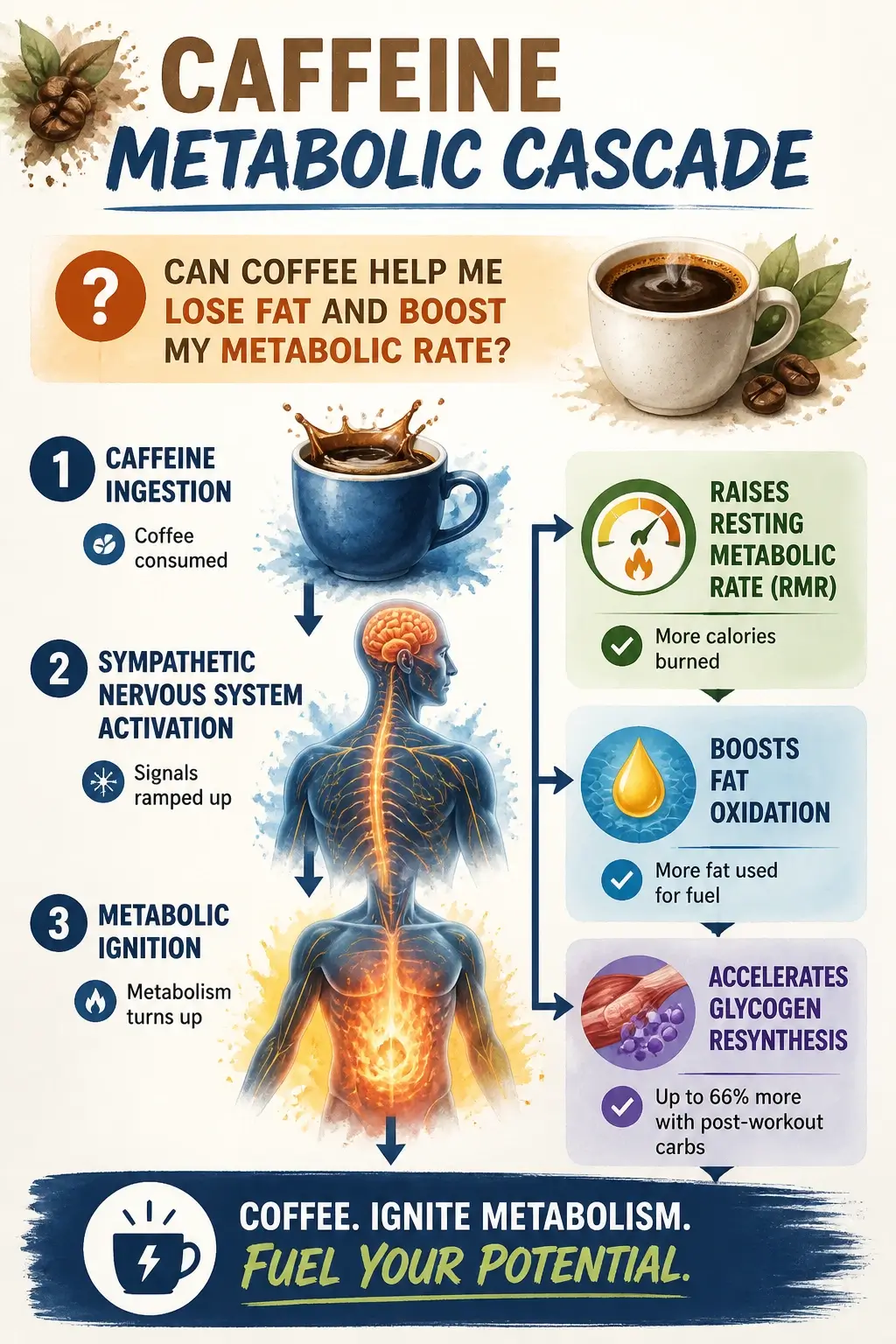
Yes, coffee can help you lose fat, and that fat loss, not improved insulin signaling, may be the real reason lifelong coffee drinkers show lower rates of type 2 diabetes. The mechanism runs through thermogenesis: caffeine activates the sympathetic nervous system, which turns up your resting metabolic rate and pulls fatty acids out of storage to be burned as fuel. Understanding that chain: caffeine triggers a hormonal cascade, the cascade reshapes how your body partitions energy, gives you a clearer picture of what coffee is actually doing for your metabolism.
Two distinct pathways drive that effect: one mechanical, one structural. The first is the real-time calorie-burning and fuel-switching that happens every time you drink coffee. The second is the slower, measurable shift in body composition that builds up over weeks and months of consistent use.
Caffeine fires up your metabolic rate and fuel mix
Metabolically active caffeine works by blocking adenosine receptors, which triggers a sympathetic nervous system response, essentially putting your body on a low-grade alert that increases resting metabolic rate and tells fat cells to release their stored fatty acids into the bloodstream. That’s not a minor effect. Reviewers of caffeine’s effects on metabolic homeostasis put a number on it:
“Caffeine contained in coffee has been shown to induce lipolysis, thermogenesis… and fat oxidation… consuming six cups of coffee (600 mg) within 12 h would be expected to induce a 100 kcal increase in daily energy expenditure.”
A hundred extra calories burned per day from a beverage you were already drinking. That’s not nothing: over a year, that’s roughly ten pounds of fat in energy terms, assuming nothing else changes.
The fuel-switching effect matters especially if you exercise. When you drink coffee before a fasted workout, insulin levels are already low, which means the fatty acids that caffeine just freed up from storage are actually available to burn. Your muscles preferentially use fat as fuel instead of reaching for glycogen. That’s the mechanistic case for strategic fasted cardio: it’s not a myth, it’s just caffeine and low insulin working in the same direction at the same time.
Here’s the part that surprises most people: caffeine also helps on the back end of a workout. When you pair it with carbohydrates after training, muscle glycogen replenishment increases by up to 66% compared to carbohydrates alone. Your muscles refuel faster, which means you recover faster and can train at full intensity again sooner. The sympathetic nervous system activation that burns fat during exercise also accelerates the repair process after it.
The infographic below maps how that cascade actually sequences from first sip to metabolic outcome.
Regular coffee quietly shifts your body composition
The thermogenic effect is real, but it’s short-lived (a few hours per cup). What’s more interesting for long-term metabolic health is what happens to body composition when coffee becomes a consistent habit.
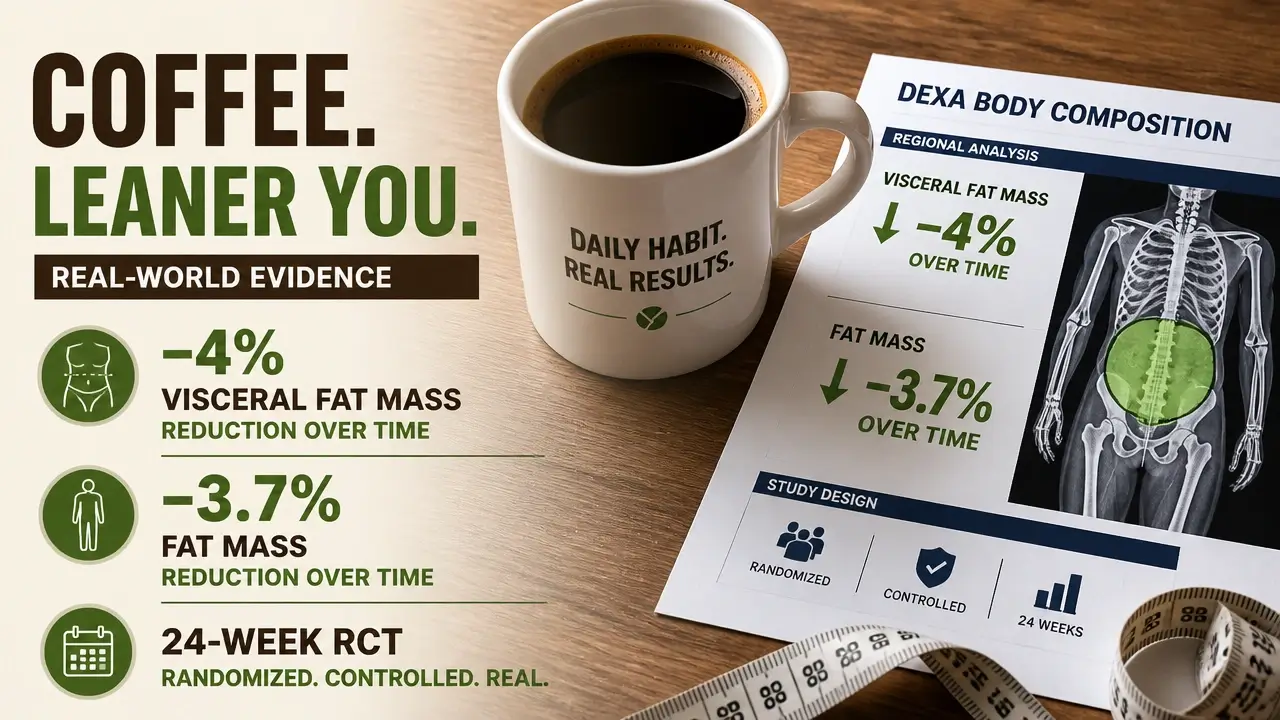
Observational data links habitual consumption of around four cups daily to roughly a 4% reduction in visceral fat over time. But observational data always carries the question: is coffee doing that, or do coffee drinkers just live differently?
The more telling evidence comes from a controlled trial. A 24-week randomized controlled trial, the same one that found no improvement in insulin sensitivity, still produced a statistically significant reduction in fat mass of –3.7% (p = 0.006). Coffee moved body composition toward less fat without touching how cells respond to insulin at all. The two effects are independent of each other.
That same trial flagged something else worth noting: a 21.2% decrease in urinary creatinine (p = 0.001). The honest read on that finding is that we don’t fully know what it means yet. It could reflect changes in muscle metabolism, shifts in how the kidneys handle creatinine, or something else entirely. It’s a signal that coffee’s metabolic fingerprint is broader than thermogenesis alone, but it shouldn’t be read as proof that coffee spares muscle mass. The data doesn’t support that conclusion yet.
What the data does support is a cleaner explanation for the diabetes-protection paradox from the previous section. If coffee doesn’t improve insulin sensitivity, how does it lower diabetes risk? Fat mass. Less visceral fat means lower systemic inflammation, better metabolic signaling across the board, and a body that simply handles glucose more efficiently: not because the insulin pathway got fixed, but because the load on that pathway got lighter. The fat loss is the bridge between the cup and the outcome.
Smart Coffee Habits That Protect Your Blood Sugar
Black coffee’s metabolic payoff is real, but it comes with a timing tax that the 90-minute rule, a high-protein breakfast, and a strategic decaf swap can almost entirely eliminate. The caffeine itself isn’t the villain. The problem is when you drink it, what you drink it with, and what you add to it. Get those three variables right, and coffee shifts from a blood-sugar liability into a genuinely useful metabolic tool.
The two variables that matter most, timing relative to your cortisol peak and what’s in your cup, work through completely different mechanisms. So let’s take them one at a time.
Wait 90 minutes before your first cup
Morning cortisol is already doing exactly what caffeine does: it’s raising blood glucose, mobilizing stored energy, and sharpening your focus. That surge peaks within 30–45 minutes of waking. If you pour coffee into that window, you’re not getting an energy boost: you’re stacking two separate glucose-raising signals on top of each other, and your cells take the hit.
The fix is simple. Wait 60–90 minutes after waking before your first cup. Let cortisol do its job and start to taper, then bring in the caffeine. You still get the alertness and the fat-oxidation benefit: you just stop amplifying the spike that happens when both signals fire at once.
Pair that timing shift with food. Black coffee on an empty stomach removes every buffer between caffeine and your bloodstream. A high-protein, high-fiber breakfast slows gastric emptying, which means glucose enters circulation more gradually and your cells have time to respond. Protein also blunts the cortisol response itself, so the combination of waiting and eating first compounds the benefit.
The third variable is what’s actually in your cup. This is where most people quietly wreck an otherwise solid habit:
| Coffee Preparation | Blood Sugar Impact | Insulin Response | Caffeine Content | Caloric Load | Recommended Timing | Decision Framework |
|---|---|---|---|---|---|---|
| Black Coffee | Minimal direct spike in healthy adults; temporary ~40% reduction in insulin sensitivity; greater impact on empty stomach | Reduced insulin sensitivity short-term; improved glycemic metabolism long-term (2+ weeks) | 120–180 mg per 8 oz | 0–5 cal | With or after meals; avoid on empty stomach if diabetic | Best for fitness enthusiasts; acceptable for diabetics with monitoring; pair with protein/fat |
| Decaffeinated Coffee | Minimal impact; retains beneficial compounds without caffeine-induced spike | Maintains insulin sensitivity; no significant glucose disruption | <5 mg per cup | 0–5 cal | Any time; optimal for afternoon and evening use | Preferred for diabetics; full antioxidant benefit without the insulin resistance trigger |
| Coffee with Unsweetened Creamer | Minimal spike; caffeine effect slightly buffered by fat content | Reduced caffeine-driven insulin resistance due to slower absorption | 120–180 mg | 10–50 cal | With meals; fat slows glucose absorption | Moderate choice; check the label: “unsweetened” varies by brand |
| Coffee with Sugar | High spike: glucose AUC ~145% greater than decaf; 28.5% increased insulin response | Significantly elevated: caffeine-induced resistance plus exogenous glucose load | 120–180 mg | 30–100+ cal | Avoid on empty stomach; if consumed, pair with protein and follow with movement | Avoid for diabetics; undermines metabolic stability for fitness goals |
| Specialty Latte (milk + syrup + foam) | Very high spike: caffeine + milk carbs + added syrups compound the response | Severely elevated: multi-factor insulin demand from all three sources simultaneously | 75–150 mg (varies by shot count) | 150–300+ cal; 20–50g carbs | Not recommended for blood sugar management | Treat as dessert, not coffee; high caloric density works against both goals |
The pattern in that table is straightforward: the problem is never the coffee. It’s the liquid sugars riding along with it. Unsweetened almond or macadamia milk adds negligible carbohydrate load and doesn’t meaningfully change your glucose response. A vanilla latte with two pumps of syrup is a different drink entirely: it just happens to contain espresso.
Decaf, fasted workouts, and the drinks that actually wreck blood sugar
Decaf coffee is the underrated option that most people dismiss without thinking about it. The caffeine is what drives the acute insulin resistance effect, but the chlorogenic acids and magnesium that give coffee its long-term protective properties survive the decaffeination process almost entirely intact. That means an afternoon or evening cup of decaf gives you the antioxidant benefit and the gut-microbiome support without reopening the glucose spike you worked to avoid in the morning. For anyone managing blood sugar closely, decaf isn’t a consolation prize: it’s a genuinely strategic choice.
For the fitness crowd, there’s one CGM reading that causes unnecessary panic: the glucose spike during a fasted morning workout after coffee. Here’s what’s actually happening. Caffeine triggers an adrenaline release. Adrenaline tells your liver to dump stored glycogen into the bloodstream. Your CGM goes up (sometimes sharply) and it looks like a dietary glucose spike. It isn’t. That glucose is being actively pulled into working muscle, not floating in circulation looking for somewhere to go. The spike is functional. It’s your body mobilizing fuel for the effort, not a sign that your metabolic strategy is broken.
This is exactly the kind of nuance that’s hard to convey in text alone. The video below shows a real-time CGM session through a fasted coffee-and-workout sequence, with a live explanation of why the adrenaline-mediated rise looks different and resolves differently than a sugar spike from food:
Now, if you want to know what actually wrecks blood sugar, the drinks that cause the kind of prolonged, insulin-demanding spikes that black coffee never comes close to, the list is short and consistent: sugar-sweetened coffee beverages, fruit juice, and regular soda. All three share the same mechanism: fast-acting liquid carbohydrates with no fiber, no protein, and no fat to slow absorption. They hit your bloodstream as a single unbroken glucose wave: a Frappuccino with caramel syrup belongs in that category. Plain black coffee does not.
The practical upshot: coffee is not the threat. Coffee plus the wrong additions, at the wrong time, on an empty stomach, is. Separate those variables, and you’ve already solved most of the problem.
One important caveat before you build this into a daily protocol: none of this applies cleanly if you’re on medication that lowers blood sugar. The timing rules, the fasted workout strategy, the decaf swap, all of it assumes your baseline glucose regulation is working on its own. If it isn’t, there’s a layer of complexity here that the research hasn’t fully mapped yet.
Coffee’s net effect on metabolic health depends on more than caffeine
Metabolic health sits at the center of a real contradiction: coffee raises blood sugar acutely while long-term coffee drinkers consistently show lower rates of type 2 diabetes and modestly better body composition. That’s not a paradox you can resolve by pointing to a single biological property. It only makes sense when you account for timing, what you put in the cup, and what’s already happening in your body before you take the first sip.
Here’s where the science lands: the epidemiological pattern is solid. Regular coffee drinkers develop type 2 diabetes at meaningfully lower rates. But the strongest interventional evidence, the RCT data, doesn’t show coffee directly improving insulin sensitivity. Your cells don’t become more receptive to insulin because you drink coffee. What the controlled trial evidence does show is a measurable reduction in fat mass. And since excess body fat (particularly visceral fat) is one of the primary drivers of insulin resistance, a leaner body composition over time is a plausible, evidence-grounded explanation for the protective pattern. The protection appears to come through the back door, not the front.
One question that comes up in blood sugar conversations is the “15-minute rule for diabetes.” That rule is actually about post-meal walking: a short walk after eating blunts the glucose spike by pulling sugar into working muscles without requiring insulin to do it. It’s a genuinely useful tool for blood sugar control, but it’s a separate mechanism from anything caffeine does. The two don’t directly interact, and conflating them muddies both strategies.
As promising as the metabolic strategies are, there is one stark silence in the research that every diabetic should know about.
No major scientific body, clinical guideline, or consumer health source has published guidance on how caffeine interacts with insulin secretagogues: drugs like sulfonylureas that force the pancreas to release more insulin, or with exogenous insulin itself. That’s not a minor gap. An 8% rise in blood glucose after 250 mg of caffeine is a documented acute effect. For someone on a fixed insulin dose or a medication that drives insulin output on a schedule, that 8% shift could push glucose outside the target range in either direction: high before the medication kicks in, or low once it does. The timing mismatch between caffeine’s effect and the drug’s action window has simply never been studied in a controlled protocol.
That means no one can tell you when to drink your coffee relative to your medication. Not a researcher, not a pharmacist, not this article. The burden falls entirely on you and your healthcare team to monitor your individual response, track your glucose data, and adjust from there.
So here’s the honest bottom line. Coffee can be a net positive tool for body composition and long-term metabolic health, when you use it with the timing strategies and dietary habits outlined here, and when you’re not managing a blood sugar condition with medication. The acute insulin resistance is real but manageable. The long-term fat loss signal is real and meaningful. The lower type 2 diabetes risk in coffee drinkers is one of the most replicated findings in nutritional epidemiology.
But coffee is not a treatment. It doesn’t fix insulin signaling. It doesn’t replace medication. And for anyone whose blood sugar is actively managed with drugs, it introduces a variable that medicine hasn’t caught up to yet. Use it strategically, track how your body responds, and loop in your healthcare team before making it a cornerstone of your metabolic plan.
Key Takeaways on Coffee
- The real diabetes protection from coffee comes through fat loss, not improved insulin sensitivity.
- Waiting 90 minutes after waking before drinking coffee prevents compounding cortisol and glucose surges.
- Only black coffee supports metabolic health; added sugars cancel the benefits and destabilize blood sugar.
- Coffee before fasted workouts mobilizes fat for fuel, and the resulting glucose spike is functional, not harmful.
- No clinical guidelines exist for coffee with diabetes medication—track your own response with your healthcare team.
Frequently Asked Questions About Coffee
Q: What happens to your blood sugar if you drink coffee before breakfast every day?
A: Drinking coffee before breakfast daily without food amplifies the morning cortisol and glucose spike, increasing insulin demand over time. But waiting 90 minutes and eating protein first blunts this effect. The real risk isn’t the coffee itself—it’s the timing and what’s missing from your stomach.
Q: Why don’t long-term coffee drinkers show improved insulin sensitivity even with lower diabetes risk?
A: Long-term coffee consumption lowers diabetes risk through fat loss, not better insulin signaling. Controlled trials show no improvement in insulin sensitivity, but a 3.7% reduction in fat mass. Less body fat reduces inflammation and metabolic load, which independently protects against diabetes.
Q: Can decaf coffee still support fat loss and metabolic health?
A: Yes, decaf still supports metabolic health because it retains chlorogenic acids—the anti-inflammatory compounds that slow glucose absorption. You miss caffeine’s thermogenic boost, but you also avoid its acute insulin resistance effect, making decaf a smart afternoon choice for blood sugar control.
Q: If caffeine raises blood sugar, why is it recommended before fasted workouts?
A: The pre-workout coffee glucose surge comes from adrenaline telling your liver to release stored energy, not from dietary sugar. Your muscles soak it up without needing insulin. This spike is functional fuel delivery that resolves quickly—unlike a sugar crash from a Frappuccino.
Q: Is it safe to consume coffee while taking diabetes medications like metformin or insulin?
A: There’s a stark research gap—no major guidelines exist on mixing coffee with insulin or sulfonylureas. Caffeine’s unpredictable blood sugar shifts could clash with fixed medication schedules. You must track your own glucose response and adjust with your doctor, not rely on general advice.
Q: How does adding a splash of milk to coffee affect its metabolic benefits?
A: A splash of unsweetened milk adds minimal carbs and a little protein, which may slightly buffer caffeine’s glucose spike without erasing coffee’s benefits. The real metabolic wreck comes from added sugars, syrups, and creamers that turn coffee into a liquid dessert.
References
- Caffeine Increases Ambulatory Glucose and Postprandial Responses – diabetesjournals.org
- Postprandial Glycemic and Insulinemic Responses to Common Breakfast Beverages – mdpi.com
- 24-Week Randomized Trial on Coffee and Insulin Sensitivity – PubMed
- Coffee and Lower Risk of Type 2 Diabetes: Arguments for a Causal Relationship – mdpi.com
- Caffeine’s Effects on Thermogenesis and Metabolic Homeostasis – frontiersin.org