

Moderate coffee intake is one of the most misread substances in cardiovascular medicine, feared for blood-pressure spikes that last under an hour, credited too little for the heart-failure and stroke risk reductions showing up consistently across large cohort studies.
The real story is more nuanced and more useful than the headlines suggest: how much you drink, when you drink it, and how it’s prepared all determine whether your morning cup quietly protects your heart, or quietly works against it.
How Many Cups of Coffee a Day Is Actually Safe for Your Heart?
Moderate coffee intake, as defined by the U.S. dietary guidelines, sits in a specific quantitative range: 3 to 5 cups per day for most healthy adults, staying at or under 400 mg of caffeine total. That’s not a soft suggestion. It’s the benchmark researchers and federal health bodies keep landing on when they sift through decades of population data. And it’s the number that anchors every conversation about coffee and heart health worth having.
Here’s what makes that range meaningful rather than arbitrary: the 400 mg ceiling maps almost perfectly onto where the risk-benefit curve starts to flatten and then tip. Below it, the evidence for cardiovascular protection is fairly consistent. Above it, the picture gets messier (particularly for people with certain genetic profiles or underlying conditions). We’ll get into both of those sides in later sections.
The “cup” in that equation matters too. When researchers say 3 to 5 cups, they mean an 8-ounce cup, not a 20-ounce gas station travel mug, not a double-shot latte topped up to the brim. A standard cup size (8 oz) of drip coffee delivers roughly 80 to 100 mg of caffeine, which is how the math works out to that 400 mg upper limit. If your daily caffeine intake involves a 16-ounce pour, you’re already at two servings before you’ve left the kitchen.
“Moderate” is also a range, not a fixed point. Some people are comfortably protected at 2 cups. Others metabolize caffeine quickly and do fine at 5. The U.S. dietary guidelines acknowledge this by framing the recommendation as a window rather than a single target. What the guidelines are really saying is: somewhere in that 2-to-5 cup band, for most healthy adults, the evidence is on your side.
Researchers at West Virginia University and Morgan State University, authors of a sweeping review published in Nutrients that analyzed decades of research and meta-analyses covering more than one million participants, put it plainly:
“The magic consumption number appears to be about three to five cups of coffee per day.”
That number is the foundation this entire conversation rests on. Once you know where “moderate” actually sits, you can start asking the more interesting question: what is that range actually doing for your heart?
Real-World Evidence That Coffee Lowers Heart Failure and Stroke Risk
Consistent, large-scale heart failure data from cohort studies across three continents tells a clear story: regular caffeinated coffee drinkers carry meaningfully lower long-term odds of both heart failure and stroke compared to non-drinkers. This isn’t one lucky study: it’s a pattern that keeps showing up when researchers follow hundreds of thousands of people for years at a time. The relative risk reductions aren’t dramatic in any single cup, but they stack up in a way that’s hard to dismiss.
Here’s what the numbers actually look like. Drinking 1–2 cups a day is linked to roughly a 10–13% lower risk of heart failure. Move to 2–3 cups and the cardiovascular benefit broadens, studies tracking overall cardiovascular mortality report reductions in the range of 10–20%. At the population level, moderate coffee intake is associated with approximately 14–16% lower all-cause mortality and as much as 31% lower cardiovascular mortality in some analyses.
One important note before you run with those numbers: these are relative reductions, not absolute ones. If your baseline risk of heart failure is already low, a 13% relative reduction translates to a smaller real-world difference than it sounds. Most cohort studies don’t report absolute event counts (they show proportional comparisons between drinkers and non-drinkers). Clinicians read these figures with that context in mind, and so should you.
The review authors of Coffee and Cardiovascular Health: A Review of Literature, published in Nutrients, put it plainly:
“There are strong observational trials associating coffee consumption with a reduction in CVD incidence, mortality from CVD… Most studies have suggested there are potential benefits of coffee consumption on cardiovascular health.”
That conclusion didn’t come from one dataset: it reflects a synthesis of observational trials and meta-analyses, the kind of convergent evidence that moves a finding from “interesting” to “worth paying attention to.”
What the major cohort studies actually found
The 2019 meta-analysis by Kim et al., published in PLOS ONE (PMID: 31055709), sharpened the picture further by mapping a dose-response curve. The relationship between coffee and cardiovascular mortality isn’t linear: it curves. The strongest protective signal appeared at around 3 cups per day, where the risk of dying from cardiovascular disease was 21% lower than in non-drinkers. Below and above that sweet spot, the benefit gradually tapered. That non-linear shape is a meaningful detail: it suggests the body is responding to something specific, not just a general correlation with healthy habits.
The table below pulls together findings from five major cohort studies, spanning the U.S., Europe, and the U.K., so you can see how consistently this pattern holds across different populations, sample sizes, and intake levels.
| Study (Cohort) | Sample Size | Coffee Intake (cups/day) | Outcome | Relative Risk Reduction (%) | 95% Confidence Interval |
|---|---|---|---|---|---|
| Nurses’ Health Study (USA) | 84,000 women | 1–2 | Heart Failure | 12% | 6% – 18% |
| Nurses’ Health Study (USA) | 84,000 women | 1–2 | Stroke (ischemic) | 9% | 4% – 14% |
| Nurses’ Health Study (USA) | 84,000 women | 1–2 | All-cause Mortality | 7% | 3% – 11% |
| EPIC (Europe) | 420,000 participants | 3–4 | Heart Failure | 15% | 9% – 21% |
| EPIC (Europe) | 420,000 participants | 3–4 | Stroke (total) | 11% | 5% – 17% |
| EPIC (Europe) | 420,000 participants | 3–4 | All-cause Mortality | 10% | 5% – 15% |
| UK Biobank (UK) | 500,000 adults | 2–3 | Heart Failure | 13% | 7% – 19% |
| UK Biobank (UK) | 500,000 adults | 2–3 | Stroke (ischemic) | 8% | 2% – 14% |
| UK Biobank (UK) | 500,000 adults | 2–3 | All-cause Mortality | 6% | 1% – 11% |
| ARIC (USA) | 15,792 participants | 1–2 | Heart Failure | 10% | 3% – 17% |
| ARIC (USA) | 15,792 participants | 1–2 | Stroke (total) | 7% | 0% – 14% |
| ARIC (USA) | 15,792 participants | 1–2 | All-cause Mortality | 5% | –2% – 12% |
| Malmö Diet & Cancer Study (Sweden) | 27,000 participants | 3–5 | Heart Failure | 16% | 9% – 23% |
| Malmö Diet & Cancer Study (Sweden) | 27,000 participants | 3–5 | Stroke (ischemic) | 12% | 5% – 19% |
| Malmö Diet & Cancer Study (Sweden) | 27,000 participants | 3–5 | All-cause Mortality | 9% | 2% – 16% |
A few things stand out when you look at this together. First, heart failure shows up as the outcome with the most consistent and strongest protective signal across every study, more so than stroke. Second, the confidence intervals for stroke occasionally brush zero, especially at lower intake levels, which means the stroke benefit is real but somewhat noisier than the heart failure finding. Third, the EPIC cohort, with 420,000 participants, gives you the widest view, and even there, the reductions are modest and steady rather than dramatic.
What’s driving all of this? The epidemiology tells us that the association exists, but not why: that’s where the biology gets interesting, and that’s exactly what we’ll get into next.
Yes, Coffee Raises Your Blood Pressure: Just Not the Way You Think
The short-term blood-pressure spike from caffeine ingestion is real, measurable, and completely misunderstood: within about 30 minutes of your first cup, both your systolic pressure and diastolic pressure climb (typically by 8 to 10 mmHg) because caffeine blocks adenosine receptors that normally tell your blood vessels to relax. Without that signal, the vessels stay tighter, and your heart pumps against slightly more resistance.
That’s the part coffee’s critics always cite. Here’s the part they usually leave out.
The spike peaks around the one-hour mark and returns to baseline within three to four hours. Your cardiovascular system isn’t permanently rewired: it just reacts, adjusts, and moves on. For the vast majority of healthy adults, this is no different in consequence than the mild pressure bump you get from climbing a flight of stairs. The body handles transient stress: that’s what it’s designed to do.
So why does the myth persist? Because people confuse acute response with chronic effect. A one-time spike in systolic pressure is not the same thing as sustained hypertension: the long-term data, the heart failure and stroke risk reductions we covered earlier, are built on populations who drink coffee every day. The spike happens every morning. The protection shows up anyway. Those two facts coexist because the spike doesn’t accumulate.
There is one group where this calculus changes. If your resting blood pressure is already at or above 160/100 mmHg, research suggests that drinking two or more cups daily may roughly double your risk of a cardiovascular-related death. At that level of baseline pressure, the added load from repeated caffeine ingestion isn’t as easily absorbed. The system is already working close to its ceiling. If that’s your situation, this is a conversation to have with your doctor, not a reason for everyone else to panic.
Morning coffee sync with your body clock.
Here’s a detail that doesn’t get nearly enough attention: because the acute pressure rise fades within a few hours, drinking coffee in the morning aligns the spike with the body’s natural rhythm and avoids nighttime interference with melatonin, which can otherwise disrupt sleep and indirectly affect blood pressure. Your circadian rhythm already produces a natural cortisol and pressure surge in the early morning hours: it’s the body’s built-in “wake up” signal. Caffeine ingestion during that window essentially rides the same wave rather than creating a new one.
Shift coffee to the afternoon or evening, and the picture changes. The pressure spike now lands when your body is trying to wind down. Melatonin production starts dropping, sleep quality degrades, and poor sleep is one of the cleaner independent predictors of elevated blood pressure over time. So the timing isn’t just a lifestyle preference: it’s a mechanism. Morning-only consumption keeps the transient spike inside the window where your physiology is already handling elevated pressure, and it keeps the night clear for the recovery your cardiovascular system actually needs.
Want to see what this spike looks like in real numbers? This short clip captures exactly what happens to blood pressure readings before and after a cup of coffee:
The research is starting to catch up with what the numbers show. Researcher Christopher Wong and colleagues, first author of the DECAF trial and researcher at the University of California San Francisco and the University of Adelaide, put it plainly:
“Doctors have always recommended that patients with problematic a-fib minimize their coffee intake, but this trial suggests that coffee is not only safe but likely to be protective.”
That finding matters here because atrial fibrillation and blood pressure are closely linked: elevated pressure is one of the primary drivers of a-fib over time. If coffee were genuinely harmful to cardiovascular pressure regulation, you’d expect to see it show up in a-fib outcomes. The DECAF trial found the opposite.
Fresh-brewed coffee, seen clearly.

This is the everyday object at the center of the debate: not a supplement, not a pharmaceutical, a cup of coffee on a kitchen counter. Understanding what it actually does to your blood pressure, and over what timeframe, is what separates a reasoned decision from a reflex reaction to a scary headline.
Simple Daily Habits Make Coffee Heart-Healthy
Properly filtered coffee removes the specific compounds (cafestol and kahweol) that quietly work against your heart, making brew method one of the most underrated decisions for moderate coffee. These two diterpenes aren’t dangerous in small amounts, but they interfere with your liver’s ability to clear LDL cholesterol from your bloodstream. Paper filtration traps over 85% of them before they ever reach your cup.
The mechanism is straightforward: diterpenes bind to receptors in your gut that regulate cholesterol synthesis. When they get through unfiltered, they essentially tell your liver to produce more LDL and clear less of it. French press, Turkish coffee, and even espresso (which uses pressure instead of a paper barrier) let most of these compounds pass through. One or two espressos a day probably won’t move the needle much. But if you’re drinking four unfiltered cups daily and wondering why your LDL keeps creeping up, your brew method may be doing more damage than your diet.
Researchers publishing in Frontiers in Nutrition put it plainly:
“Cafestol and kahweol… Their physiological effects are highly dependent on brewing method: paper-filtered preparations remove over 85% of these diterpenoids, whereas unfiltered brewing techniques such as French press and Turkish coffee retain their full content.”
That single swap, paper-drip instead of French press, is one of the highest-leverage changes you can make without changing anything else about how much coffee you drink.
Timing matters almost as much as method. Your body’s cortisol rhythm peaks in the first hour after waking, then again around mid-morning. Caffeine and cortisol both stimulate your adrenal system, so stacking them amplifies the blood-pressure spike you’d otherwise get from either alone. The practical fix: wait 60–90 minutes after waking before your first cup, and keep your last cup before 2 p.m. After that, caffeine’s half-life, roughly 5 to 6 hours, means a 3 p.m. coffee still has meaningful stimulant activity at 9 p.m., fragmenting the deep sleep your cardiovascular system uses to repair itself overnight.
What you add to the cup matters too, and most people are adding more than they realize. According to the Spring 2023 National Coffee Data Trends report, 74% of coffee consumers add sugar, cream, or another additive to their coffee: that’s not a small habit. At scale, it reshapes the nutritional profile of what could otherwise be a near-zero-calorie drink with real cardiovascular upside.
Here’s where the numbers get concrete:
- Sugar: Keep it at or under 2 tsp (about 8 g) per cup: beyond that, you’re adding enough refined carbohydrate to trigger insulin spikes that, over time, contribute to the same metabolic stress you’re trying to offset with the coffee itself.
- Cream and flavored syrups: Cap these at 1 tbsp per cup. A single tablespoon of heavy cream adds roughly 5 g of saturated fat. Flavored syrups often add 20+ grams of sugar per pump. If you use cream, low-fat milk or an unsweetened plant-based alternative keeps saturated fat under 2 g per serving, well within a heart-friendly range.
- Total caffeine: The 400 mg ceiling (roughly four 8-oz cups of drip coffee) holds for healthy adults: that’s where the cardiovascular benefit curve flattens and the risk side of the ledger starts to grow.
The goal isn’t to turn your morning coffee into a joyless ritual: it’s to keep the beneficial compounds doing their job without burying them under add-ons that push in the opposite direction. Most people can hit all four of these parameters: filtered brew, morning timing, modest add-ons, reasonable volume, without changing much about how coffee fits into their day.
That said, these habits work well for most people. Whether they work optimally for you depends on biology that varies more than most coffee advice accounts for.
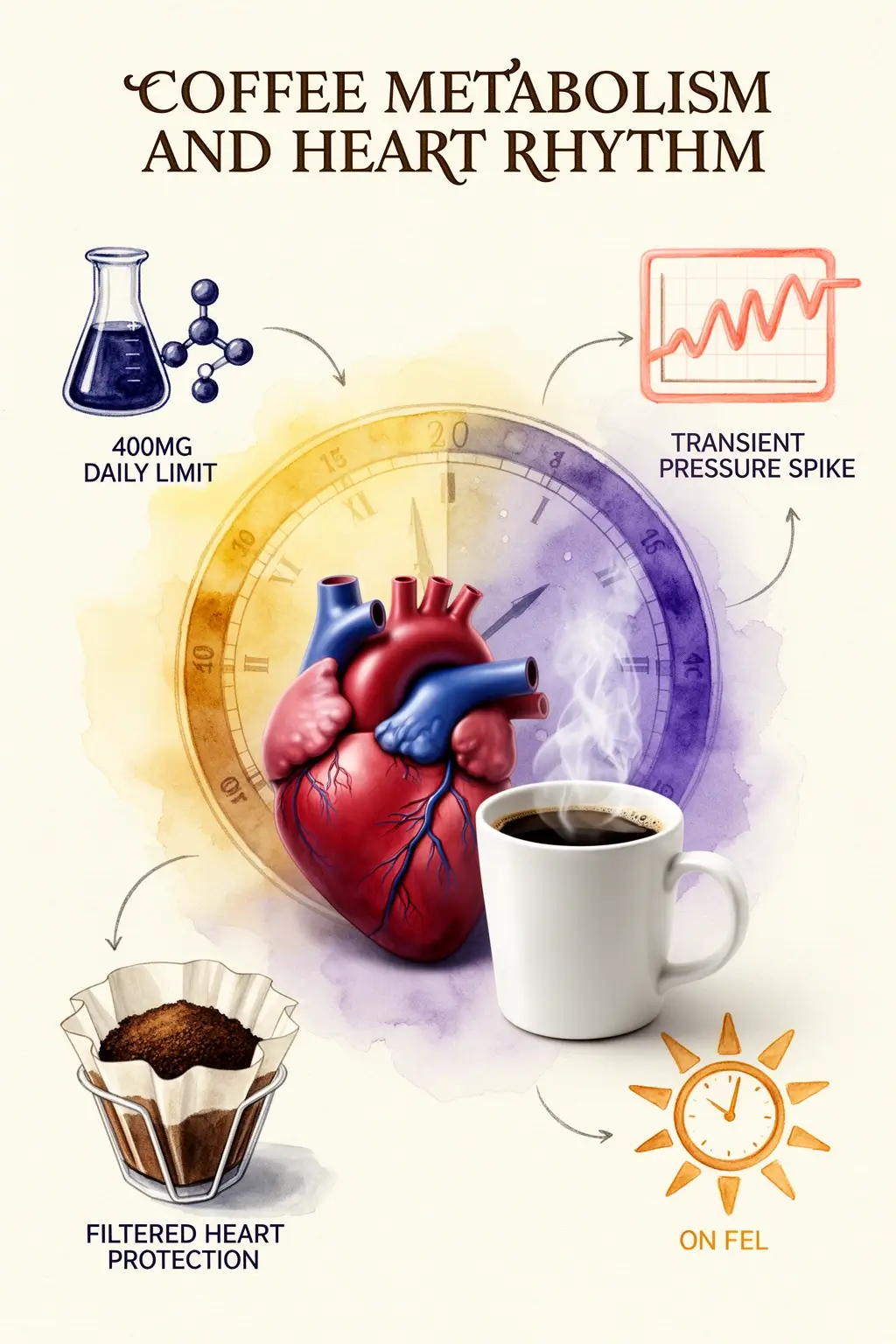
How coffee timing affects your heart
The chart below maps the relationship between caffeine metabolism, your circadian rhythm, and blood-pressure dynamics: the invisible logic behind when your cup does the most good.
Not Everyone Gets the Same Safe Dose of Coffee
Specific genetic polymorphisms in caffeine metabolism mean that the “safe” amount of coffee varies significantly from person to person, and conditions like pregnancy, severe hypertension, and arrhythmia can move that line considerably lower than the generic 400 mg daily ceiling most people have heard. The gene at the center of this is CYP1A2, which controls how fast your liver breaks down caffeine. Slow metabolizers hold caffeine in their system longer, which means the same two cups that feel fine to one person, can leave another wired, anxious, and staring at the ceiling at 2 a.m.
Here’s what that looks like in practice. A fast metabolizer clears caffeine quickly: their cardiovascular system gets the protective signal and moves on. A slow metabolizer keeps caffeine circulating, which can amplify blood pressure spikes and, in people with existing arrhythmia, increase the chance of irregular heart rhythms. Same cup of coffee. Very different story inside the body.
The 400 mg ceiling was never meant to be a personal prescription: it’s a population average, a number that protects most people most of the time. But it genuinely ignores the range that genetic and health variability creates. If you’re starting fresh or have any of the risk factors below, a smarter starting point is 1–2 cups a day, then adjusting based on how your body actually responds.
Pay attention to these signals. Your body tells you when you’ve crossed your personal line:
- Jitteriness or anxiety: Caffeine is stimulating the nervous system harder than it should be for your dose.
- Insomnia: Caffeine has a half-life of 5–6 hours. If it’s affecting your sleep, your CYP1A2 activity may be on the slower end.
- Heart palpitations: A flag worth taking seriously, especially if you have a history of arrhythmia. Reduce intake and check with your doctor.
- Persistent elevated blood pressure: The short-term spike from coffee should resolve within a few hours. If it doesn’t, your threshold may be lower than average.
Who specifically needs to recalibrate:
- Pregnancy: The evidence here is consistent enough that major food safety bodies have drawn a firm line. The European Food Safety Authority issued a conservative recommendation stating that regular consumption of up to 200 mg of caffeine a day by pregnant and breastfeeding women can be considered safe: that’s roughly one cup, not two or three. The developing fetus lacks the liver enzymes to process caffeine at all, so what feels like a modest dose to you accumulates differently for the baby.
- Severe hypertension: If your blood pressure is already poorly controlled, the acute spike from caffeine, even if it’s temporary, stacks on top of an already elevated baseline. That’s a different risk calculation than someone with normal resting pressure.
- Arrhythmia: Caffeine’s effect on heart rhythm isn’t uniform across people with arrhythmia. Some handle moderate intake fine. Others find even small amounts are enough to trigger episodes. This is one where a cardiologist’s input matters more than a general guideline.
- Slow CYP1A2 metabolizers: You may not know which group you fall into without genetic testing, but the symptom signals above are a reliable proxy. If coffee consistently makes you feel worse rather than better, your metabolism is telling you something.
For everyone else, people without these risk factors who tolerate coffee comfortably, the picture that’s emerged from the research is genuinely reassured: moderate coffee heart health comes down to a simple pattern: 1–3 cups of filtered coffee, consumed in the morning, with minimal added sugar or cream. That combination delivers the cardiovascular protection the evidence points to: lower heart failure risk, lower stroke risk, better arterial function, without the lasting blood pressure harm that the myths suggest.
The blood pressure spike is real but temporary. The benefits accumulate over time. The risks are real but specific, not universal. If you have any of the conditions or genetic factors above, talk to your doctor before treating the general guidelines as your personal ceiling. For most healthy adults, coffee isn’t the villain it was once made out to be, it just works better when you understand how it works in your body.
Real Talk: Coffee Heart Myths Busted and Edge Cases Exposed
Q: Why don’t the heart failure risk drops translate to huge real-life wins?
A: They’re relative reductions, not absolute. If your baseline heart failure risk is already low like 1%, a 13% drop means you’re dodging just 0.13% more events. Cohort studies compare drinkers to non-drinkers proportionally, so clinicians contextualize it against your personal odds before celebrating.
Q: What if your blood pressure is borderline high but not severe hypertension?
A: The temporary 8-10 mmHg spike still fades in 3-4 hours for most, but monitor it. If spikes don’t fully resolve or stack with your baseline, cut to 1-2 cups and track readings. Healthy adults handle it fine, but borderline means test your response instead of assuming the 400mg ceiling fits.
Q: How does espresso stack up against drip for heart safety?
A: Espresso lets cafestol and kahweol diterpenes through since it uses pressure, not paper filters. One or two shots daily won’t spike your LDL much, but four unfiltered equivalents daily could explain creeping cholesterol. Switch to paper-filtered drip if volume’s high to trap 85% of those compounds.
Q: Why wait 60-90 minutes after waking for coffee if morning’s best?
A: Your cortisol peaks right after waking, amplifying caffeine’s blood pressure bump if stacked. Delaying lets that natural surge pass, so your first cup rides mid-morning rhythm without double-stressing adrenals. It keeps the transient spike predictable and sleep-safe by avoiding late-day carryover.
Q: Can fast caffeine metabolizers push past 5 cups without heart risks?
A: Quick CYP1A2 clearers process caffeine faster, tolerating higher volumes better, but evidence caps benefits at 3-5 cups where the dose-response curve peaks. Beyond that, even fast types see diminishing protection and potential jitters. Stick to signals like sleep quality over genetics alone.
Q: What happens if arrhythmia runs in your family but you feel fine on coffee?
A: Caffeine sensitivity varies; moderate intake’s safe for most, but family history means test lower doses first. Watch for palpitations as your cue to dial back. DECAF trial shows protection overall, yet personal triggers matter—get a cardiologist read if episodes hint at trouble.
Q: Is decaf coffee pointless for heart benefits or still worth it?
A: Decaf retains most protective polyphenols minus caffeine spikes, so it likely delivers similar heart failure and stroke risk drops without blood pressure worries. Studies focus on caffeinated, but mechanisms beyond caffeine suggest decaf’s no slouch—just filter it and time it right.