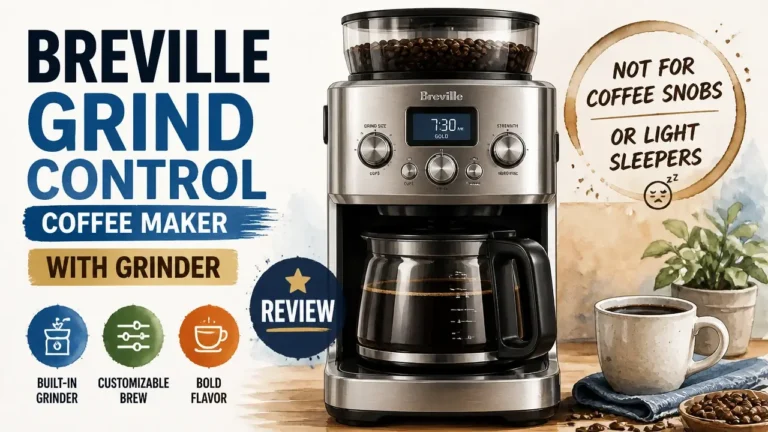

Polarizing Breville Grind Control sits at a strange crossroads: too loud for light sleepers, too imprecise for specialty enthusiasts, and yet genuinely beloved by the patient, automation-minded coffee drinker who just wants a hot, fresh carafe waiting each morning.
It earns its $400 price tag – but only for a very specific person. The grinder noise, the clog-prone chute, the awkward thermal carafe, and the mandatory calibration ritual aren’t bugs. They’re the honest cost of collapsing two appliances into one countertop machine.
This $400 Machine Tells You Upfront Who It’s Not For
The Breville Grind Control Coffee Maker With Grinder doesn’t hide its flaws – it broadcasts them. Coffee snobs will clock the compromises within the first week. Light sleepers will clock them on day one, the moment the grinder fires up at 6 a.m. with the subtlety of a table saw. That honesty, accidental as it may be, is actually the most useful thing about this machine.
Pull up the reviews and the split is immediate. On Breville’s own website, it holds a 3.2 out of 5 stars from 1,278 reviews. On Amazon, 6,514 reviewers land it at 3.5 stars – a number that almost never appears on premium appliances, because most products either succeed or fail. This one does both, depending entirely on who’s using it.
The grinder noise level is the first filter. Owners describe it as “incredibly loud – it would wake up my entire house every morning.” That’s not hyperbole; it’s a structural reality of integrating a flat-burr grinder into a drip brewer without any meaningful acoustic dampening. The second filter is the carafe dripping problem. Multiple reviewers describe it as “one of the worst pouring carafes” they’ve encountered, requiring you to tilt it nearly fully upside down to empty – and even then, it drips. The brew temperature issue adds a third layer: documented readings as low as 160°F, well below the 195–205°F range that most coffee professionals consider optimal.
None of this is hidden. It’s right there in the one-star reviews, sitting alongside five-star reviews from people who use the same machine every day and love it.
That gap isn’t a mystery. It’s a targeting problem – and understanding it is the entire point of this review.
Surprisingly Good Coffee, Once You Tame the Beast
Good coffee does come out of this machine. That’s not a concession – it’s the central fact that makes the Breville Grind Control worth discussing at all. The path to that good coffee, however, requires calibration effort that the product page glosses over entirely.
The machine uses Steep and Release technology: rather than letting hot water flow straight through the grounds, it closes a valve and allows the coffee to steep in immersion contact with the water before releasing. The effect, when everything is dialed in, is a noticeably fuller extraction – more essential oils, more body, more of what makes freshly ground coffee worth the trouble. One reviewer who put in the work described pulling out “sparkling acidity and sweet vanilla notes” from beans that had previously tasted flat in a standard drip machine. That’s a real result, and it matters.
The 8 strength settings and 6 grinder settings give you a meaningful range to work with – more than most grind-and-brew competitors offer. But the warning that comes with that range is equally real: the first batch is almost always a failure. “The coffee was weak and watery,” one experienced user noted, before spending time methodically working through grind and strength combinations to find the sweet spot. The Food & Wine reviewer called the end result a “super tasty cup of rich and robust coffee” – and then went further, repurchasing the machine after exploring other options and using it for years. That’s not the behavior of someone who settled.
The emotional pull of this machine is real, too. The programmable timer means you can wake up to the smell of freshly ground, freshly brewed coffee without touching anything. That morning ritual dream is what draws most buyers in – and for the right person, it delivers. The catch is that the dream only holds if you’ve already done the calibration work, committed to the daily maintenance, and accepted that this machine rewards patience over immediacy.
The video below shows Sprometheus calibrating the Ratio Eight and walking through the steep-and-release brewing method – a useful reference for understanding what immersion-style drip brewing actually does to a cup’s flavor profile before you commit to the Grind Control’s learning curve.
Breville Grind Control: Specs, Costs, and the Dirty Truth About Maintenance
The glossy product page leads with “fresh-ground coffee at the touch of a button.” The maintenance reality leads with daily chute cleaning, biweekly descaling, and a grinder that over-doses beans by design. Both are true. Here’s the complete picture.
This post contains affiliate links, meaning I may earn a commission if you make a purchase through these links, at no additional cost to you. As an Amazon Associate, I earn from qualifying purchases. I only recommend products I genuinely believe will add value.

Breville BDC650BSS Grind Control Thermal Carafe, Brushed Stainless Steel
- The Breville Grind Control coffee maker creates third wave specialty coffee by capturing freshness and essenti…
- INTEGRATED AND ADJUSTABLE GRINDER: Adjust the coffee grinder output to suit any bean from anywhere and customi…
- Receive 2 free bags of specialty coffee when you purchase and register any Breville coffee machine; T and Cs a…
- STEEP AND RELEASE TECHNOLOGY: Brew your coffee directly into a large carafe, tall cup or travel mug with equal…
- INCLUDED ACCESSORIES: Gold Tone Filter, 12 Cup Dual Wall Stainless Steel Thermal Carafe and Cleaning Brush
Core Specifications
- Dimensions & Weight: 8.5″ × 12.5″ × 16.3″; 16.09 lbs – a substantial countertop footprint.
- Power: 1,100 watts, 110–120V.
- Water Tank: 60 oz (12-cup capacity).
- Bean Hopper: 0.5 lb.
- Grinder: Integrated machined stainless steel flat burrs, 6 grind settings.
- Brew Modes: Carafe mode (2–12 cups) and single-cup mode (7 sizes, up to a 20 oz travel mug).
- Included: Gold Tone Filter, dual-wall stainless steel thermal carafe, cleaning brush, measuring spoon.
- Warranty: 1 Year Limited (one specs table on Breville’s site lists 2 years – worth confirming at purchase).
Price and Ownership Costs
The MSRP sits at $399.95. Used units appear around $266.94 – a reasonable entry point if you want to test the machine before committing fully. What the sticker price doesn’t capture is the ongoing cost of ownership.
Paper filters (8–12 cup flat-base style) aren’t included and need to be purchased separately. Descaling requires white vinegar, and Breville recommends doing it every two weeks – more frequently than most drip brewers demand. The more significant hidden cost is beans. The Grind Control System is calibrated to dose a high volume of coffee to ensure bold flavor by default, which means your bag empties faster than it would in a standard brewer. Add in the beans lost through grinder chute clogs – which multiple owners report happening on almost every run – and the monthly bean bill climbs noticeably.
The Maintenance Reality
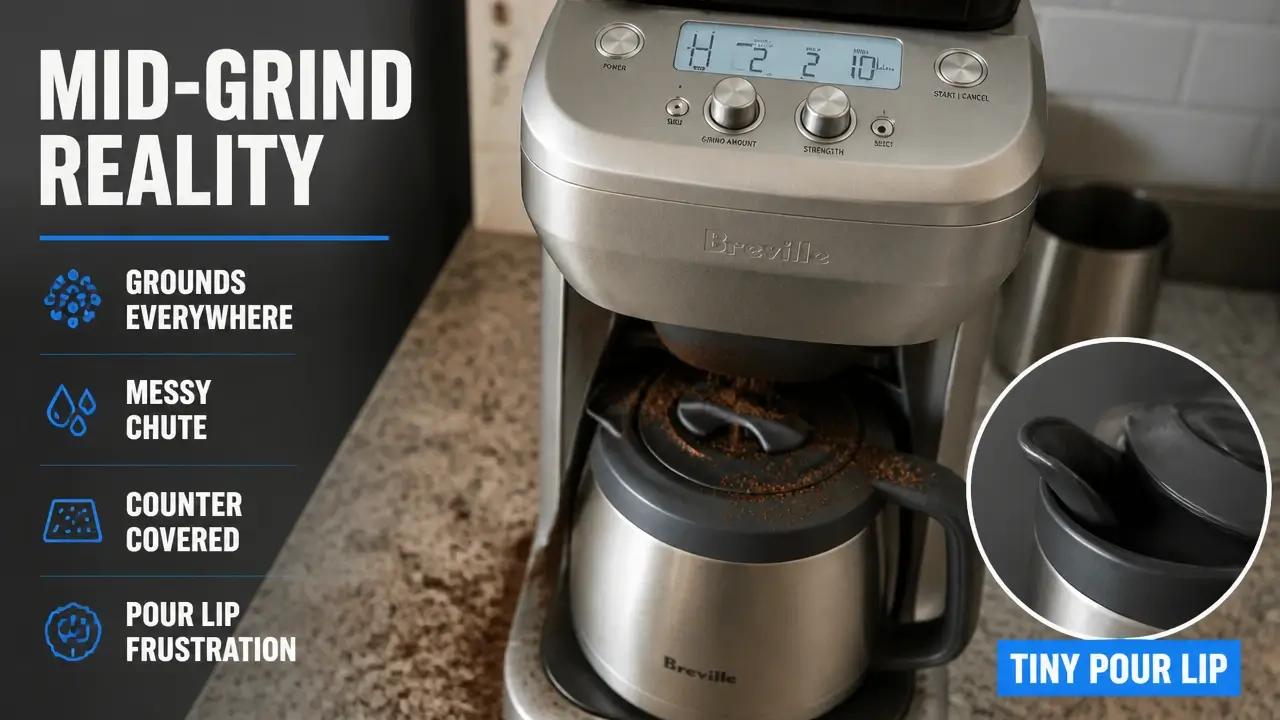
This is where the machine separates its fans from its critics most sharply. The grinder chute clogs with ground coffee regularly, scattering grounds and requiring a thorough cleaning after nearly every brew cycle. The LCD panel does display reminders for chute and burr cleaning, and both the burr set and hopper are removable, which helps. The included cleaning brush gets used daily. The manual even includes a “hair dryer hack” for clearing a moisture-clogged grinder – a detail that tells you everything about how Breville’s own engineers anticipate the machine being used in real kitchens.
One owner’s summary from Amazon is worth quoting in full for its specificity: cleaning required every single day, coffee quality inconsistent, strict rules about removing the carafe immediately after brewing to prevent steam backflow into the grounds. That’s not a broken machine – that’s the operating reality of this design.
On the positive side, Breville lists over 16 spare parts and accessories for the Grind Control, which suggests the machine is built to be serviced rather than discarded. For a $400 appliance, that matters.
Where the Grind Control Sits in the Coffee Maker Universe
At $400, the Breville Grind Control occupies a specific and somewhat lonely position in the market – premium enough to sit above most grind-and-brew competitors, but not refined enough to satisfy the buyers who spend that kind of money on coffee equipment. Understanding that positioning tells you more about who should buy it than any single feature comparison.
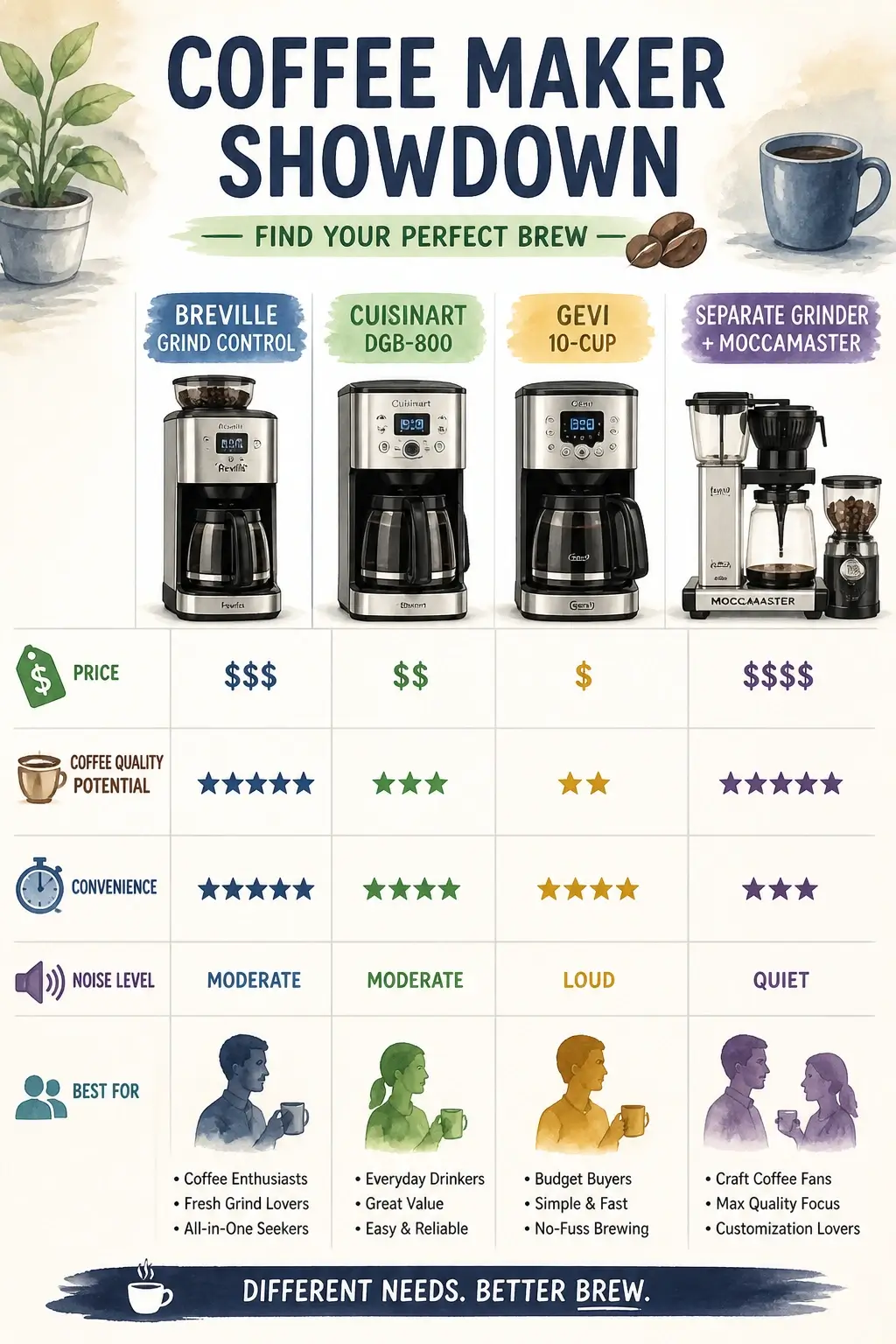
The most direct competitors cluster well below the Grind Control’s price point. The Cuisinart DGB-800 comes in around $199.95. The Gevi 10-Cup lands at approximately $200. The Capresso Team Pro Plus sits at $249.95. All three offer integrated grinding and brewing in a single unit. None of them match the Breville on brew quality or carafe design – Food & Wine’s testing found the Breville brews stronger coffee than the Cuisinart and has a meaningfully better carafe. The Gevi requires double-grinding to achieve acceptable strength, uses a glass carafe, and has a poorly designed water tank. The Capresso offers only 3 grind settings against the Breville’s 6.
The comparison that matters more to serious buyers, though, isn’t machine versus machine – it’s all-in-one versus separate setup. A Baratza Encore grinder paired with a Technivorm Moccamaster or an OXO Brew 9-Cup costs roughly the same or slightly more than the Grind Control, but delivers better grind consistency, more reliable brew temperature, quieter operation, and a dramatically simpler cleaning routine. Reddit communities dedicated to coffee return to this recommendation constantly, with users who tried the Grind Control eventually abandoning it for exactly this kind of setup.
That’s the Grind Control’s unique selling proposition in a single sentence: it’s the only machine in its class that combines programmable fresh grinding with steep-and-release brewing in one countertop unit. The trade-off for that consolidation is refinement – on every dimension. It’s a genuine convenience gateway for the buyer moving up from pre-ground coffee who isn’t ready to manage two separate appliances. It was never designed to be a destination for someone already deep into the hobby.
The chart below maps the Grind Control against its closest competitors across the dimensions that actually matter at this price tier.
While bean-hopper appliances cater to volume brewing, those measuring their morning stimulant intake against pods will find clarity in studying K Cup Caffeine Levels Complete.
Why This Machine Will Drive Specialty Enthusiasts Crazy
Specialty enthusiasts will find something to object to in almost every design decision the Breville Grind Control makes. That’s not an accident – it’s the predictable result of engineering a machine around automation convenience rather than precision. Every compromise has a logic to it. That logic just happens to be completely incompatible with what serious coffee drinkers actually want.
Arne Preuß, Founder and Chief Editor of Coffeeness – one of Europe’s most authoritative specialty coffee review publications – puts it plainly: he “seriously doubts any coffee maker with grinder could lure him away” from his separate grinder and coffee maker setup. That’s not brand loyalty talking. It’s a considered rejection of the entire grind-and-brew category by someone who has tested most of them.
The grinder noise level is the most immediately disqualifying issue for a significant portion of buyers. The machine is loud enough to wake a household, which turns the programmable auto-start timer from a selling point into a liability. Some owners work around this by grinding beans the night before and loading them directly into the filter basket – which, it’s worth noting, entirely defeats the purpose of having an integrated grinder. Noise dampening was clearly not a design priority.
The carafe design flaws compound the frustration. The opening is too narrow for large hands to clean properly. Emptying it fully requires tilting it nearly upside down, and it still drips through the pour hole. New units arrive with a chemical smell that takes multiple cleaning cycles to clear. These aren’t manufacturing defects – they’re consistent across units, which means they’re design choices.
The “brew temperature” complaints deserve a correction that most reviews get wrong. You’ll find forum posts and Amazon reviews citing Breville support’s confirmation of a 160–180°F range as evidence that the machine under-extracts. It isn’t. That figure refers to the serving temperature in the carafe — the temperature of finished coffee ready to drink — not the temperature at which grounds are being extracted. Consumer Reports’ lab testing confirmed the Grind Control reaches above 195°F during brewing, which falls squarely within the 195–205°F range that specialty coffee professionals consider optimal. The 160–180°F carafe temperature is normal for any thermal drip brewer; coffee cools between the brew chamber and the carafe, and you don’t want to drink 200°F liquid anyway.
What’s actually happening in the complaints that cite this: users who add cold milk or cream to already-cooled carafe coffee are finding the final cup lukewarm. That’s not a brewing defect — it’s physics. The machine does not compensate for the temperature drop caused by adding cold dairy, and it was never designed to. If you drink your coffee black or with pre-warmed milk, this is a non-issue. If you add cold cream straight from the fridge to a carafe that’s been sitting for 20 minutes, you’ll want a microwave. That’s a real inconvenience worth naming — but it’s not the extraction failure the forums describe.
The grinder chute clogs deserve their own mention because they affect both coffee quality and bean consumption simultaneously. The system over-grinds by design – dosing high volumes to guarantee bold flavor – but inconsistency in that dosing is well-documented. One user calibrating for a 30g dose received approximately 9g instead, with Breville support unable to resolve the issue. The clogging scatters grounds, increases waste, and makes the daily cleaning ritual feel less like maintenance and more like damage control.
Single-cup mode adds one more limitation: reviewers consistently describe the output as “indistinct and slightly muddy” – a profile that reflects the machine’s optimization for full-carafe brewing rather than concentrated single-serve extraction.
And then there’s the missing carafe-presence sensor. If the carafe isn’t seated correctly when brewing begins, coffee drips directly onto the counter. No alarm, no auto-shutoff. Just a mess.
For the target user – the casual-to-interested coffee drinker who brews full carafes, doesn’t mind noise, and is willing to build a maintenance routine – these trade-offs are manageable. They’re the price of not managing two separate appliances. For everyone else, they’re dealbreakers that no amount of steep-and-release technology can offset.
The Final Verdict: Buy This If…
The Breville Grind Control Coffee Maker With Grinder is the right machine for a specific target audience, and a genuinely poor fit for everyone outside it. The clearest service this review can offer is drawing that line precisely.
Buy this if:
- You’re a casual-to-interested coffee drinker stepping up from pre-ground beans who wants the full fresh-grind experience without managing two separate appliances.
- You’re not noise-sensitive – or your household genuinely sleeps through anything – and you plan to use the programmable timer to wake up to a ready carafe.
- You’re willing to spend 30–60 minutes in the first week calibrating grind size and strength settings, and you’ll commit to descaling every two weeks and cleaning the chute daily.
- You primarily brew full carafes and can accept the thermal carafe’s awkward pour ergonomics in exchange for its excellent heat retention – owners consistently praise how long it keeps coffee hot.
Skip this if:
- You’re a specialty coffee enthusiast who values precise dosing, a clean grind profile, and a quiet kitchen. The Grind Control will frustrate you on all three counts.
- You have large hands or a low tolerance for poorly designed kitchen tools. The carafe will become a daily irritant.
- You want an out-of-the-box perfect cup without a learning curve. The first several batches will be underwhelming, and some buyers never find the right calibration.
- You’re on a tight bean budget. The grinder’s high-dose default and frequent chute clogs mean you’ll burn through beans faster than expected, and that cost adds up.
Zachary Carlsen, Co-Founder of Sprudge – one of the most widely read specialty coffee publications in the industry – frames the alternative setup well. In his streamlined home brewing guide, he recommends the Bonavita 8-Cup as a reliable entry-level workhorse, the Technivorm Moccamaster as the step-up choice for those who want form and function in one brewer, and the Baratza Encore as the gold-standard entry-level grinder used by both coffee professionals and casual drinkers alike. His logic: simple, repeatable, and consistent beats complicated and automated every time.

Bonavita 8 Cup Drip Coffee Maker Machine, One-Touch Pour Over, Auto Pause Brewing with Stainless Steel Double Wall Thermal Carafe, SCA Certified, Dishwasher Safe, BV1901TS
- 8 CUP IN 6 MINS: Brew a full 8-cup carafe in just 6 minutes with one touch. The powerful 1500-watt heater ensu…
- ONE-TOUCH FAST BREW: Start your day effortlessly with a single press, enjoying professional and fresh coffee f…
- EVEN EXTRACTION FOR FULL FLAVOR: The specially designed showerhead ensures even saturation of coffee grounds, …
- BLOOM FOR RICHER TASTE: The optional pre-infusion mode gently pre-wets coffee grounds before brewing, resultin…
- DISHWASHER-SAFE & BPA-FREE: The carafe lid, filter basket, and showerhead are dishwasher-safe and BPA-free. Th…
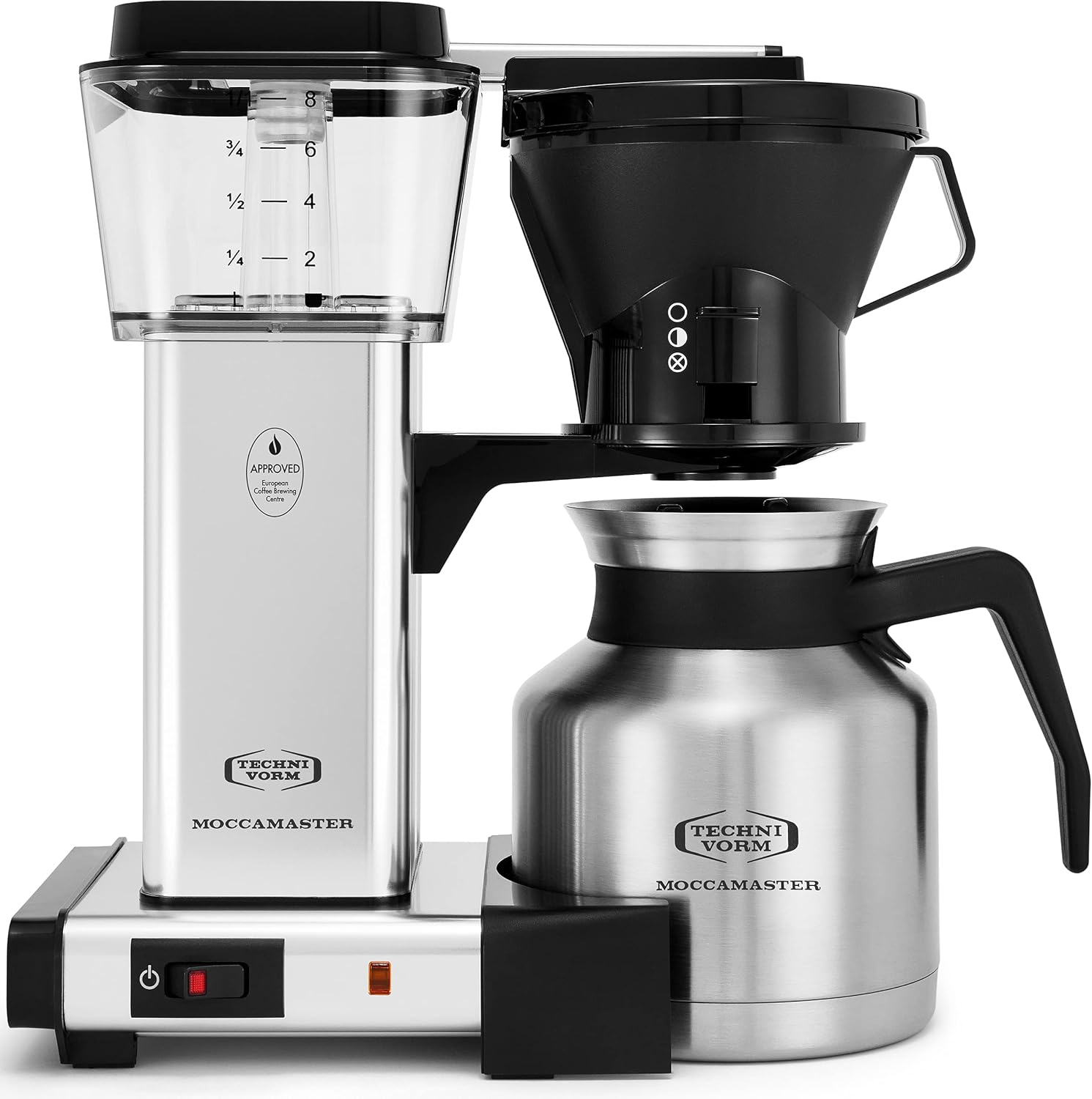
Technivorm Moccamaster 79212 KBTS Coffee Brewer, 32 oz, Polished Silver
- Material Type: Aluminum Stainless Steel.Filter type:Reusable
The Breville Grind Control’s true role in the market is a bridge – for buyers who are intimidated by separate gear and want the automation to handle the complexity. Once a buyer outgrows that need, or arrives already past it, the machine has nothing left to offer them.
For Specialty Enthusiasts and Early-Morning Light Sleepers: Your Better Option
Specialty enthusiasts and light sleepers aren’t losing much by skipping the Grind Control – they’re gaining a great deal by choosing differently. The separate grinder-and-brewer route that Reddit coffee communities consistently recommend isn’t just a workaround. For this group, it’s a straightforwardly better experience.
A Baratza Encore grinder paired with an OXO Brew 9-Cup or Technivorm Moccamaster delivers meaningfully better grind consistency, reliable brew temperature in the optimal 195–205°F range, and a cleaning routine that takes minutes rather than the daily ritual the Grind Control demands. The Moccamaster, in particular, brews quietly enough that an auto-start timer becomes genuinely useful for early mornings – no household-waking grinder blast required. Precise dosing with a separate grinder also means you control exactly how much coffee goes into each brew, with no waste from clogged chutes and no design-default over-dosing inflating your bean consumption.

OXO Brew 9-Cup Drip Coffee Maker – Programmable Machine, Stainless Steel
- BetterBrew Precision Brewing controls water temperature and optimizes brew cycles for rich, flavorful coffee '…
- Fully programmable and easy to use, a single dial lets you choose cups, program the time and set the automatic…
- Temperature-controlled brewing keeps the water between 197.6'204.8'F /92-96'C ' the ideal range for drip coffe…
- Rainmaker shower head evenly disperses water over coffee grounds for better flavor extraction
- Internal mixing tube ensures your last sip is as delicious as your first
The total cost of a Baratza Encore plus a quality drip brewer lands in a similar range to the Grind Control’s $400 MSRP, sometimes less. The difference is that the investment scales – you can upgrade either component independently as your palate develops, rather than replacing the entire unit when the integrated grinder no longer satisfies.

Baratza Encore ESP Coffee Grinder ZCG495BLK, Black
- SPECIALTY COFFEE ASSOCIATION AWARD-WINNING GRINDERS - Baratza grinders are preferred by coffee professionals a…
- DUAL-RANGE ADJUSTMENT SYSTEM - This innovative multi-purpose adjustment mechanism features micro-steps from #1…
- USER FRIENDLY - Fresh coffee is as simple as a single-handed hopper twist for grind size adjustment, then a pu…
- QUICK-RELEASE BURR - The burr mounting system has been redesigned to allow for quick removal without taking th…
- WARRANTY/QUALITY PARTS - Engineered with 40mm hardened alloy steel burrs manufactured in Liechtenstein, Europe…
For a full breakdown of the best coffee makers built around the specialty enthusiast’s priorities, the guide to the best coffee makers for specialty coffee lovers walks through the top options at every price point.
Key Takeaways on Breville Grind Control Coffee Maker With Grinder
- The Breville Grind Control rewards patient, calibration-willing users with genuinely rich, full-bodied coffee – but the first batches will disappoint.
- The integrated grinder is loud enough to wake a household, making the auto-start timer a liability for light sleepers.
- Grinder chute clogs happen nearly every run, requiring daily cleaning and increasing bean consumption beyond what the price tag implies.
- At $400, the machine loses on grind precision, noise level, and carafe ergonomics to a comparable separate grinder-and-brewer setup — but matches it on brew extraction temperature, a common misconception in online reviews.
- The thermal carafe retains heat exceptionally well but has serious ergonomic flaws that will frustrate anyone with large hands or a low tolerance for dripping.
- Specialty enthusiasts are better served by a Baratza Encore paired with a Moccamaster or OXO Brew 9-Cup at a similar total investment.
Frequently Asked Questions About Breville Grind Control Coffee Maker With Grinder
Is the Breville Grind Control actually worth $400?
It depends entirely on who’s buying it. If you want fresh-ground, automated drip coffee without managing two separate appliances and you’re willing to calibrate and clean daily, it earns the price. If you value precision, quiet operation, or a plug-and-play experience, a separate grinder and brewer at the same cost will serve you far better.
How loud is the Breville Grind Control grinder, really?
Loud enough that multiple owners describe it waking their entire household. There’s no meaningful acoustic dampening built into the design, so if you’re using the auto-start timer for early mornings in a shared home, expect complaints.
Why does my Breville Grind Control coffee taste weak?
The default grind and strength settings are rarely dialed in out of the box. Most users need to increase both the grind coarseness and the strength setting simultaneously, then adjust from there – plan for several test batches before landing on the right combination for your beans.
How often does the grinder chute actually clog?
Frequently enough that daily cleaning should be considered part of the machine’s operating routine, not an occasional fix. The grinder doses a high volume of coffee by design, and moisture in the chute compounds the problem – the manual even includes a hair dryer hack for clearing stubborn clogs.
Does the Breville Grind Control brew coffee at the right temperature?
Most online complaints about temperature are conflating two different measurements. Brewing temperature — the temperature at which water contacts the grounds — has been confirmed by Consumer Reports to exceed 195°F, which is within the optimal 195–205°F extraction range. What Breville’s support team describes as “160–180°F” is the serving temperature in the carafe, meaning the temperature of finished coffee ready to drink. That’s normal for any thermal drip brewer. The real-world complaints come from users adding cold dairy to cooled carafe coffee and finding the result lukewarm.
Can I use the Breville Grind Control for a single cup?
Technically yes – it has a single-cup mode with seven size options up to 20 oz. In practice, reviewers consistently describe the single-cup output as muddy and indistinct compared to the full-carafe result. This machine is optimized for carafe brewing, not single-serve.
What happens if I forget to place the carafe before brewing starts?
Coffee brews directly onto the counter. There’s no carafe-presence sensor and no auto-shutoff triggered by a missing or misaligned carafe, so placement before every brew cycle is a non-negotiable step in the routine.
What’s the best alternative to the Breville Grind Control for specialty coffee drinkers?
A Baratza Encore grinder paired with a Technivorm Moccamaster or OXO Brew 9-Cup gives you better grind consistency, accurate brew temperature, quieter operation, and a simpler cleaning routine – often at a comparable or lower total cost than the Grind Control’s $400 MSRP.
References
- Breville Grind Control product page and customer reviews – breville.com
- Breville Grind Control customer reviews and ratings – amazon.com
- Breville Grind Control review and testing – foodandwine.com
- Grind-and-brew coffee maker category review – coffeeness.de
- The Only Coffee Guide You Really Need – sprudge.com