
The Misconception: What “Stronger” Really Means
The espresso vs drip coffee debate starts with a word that’s doing too much work: stronger. Most people use it to mean the same thing, but it actually describes two completely different measurements – and mixing them up is exactly why caffeine myths have such a long shelf life.
When someone calls espresso stronger, they usually mean one of two things: it tastes more intense, or it hits faster. Both observations are accurate. Neither one tells you how much caffeine you actually swallowed.
There are two honest ways to measure caffeine in a cup. The first is concentration – milligrams of caffeine per fluid ounce. The second is total dose – milligrams of caffeine in the entire serving you drink. Espresso dominates on concentration. Drip coffee, because of its larger serving size, almost always wins on total dose. These two metrics can point in opposite directions, and that’s the root of the confusion.
Taste intensity makes the problem worse. Espresso’s bold, almost syrupy flavor signals potency to your brain before you’ve even checked a number. That sensory signal is real – espresso is more chemically concentrated per ounce – but your body responds to total caffeine dose, not density. A small, highly concentrated shot and a large, mildly concentrated cup can deliver very different amounts of caffeine to your bloodstream, even if the shot feels stronger going down.
The serving size and brew method are the variables most caffeine guides quietly skip. A single espresso shot is roughly one ounce. A typical drip coffee is eight to sixteen ounces. That volume gap is where the math flips – and forgetting it is precisely why the myth survives.
According to a 2024 IFIC Spotlight Survey on Caffeine, a significant share of coffee drinkers hold persistent misconceptions about caffeine content across brew methods, suggesting that the concentration-versus-dose distinction rarely makes it into everyday conversation.
To understand how other popular formats compare when you factor in both volume and concentration, refer to K Cup Caffeine Levels Complete for a detailed brand breakdown.
Dr. Emma Beckett, Senior Lecturer in Food Science and Human Nutrition at the University of Newcastle, puts the mechanics plainly:
“If we focus on caffeine concentration, on a milligram per milliliter (mg/ml) basis, espresso methods are typically the most concentrated, able to deliver up to 4.2 mg/ml… Drip and plunger methods (including French and Aeropress) are about half that again. So, while espresso gives you the most concentrated product, this is delivered in a smaller volume (just 18-30ml), compared to much larger volumes for most other methods.”
That’s the whole framework in one paragraph. High concentration, small volume – versus moderate concentration, large volume. Everything in this guide flows from that single trade-off.
Concentration vs. Volume: The Milligram Math
Caffeine per ounce is where espresso vs drip coffee stops being a conversation and starts being arithmetic. Espresso typically delivers 45–80 mg of caffeine per fluid ounce, meaning a single one-ounce shot lands somewhere between 63 and 75 mg. Drip coffee sits at 8–16 mg per ounce – a fraction of that density.
But then the serving sizes enter the picture, and the whole comparison inverts.
A single espresso shot is about 1 oz (30 mL). A double shot doubles that to 2 oz. A standard drip coffee, though? Eight ounces at minimum – and most café orders run 12 to 16. Once you multiply concentration by volume, here’s what the actual caffeine doses look like:
Here’s how the numbers stack up across standard serving sizes:
| Serving | Size | Caffeine (mg/oz) | Total Caffeine (mg) |
|---|---|---|---|
| Single Espresso Shot | 1 oz | 63–75 mg/oz | 63–75 mg |
| Double Espresso Shot | 2 oz | 63–75 mg/oz | 126–150 mg |
| 8 oz Drip Coffee | 8 oz | 12–18 mg/oz | 95–144 mg |
| 12 oz Drip Coffee | 12 oz | 12–18 mg/oz | 144–216 mg |
| 16 oz Drip Coffee | 16 oz | 12–18 mg/oz | 192–288 mg |
The inversion is right there in the numbers. Espresso is four to six times more concentrated per ounce, yet a standard 8 oz drip cup already matches or beats a single shot on total caffeine. Scale up to 12 or 16 ounces, and it’s not even close.
The double-shot exception is worth noting. A double espresso – 126 to 150 mg – can rival a standard 8 oz drip cup. But the moment someone orders a 12 oz or larger drip, the drip pulls ahead again. And most people who drink drip at home or at a café aren’t stopping at 8 oz.
The practical verdict for anyone tracking their intake: a single espresso is actually your lower-caffeine option. If you’re trying to cap your daily total, one shot is a modest slice of your budget. A 16 oz drip, on the other hand, can use more than half your daily allowance in a single cup.
One honest caveat before you screenshot these numbers. Dr. Craig S. Patch, Clinical Nutritionist and Associate Professor, measured real-world espresso caffeine content and found the variation is wider than most guides admit:
“The mean (±SD) quantity of caffeine from espresso coffee was 107±37mg/serving with a concentration of 2550±1030mg/L… There was considerable variation in caffeine content… 42 samples (27.5%) contained ≥120mg per serving of caffeine, and 20 samples (13.1%) exceeded 165mg per serving.”
That standard deviation of ±37 mg per serving is a meaningful swing. The ranges above are trustworthy guidelines drawn from industry averages, not lab-certified absolutes. If you’re tracking caffeine precisely for medical or performance reasons, treat them as useful approximations and adjust based on your own body’s response.
Roast Myths: Does Light Roast Really Have More Caffeine?
Roast color is one of the most confidently stated, most frequently wrong pieces of coffee knowledge out there. The claim usually goes: light roast has more caffeine because it’s less processed. The chemistry says the story is more complicated – and for most home brewers, the roast level barely matters at all.
Caffeine is thermally stable. When a green bean goes into a roaster, its caffeine content holds remarkably steady across the full temperature range used in commercial roasting. A study published in Heliyon measured caffeine in beans roasted across four temperature-time regimes – from light (160°C for 40 minutes) to dark (220°C for 40 minutes) – and found caffeine levels ranged only from 9.88 mg/g in green beans to 11.87 mg/g at the darkest roast. The authors attribute that slight apparent increase not to caffeine being created, but to mass loss: as thermolabile compounds burn off, caffeine becomes a larger share of what remains. The caffeine itself barely moved.
A peer-reviewed article in Food & Function reinforces this from a different angle. Researchers tracked caffeine and chlorogenic acids across light, medium, and dark roasted Arabica beans. Chlorogenic acids dropped by roughly 90% in dark roast – a dramatic shift. Caffeine stayed stable at approximately 8.4 mg/g throughout, degrading only under extreme temperatures above 270°C, well beyond what any standard roast reaches.
So where does the “light roast has more caffeine” idea come from? It’s a measurement trick, and it’s actually correct under one specific condition.
If you measure your coffee by volume – a scoop, a tablespoon – light roast beans are denser. They haven’t lost as much mass during roasting, so you physically pack more bean into that scoop. More bean mass means more caffeine in your cup. By the scoop, light roast does win.
If you measure by weight – grams on a kitchen scale – that density difference disappears entirely. Ten grams of light roast and ten grams of dark roast contain essentially the same amount of caffeine.
Juliet Han, Head Roaster at Blue Bottle Coffee, confirmed this experimentally:
“What Juliet found was that when she weighed the coffee grounds and based her calculations on that, the darker roast did in fact yield more caffeine than the lighter roast… A darker roasted coffee is less dense, so by the bean, it has lower mass than a light roasted coffee. All other things being equal, if you grind and weigh out a certain number of grams of coffee, there are more beans involved when using dark roast.”
That finding sounds counterintuitive until you work through the geometry. Fewer grams per dark-roast bean means you need more beans to hit the same weight – which means slightly more caffeine per gram when measured precisely.
The practical rule is simple: use a kitchen scale, and stop adjusting your caffeine log based on bag color. Across typical roast levels, the variance is at most 5–10% per gram – too narrow to shift your daily intake calculation in any meaningful way. Whether you’re pulling a light roast espresso or a dark roast drip, the roast level is not the variable worth tracking.
Beyond Caffeine: The Health Angle on Espresso vs. Drip
The cholesterol question catches a lot of people off guard, because it has nothing to do with caffeine. The culprit is a different class of compounds entirely – and the brew method determines whether they end up in your cup.
Natural coffee oils called diterpenes, specifically cafestol and kahweol, are present in every coffee bean. When hot water passes through ground coffee and isn’t filtered through paper, these oils flow straight into your drink. Espresso uses a metal portafilter basket, not a paper filter, so diterpenes pass through freely. Paper-filtered drip coffee traps them almost completely.
Professor Chahan Yeretzian, Head of the Coffee Excellence Center at the Zurich University of Applied Sciences, describes why this matters:
“Cafestol and kahweol are two specific compounds that belong to the family of coffee oils… They are also known as ‘diterpenes’… Cafestol in particular affects the cholesterol levels in blood… It’s the most potent cholesterol-raising compound identified in the human diet… Paper filters also help to minimise the levels of extracted oils, especially when compared to metal and cloth filters. This is because paper absorbs more oils than cloth, whereas metal allows the oils to pass through.”
To be clear: caffeine does not raise LDL cholesterol. This is a completely separate mechanism. The diterpene issue is filter-dependent, not caffeine-dependent, and it only becomes clinically relevant for people who already have elevated LDL or who drink large volumes of unfiltered coffee daily.
For a typical healthy adult drinking one or two espresso shots a day, the diterpene exposure is moderate. But if you have elevated LDL or existing cardiovascular risk, the brew method choice becomes a meaningful health variable – independent of how much caffeine you’re managing.
This is what that looks like in practice:
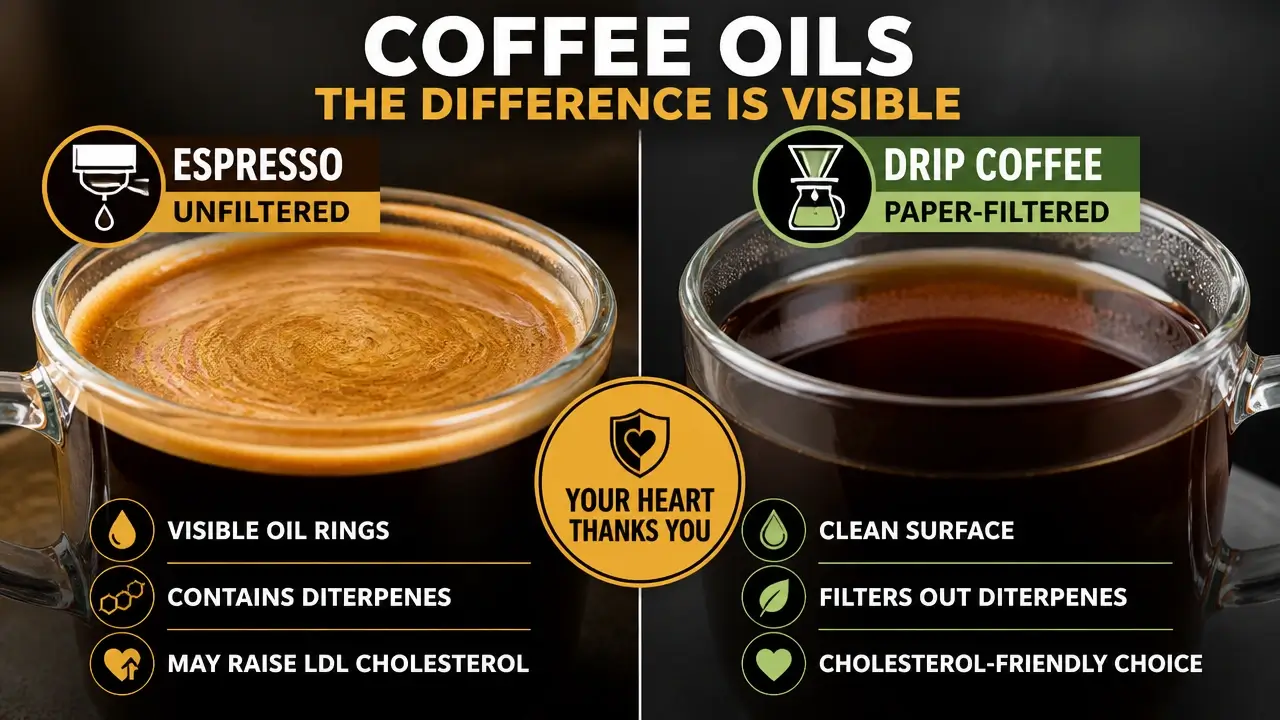
If you’re in that higher-risk group, switching to paper-filtered drip – or using a paper filter insert on your espresso setup – reduces your diterpene intake substantially. It won’t change your caffeine numbers at all, but it can meaningfully reduce the cholesterol-raising compounds your body absorbs. Think of it as a free tiebreaker that costs you nothing if paper-filtered drip already fits your routine.
Your Caffeine Management Playbook: Which Brew and How Much?
Caffeine intake tracking becomes genuinely easy once you stop thinking about “stronger” and start thinking in two numbers: concentration and total dose. Here’s the summary that ties everything together.
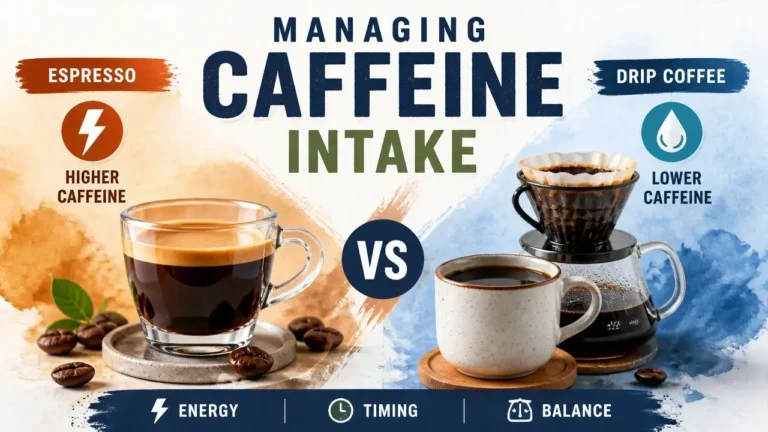
Espresso delivers high concentration with a fast, intense effect and a relatively low total caffeine dose per serving. Drip coffee delivers lower concentration with a slower, longer-lasting lift and a higher total caffeine dose. Those aren’t value judgments – they’re the two levers you pull depending on what you need from your coffee.
The decision matrix is straightforward:
- Fast, intense pick-me-up with minimal liquid: Choose espresso – a single shot (~75 mg) or double (~130–150 mg).
- Steady, sustained alertness over a longer stretch: Choose drip – an 8 oz cup (~120 mg) gives you a moderate, even release.
- Capping your daily total: A single espresso uses roughly 75 mg of your budget. An 8 oz drip uses about 120 mg. A 16 oz drip can hit 240 mg – more than half the 400 mg daily limit that Dr. Jennifer L. Temple, Associate Professor and Director of the Nutrition and Health Research Laboratory at the University at Buffalo, cites in her research on safe caffeine consumption:
“Caffeine is recognized by the US Food and Drug Administration as safe for adults in amounts < 400 mg/day."
For daily tracking, use the midpoints: 75 mg per single espresso shot, 120 mg per 8 oz drip. Scale linearly for larger sizes – a 12 oz drip is roughly 180 mg, a 16 oz is roughly 240 mg. Tally as you go.
Three practical habits that make this stick:
- Weigh your beans at home. A kitchen scale removes the roast-level variable and gives you consistent doses every time.
- Know your café’s cup sizes. A “medium” varies wildly between chains. Ask once, remember it, and adjust your tally accordingly.
- Don’t forget milk-based drinks. A latte, cappuccino, or cortado still contains the full caffeine of its espresso base. The milk changes the texture and flavor – not the milligrams.
Here’s a visual summary of the playbook to keep handy:
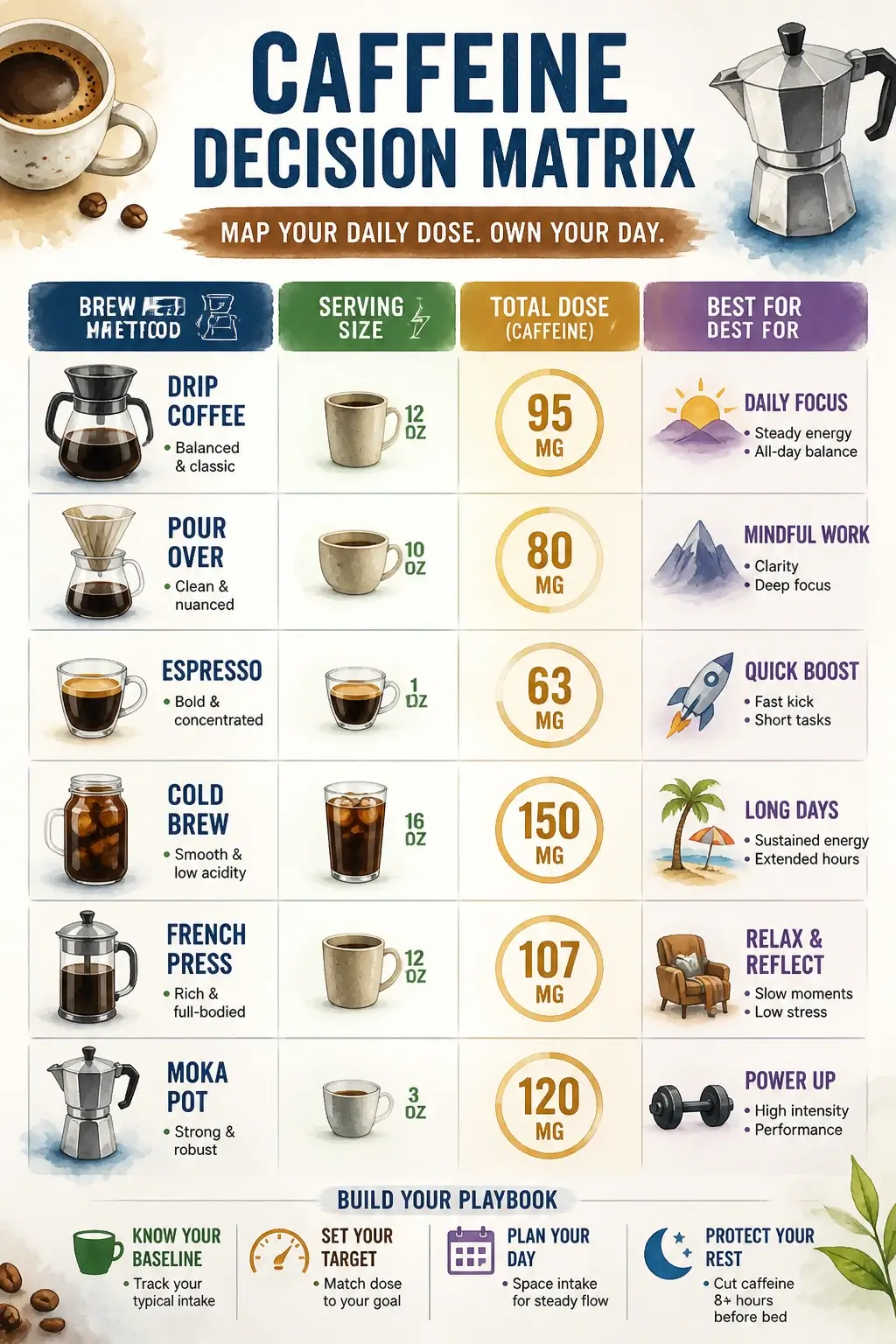
The concentrated shot seeker gets punchy flavor and a rapid effect from a small, manageable dose. The volume drinker gets a larger, slower-building lift that sustains focus for hours. The health-conscious drinker can tilt the field further with paper filters, cutting diterpene exposure without touching their caffeine numbers at all.
You now have the full picture. Espresso vs drip coffee isn’t a question of which is better – it’s a question of what you’re optimizing for. Pick your metric, know your numbers, and both brew methods fit cleanly into a day you’re in control of.
Key Takeaways on Espresso vs Drip Coffee
- “Stronger” means two different things – concentration per ounce and total caffeine dose – and they almost always point in opposite directions.
- Espresso is 4–6× more concentrated per ounce, but a standard 8–12 oz drip cup typically delivers more total caffeine than even a double shot.
- A single espresso shot (~75 mg) is your lowest-caffeine option; a 16 oz drip can deliver over 240 mg in one cup.
- Roast color has virtually no effect on caffeine per gram – the light roast myth only holds when you measure by volume, not by weight.
- Cafestol and kahweol in espresso can raise LDL cholesterol; paper-filtered drip removes these oils almost entirely, independent of caffeine content.
- For daily tracking, use 75 mg per espresso shot and 120 mg per 8 oz drip as your baseline numbers, then adjust based on your body’s response.
Frequently Asked Questions About Espresso vs Drip Coffee
Is 2 shots of espresso equal to a cup of coffee?
A double espresso (roughly 126–150 mg of caffeine) is close to an 8 oz drip cup (roughly 95–144 mg), so yes – in terms of total caffeine, they’re in the same ballpark. Go up to a 12 oz drip, though, and the drip pulls ahead by a meaningful margin.
Can espresso increase LDL cholesterol?
Espresso itself doesn’t raise LDL, but the unfiltered coffee oils it contains – specifically cafestol – are the most potent dietary cholesterol-raising compounds identified in the human diet. Switching to paper-filtered drip eliminates nearly all of that exposure without changing your caffeine intake at all.
If I drink drip all day, how quickly do I hit the 400 mg limit?
Faster than most people realize. Two 12 oz drip coffees put you at roughly 360 mg – already close to the FDA’s recognized safe ceiling for healthy adults. A third cup of any size pushes you over, which is why knowing your cup sizes matters more than most guides admit.
Does the grind size affect caffeine content in espresso vs drip?
Grind size affects extraction efficiency, not the amount of caffeine in the bean. A finer grind extracts more of the available caffeine in a shorter time – which is part of why espresso is so concentrated – but you can’t grind your way to more caffeine than the bean contains.
Does caffeine affect GABA?
Caffeine doesn’t directly raise or lower GABA, but it does block adenosine receptors, which indirectly affects the balance between stimulatory and inhibitory neurotransmitters including GABA. The net result is the alertness and reduced drowsiness most people experience – it’s a blocking mechanism, not a direct GABA interaction.
What’s the 80/20 rule for coffee?
In coffee terms, the 80/20 rule usually refers to extraction: roughly 80% of a coffee bean’s soluble compounds extract in the first 20% of brewing time, which is why espresso can deliver intense flavor from a short, high-pressure extraction. It’s a useful reminder that volume and time don’t scale caffeine linearly – the first ounces of any brew carry the most.
Does adding milk to espresso reduce its caffeine?
No. Milk changes the texture, flavor, and calorie count of a drink, but it has zero effect on caffeine content. A flat white, latte, or cappuccino contains the full caffeine of its espresso base – usually one or two shots – regardless of how much milk surrounds it.
Is decaf espresso actually caffeine-free?
Not quite. Decaf coffee retains roughly 2–15 mg of caffeine per serving depending on the decaffeination process used. A decaf espresso shot typically contains 3–15 mg – low enough to ignore for most people, but worth knowing if you’re highly caffeine-sensitive or tracking intake precisely for medical reasons.
References
- IFIC Spotlight Survey on Caffeine (2024) – ific.org
- Dr. Emma Beckett on Caffeine Concentration Across Brew Methods – dailycoffeenews.com
- Dr. Craig S. Patch et al., Caffeine Content in Espresso Servings – Journal of Food Composition and Analysis – sciencedirect.com
- Thermostability of Bioactive Compounds During Roasting Process of Coffee Beans – Heliyon / PubMed Central – pmc.ncbi.nlm.nih.gov
- Variations in Caffeine and Chlorogenic Acid Contents of Coffees – Food & Function / Royal Society of Chemistry – pubs.rsc.org
- Juliet Han, Correlation Between Caffeine and Roast Levels Using HPLC – sprudge.com
- Professor Chahan Yeretzian on Cafestol, Kahweol, and Paper Filters – perfectdailygrind.com
- Dr. Jennifer L. Temple, Caffeine Use Disorder and FDA Safe Limits – Frontiers in Psychiatry – frontiersin.org