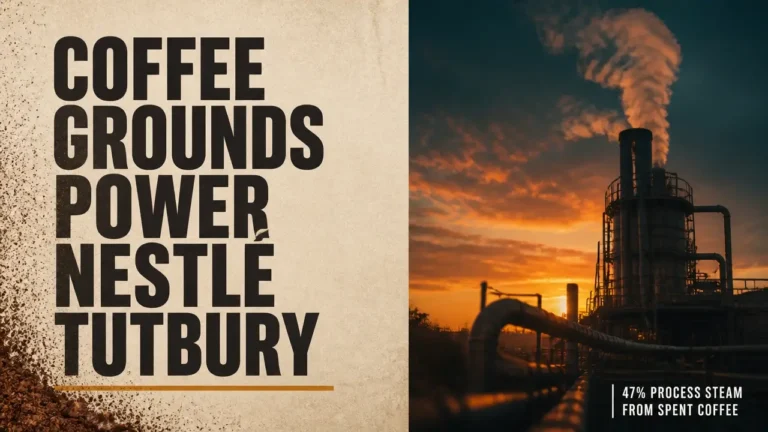

Nestlé’s coffee factory in Tutbury, Staffordshire is now generating nearly half of its process steam from spent coffee grounds, turning what was once waste into an on-site fuel source and a test case for circular manufacturing in the global coffee sector.
According to Global Coffee Report, 47 per cent of the steam required to run the Tutbury site in 2025 came from a biomass boiler that burns used coffee grounds after they are mechanically pressed to remove moisture. Nestlé told the publication that utilising spent coffee as biomass has reduced the volume of material sent to waste by 94 per cent since 2024, and that in 2025 the factory used 97.7 per cent of its used coffee beans as fuel.
The Tutbury facility, in central England, produces coffee for the United Kingdom, Ireland and export markets, and recycles 50,000 tonnes of coffee grounds annually, according to Nestlé UK. The company says the on-site biomass system efficiently reuses waste coffee grounds to provide heat for the entire site, cutting the need to transport grounds offsite for other uses.
The technical backbone of the steam project is a dedicated biomass unit installed in 2015. Boiler supplier Windsor Energy describes the system as a 9.22 megawatt B&W Towerpak boiler with a bubbling fluidized bed (BFB) combustion system designed to burn spent coffee grounds. The unit is rated to produce 14,000 kilograms of saturated steam per hour at 220°C, with design and operating pressures of 2500 and 2200 kilopascals respectively, and includes baghouse particulate control and selective non-catalytic reduction for NOx.
“At a site the size of Tutbury, even a small improvement can make a huge difference in energy use, waste reduction and emissions,” Industrial Services Manager Mike Parr said in comments reported by Global Coffee Report. He added that projects like the biomass boiler are “rewarding” for factory teams and that the progress achieved so far shows what can happen when the site “gets behind a common goal.”
Nestlé says it has been recycling spent coffee from Tutbury since 2015, and positions the biomass boiler alongside solar panels and a new water treatment plant as part of a wider sustainability effort. In a press release on its UK operations, Nestlé UK stated that all its sites in the United Kingdom and Ireland already run on 100 per cent renewable electricity and linked the Tutbury investments to the company’s global drive to become a net-zero greenhouse gas emissions business by 2050.
Beyond energy, the Tutbury site is also feeding a closed-loop materials system for branded self-serve coffee units. In a 2025 update, Nestlé Professional reported creating a board material called “Nestlé Recycled Plastic Coffee Board” made solely from waste generated at Tutbury: 70 per cent plastic waste from the factory and 30 per cent used Nestlé coffee grounds. The board is used for new NESCAFÉ furniture units, replacing earlier designs made from melamine-faced chipboard, medium-density fibreboard and other virgin materials.
That report notes that an earlier iteration of the panels, made from 90 per cent recycled materials including coffee grounds and known as “Regency Plastic Board”, already showed 70 per cent lower carbon emissions than the previous panel materials when used five times, based on a 2018 life cycle assessment by Quantis for UK manufacturer Regency. Nestlé Professional says the current board can likewise be refurbished and reused up to five times, and that around 200 units using the recycled panels have been implemented.
Reconfiguring the NESCAFÉ furniture supply chain has also changed logistics. Nestlé Professional states that by moving to the new closed-loop board made from Tutbury waste and localising production, it eliminated five separate distribution stages “from raw material sourcing to final product delivery” and reduced lead times from up to 12 weeks to 10 days.
The combined initiatives have drawn external recognition. Nestlé Professional reports that the recycled coffee grounds projects, including the NESCAFÉ furniture units, received the 2025 Footprint Award in the Waste Innovation category and the Best Closed Loop Project Award at the 2024 waste2zero Awards, highlighting Tutbury’s role as a reference point for circular-economy engineering within large-scale coffee manufacturing.