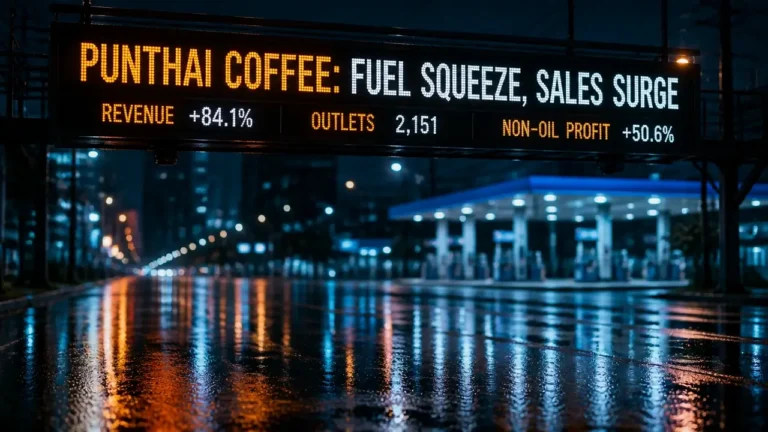

High energy prices in Thailand are now spilling directly into the coffee bar, with PunThai Coffee reporting rapid growth even as rising fuel costs squeeze sales at its predominantly petrol-station locations.
World Coffee Portal reported on 18 August 2026 that high fuel prices are “putting the brakes” on sales for Bangkok-based PunThai Coffee, which is under greater pressure than its two main rivals because 70% of its stores are situated across petrol stations. The publication noted that Café Amazon and Inthanin, Thailand’s other two major branded coffee chains, are also tied to fuel networks but have a lower proportion of sites directly on forecourts.
Despite that pressure, filings from parent company PTG Energy show PunThai’s business expanding quickly. In the first quarter of 2026, PunThai Coffee revenue grew 84.1% year-on-year and 8.8% quarter-on-quarter, according to a 12 May 2026 disclosure to Thailand’s Securities and Exchange Commission. The same filing states that non-oil gross profit rose 50.6% year-on-year to 2,001 million baht, with food and beverage, particularly PunThai Coffee, recording revenue and gross profit growth of more than 80% year-on-year.
PunThai operates under PunThai Coffee Company Limited, a PTG Energy subsidiary, and had more than 2,151 outlets nationwide at the end of 2025, PTG’s corporate information page states. The chain opened more than 800 net new outlets that year, beating its 2,000-store target and averaging roughly two new stores per day, according to a 15 May 2026 report from World Coffee Portal. PTG’s own year-end snapshot similarly records 2,151 branches and an average expansion rate of 2.2 branches per day.
That rapid rollout has been closely intertwined with Thailand’s fuel infrastructure. World Coffee Portal reports that Thailand’s three largest branded coffee chains – Café Amazon, PunThai Coffee and Inthanin – all operate through the petrol station networks of their parent energy companies. PunThai’s store network is particularly weighted toward service stations, with PTG stating that 38.3% of outlets are company-owned inside service stations, 35.7% are company-owned outside service stations and 26% are franchised.
The same period has seen exceptional volatility in Thailand’s oil market. In a 12 May 2026 filing, PTG said geopolitical tensions in the Middle East escalated from 28 February 2026, with the Strait of Hormuz – Thailand’s primary channel for crude imports from the region – effectively closed to international shipping on 2 March. PTG reported that this disruption drove a significant increase in global crude prices, while short-term demand spikes and logistical bottlenecks created temporary fuel shortages in some areas.
According to that PTG filing, the Thai government responded by gradually increasing domestic retail fuel prices several times during March 2026, while the Oil Fuel Fund mechanism continued to be used to stabilise pump prices. PTG stated that, even with those adjustments, fuel price changes in the quarter were not sufficient for service-station gross profit to fully offset costs, describing March as “significantly more challenging” than other months due to volatility in oil prices and marketing margins.
In spite of that environment, PTG has emphasised the growing importance of its coffee arm. A Q&A on the company’s investor site reports that non-oil businesses currently contribute approximately 40% of total gross profit, while the 1Q2026 filing shows that non-oil activities accounted for 46.9% of gross profit in the quarter. Within that figure, PunThai Coffee contributed 22.5% of total gross profit, with liquefied petroleum gas at 9.5% and other businesses – including Max Mart convenience stores, Autobacs auto centres, Subway restaurants and Max lubricants – providing 14.9%.
PTG explicitly links this shift to its exposure to fuel volatility. In its investor Q&A, the company states that “one of The Company’s key strategies is to diversify its portfolio toward Non-Oil businesses, which helps reduce exposure to oil market volatility and supports a more balanced earnings structure.” At the same time, World Coffee Portal’s assessment that PunThai’s 70% petrol-station footprint leaves it more exposed than competitors underlines how deeply the chain’s growth remains connected to Thailand’s unsettled energy market.
Those dynamics are playing out in a country that World Coffee Portal identifies as East Asia’s third-largest branded coffee shop market, where Café Amazon, PunThai Coffee and Inthanin together operated more than 8,500 stores and held a combined 66% share of the branded segment at the end of 2025.