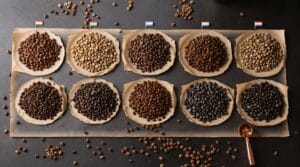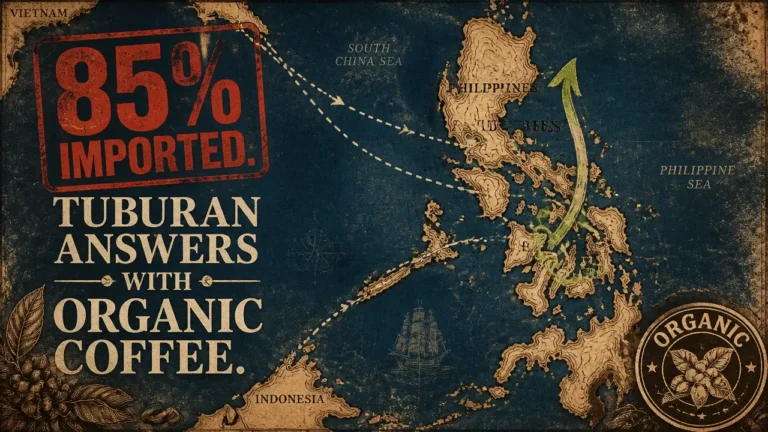

Tuburan, a coastal municipality in Cebu province in the central Philippines, is emerging as a national testbed for organic, agroforestry-based coffee as the government’s new Coffee Industry Development Office (CIDO) and international certifiers rally around Tuburan Coffee, billed as the country’s first certified-organic coffee, in a market that still imports about 85% of its beans.
InsiderPH reports that Tuburan Coffee is positioning Cebu at the forefront of the Philippines’ growing certified-organic agriculture movement and describes the brand as “the country’s first certified organic coffee.” According to the Philippine Information Agency (PIA), Tuburan’s Municipal Agriculture Office recorded 108 metric tons of coffee output in 2025 from close to 2,000 farmers.
The push comes amid pronounced supply gaps. Former mayor and Tuburan Coffee founder Democrito “Aljun” Diamante told PIA that annual Philippine coffee demand is between 150,000 and 200,000 metric tons, while local production is only about 30,000 to 33,000 metric tons, mainly from Mindanao, and that the country imports most of the balance from Vietnam and Indonesia. Agriculture Undersecretary Romeo V. Oliveros separately stated that the Philippines imports 85% of its coffee requirements, underscoring the scale of dependence on foreign supply.
Against this backdrop, the Department of Agriculture created the Coffee Industry Development Office in 2026 to centralize coffee programs, funding and strategy, with the first Visayas office to be built in Barangay Kabangkalan, Tuburan, on a one-hectare lot donated by Diamante, PIA reported. The site will house a nursery for robusta and arabica and serve as a hub for research and development, capacity training, innovation and technology transfer, according to the agency.
InsiderPH notes that agroforestry is central to Tuburan Coffee’s model, with companion plants and trees, including the native Narra, used to provide shade, moderate temperatures, slow cherry maturation and support more diverse farm ecosystems. “That’s why we’re 100-percent organic,” Tuburan Coffee chief operating officer Jamaica B. Diamante said during a media launch, adding that the company focuses on organic fertilizer and agroforestry together as “one of the better ways of improving our coffee.”
Becoming certified organic required soil testing and years of waiting for previously applied synthetic inputs to dissipate, InsiderPH reported. For an archipelagic country where many farmers face costly access to synthetic fertilizers and pesticides, the publication added, organic production can reduce dependence on imported inputs and create premium-market opportunities.
International certification advocates have also framed Tuburan as part of a broader organic-farming shift. “I think we want to put at least the potential of the Philippines in organic farming and the role organic farming can play,” said Marco Schlüter, director for strategy and international affairs at German organic association Naturland, in the same InsiderPH report. With what he called a strong grassroots movement, Schlüter said there is an opportunity “to give independence to farmers here in the Philippines.”
Domestic agencies have already treated Tuburan as a model project. A February 2024 article from the National Economic and Development Authority (NEDA) Region 7 described the Tuburan coffee initiative as a success story of the national Accelerated and Sustainable Anti-Poverty Program in 2015. The same report noted that the Department of Agriculture’s Agricultural Training Institute has certified the Tuburan project as a Learning Site for Agriculture until 2029.
NEDA Region 7 further reported that the Department of Agriculture’s Bureau of Agricultural Research, Cebu Technological University’s Tuburan campus and the local government signed a memorandum of agreement to establish a Research Development Center for Agriculture in Tuburan. DA Undersecretary Mercedita Sombilla and DA-BAR director Junel B. Soriano expressed support for funding a proposed impact-evaluation study of the community-based Tuburan coffee project, subject to submission and evaluation of the proposal.
Tuburan’s organic coffee has also reached symbolic international stages. The municipality’s official website states that Tuburan Coffee was showcased in Canada’s Parliament during the first Lapulapu Day celebration in Vancouver in April 2024, describing it as the first time a Filipino product had been acknowledged inside the Parliament building itself and noting an “overwhelming reception” from attendees.
Locally, officials have linked the coffee initiative to wider land-use and water projects. In an April 2024 report from Philippine newspaper The Freeman (Philstar), Diamante said Tuburan Coffee began in 2012 “as a means to help alleviate poverty” and stated that the town’s goal is that “in five years Tuburan will be an Organic Town” and “the organic capital of Cebu Province.” He also linked a proposed P1.8-billion dam project from the National Irrigation Administration, planned to irrigate 1,550 hectares pending regional approval, to food security and the planting of bamboos, native trees and coffee.
To support expansion beyond Tuburan, Oliveros told farmers in June 2026 that “the order is to plant 100,000 hectares of coffee within the next three years or until 2028,” according to PIA. At the same meeting, Tuburan farmer Bayo said he was “very grateful that CIDO is being established here in Tuburan because it will be a great help to us in further improving our coffee production.”
Land assessments cited by PIA indicate that seven barangays in Tuburan have 4,561.54 hectares most suitable for coffee plantations and another 13 barangays have 16,047.30 hectares considered suitable, suggesting room for scaling an organic, agroforestry-based model that national agencies and international partners are now closely watching.