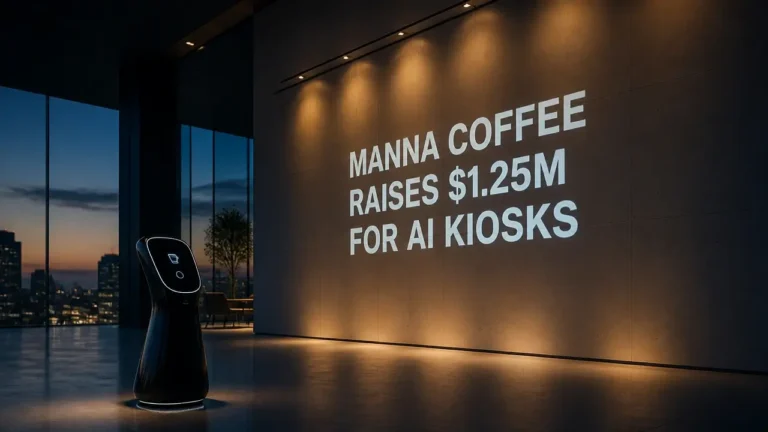

Autonomous coffee kiosks are moving deeper into the U.S. takeaway market as Manna Coffee secures a $1.25 million seed round at a $15 million pre-money valuation to expand its AI-managed network, according to Vending Times on 14 August 2026.
The Miami-based company plans to use the financing to grow its autonomous kiosk footprint, build out its technology platform, increase deployment capacity and convert more than 500 potential locations into operating sites, Vending Times reported. As of mid-August, the round remained open, with 119 investors contributing more than $300,000 toward the $1.25 million target, the publication added.
Manna positions itself as an AI-driven platform for unattended retail, built around its Manna Co:llective AI Digital Twin, a multi-agent system that coordinates telemetry, payment reconciliation, restocking logistics and marketing, according to Vending Times and Retail Technology Innovation Hub. The platform underpins a network that already spans 16 U.S. states, where the company has sold more than 100 coffee kiosks, Vending Times reported.
Manna was founded in 2025 and delivers barista-style espresso drinks in 30 seconds without a barista or storefront, the company stated in an SEC Form C-AR filing dated 8 April 2026. Each cup is priced at $3.75, and the firm is targeting the $56 billion U.S. coffee-to-go market, the filing said. Manna reported in-house manufacturing and assembly in Miami, which it cited as a way to control cost structure, quality and delivery timelines.
The company’s Platform-as-a-Service model combines equipment, implementation, recurring software and licensing fees, ingredients and consumables, payments, and co-branding and white-label programmes, according to Vending Times. In its SEC filing, Manna said it had sold more than 80 licences during 2025, reaching 88 by January 2026, and had raised $880,000 from kiosk and consumables sales, representing 3.2× growth in 2025.
Demand from would-be kiosk operators appears strong: Manna reported 2,500+ qualified partner applications with an average of 5–10 kiosks per partner, alongside a $513,000 backlog of customer-paid orders awaiting fulfilment, Vending Times and the SEC filing stated. The company also cited pilot installations with network landlords that together represent over 1,000 potential locations, and said a solution being implemented aims to reduce kiosk delivery times from approximately two months to around two weeks.
Investor interest extends beyond retail investors. Backers include StartEngine’s investor community, U.S.-based fintechs CoinFlip and Netevia, and Aleksandr Deriglazov, founder of Kazakh entertainment retailer Meloman and current distributor for The Walt Disney Company across Kazakhstan and Central Asia, according to FinSMEs and Retail Technology Innovation Hub. Manna’s SEC filing also listed 116+ private investors and its two strategic fintech partners, CoinFlip and Netevia, by the end of 2025.
Tim Perepelkin, chief operating officer at Manna Coffee, said the company’s digital twin was designed to make distributed retail more manageable. “Our Manna Co:llective digital twin doesn’t replace management – it removes the operational friction that used to make distributed retail hard to run: telemetry, reconciliation, replenishment, service coordination,” he told Retail Technology Innovation Hub, adding that this infrastructure is what allows a relatively small core team to support the current and planned kiosk footprint.
Manna’s own guidance, quoted by Retail Technology Innovation Hub, suggests that a network of approximately 20 well-performing kiosks averaging 25 cups per day could generate around $350,000–$400,000 in annual kiosk-level operating profit while being managed by one or two employees, though the company stated that actual outcomes depend on location performance, costs and execution. To support kiosk partners, Manna’s SEC filing cited financial-institution partnerships that enable purchases via instalment plans and leasing, rather than 100% prepayment, and said it had secured one of the most competitive processing rates for small-ticket transactions in the U.S.
As of its latest filings and media reports, Manna described “dozens” of active high-performing locations, including transportation hubs, sports facilities, and Class A office and residential buildings, and said it was working to activate more than 500 additional sites as operating points within its AI-managed, unattended coffee network.