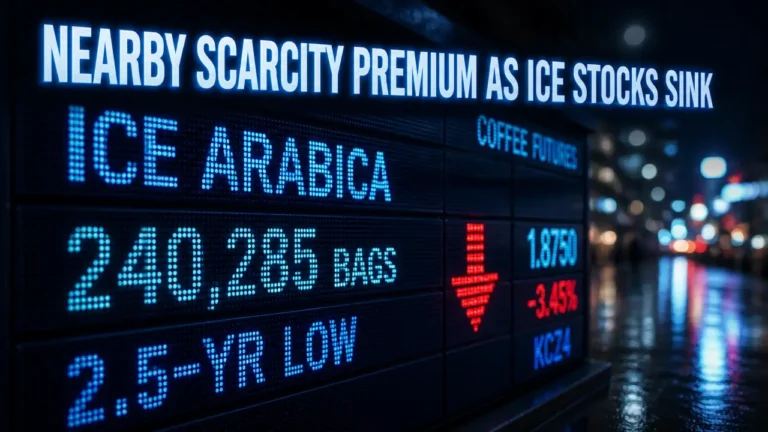

Exchange-certified arabica stocks on the Intercontinental Exchange (ICE) have fallen for more than a month to their lowest level in nearly three years, even as robusta inventories climb and a major earthquake in Colombia temporarily disrupts shipments.
According to Vietnam.vn, ICE-certified arabica inventories slipped to 240,285 bags on Wednesday, 12 August 2026, described as the lowest level in about 2 years and 9 months. One day earlier, Barchart reported stocks at 241,838 bags, already a 2.5‑year low. CocoaIntel said inventories had declined for 33 consecutive sessions to 242,673 bags on Monday, 10 August, calling it another historical low.
The tightening comes as Sucafina reported ICE-certified arabica stocks “just above 250,000 bags” in early August and described that level as low by historical standards. CocoaIntel added that coffee awaiting certification totaled only 4,530 bags on 10 August—3,890 from Brazil and 640 from Burundi—limiting the near-term cushion to rebuild exchange inventories.
At the same time, robusta availability on ICE is moving in the opposite direction. Barchart noted that ICE robusta inventories reached 4,285 lots on Monday, 10 August, a 4.5‑month high, and 4,352 lots on Tuesday, 11 August. Vietnam.vn reported that robusta stocks edged up again to 4,364 lots on Wednesday, described as the highest level in five months. London robusta futures were lower across nearby contracts that day, with September 2026 down $13 (0.34%) to $3,769 per ton and January 2027 off $28 (0.74%) to $3,733 per ton, Vietnam.vn said.
In arabica, price structures continue to reflect scarcity of nearby exchange-grade coffee. CocoaIntel reported that on 6 August, September arabica futures traded around 321.65 cents per pound while December traded near 306.10 cents, a firm backwardation that the publication described as a scarcity premium for prompt coffee. Earlier that week, Vespertool wrote that December coffee futures had fallen 8.5 cents week on week to $3.088 per pound while the September–December spread narrowed to 15 cents.
Physical flows from Brazil, the world’s largest coffee exporter, are adding to the tightness in certified stocks. CocoaIntel, citing exporter group Cecafé, said Brazil shipped 354,191 bags in the first ten days of August, an average of about 35,419 bags per day and a 16.6% decline versus the same period a year earlier. The same report noted that certificate-of-origin applications covering August shipments fell 43.3% to 458,991 bags and projected total August exports at about 1.24 million bags based on the early-month pace.
CocoaIntel also linked the slow start to a delayed arabica harvest, stating that a slower Brazilian arabica harvest was delaying new-crop arrivals in commercial and export channels and that recent rainfall was creating uncertainty about the quality of some harvested beans. Separately, Vespertool reported that Sucafina’s quality checks on Brazil’s new crop found cup quality and screen sizes falling short of expectations and said Sucafina had trimmed its estimates for both arabica and conilon output in 2026/27, while still viewing Brazil as heading for a record crop overall.
On top of Brazilian uncertainties, Colombia—one of the premium origins deliverable against the ICE Coffee “C” contract—has been hit by a significant logistical shock. Barchart reported that a 7.4‑magnitude earthquake struck the coffee-growing provinces of Caldas and Risaralda on Monday, 10 August, an area that accounts for about a quarter of Colombia’s coffee production. The same report said inland road closures and traffic restrictions followed, and that shipping company Maersk described operations at the Pacific port of Buenaventura as “temporarily suspended.”
Barchart stated that arabica prices rallied on Tuesday as traders focused on the Colombian export disruption and the historically low level of certified stocks, before consolidating below a one‑month high on Wednesday. On 12 August, the publication recorded September arabica up 0.85 cents (0.25%) on the day, while September ICE robusta fell 36 points (0.95%), underscoring the current divergence between a tight exchange arabica market and a comparatively better‑supplied robusta complex.
Behind these daily moves sits the benchmark ICE Coffee “C” futures contract, which ICE defines as a 37,500‑pound contract for exchange-grade green arabica, with deliverable origins including Mexico, several Central and South American countries, select African producers, and Papua New Guinea, and with delivery points in ports in the United States and Europe. ICE has stated in its rulebook that it is phasing out the current Coffee “C” contract and plans to introduce a new arabica futures contract, tentatively scheduled for listing in fall 2025, with Coffee “C” futures no longer listed beyond the March 2028 contract month.
While the United States Department of Agriculture (USDA) has forecast record global coffee production of 189.7 million bags in 2026/27 and record Brazilian output of 71.9 million bags, which Barchart characterized as bearish for prices, the present combination of historically low ICE-certified arabica stocks, slower and more selective flows from Brazil, and earthquake-related disruptions in Colombia is keeping the benchmark exchange market focused on nearby supply.