
Indonesian coffee farmers, traders and policymakers are stepping up efforts to build farm-level traceability systems ahead of the European Union’s deforestation law taking effect for major operators on 30 December 2026, as the EU finalises technical rules and expands the regulation’s product scope to include soluble coffee.
The latest push came at the fourth “Taste of Conservation: Blending Coffee, Profit, and Forest Sustainability” webinar on 5 August in Jakarta, where more than 100 participants joined a hybrid session on “Product Traceability,” according to Tempo.co, Suara.com and Media Indonesia. The event was hosted at Rumah KEHATI by conservation finance initiative TFCA-Sumatra, Indonesian biodiversity foundation Yayasan KEHATI and the Sustainable Coffee Platform of Indonesia (SCOPI).
At the same time, the European Commission has adopted a Delegated Act and an Implementing Act to refine the EU Deforestation Regulation (EUDR), confirming that coffee remains in scope and adding soluble coffee and certain other products from 30 December 2027, the Commission said in a 13 July announcement on its official website. The new Implementing Act also sets technical rules for the EUDR Information System, including simplified declarations for micro and small primary operators and updated API specifications.
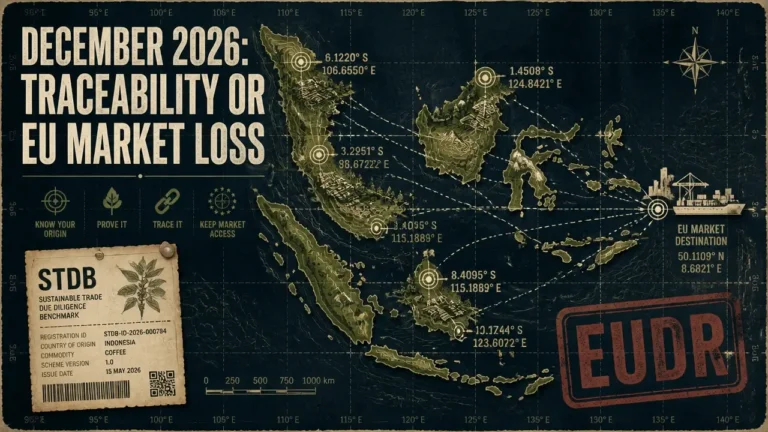
The EUDR covers coffee alongside cattle, cocoa, palm oil, rubber, soy and wood, plus related products, and requires any such goods placed on the EU market to be traceable to origin and verified as deforestation-free, Tempo.co and the Commission reported. Under the updated timelines, it will apply from 30 December 2026 for large and medium-sized operators and traders, and for some micro and small operators already covered by the EU Timber Regulation, and from 30 June 2027 for other micro and small operators, according to the Commission and Tempo.co.
Opening the Jakarta webinar, TFCA-Sumatra program director Samedi Samedi told participants that “implementing traceability is no longer just an option, but a necessity for the future of the Indonesian coffee industry,” Tempo.co reported. His comments underscored findings from an academic study published in Jurnal UAI, which concluded that there is a gap between Indonesia’s sustainable coffee management policies and EUDR requirements, particularly around farm-level traceability, and recommended accelerating work toward an integrated national traceability system.
To bridge that gap, the Indonesian government is leaning on its existing Cultivation Registration Certificate, known by its Indonesian acronym STDB, which is used to verify land legality and uphold sustainability principles, according to Tempo.co. Senior agricultural product quality supervisor Doris Monica Sari Turnip from the Ministry of Agriculture told webinar attendees that “the government’s acceleration is by allowing parties outside the government to carry out the STDB data collection and mapping stages,” a move she said is expected to speed up the growth of STDB data for coffee, Tempo.co reported.
Project partners are already piloting models to connect that kind of geo-referenced farm data with buyers. At the event, Bryant Hartanto presented the Pundi Sumatera–Telapak traceability model developed for TFCA-Sumatra partners under its Grant Cycle X, according to Tempo.co and Media Indonesia. The organisers said this work aims to help coffee producers align with EUDR traceability demands while maintaining access to export markets.
Technology providers are also positioning traceability as a commercial opportunity. Ainu Rofiq, co-founder and board member of supply-chain tech firm Koltiva, told the webinar that “market access is increasingly valuing single-origin and specialty coffee,” concluding that “so traceability is crucial,” according to Tempo.co and Media Indonesia. He added, in coverage by Tempo.co, Suara.com and Media Indonesia, that stronger traceability offers internal benefits such as quality control as well as external benefits, including compliance with regulations and meeting consumer expectations.
Yet turning those regulatory and market signals into daily practice remains difficult for many smallholders. “The challenge is that farmers cannot yet view the EUDR from a buyer’s perspective, because for them, even meeting their daily needs remains a challenge,” said Java Kirana founder Noverian Aditya during the webinar, as reported by Suara.com, Media Indonesia and Tempo.co’s English edition.
Indonesia’s coffee sector is not adapting in isolation: the country is the world’s largest palm oil producer and a major exporter of timber, coffee, cocoa and rubber, all covered by the EUDR, Mongabay reported. It added that Indonesia, Malaysia and the EU formed a joint task force on the regulation in August 2023, and that Indonesia established its own task force in October 2024, while an EU official, responding to concerns over geolocation data, told Mongabay that EUDR geolocation sharing “should not be confused or mixed with privacy issues” and would not involve personal data.
While communication between Indonesia and the EU has previously stalled over differing forest definitions and resulting discrepancies in supply-chain data, the Jurnal UAI article concluded that the EUDR can act as a catalyst to accelerate governance reforms toward verifiable sustainability in Indonesia’s coffee sector, particularly by speeding the development of traceability systems that link farm-level information to international buyers.