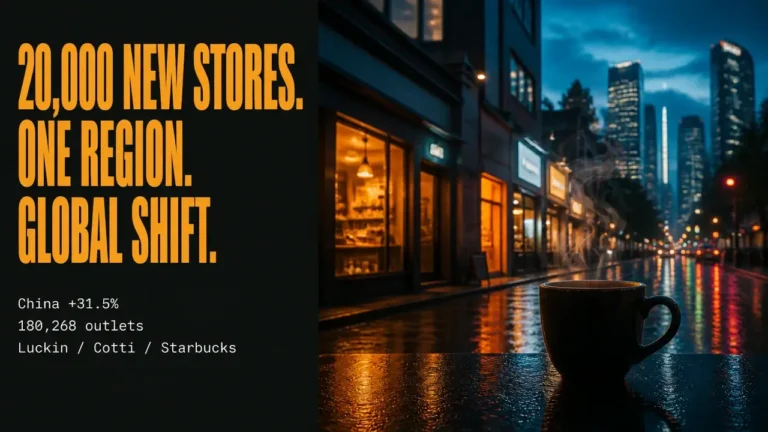

The global coffee industry is increasingly orienting itself toward East Asia, where branded coffee shop outlets and consumption are growing faster than in traditional Western markets, according to new analysis from Coffee Intelligence and market data from World Coffee Portal published between December 2023 and March 2026.
Coffee Intelligence reports that in 2024–2025 Asia and Oceania were the strongest regional contributor to global coffee demand growth, with consumption rising 7.4% to 47.4 million bags of green coffee. The same article notes that East Asia’s branded coffee shop market has been expanding at “an extraordinary pace,” adding more than 20,000 new stores in a single year.
Outlet data compiled by World Coffee Portal shows the total East Asian branded coffee shop market grew 18.4% by outlets over the last 12 months to reach 180,268 stores. Within that, China’s branded coffee shop market grew 31.5% over the same period to 87,505 outlets and became the only branded coffee shop market globally to add more than 20,000 net new outlets in a calendar year.
According to World Coffee Portal, China overtook the US as the world’s largest branded coffee shop market by outlets in 2023 and is now home to more than 87,500 stores. Earlier research from World Coffee Portal indicated that 17 of the 18 East Asian branded markets achieved net outlet growth over a 12‑month period, with 11 posting double-digit store expansion.
In its August 2026 article, Coffee Intelligence highlights China, South Korea, Malaysia, Indonesia and Singapore as increasingly important contributors to specialty coffee. The publication also identifies technology-enabled ordering, designed coffee-shop experiences, ready-to-drink products and compact retail formats as concepts emerging from Asian markets that are influencing how coffee is bought and consumed.
Coffee Intelligence cites Chinese chain Luckin Coffee as an example of this shift, noting its use of digital ordering, delivery, aggressive pricing and business models tailored to Chinese consumers. Separately, World Coffee Portal finds that domestic operators such as South Korea’s Mega Coffee, Indonesia’s Tomoro Coffee and Malaysia’s Zus Coffee are challenging Starbucks’ regional dominance and increasing their market share.
Starbucks remains the largest branded coffee chain in East Asia and, according to World Coffee Portal, opened 1,223 net new outlets in the last 12 months to reach 13,524 stores across 15 markets. During an earlier phase of China’s growth, the same source reports that Luckin Coffee added 5,059 net new stores, Cotti Coffee added 6,004, and Starbucks opened 785 net outlets in China alone, illustrating how both regional and international brands are using the market to scale.
Survey findings from World Coffee Portal indicate that 72% of East Asian industry leaders reported increased sales over the previous 12 months, with the same proportion believing trading conditions would further improve in the following year. Allegra Group founder and CEO Jeffrey Young described the region’s trajectory by stating that “the East Asian coffee shop market is clearly experiencing rapid growth led by phenomenal outlet expansion in China, which has fast become a global coffee industry powerhouse.”
While Coffee Intelligence notes that Europe remains the world’s largest coffee-consuming region, it argues that the geography of influence is becoming more dispersed. “The coffee industry is increasingly looking beyond traditional Western markets as Asia emerges as a major source of new ideas, products and consumer trends,” the article states, adding that “the coffee industry isn’t replacing one centre of influence with another” as it “has started looking everywhere.”
Global supply and demand figures from the International Coffee Organization provide context for this regional shift. The ICO reports that world coffee consumption decreased by 2.0% to 173.1 million bags in coffee year 2022/23, while production increased slightly by 0.1% to 168.2 million bags, and that Asia & Oceania accounted for 44.5 million bags of consumption in that period with regional production down 7.2% to 49.8 million bags.
For 2023/24, the ICO forecasts world coffee consumption at [UNVERIFIED] 177.0 million bags and production at [UNVERIFIED] 178.0 million bags, with Asia & Oceania consumption projected at [UNVERIFIED] 45.7 million bags, reinforcing the view from Coffee Intelligence and World Coffee Portal that East Asia’s expanding coffee shop networks and rising demand are becoming central to how the global coffee industry grows and innovates.