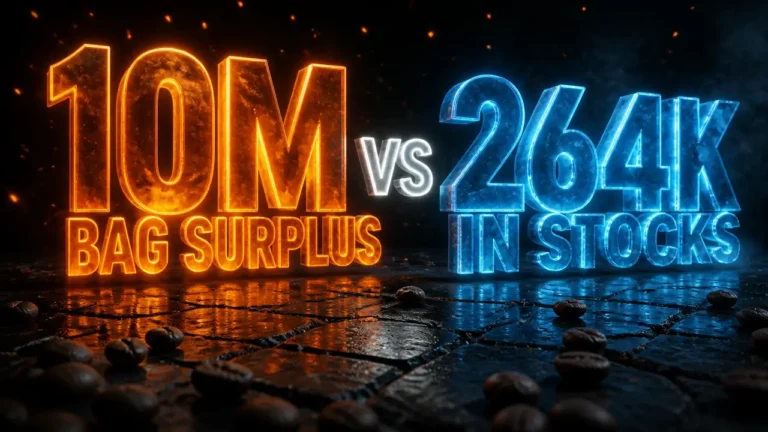

Arabica futures swung violently but finished the week sharply higher on 1 August 2026, as traders weighed tightening visible stocks and delayed Brazilian harvests against official forecasts of a large global coffee surplus, according to the latest Coffee Industry Corporation (Weekly Market Report – 02 August 2026).
The report states that arabica prices ended the week 16.60 cents/lb higher, with the second position December contract closing at 314.65 cents/lb. It describes “yet another week of huge fluctuations,” with prices rallying strongly at the beginning of the week, retreating mid-week, and then finishing with another strong upward surge, in language attributed to report author Mick Wheeler.
Robusta futures also advanced, though less dramatically. The report notes that robusta prices initially mirrored arabica’s moves but “failed to rally as strongly” at the end of the week, finishing with a gain of $37 per ton, or 1.65 cents/lb, to close at $3,775 per ton for the November position.
Behind the volatility, the report points to a marked drawdown in exchange stocks and ongoing harvest disruptions in Brazil. It records that the volume of coffee certified against the New York market fell by more than 47,000 bags in the latest week to 264,179 bags, described as a two-and-a-half-year low. At the same time, harvest progress among members of Brazilian cooperative Cooxupe was 58.3% complete as of 24 July, compared with 67% at the same point last year, according to the report.
The document says that continued wet weather in Brazil is “having a serious effect on the harvest, affecting not only the quantity of coffee being picked but also, maybe more significantly, the quality of the crop.” It adds that this situation is “exacerbating the short-term supply availability with roasters scrambling to find the coffee they require.”
Set against these near-term supply concerns are sizable surplus projections from major analytical bodies. The report notes that the United States Department of Agriculture (USDA) last week forecast a global coffee surplus of 10 million bags. In the same period, Hedgepoint Global Markets issued a revised estimate that still points to a surplus, but of about 8.2 million bags for the 2026/27 season, down from its earlier figure of 9.9 million bags.
According to the report, Hedgepoint attributes the reduction in its surplus estimate to the impact that El Niño is expected to have on production in many countries, particularly those that have already experienced irregular rainfall patterns, including Colombia and Indonesia. Despite that cut, both USDA and Hedgepoint figures still describe a global coffee market in surplus, the report notes.
The author characterises the current price swings as a direct expression of these conflicting signals. “The volatility can be attributed to the fact that the market is currently being pulled in opposite directions by two opposing forces,” the report quotes Wheeler as saying, referring to the combination of short-term tightness and longer-term surplus expectations.
The report also highlights shifting behaviour among financial players. It says that speculators and managed funds continued to reduce their exposure to the coffee market in the week to Tuesday, liquidating a total of 1,388 contracts, consisting of 559 long contracts and 829 short contracts. Wheeler comments in the report that he is “not really sure why” funds are moving out, adding that they “clearly think they can get better returns elsewhere.”
In addition to futures market moves, the publication notes that physical differential movements have been “erratic” and that it was difficult to report any quotation with confidence during the week, with the author stating that he lacks access to reliable, regularly published differential data and must rely on sources that may not be entirely accurate or up to date.
Looking ahead, the report cites forecasts for drier weather in Brazil over the next two weeks, which it says should speed up the harvest, but it stresses that “nothing is normal at the moment” and concludes by urging readers to “expect continued volatility.”