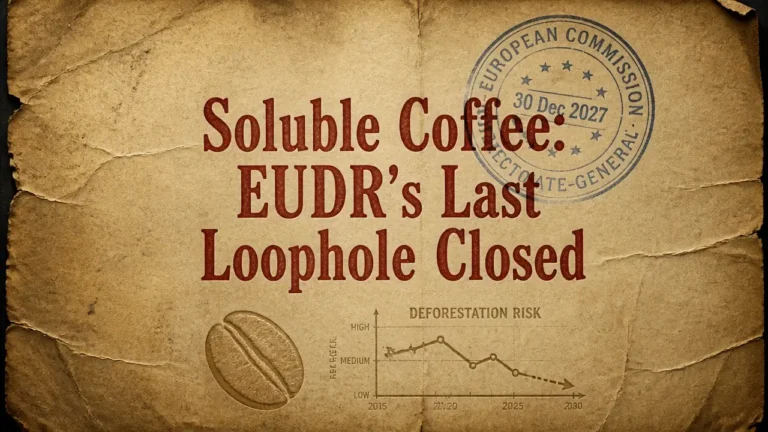

Soluble coffee will formally fall under the European Union’s anti-deforestation rules from 30 December 2027, closing a long-criticised gap between instant and roasted coffee but adding new compliance demands for manufacturers and supply chains linked to major robusta origins.
On 13 July 2026, the European Commission adopted Delegated Act C(2026) 4920 final, amending Annex I of the EU Deforestation Regulation (EUDR) to include HS Code 2101 11 00, covering extracts, essences and concentrates of coffee. The same package added certain palm oil derivatives and frozen cattle tongues, while removing cattle hides, skins and leather, re-treaded tyres, soybeans for sowing, some vulcanised rubber articles, conveyor and transmission belts, and aircraft and motor vehicle seats from the regulation’s product list.
The Commission’s written justification states that excluding soluble coffee from Regulation (EU) 2023/1115 “creates a fragmented and incoherent approach for the coffee sector” and could allow soluble products to be placed on or exported from the EU market without complying with deforestation rules. According to the Delegated Act, this gap risked “relocation rather than the elimination of the deforestation risk,” undermining the regulation’s objective of fighting deforestation and forest degradation.
Welcoming the decision, Eileen Gordon-Laity, Secretary General of the European Coffee Federation, said that including soluble coffee “would support fair competitive conditions within the internal market and reinforce the Regulation’s environmental integrity,” adding that aligning requirements across coffee categories is essential for effective implementation and for operators preparing for compliance.
Soluble coffee is typically produced from robusta coffee, which has been associated with increased deforestation when grown as full-sun monocrops in regions such as Southeast Asia and West Africa. Six countries — Vietnam, Brazil, Indonesia, Uganda, India and Côte d’Ivoire — produce approximately 95% of the world’s robusta, according to reporting on the new rules. Producing 1 kilogram of soluble coffee also requires about 2.6 kilograms of green coffee, compared with 1.19 kilograms of green coffee needed for each kilogram of roasted coffee, according to an earlier analysis cited by Comunicaffe.
The EU is described as a critical hub for soluble coffee manufacturing, with around 280,000 tonnes produced annually, mainly in Germany, Spain and Italy. While the EUDR’s core commodity list (cattle, cocoa, coffee, palm oil, rubber, soy and wood) remains unchanged, the expanded product scope means that both roasted and soluble coffee destined for or exported from the EU will be subject to uniform deforestation and legality requirements once the rules apply.
The new inclusion sits within a broader EUDR rollout. According to Daily Coffee News, the regulation is scheduled to apply from 30 December 2026 for large and medium operators, and from 30 June 2027 for most micro and small operators. Soluble coffee and the other newly added products will follow one year later, on 30 December 2027, if the Delegated Act passes scrutiny by the European Parliament and the Council of the EU, as outlined in the Commission communication.
The coffee sector has previously highlighted geolocation and farm-level traceability as core operational challenges under the EUDR. In a June 2026 European Parliament event summarised by the European Coffee Federation, industry representatives called for harmonised interpretation, clarity on acceptable due diligence evidence, and certainty on product scope including soluble coffee.
The July 13 package also introduced an Implementing Act detailing how the EUDR’s Information System will function for submitting due diligence statements and simplified declarations, according to Comunicaffe. In the same Commission press release, European Environment Commissioner Jessika Roswall said the measures aim to provide “clarity and predictability” for businesses, EU Member States and international partners as they prepare for the regulation’s application at the end of 2026.
Beyond coffee, the EUDR update reflects competing pressures from different sectors. Daily Coffee News reports that the European leather industry had lobbied for over a year to secure the removal of cattle hides, skins and leather from the regulation’s scope, a change that was formalised alongside the soluble coffee inclusion. The Commission’s Staff Working Document, published in May 2026 and referenced in the Delegated Act, also notes that biofuels (HS 3826 00), preparations for animal feeding (HS 2309) and the removal of oilcake (HS 2306 60) were assessed but ultimately not included.
At the farm level, the European Coffee Federation points to 12.5 million coffee farmers across more than 50 producing countries, 85% of them smallholders cultivating under 2 hectares and many heavily reliant on EU demand; the federation notes that Burundi sends over 90% of its coffee exports to the EU+ and Honduras around two-thirds. In a 2025 letter to the Commission, a group of 40 Members of the European Parliament warned that EUDR traceability demands risk placing disproportionate administrative burdens on small and medium-sized enterprises, and urged a delay to full implementation while technical and legal issues, including data sensitivity and redundant reporting, are addressed.