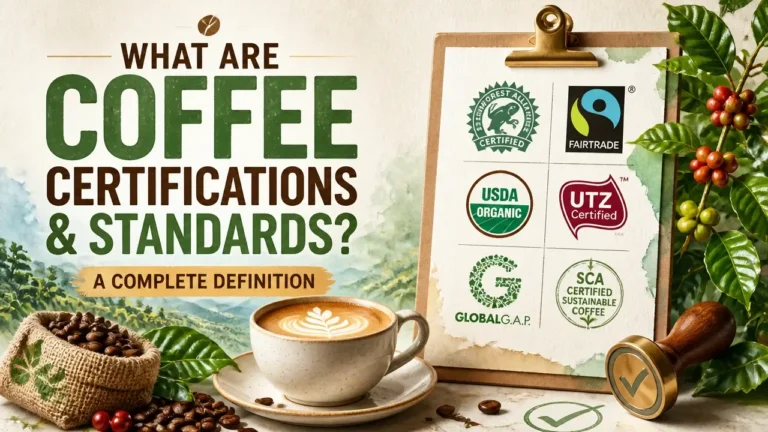

Misunderstood coffee certifications cost consumers real clarity every single day. Most people assume a seal like Fair Trade or Rainforest Alliance means the coffee inside tastes better. It doesn’t. These labels tell you how the coffee was grown and traded, not what it tastes like in the cup.
To better understand how different sourcing models impact producers and flavor outcomes, a Fair Trade and Direct Trade comparison reveals the distinct priorities behind these popular labels.
There’s a second system running alongside those seals, built entirely around sensory quality. The Specialty Coffee Association uses trained Q Graders and a 100-point scale to measure that. Knowing how these two systems work, and where they don’t overlap, puts you ahead of most coffee drinkers before you even open the bag.
Key Takeaways on Coffee Certifications Definition
- Coffee certifications verify how beans were grown and traded; they say nothing about how the coffee tastes in the cup.
- The SCA cupping score is the only standardized, independently verified quality indicator, with 80 points as the specialty threshold.
- A certification seal does not guarantee every bean in the bag is certified; mass balance models allow as little as 30% certified content under some programs.
- In 2019, roughly half of all certified coffee sold as conventional, meaning farmers bore certification costs without receiving premiums on much of their harvest.
- Bird Friendly is the most ecologically rigorous label, requiring both USDA Organic status and strict native shade canopy criteria verified by science.
- Direct Trade is a sourcing philosophy, not a certification; no independent auditor, published standard, or audit process governs the term.
Coffee Certifications vs. Quality Standards: What’s the Difference?
Coffee certifications and coffee quality standards measure completely different things. A certification is a voluntary label issued by an independent third-party organization after a farm or cooperative meets specific social, environmental, or economic criteria. A quality standard is a set of benchmarks used to evaluate the coffee itself, most famously the SCA cupping score developed by the Specialty Coffee Association.
Think of it this way. A certification is like an “organic” or “fair labor” sticker on a product. It tells you something about the conditions under which that product was made. A quality standard is more like a “Grade A” score. It tells you whether the product itself meets a defined bar for taste, aroma, and physical integrity. You can have one without the other. A coffee can earn a Fair Trade seal and still taste mediocre. A coffee can score 90 points on the SCA scale and have been grown with no certifications whatsoever.
The people who issue these two judgments are also different. A third-party auditor visits the farm, reviews documentation, and checks whether farming and trading practices meet the certifying body’s published rules. A trained Q Grader, on the other hand, evaluates a brewed cup using a standardized cupping protocol. One checks the farm. The other checks the cup.
This distinction is the foundation for everything else in this article. For a deeper look at the full universe of seals and standards, our complete guide to coffee certifications and standards maps the entire landscape in one place.
Here’s a visual breakdown of how these two systems sit side by side:
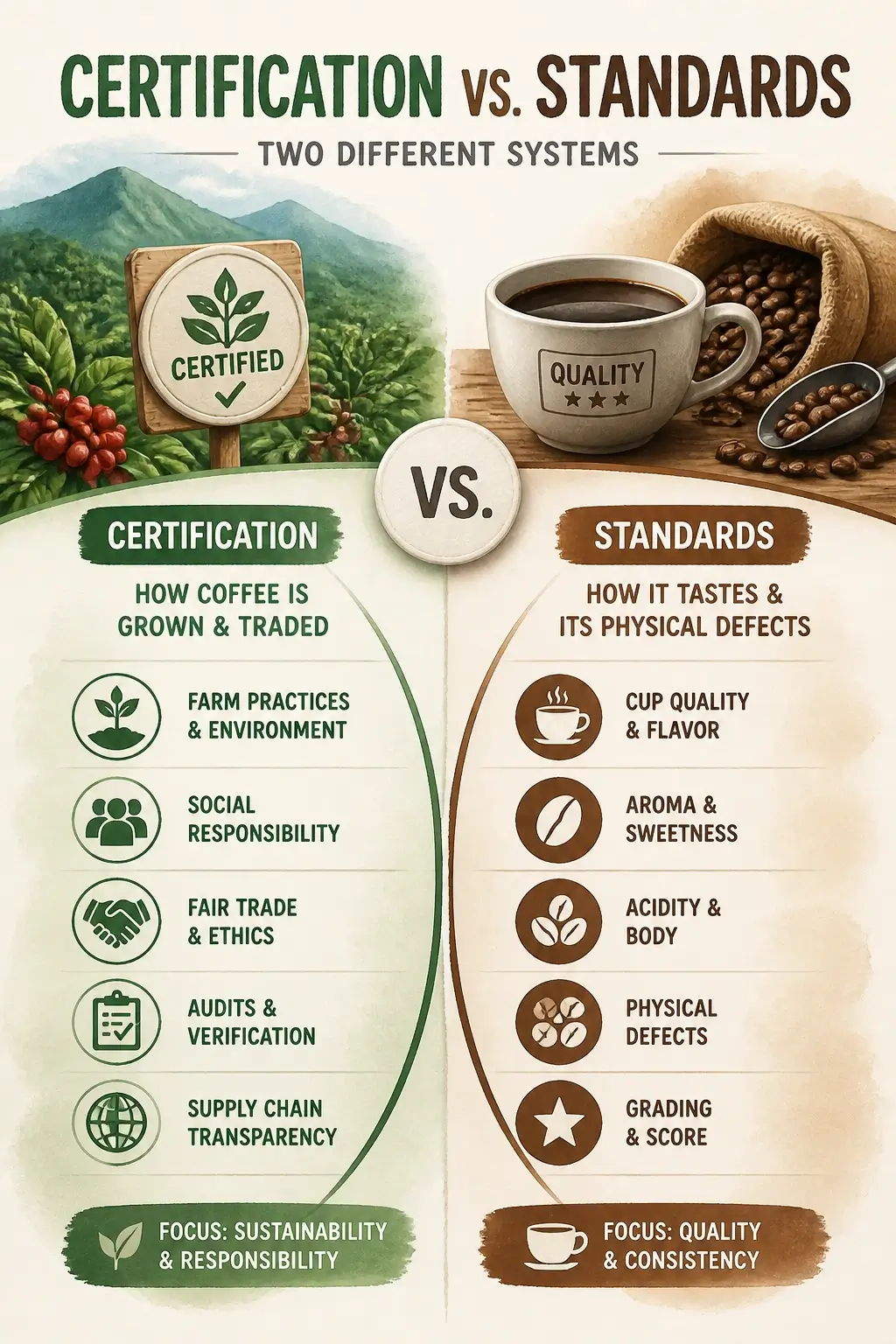
That separation between process and product is precisely what makes certifications both valuable and limited. Three experts who work closest to these systems have each flagged the same tension from different angles.
According to Colleen Anunu, Fairtrade International Representative, coffee’s trade history carries deep structural inequalities, and Fairtrade’s standards are designed to rebalance that power by giving producers a guaranteed price floor, stronger collective voice, and financial safety nets when market conditions turn hostile.
The goal is real. But the execution has limits that the label itself doesn’t advertise.
Eric Lambin, Environmental Scientist at Stanford University, reviewed the evidence on sustainability certifications across agriculture and found the data genuinely unclear on whether certifications reliably make a product better for the planet or for the farmers who grow it.
Amir Gehl, Founder of Difference Coffee, puts it more bluntly: current sustainability protocols contain enough gaps that companies can bypass certain requirements while still carrying a certified label.
Catherine McCosker, Researcher at 3Keel sustainability advisory firm, raises the consumer-facing version of that same question: if the evidence that certifications create measurable positive change is weak, does the premium price a consumer pays actually accomplish anything?
These aren’t reasons to dismiss certifications. They’re reasons to understand exactly what a seal can and can’t tell you, which is what the rest of this article does.
Why Do Coffee Certifications Exist?
Coffee certifications exist because consumers had no reliable way to know whether their purchase helped or harmed the people who grew it. Before these labels appeared, a bag of coffee gave you zero information about wages paid, chemicals used, or forests cleared to plant those trees. Certifications were built to solve that information gap.
Most certifications organize their requirements around three pillars. Economic fairness covers the prices paid to farmers and cooperatives. Environmental protection covers land management, shade canopy, water use, and prohibited chemicals. Social equity covers worker rights, safe conditions, and community investment. Different certifications weight these pillars differently, but nearly all of them address at least two of the three.
The concrete problem these labels target is real. Coffee prices on commodity markets are notoriously volatile. A farmer selling conventional coffee gets whatever the market pays that week, which can fall below their cost of production during a price crash. A Fair Trade certified cooperative, by contrast, receives a minimum price floor regardless of market conditions, plus a separate community development premium. That premium funds schools, clinics, and infrastructure projects the market price alone would never cover.
Here’s where the honest picture gets more complicated. Even when the system works as designed, the benefits are far from automatic.
In 2019, only about half of all coffee produced under certification was actually sold as certified coffee. The rest moved through conventional channels at conventional prices. That means farmers paid the cost of certification, including audit fees and compliance requirements, but received the premium on only a fraction of what they grew. The certification volume gap is structural, not accidental. It exists because certified supply often exceeds the market’s demand for certified coffee, leaving producers holding the cost without capturing the reward.
The premium itself carries a second problem. Fair Trade and Organic premiums are fixed dollar amounts, not percentages tied to production costs. If fertilizer prices double or a drought forces extra irrigation, the premium stays the same. A farmer can be certified, receive their premium, and still end up no better off than if they’d sold conventional coffee. The seal signals intent. It doesn’t guarantee outcome.
How the Certification Process Works
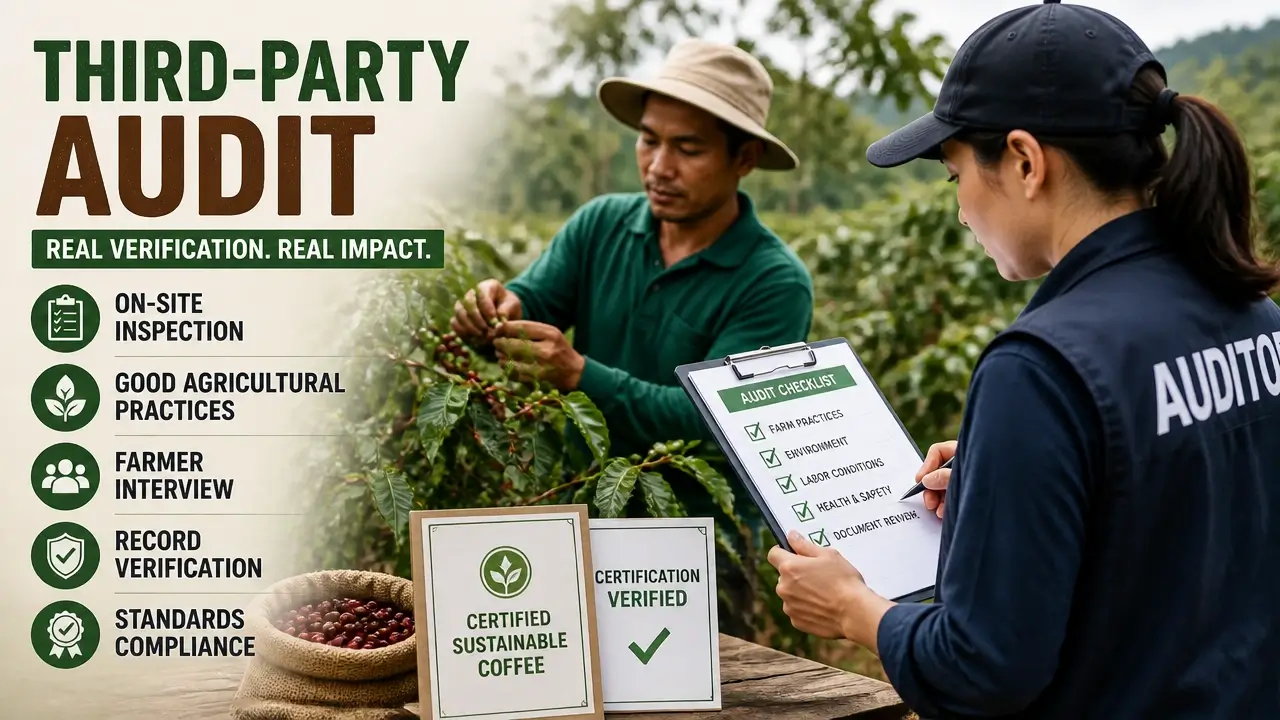
Earning a certification seal follows a predictable sequence, though the details vary by program. A farm or cooperative first applies to a certifying body, submitting documentation about their practices, land use, and trading agreements. The certifying body reviews that paperwork, then dispatches an approved third-party auditor for an on-site inspection. If the farm meets the published standard, a certificate is issued. Most programs require annual renewal inspections to keep the certificate active.
Each certification program publishes its own standards and maintains its own list of approved auditors. There is no universal coffee inspector. A farm seeking both Organic and Fair Trade certification goes through two separate audit processes, with two different sets of auditors, against two different rulebooks.
Traceability is where the system gets more nuanced. Physical segregation, the stricter model, means certified beans are kept separate from uncertified beans at every step: the farm, the mill, the exporter, the importer, the roaster. When you buy a bag under this model, the chain of custody is intact and every bean inside came from a certified source.
Mass balance is the alternative. Under this model, certified and uncertified coffee can be mixed in the supply chain, as long as the volumes are tracked on paper. The certifying body monitors that the total volume sold as certified doesn’t exceed the total volume purchased as certified. The beans in your bag may not all be from a certified farm. The accounting balances, but the physical product doesn’t.
This matters for how you read a label. Under Rainforest Alliance’s mass balance system, a bag carrying the green frog seal may contain as little as 30% certified coffee. The rest can be uncertified. Rainforest Alliance designed this deliberately to allow more supply chain participants to engage with the program, even if they can’t guarantee full physical segregation. It’s not deception. But it is a significant gap between what the label implies and what it guarantees.
Layer the certification volume gap on top of that, and the picture sharpens further. Even at the farm level, only a fraction of certified coffee gets sold as certified. Combined with mass balance at the roaster level, a bag carrying a certification seal may represent only a partial connection to the certified farm that grew it.
There’s also the cost reality. Initial Organic certification fees typically run between $700 and $1,500. Rainforest Alliance initial fees run $1,000 to $2,000, with ongoing annual renewal costs. For a smallholder farming two to three hectares, those fees can consume a meaningful share of annual profit. The certifications designed to help the most vulnerable producers can be financially out of reach for exactly those producers.
A Tour of the Main Certification Labels
Social and Environmental Coffee Certifications: Fair Trade, Rainforest Alliance, Organic, and Bird Friendly
Sustainable coffee certifications split into two broad families: those focused primarily on social and economic conditions, and those focused primarily on environmental practices. Most real-world certifications blend both, but each one has a center of gravity.
Fair Trade sits closest to the social and economic end. Its core mechanism is a minimum price floor, which protects farmers when market prices fall, plus a Fair Trade Premium, a separate sum paid on top of the purchase price that cooperatives vote on how to spend. Roads, schools, water systems, and processing equipment are common uses. Fair Trade also requires that producers organize into democratic cooperatives, giving farmers collective bargaining power they wouldn’t have as individuals.
Rainforest Alliance sits closer to the environmental and social management end. Its standards govern how farms manage ecosystems, protect wildlife habitat, conserve water, and treat workers. The recognizable green frog seal signals that a farm has met these management criteria. Rainforest Alliance absorbed the UTZ Certified program in 2018, so UTZ seals on older bags point to the same system.
USDA Organic focuses on what goes into the soil and onto the plants. It prohibits synthetic pesticides, synthetic herbicides, and synthetic fertilizers. Farms must complete a multi-year transition period, during which they follow organic practices but cannot yet sell their product as certified organic. Non-GMO verification is built into the standard. Organic says nothing about wages, worker rights, or community development.
Bird Friendly, issued by the Smithsonian Migratory Bird Center, is the most ecologically rigorous label in coffee. It requires two things simultaneously: the farm must already hold USDA Organic certification, and it must meet strict shade-management criteria. The canopy must reach at least 12 meters in height, maintain at least 40% foliage cover, and include at least 10 native tree species. That combination of organic soil management and structured shade canopy creates genuine habitat.
The science behind why those specific requirements matter is direct. A peer-reviewed study by Smithsonian researchers Narango, Rice, and colleagues, published in Biotropica, examined bird foraging behavior on Bird Friendly certified farms and found that birds did not forage randomly across the canopy. They showed strong preferences for native tree species, particularly nitrogen-fixing trees in the Fabaceae family. Farms with higher proportions of those native species supported greater bird abundance, longer foraging times, and higher species richness for both resident and migratory insectivorous birds.
That finding validates the specific design of the Bird Friendly standard. The 10-species minimum and canopy height requirement aren’t arbitrary numbers. They reflect the actual ecological conditions that make shade-coffee farms function as meaningful habitat rather than just trees with coffee underneath.
To understand the exact agricultural standards and ecological criteria behind this prominent seal, examine the Rainforest Alliance certification meaning in greater depth.
Direct Trade and Lesser-Known Seals: UTZ and 4C Explained
Direct Trade is not a certification. This point matters more than it might seem. Direct Trade is a sourcing philosophy where a roaster builds a direct, transparent relationship with a specific producer, often visiting the farm, paying prices above the commodity or Fair Trade floor, and providing quality feedback that helps the farmer improve. Many exceptional coffees reach consumers through Direct Trade relationships.
But there is no certifying body, no published standard, no independent auditor, and no audit fee. Any roaster can print “Direct Trade” on a bag without meeting any defined criteria. Grouping it alongside Organic or Fair Trade creates a false equivalence. A Direct Trade claim reflects a relationship. A certification reflects a verified standard.
The clearest rule of thumb: if a label carries an auditor logo and links to published criteria, it’s a certification. If it doesn’t, it’s a sourcing narrative, which may be entirely genuine, but cannot be independently verified.
UTZ Certified merged into Rainforest Alliance in 2018. Bags carrying the older UTZ mark fall under the same framework as Rainforest Alliance today.
4C (Common Code for the Coffee Community) is an entry-level baseline certification designed to help large-scale conventional coffee producers meet minimum sustainability thresholds. It’s less visible to retail consumers and functions more as a supply chain tool for commercial buyers than as a consumer-facing quality signal.
The Specialty Coffee Quality Standard: What an 80-Point SCA Score Means
The SCA cupping score is the coffee industry’s primary quality benchmark, and it operates on entirely different logic from the farming certifications above. Where certifications verify how coffee was grown and traded, the Specialty Coffee Association protocol measures what ends up in the cup.
To understand the history of coffee certifications is to see how this quality system developed separately from, and largely independently of, the ethical labeling movement.
Trained Q Graders evaluate each coffee sample against 11 defined attributes: fragrance and aroma, flavor, aftertaste, acidity, body, balance, uniformity, clean cup, sweetness, defects, and an overall score. Each attribute receives a numerical score. The total possible score is 100 points.
The threshold for “specialty coffee” is 80 points. Any coffee scoring below 80 is classified as commodity or commercial grade, regardless of how it was grown or what certifications it carries.
Physical defects carry their own separate gate. To qualify as specialty grade, a 350-gram green coffee sample must contain zero Category 1 defects, which include things like full black beans, full sour beans, or foreign matter. It can contain no more than five Category 2 (secondary) defects, such as partial blacks or minor insect damage. A coffee that fails the defect screen doesn’t reach the cupping table as a specialty candidate.
In consumer language, the scores break down like this:
| Score Range | SCA Classification |
|---|---|
| 80.00 – 84.99 | Very Good |
| 85.00 – 89.99 | Excellent |
| 90.00 – 100 | Outstanding |
The critical point: this score tells you nothing about whether the coffee was grown organically, whether the farmer received a fair price, or whether any birds nested in the canopy above those plants. A 90-point coffee could be uncertified. An 80-point coffee could carry four different seals. The two systems measure different things, and neither one substitutes for the other.
Common Myths About Coffee Certifications
Certification myths persist because the labels look authoritative on a bag, and most packaging doesn’t explain what they actually cover. Three misconceptions come up constantly, and each one costs consumers real clarity.
Myth 1: Certified coffee always means higher quality.
Certifications address farming and trading practices. They say nothing about sensory quality. A Fair Trade cooperative can produce coffee that scores 78 points on the SCA scale, well below the specialty threshold. An uncertified farm can produce a 92-point coffee. The SCA cupping score is the only verifiable, standardized quality indicator. If taste is your primary concern, look for a specialty grade designation or a roaster who publishes cupping scores, not a farming practice seal.
Myth 2: The seal means 100% of the bag is certified.
This depends entirely on which traceability model the certifying body uses. Physical segregation does guarantee that every bean in the bag came from a certified source. But mass balance accounting, used by Rainforest Alliance among others, allows a bag to carry the certified seal while containing as little as 30% certified coffee by volume. The rest can be uncertified. This is a deliberate design choice to increase market participation, but it means the seal signals orientation toward sustainability rather than guaranteeing purity of content.
Myth 3: More certifications on a bag means the farmer benefited more.
Stacking certifications is common, and it does increase a farm’s marketability. But the certification volume gap undermines the assumption that more seals translate to more farmer benefit. In 2019, roughly half of all certified coffee was sold as conventional coffee, at conventional prices, because certified demand didn’t absorb the full certified supply. A farm holding both Organic and Fair Trade certification may have sold the majority of its harvest with no premium attached at all. The seals on the bag reflect what the farm can offer. They don’t confirm what premium the farmer actually received for that specific bag.
The common thread across all three myths is the same. A certification label describes a system that a farm participates in. It doesn’t deliver a guarantee about the specific beans in your hand or the specific payment that reached the specific farmer who grew them.
Making Sense of It All: How to Use Certifications to Choose Coffee
A Priority-Matching Decision Framework for Choosing Certified Coffee
The priority-matching framework is the most practical tool a beginner can use at the shelf, and it starts with one honest question: what matters most to you right now?
If farmer income is your primary concern, look for Fair Trade. The price floor and community premium are the most direct financial mechanisms available through certification.
If pesticide-free production is your priority, choose USDA Organic. It’s the only label with legally enforced prohibitions on synthetic chemicals backed by a government standard.
If biodiversity and ecological habitat matter most to you, Bird Friendly combined with Organic is the most rigorous option available. It requires both clean soil chemistry and a structured native canopy.
If taste quality is your first filter, use the SCA specialty grade designation or look for a roaster who publishes cupping scores. Then layer on certifications as a secondary signal about how that quality was produced.
The strongest overall signal is a coffee that combines at least one social or environmental certification with a clear specialty grade or explicit roaster transparency about where the coffee came from and what was paid for it. Neither element alone tells the complete story.
Here’s the honest caveat that most certification guides skip. The certification volume gap and mass balance realities mean that even a carefully chosen label can’t tell you everything about the specific transaction that brought those beans to your bag. The best roasters supplement certifications with direct, verifiable sourcing information: farm names, farm gate prices paid, and visit records. That information is increasingly available, and asking your roaster for it is a completely reasonable thing to do.
One more structural reality worth carrying with you. Premiums are fixed. Production costs are not. A farmer with Organic certification whose fertilizer costs double in a single season may end up no better off than a conventional farmer. Certifications are a real mechanism for improving conditions in coffee supply chains. They are not a complete solution. Progress requires consumer pressure for transparency and fairer purchasing models alongside the labels, not instead of them.
Applying these principles directly at the retail shelf becomes significantly more intuitive when you learn how to choose certified coffee based on your personal values.
Quick-Reference Cheat Sheet and Beginner’s Glossary of Coffee Terms
Use this table as a quick decision reference when you’re standing in front of a shelf.
| Label | Primary Focus | Third-Party Audited? | What It Guarantees |
|---|---|---|---|
| Fair Trade | Farmer income, cooperative structure | Yes | Minimum price floor + community premium |
| Rainforest Alliance | Environmental management, worker welfare | Yes | Farm management standards met; mass balance may apply |
| USDA Organic | No synthetic pesticides, herbicides, or fertilizers | Yes | Input restrictions enforced; multi-year transition required |
| Bird Friendly | Shade canopy, biodiversity, organic soil | Yes | Organic + strict native shade canopy criteria |
| Direct Trade | Roaster-producer relationship, price transparency | No | No standard; reflects a sourcing philosophy only |
| SCA Specialty Grade | Sensory quality, zero primary defects | Yes (Q Grader) | Score of 80+ on 100-point scale; defect thresholds met |
Third-party certification: A label issued by an organization that is independent from both the buyer and the seller. The independence is what gives the label credibility.
Cupping score: A numerical rating for brewed coffee assigned by trained evaluators following a standardized tasting protocol. The SCA scale runs to 100 points; 80 is the specialty threshold.
Q Grader: A professional coffee taster who has passed a rigorous exam administered by the Coffee Quality Institute, certifying their ability to evaluate coffee using the SCA cupping protocol.
Mass balance: A traceability model where certified and uncertified coffee can be physically mixed in the supply chain, as long as the certified volumes are tracked on paper. A bag can carry a certified seal without every bean inside being from a certified farm.
Physical traceability: A stricter model where certified beans are kept physically separate from uncertified beans at every step of the supply chain. Every bean in the bag comes from a certified source.
Premium: An additional payment made on top of the purchase price for certified coffee, intended to fund community development projects or offset farmer costs. The Fair Trade Premium is the most well-known example.
Smallholder: A farmer working a small plot, typically under five hectares. Most of the world’s coffee is grown by smallholders, and certification costs can be proportionally more burdensome for them than for large farms.
Cooperative: A farmer-owned organization that pools resources, negotiates collectively with buyers, and distributes income and premiums among its members. Fair Trade certification requires democratic cooperative structures.
Direct Trade: A sourcing approach, not a certification, where a roaster purchases directly from a producer with a transparent relationship and price. No independent standard or auditor governs the term.
Frequently Asked Questions About Coffee Certifications Definition
What does “certified coffee” actually mean in plain terms?
It means an independent organization audited the farm or cooperative and confirmed it met specific social, environmental, or economic rules. It’s a verified claim about how the coffee was produced, not a judgment about how it tastes.
What does a certified B designation mean in coffee?
B Corp certification applies to the company selling the coffee, not the coffee itself. It means the roaster or brand met social and environmental performance standards across their entire business operation. It’s a company-level credential, separate from farm-level certifications like Fair Trade or Organic.
Can a coffee score above 80 SCA points and still have no certifications?
Yes, and it happens regularly. The SCA cupping protocol evaluates sensory quality and physical defects only. A farm with zero certifications can produce a 90-point coffee if the growing conditions, processing, and variety are right.
What is 4C coffee certification and who is it for?
4C is an entry-level baseline standard designed for large-scale commercial coffee producers, not specialty or retail consumers. It sets minimum thresholds for environmental, social, and economic practices. It rarely appears on consumer-facing packaging because its audience is primarily commercial supply chains.
Is “shade-grown” coffee the same as Bird Friendly certified?
No. “Shade-grown” is an unregulated marketing term. Any farm with trees over coffee plants can use it. Bird Friendly requires USDA Organic certification plus verified canopy height, foliage cover percentage, and native species count. The difference between the two claims is the difference between a description and a verified standard.
Why would a certified farm sell its coffee as conventional?
Because certified demand doesn’t always match certified supply. If buyers aren’t willing to pay the certified premium for the full volume a farm produces, the farm sells the remainder at conventional market prices. This is the certification volume gap, and it’s a structural feature of the market, not a failure of the individual farm.
How can I verify a roaster’s Direct Trade claims?
Ask directly. A genuine Direct Trade relationship should come with a farm name, a country and region, a price paid at the farm gate, and ideally a visit record or producer profile. If a roaster can’t answer those questions, the “Direct Trade” label is marketing rather than a sourcing commitment.
Does holding multiple certifications guarantee better conditions for a farmer?
Not automatically. Each certification adds compliance costs and audit fees. If the market doesn’t buy all of that certified volume at a premium price, the farmer absorbs the certification costs without receiving the corresponding financial benefit. More seals increase a farm’s marketability; they don’t guarantee the farmer received every corresponding premium.
References
- Sustainability Awards Interview: Fairtrade International | sca.coffee
- A Blizzard of Sustainability Labels | dailycoffeenews.com
- Why Sustainability in Coffee Is About More Than Certifications | perfectdailygrind.com
- Do Certifications Positively Affect Coffee Farmers? New Study Says Meh | sprudge.com
- Canopy tree preference by insectivorous birds in shade-coffee farms: Implications for migratory bird conservation | doi.org