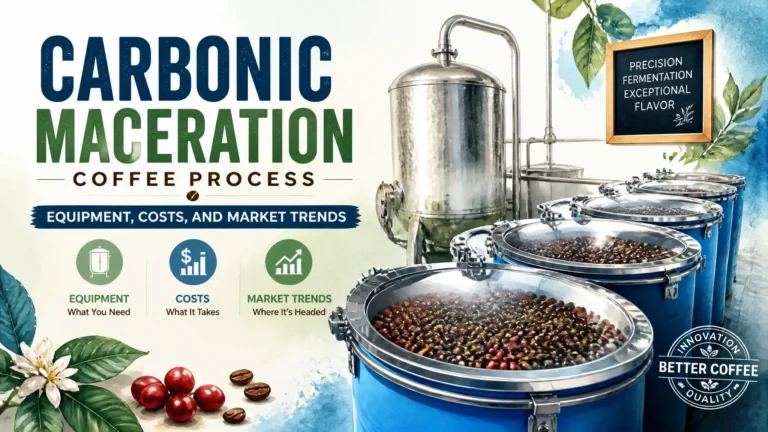

Commercial carbonic maceration coffee is one of specialty coffee’s most capital-intensive bets – a process borrowed from Beaujolais winemaking that transforms whole cherries sealed under CO₂ into intensely fruit-forward, syrup-bodied lots commanding 20–50% premiums over conventional washed grades. The equipment is real, the costs are steep, and the science is still evolving.
What separates a profitable installation from an expensive experiment is understanding exactly where the money goes – and where the hidden risks accumulate. This guide maps every cost layer, from fermentation tanks and gas systems to quality failures and regulatory exposure, so the numbers work before the first cherry goes in.
Before scaling your capital expenditure, you must establish a strict producer fermentation protocol to ensure batch consistency and protect your equipment investment from costly operational failures.
Beyond equipment costs, scaling specialty fermentation requires a deep dive into broader market trends and ROI to ensure your operational investments translate into long-term profitability.
Before finalizing your budget, it is critical to evaluate the core vessel options, with anaerobic processing tanks compared across materials like stainless steel, HDPE, and GrainPro to determine the right balance of upfront cost and sealing integrity for your operation.
To fully appreciate the financial commitments and technical nuances required for these commercial setups, you can explore the Carbonic Maceration Coffee The Complete guide to better understand the underlying biochemistry and flavor profiles driving the market.
What Carbonic Maceration Actually Costs the Business
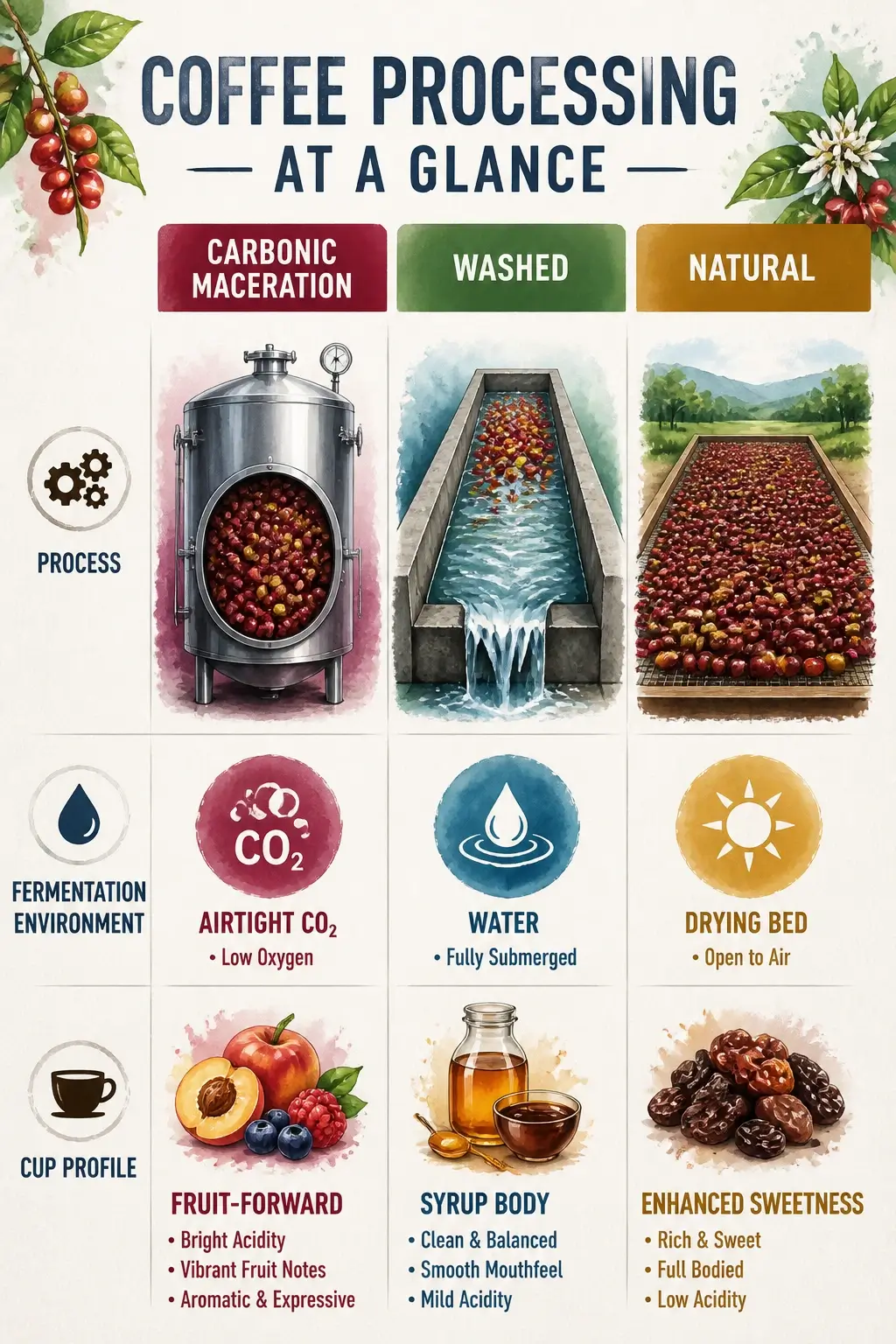
Carbonic maceration is straightforward in concept: whole coffee cherries are sealed inside airtight tanks, the oxygen is displaced by injected CO₂, and fermentation proceeds from inside the fruit through enzymatic activity rather than external microbial action. The result is a cup profile that conventional washed and natural processing simply cannot replicate – intense tropical fruit, a syrupy body, and a sweetness that specialty roasters pay real premiums to source.
The contrast with traditional methods is what drives the business case. A washed Grade 1 Ethiopian lot moves through a predictable, open-air fermentation that strips mucilage cleanly and delivers a bright, clean cup. A natural-process lot dries on raised beds with the cherry intact, developing fruit character through surface-level microbial activity. Carbonic maceration goes further: fermentation happens inside the cherry cell walls, producing flavor compounds that neither method generates. That biochemical difference is what justifies the premium pricing and what makes the process demanding to execute at commercial scale.
The technique migrated from Beaujolais winemaking, where it has been used for decades to produce low-tannin, fruit-forward reds. Its transfer to specialty coffee is relatively recent, and the specialty coffee market has responded with genuine enthusiasm. For context on the full science and process mechanics, the complete guide to carbonic maceration coffee covers the biochemistry and sensory outcomes in depth.
The broader carbonic maceration market – spanning wine and coffee – was valued at $502.1 million in 2025 and is projected to reach $910.5 million by 2036. Coffee represents a growing share of that trajectory, but the central business premise holds a tension worth naming early: the technique differentiates product and captures higher prices, but it requires significant capital, process control, and tolerance for a science that is still being written.
That last point deserves more than a footnote. Even after a tank is flushed with CO₂, residual oxygen bonded in water can remain, meaning the fermentation environment is never perfectly anaerobic. This creates batch variability that challenges standardization and raises real operational risk. The definition of “carbonic maceration” is also fragmented across the industry – some producers define it by process, others by market positioning, and commercial pressures occasionally stretch the term to include honey processing, which is technically aerobic. For a producer entering this market, definitional clarity is not just semantic hygiene. A precise, process-based claim – whole cherry, 100% CO₂-fermented, zero oxygen – builds buyer trust and defends pricing power in a landscape where the terminology is still under negotiation.
Here’s a visual comparison of how carbonic maceration stacks up against the processing methods it competes with:
Essential Equipment for Commercial Carbonic Maceration
The equipment list for carbonic maceration is shorter than most producers expect, but the tolerance for error in each component is nearly zero. The process lives or dies on airtightness, gas control, and temperature stability – and any gap in those three areas will show up in the cup.
The Core Equipment Stack
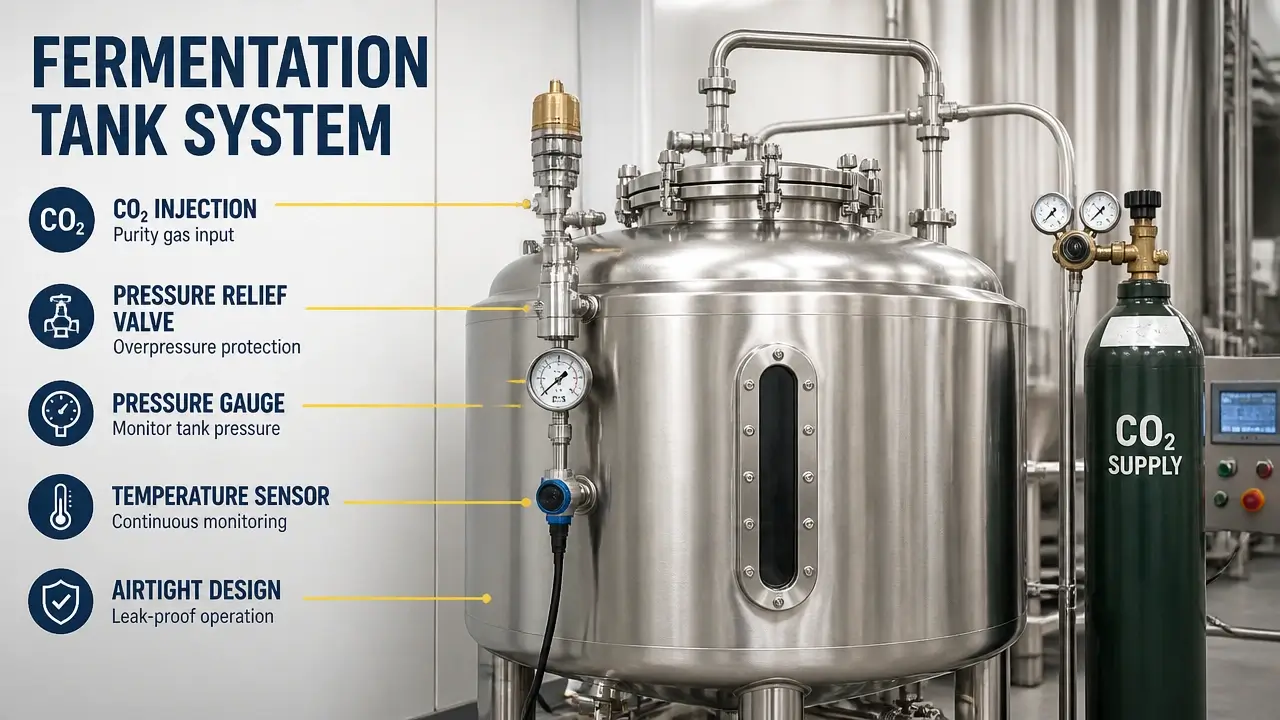
The foundation is stainless steel airtight fermentation tanks. Tank size is determined by batch volume: a micro-lot operation processing a few hundred kilograms per harvest cycle can work with repurposed wine fermenters or small custom tanks, while a mid-scale commercial facility needs purpose-built vessels with certified pressure ratings. Stainless steel is non-negotiable at commercial scale – it resists microbial contamination, handles repeated pressurization cycles, and can be sanitized without affecting flavor carry-over between batches.
The CO₂ injection system connects to the tanks via gas cylinders, a regulator, and dedicated gas lines. The regulator controls delivery pressure precisely enough to maintain the anaerobic environment without over-pressurizing the tank. Pressure relief valves are safety-critical, not optional – a tank failure under CO₂ pressure is a significant safety hazard and a total batch loss simultaneously.
Temperature sensors complete the core stack. Fermentation rate is temperature-dependent, and even a few degrees of variance can shift the flavor outcome from tropical fruit to vinegar. Sensors should feed into a data-logging system that creates a timestamped record of each batch – this documentation becomes a quality-assurance asset when presenting lots to specialty buyers.
Monitoring and Quality Control
Beyond the core system, pH meters and Brix refractometers are strongly recommended. pH tracks fermentation progression and flags early signs of over-fermentation; Brix measures sugar content and helps predict fermentation endpoint. These instruments are relatively inexpensive relative to the batch value they protect.
An in-house cupping lab rounds out the quality infrastructure. Cupping every lot before it leaves the facility is the last line of defense against shipping a defective batch – an error that costs not just the lot value but the buyer relationship behind it.
One structural advantage worth noting: existing buildings with HVAC can serve as the fermentation environment, reducing or eliminating the need for new construction. A climate-controlled room with adequate drainage and electrical capacity can house a meaningful carbonic maceration operation without a greenfield build.
Capital Investment Breakdown: What the Setup Actually Costs
The capital requirement for commercial carbonic maceration coffee equipment scales dramatically with production volume, and understanding that curve is the first step toward a realistic investment plan.
Cost Ranges by Scale
| Scale | Annual Volume | Estimated Capital Range |
|---|---|---|
| Small / Micro-lot | 5–30 bags | $5,000–$20,000 |
| Mid-size commercial | 30–200+ bags | $50,000–$150,000 |
| Industrial installation | Full processing module | $3.9 million+ |
Where the Capital Goes
Stainless steel fermentation tanks represent the bulk of upfront cost at any scale. Tank pricing reflects volume capacity, pressure certification, and whether the vessels are custom-fabricated or adapted from wine industry suppliers. Custom tanks built to coffee-specific dimensions typically cost more but integrate better with existing facility layouts.
The CO₂ gas handling infrastructure – cylinders, regulator, gas lines, and safety equipment – is a secondary but significant line item. This is not a one-time purchase: cylinders cycle through refills, regulators require calibration, and gas lines need periodic inspection for micro-leaks that would compromise the anaerobic environment.
Temperature monitoring and data-logging systems add cost but also add defensibility. A documented fermentation record is increasingly a requirement for specialty buyers who need traceability data for their own marketing. Treating this as an investment in sales infrastructure rather than overhead reframes the expense accurately.
Facility modifications – electrical upgrades, drainage improvements, ventilation for CO₂ safety – vary widely by existing infrastructure. Producers who can work within an existing building with adequate utilities absorb these costs at the low end; those building from scratch face the full range.
The Phased Rollout Advantage
A phased rollout – starting with small-scale equipment, proving the process, then reinvesting profits into capacity expansion – meaningfully reduces financial exposure and aligns capital deployment with demonstrated market demand. A producer who launches with a $15,000 micro-lot setup, achieves premium sales, and then expands to a $75,000 mid-scale system has validated the business model before committing the larger sum. The capital cost per kilogram of processed cherry is the metric that ties these decisions together: divide total amortized equipment cost by annual production volume to establish the per-unit capital burden, then test that figure against achievable premiums.
Operational Costs: CO₂ Refills, Labor, and Quality Testing
Capital gets the tanks in the ground. Operational costs determine whether the business sustains. For commercial carbonic maceration coffee, the recurring expense stack has four primary layers – and one hidden driver that inflates them all.
CO₂ Gas Costs
CO₂ gas cost is a function of batch frequency, tank volume, and system integrity. A well-sealed tank requires an initial flush to displace oxygen and a maintenance top-up during fermentation; a leaking system bleeds gas continuously and introduces the oxygen contamination that ruins batches. Per-batch gas cost for a small-scale operation running 50–100 kg tanks typically falls in the range of $15–$40 per batch, depending on local gas pricing and cylinder size. Mid-scale operations with larger vessels see higher absolute costs but lower per-kilogram figures as volume efficiency improves.
Labor Requirements
Skilled labor is the largest operational variable. Carbonic maceration requires personnel who can monitor fermentation progression (temperature, pH, timing), handle CO₂ safely – CO₂ displacement is a genuine asphyxiation risk in enclosed spaces – and maintain accurate batch logs. This is not casual harvest labor. Mistakes at the monitoring stage either generate rework or produce a total batch loss, both of which multiply labor cost well beyond the initial error.
Quality Testing
Quality testing is not optional at commercial scale. Every lot should be cupped for over-fermentation defects – vinegar notes, acetaldehyde sharpness, phenolic bitterness – before it moves forward in the supply chain. In-house cupping by trained staff is the cost-efficient option; third-party SCA-certified analysis adds credibility for buyers but adds per-lot expense. Budget $50–$200 per lot for third-party cupping, depending on the lab and market.
Batch Loss Allowance
A realistic batch loss allowance of 10–20% of annual production should be built into the operating budget. Some percentage of batches will yield off-flavors that make them unsellable at specialty prices – these lots either downgrade to commercial grade or become total losses. That shrink raises the effective per-unit cost of every saleable lot: if 15% of batches are lost, the remaining 85% must absorb 100% of the costs.
The Hidden Operational Multiplier
The layer that inflates all of the above is structural: no standardized fermentation protocols currently exist for CO₂ maceration in coffee. Unlike wine, where decades of industry practice have produced documented parameters, coffee producers must develop their own protocols through trial and error. That R&D expense – in failed batches, extended labor hours, and iterative testing – is real cash flow out the door before a single optimized process is established. Over-fermentation defects also have a timing problem: they frequently appear only at final cupping after drying and sometimes after shipment, meaning quality-control costs must include a buffer for post-drying rejection, not just pre-shipment inspection.
Utilities round out the operational picture: water for post-fermentation washing, electricity for sensors and cooling infrastructure, and any CO₂ safety monitoring systems required by local workplace regulations.
Premium Pricing Potential: How Much More Can You Charge?
The premium case for carbonic maceration is real, documented, and meaningful – but it is not unconditional.
Carbonic maceration lots from established origins consistently achieve 20–50% premiums over conventional washed Grade 1 coffees from the same region. In FOB terms, that translates to $0.50–$2.00 per kilogram above baseline pricing, with the top tier reserved for lots scoring 87–91 SCA points. Yirgacheffe lots in that scoring range have demonstrated consistent performance at the upper end of the premium band; Guji lots scoring 85–89 SCA points tend to land in the middle tier.
The premium mechanism has three drivers. First, the cup profile differentiation – the intense tropical fruit, syrupy body, and enhanced sweetness that carbonic maceration produces – is genuinely distinctive and not achievable through conventional methods. Second, scarcity and storytelling amplify the price signal: buyers pay for rarity, and a named process with a specific origin narrative supports that framing. Third, direct trade relationships with specialty roasters are the delivery mechanism – without a direct buyer who values the differentiation, the premium exists on paper but not in the invoice.
Onyx Coffee Lab demonstrates how supply-chain transparency compounds the premium. Their work with specific washing stations and producer cooperatives allows them to attach precise provenance to every lot, justifying prices beyond what the process alone would command. The story of who processed the coffee, where, and under what conditions is as commercially valuable as the flavor profile itself.
The durability of the premium, however, depends on definitional discipline. If “anaerobic” becomes a loose marketing umbrella that encompasses technically aerobic methods like honey processing, consumer trust erodes and the premium compresses for everyone. Producers who maintain precise, process-based language – and can document it – protect their pricing power while others race to the bottom. The data is clear on regional sourcing as a pricing lever: Yirgacheffe consistently outperforms Guji on cup scores, so micro-region selection is not just a quality decision but a revenue decision.
As more producers adopt the method, early movers capture the highest returns. The compression is coming – the question is whether your operation is positioned to defend its premium before it arrives.
Market Growth Projections: A $910 Million Opportunity by 2036
The macroeconomic context for this investment is genuinely favorable, with one significant caveat built into the projections that most producers won’t find in the headline number.
According to Future Market Insights, the carbonic maceration market was valued at $502.1 million in 2025 and is projected to reach $910.5 million by 2036, growing at a 5.6% CAGR. Wine dominates the current market – commercial wineries account for 48.3% of the total – but coffee adoption is accelerating and benefits from the same underlying consumer trend: a preference for fruit-forward, low-tannin, high-complexity flavor experiences.
The wine industry’s scale is instructive rather than intimidating. The fact that professional-scale carbonic maceration is already normalized in winemaking confirms that the infrastructure, supply chains, and buyer education required for commercial adoption are achievable. Coffee is following a path that wine has already validated.
A 5.6% CAGR is steady rather than explosive. That is actually appropriate for long-term capital planning – it signals a durable market expansion rather than a speculative bubble, but it also means producers should not expect rapid volume absorption of new supply. Realistic demand forecasting matters.
The caveat worth naming: the $910 million projection contains no environmental sensitivity analysis. The growth forecast does not account for carbon pricing regulations, CO₂ supply chain costs, or plastic waste restrictions – all of which are moving in the direction of increased scrutiny globally. A processing method that relies on bottled CO₂ faces material cost exposure under any carbon-accountability scenario, and none of that risk is priced into the current projections.
There is also a consumer-side knowledge gap. The market identifies growing end-user interest but provides no actionable brewing guidance for carbonic maceration coffee. Without accessible parameters for consumers, enthusiasm at the retail level may not convert into repeat purchases – a ceiling on demand growth that the headline CAGR does not capture. Coffee-specific market data remains less quantified than wine data; producers should treat the wine market trend as a structural tailwind, not a guaranteed lift.
Case Studies: Producer Success Stories and Lessons Learned
The premium is not theoretical – it is being captured, consistently, by producers who combine technical investment with supply-chain discipline.
Onyx Coffee Lab’s work with the Worka cooperative in Ethiopia is the clearest documented case. By maintaining direct trade relationships with specific washing stations and building full supply-chain transparency into their sourcing narrative, Onyx was able to offer a carbonic maceration lot with a flavor profile of heavy texture and stone fruit that commanded a strong premium in the specialty market. The transparency was not incidental – it was the commercial mechanism. Buyers paid for the story as much as the cup.
The broader data from high-performing origins confirms this is replicable. Yirgacheffe and Guji lots processed with carbonic maceration consistently achieve SCA scores of 85–91, demonstrating that quality outcomes are not accidents of individual genius but results of systematic investment. The producers behind those scores made specific decisions: upgrading washing station infrastructure, investing in worker training for fermentation monitoring, and committing to the direct buyer relationships that actually deliver the premium.
Over-fermentation remains the most common failure mode, and no source currently provides a quantified failure rate across the industry. Treating 10–20% batch loss as a planning assumption is prudent rather than pessimistic – careful monitoring reduces that figure, but it never reaches zero.
One structural tension runs beneath all of these success stories: the commercial incentive to broaden the “anaerobic” category is real. Some industry sources include honey processing – which is technically aerobic – under the same marketing umbrella. A producer who markets with honest, precise terminology stands apart in a crowded field, while category dilution erodes the premium for everyone. Onyx Coffee Lab has itself raised questions about whether the wine-to-coffee transfer of carbonic maceration is fully valid as a technical concept, which signals something important: producers who adapt the process specifically for their local coffee genetics and microclimate may discover proprietary advantages not yet documented anywhere. That is a first-mover opportunity to set the standard rather than follow it.
Hidden Risks: Environmental Costs, Quality Failures, and Market Skepticism
The risks that don’t appear in typical cost-benefit analyses are precisely the ones most likely to erode ROI. For understanding quality control costs and risks in depth, the full risk management framework is worth reviewing alongside this analysis.
The Environmental Footprint Nobody Prices In
CO₂ gas sourcing carries a carbon footprint that virtually no industry source currently quantifies or acknowledges. The gas must be produced, compressed, transported in cylinders, and eventually vented – and every step in that chain has an emissions cost. Add energy consumption for pressurized tanks, water for post-fermentation washing, and potential plastic waste from sealed bags or liners used in some systems, and the environmental footprint of carbonic maceration is materially larger than its “natural fermentation” marketing implies.
Sustainability-minded specialty buyers are already asking questions about processing footprints. That scrutiny will intensify. Producers who cannot document their environmental impact face a growing risk of buyer pushback – and in jurisdictions moving toward carbon pricing, CO₂ carbon tax exposure represents an unforeseen operational cost that current market projections do not include.
Quality Failures: The Timing Problem
Over-fermentation is the dominant quality risk, and it has a structural timing problem that makes it particularly costly. A study published in Foods examining semi-anaerobic fermentation conditions found that as fermentation duration extended, Acetobacter populations grew more abundant and overproduced acetic acid – the compound directly responsible for the vinegar defect. Samples from longer fermentation times scored significantly lower on composite quality indices (0.497 and 0.369 versus higher-scoring shorter-fermentation batches), confirming that both fermentation duration and oxygen availability are critical control variables.
The operational implication is that over-fermentation defects frequently appear only at final cupping after drying – sometimes after shipment – meaning quality-control investment cannot stop at pre-drying inspection. Entire lots can be compromised after significant labor and capital have already been invested in them.
The Practitioner Guidance Vacuum
No standardized brewing parameters currently exist for consumers of carbonic maceration coffee. Even a technically excellent green coffee can yield a poor cup in the hands of an under-informed barista or home brewer. Without accessible guidance, market acceptance is constrained by the knowledge gap between producer and end-user – a ceiling on repeat purchase behavior that no amount of supply-chain storytelling can overcome.
Definitional Fragmentation and Market Perception
As definitional fragmentation continues – with “anaerobic” expanding to cover aerobic methods, and “carbonic maceration” applied inconsistently – consumer confusion grows. That confusion compresses the specialty premium for everyone in the category, including producers who are doing the process correctly. The risk is not hypothetical; it is already visible in how different buyers, certifiers, and marketers describe the same processing methods in incompatible terms.
The 5.6% CAGR market growth projection contains no environmental sensitivity analysis. Regulatory pressure on CO₂ emissions and plastic waste could raise operational expenses or slow adoption – and none of that risk is priced into the forecast. Producers who ignore this blindspot are betting that regulation will lag behind their investment horizon.
Return on Investment: Is Carbonic Maceration Worth the Risk?
The answer depends on which producer is asking the question – and how honestly they account for the costs that most projections omit.
A Simplified ROI Model
Start with the revenue side. A producer processing 2,000 kg of cherry annually with a net FOB premium of $1.50/kg above conventional pricing generates $3,000 in incremental revenue. That figure must cover incremental capital amortization, CO₂ and labor costs, quality testing, and a batch loss allowance – and still deliver a margin worth the operational complexity.
The per-kg premium vs. cost calculation tightens significantly when batch failures enter the model. At a 15% batch loss rate, the 2,000 kg of input cherry yields approximately 1,700 kg of saleable output. The $3,000 incremental revenue now needs to cover costs calculated on 2,000 kg of input while being earned on 1,700 kg of output. Scale and efficiency are not secondary concerns – they are decisive.
At mid-scale (10,000 kg annually) with the same $1.50/kg net premium and a 15% loss rate, incremental revenue reaches $12,750 on saleable output. With mid-scale equipment amortized over five years and controlled operational costs, that figure supports a viable margin. The ROI model does not work at small scale without exceptional premium pricing or very low failure rates.
Who Should Invest
For well-capitalized producers with established direct buyer relationships and the capacity to invest in meticulous process control, carbonic maceration can be highly profitable – particularly as an early mover in premium markets where the premium has not yet compressed. The technology is most powerful in the hands of operators who can document their process precisely, tell a credible provenance story, and maintain the buyer relationships that convert cup scores into invoices.
For smallholders or producers without direct specialty market access, the combined risks – capital outlay, quality failures, environmental scrutiny, and the absence of standardized protocols – frequently outweigh the benefits. A partnership with a larger washing station that already has the infrastructure and buyer network is a more prudent entry point than a standalone investment.
The Final Verdict
Direct buyer access is not a nice-to-have; it is a prerequisite. Without a roaster willing to pay the premium and capable of communicating the process to their customers, the entire business case collapses regardless of cup quality.
The knowledge infrastructure around carbonic maceration is still being built. That fragmentation is simultaneously the greatest risk and the greatest opportunity. Early adopters who invest in local R&D – optimizing fermentation protocols for their specific cultivars, altitude, and microclimate – can develop proprietary processes that competitors cannot easily replicate. That differentiation shifts the ROI calculus in their favor and creates pricing power that outlasts the general market premium.
Producers who proactively address the environmental blindspot – implementing carbon-offset programs, water recycling, and transparent sustainability reporting – can turn a regulatory liability into a marketing differentiator that reinforces premiums with the buyers who will increasingly require that documentation.
The market is growing. The flavor profile is distinctive and in demand. But carbonic maceration is not a silver bullet – it is a high-skill, capital-intensive process whose full commercial potential is available only to operators who navigate the hidden risks with the same rigor they apply to fermentation monitoring.
Key Takeaways on Commercial Carbonic Maceration Coffee Equipment Cost
- Small-scale setups cost $5,000–$20,000; mid-size commercial operations require $50,000–$150,000; industrial installations can exceed $3.9 million.
- Airtightness is the single most critical equipment variable – micro-leaks introduce oxygen that spoils batches and destroys the premium justification.
- CO₂ gas, skilled labor, and quality testing are the three largest recurring operational costs, compounded by the absence of standardized fermentation protocols.
- A realistic 10–20% batch loss allowance must be built into the per-kilogram cost model before any premium calculation is meaningful.
- Carbonic maceration lots command 20–50% premiums over conventional washed grades, but only producers with direct specialty buyer relationships actually realize that premium.
- Environmental costs – CO₂ sourcing, water use, and potential carbon tax exposure – are absent from current market projections and represent material unpriced risk.
Frequently Asked Questions About Commercial Carbonic Maceration Coffee Equipment Cost
What are the disadvantages of carbonic maceration for coffee producers?
The main disadvantages are high capital cost, the absence of standardized fermentation protocols, and a significant batch failure risk where over-fermentation defects often appear only after drying or shipment. The process also carries an environmental footprint – CO₂ sourcing, water use, and energy consumption – that sustainability-focused buyers are beginning to scrutinize.
How long does carbonic maceration fermentation take for coffee?
Fermentation duration varies by temperature, cherry density, and target flavor profile, typically ranging from 24 to 120 hours. There’s no universal standard yet; producers must develop their own parameters through trial and error, which is one reason why skilled labor and monitoring infrastructure are non-negotiable costs.
Can existing wine fermentation tanks be used for coffee carbonic maceration?
Yes, repurposed wine fermenters are a common starting point for micro-lot operations, and they can meaningfully reduce upfront capital cost. The key requirement is verified airtightness and compatibility with CO₂ pressure ratings – tanks that held wine under low pressure may not perform reliably under coffee fermentation conditions without inspection and possible modification.
How does batch size affect the cost per kilogram in carbonic maceration?
Larger batches spread fixed costs – equipment amortization, gas system setup, and monitoring infrastructure – across more kilograms of output, lowering the per-unit capital burden. Small batches under 100 kg often carry a per-kilogram capital cost that makes the economics marginal unless the premium is at the very top of the achievable range.
What happens to over-fermented carbonic maceration lots?
Over-fermented lots typically downgrade from specialty grade to commercial grade, selling at commodity prices that may not cover processing costs. In severe cases, the lot is a total loss. Neither outcome is recoverable, which is why pH monitoring and cupping at multiple fermentation checkpoints are essential rather than optional.
Do buyers require documentation of the carbonic maceration process?
Increasingly, yes. Specialty roasters who market the process to their customers need verifiable fermentation records – temperature logs, CO₂ usage data, fermentation duration – to support their own product claims. Producers who can supply timestamped batch documentation strengthen buyer relationships and justify premiums that undocumented lots cannot command.
Is carbonic maceration coffee better suited to certain origins or cultivars?
High-sugar, fruit-forward cultivars at elevated altitudes – particularly in Ethiopia’s Yirgacheffe and Guji zones – have produced the most consistently high-scoring carbonic maceration lots documented to date. However, the science of adapting the process to specific local genetics and microclimates is still developing, and producers in other origins who invest in local R&D may find proprietary advantages not yet captured in published data.
What is the minimum scale at which carbonic maceration becomes financially viable as a standalone operation?
There’s no fixed threshold, but the ROI model becomes more defensible around 5,000–10,000 kg of cherry annually, where scale efficiencies lower per-kilogram costs enough to generate meaningful margin above the premium. Below that volume, the economics typically require either exceptionally high cup scores, a very low failure rate, or an existing direct buyer relationship that can absorb small-lot pricing at the top of the premium range.
References
- The Complete Guide to Carbonic Maceration Coffee | coffeefactz.com
- Carbonic Maceration Market Report | futuremarketinsights.com
- Foods – Development of Fermentation Strategies for Quality Mild Coffee Production | mdpi.com
- Managing Risks in Carbonic Maceration: Spoilage and Quality Control | coffeefactz.com