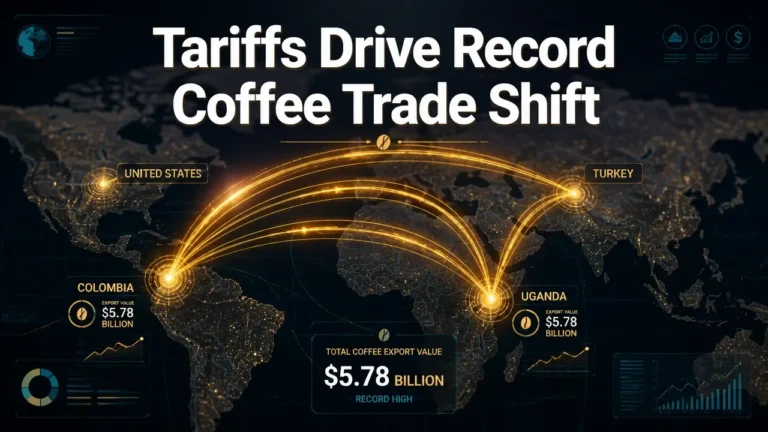

Colombia and Uganda are rapidly gaining ground in global coffee trade, as new tariffs and strategic partnerships reroute export flows toward the United States and Türkiye in record-breaking volumes documented over 2024–2025.
In 2025, Colombia’s total coffee exports reached US$5.78 billion, surpassing coal exports at US$4.90 billion and becoming the country’s leading export product for the first time in 25 years, according to ColombiaOne, citing official data from DANE. In a post on X quoted by ColombiaOne, Federación Nacional de Cafeteros (FNC) CEO German Bahamon said coffee exports in 2025 grew 70.6% and accounted for 38% of Colombia’s agricultural exports, channeling more than 20 trillion pesos into the national economy across 23 departments and 611 municipalities.
The United States has been a central driver in this reshaping of trade flows. Between January and August 2025, Colombian coffee sales to the US increased 14.7% compared with the same period in 2024, reaching 3.3 million 60‑kg bags, according to an insight by StoneX that cited data from Dian, Analdex, and Asoexport. StoneX reported that cumulative Colombian coffee exports through August 2025 were estimated at about US$4.1 billion, a 76% increase versus the US$2.35 billion recorded in the same period of 2024.
Tariff policy has been a key structural factor behind these shifts, according to the same StoneX report. Citing the Colombian coffee exporters association Asoexport, StoneX noted that Colombian coffee enters the US market at a 10% tariff, while Brazilian coffee is subject to a 50% tariff and Vietnamese coffee to a 20% tariff; Central American and Peruvian coffees also benefit from a 10% tariff. Asoexport President Gustavo Gómez told StoneX that this environment is “very good news for the country,” adding that increased interest in Colombian coffee worldwide could bring more income to coffee‑growing families in Colombia.
Colombian exporters are also seeing rapid diversification across other destinations. StoneX highlighted European markets where Colombian shipments above 100,000 60‑kg bags between January and August 2025 grew strongly versus a year earlier: France by 223.3% (to 128,000 bags), the Netherlands by 65.9% (168,000 bags), Norway by 46.2% (106,000 bags), Mexico by 38.4% (110,000 bags), and Germany by 30% (678,000 bags). The report also pointed to dramatic percentage increases in smaller markets, such as the Dominican Republic, where imports of Colombian coffee surged from 180 bags to 16,400 bags.
At the same time, Türkiye has emerged as one of the fastest‑growing importers of green coffee, creating new opportunities for producers beyond traditional buyers. Barista Magazine, citing Trade Map data, reported that Turkey’s total coffee imports rose from US$232 million in 2021 to US$909 million in 2025. Within that expansion, Travel And Tour World stated that Colombia’s coffee exports to Türkiye grew 105% between 2024 and 2025, increasing in value from US$28.5 million to US$52.8 million.
This push into Türkiye is part of a broader diversification away from traditional Colombian export staples. Travel And Tour World and ProColombia reported that roughly 96% of Türkiye’s imports from Colombia have historically been energy and mineral fuels, and that the two countries are now expanding cooperation into agribusiness and sustainable agriculture ahead of Türkiye’s hosting of COP31. Travel And Tour World also noted that a direct Bogotá–Istanbul route operated by Turkish Airlines has improved connectivity for tourism, business travel, and cargo, supporting the emerging coffee trade link.
Uganda is simultaneously carving out space in the same growing Turkish market. Barista Magazine reported that Uganda’s coffee exports to Turkey rose from about 2,300 bags in 2024 to more than 15,000 bags in 2025, while Uganda’s overall coffee export revenues doubled to US$2.2 billion in the 2024/2025 fiscal year. At a May 2026 signing ceremony with Turkish company Kafe Kavil covered by Barista Magazine, Uganda’s Ministry of Agriculture Undersecretary Aacha Mary Orikiriza said the country is strengthening its presence in emerging coffee markets through partnerships that create direct engagement between producers, buyers, and consumers.
Barista Magazine added that Uganda is shifting toward washed robusta and single‑origin arabica to compete in Turkey’s specialty segment, while recent Ugandan government data cited in the same article indicate a production base of 9.3 million bags per year. Together with Colombia’s export surge and market diversification, these developments illustrate how shifting tariffs and new trade relationships are redrawing the map of global coffee sourcing for roasters and importers.