
Brazil’s coffee sector is bracing for sweeping changes in access to its main export market, after a new study from the Institute of Economics at the Federal University of Rio de Janeiro (UFRJ) found that just over half of the country’s 2024 coffee production went to the European Union, directly exposing farmers and exporters to incoming EU deforestation rules.
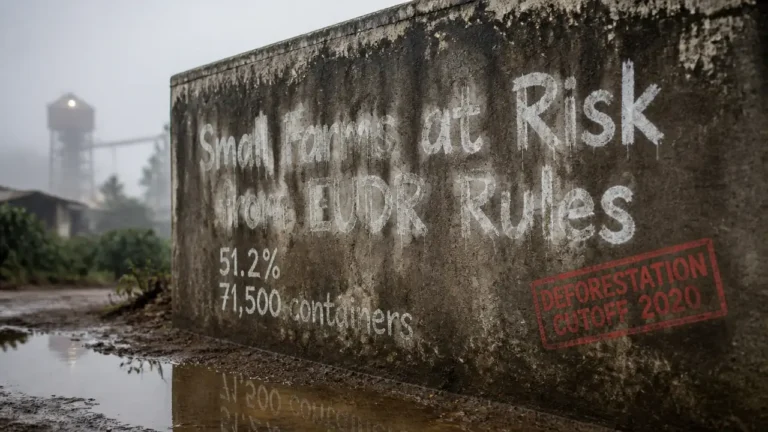
According to DatamarNews, which reported on the UFRJ project “Decarbonization and Industrial Policy: Challenges for Brazil,” the study calculates that 51.2% of Brazil’s coffee production in 2024 was exported to the EU and estimates that 5.3% of Brazil’s total exports across all sectors fall under the European Union Deforestation Regulation (EUDR). The EU measure bans imports of commodities produced on land deforested after December 2020 and, in the case of Brazil, applies under a “standard risk” classification that triggers more rigorous verification and traceability procedures than for “low risk” suppliers.
The coffee trade already reflects how central Europe has become for Brazilian exporters. Citing data from exporter association Cecafé, Food Ingredients First reported that Brazil shipped 23.6 million bags of coffee to the EU in 2024, a 42.8% increase in sales to the bloc. As a result, the EU now accounts for 47% of Brazil’s total coffee exports, and the country is the largest coffee supplier to the bloc, with a 21.8% share of EU purchases compared with Vietnam’s 9.1% share.
The UFRJ authors warn that this exposure intersects with uneven capacity to meet EUDR demands. DatamarNews notes that the study identifies micro and small coffee producers as facing the greatest difficulties, citing technical limitations and gaps in land regularization as key obstacles to compliance with traceability and due diligence requirements. Large and medium-sized companies must comply with the EUDR by December 30, 2026, while micro and small enterprises, including family farmers and small rural cooperatives, have until June 30, 2027, according to DatamarNews and Marília Notícia.
For coffee sellers, simply getting product into Europe will depend on proof of origin and land-use history. Economist and UFRJ researcher Kethelyn Ferreira told DatamarNews that “access to the European market will depend on compliance with strict traceability and due diligence requirements,” and argued that the regulation’s “design and commercial effects raise questions about potentially discriminatory impacts on exporting countries such as Brazil.” The study further notes that the EUDR may operate as a non-tariff trade barrier, creating additional costs for exporters, especially in developing countries.
Ferreira also stated that “it is plausible to assume that some European importers may replace Brazilian suppliers with Vietnamese ones,” as reported by DatamarNews. The same coverage highlights that while Brazil is treated as a “standard risk” origin under the EUDR, Vietnam is cited in the study as a potential “low risk” alternative, which would be subject to lighter due diligence.
Brazilian coffee organizations are already trying to quantify the scale of the regulatory challenge. In its December 2024 monthly report, Cecafé estimated that approximately 71,500 containers of Brazilian coffee destined for the EU will be subject to verification under the EUDR, according to Food Ingredients First. The association wrote that this “highlights the need for a structured and strategic approach in working with European leaders to classify Brazil’s coffee growing regions based on technical and scientific data.”
Mapping where coffee is grown is central to that effort. Food Ingredients First reports that Brazil’s Ministry of Agriculture and Livestock is collaborating with coffee sector organizations on a georeferencing project to map coffee-growing areas as of the EUDR cut-off date in December 2020 and today. Cecafé stated that “the mapping will show coffee plantations as of December 2020 (the cut-off date of the EUDR), as well as coffee plantations currently under cultivation. Based on these two reference points, the dynamics of the coffee growing area will be accurately determined.” Preliminary data from this project indicate stability in the size of the cultivated area, with localized expansions over low-capacity pastures, according to Cecafé’s report cited by Food Ingredients First.
At the same time, Brazilian actors point to technical frictions in how European authorities and buyers assess deforestation risks. Cecafé reported, via Food Ingredients First, that European authorities and importers have used algorithms and artificial intelligence tools to obtain imagery, leading to false deforestation alerts “as these tools have difficulty distinguishing between protected forest areas and coffee plantations.”
The UFRJ study situates coffee within a broader group of seven “relevant” commodities covered by the EUDR—coffee, cattle, cocoa, palm oil, rubber, soybeans and timber—but emphasizes that small agricultural producers are particularly vulnerable. DatamarNews notes that the researchers recommend that the EU recognize Brazilian monitoring systems already in place and defend the creation of European funds to provide technical and financial support to small South American producers navigating the new rules.