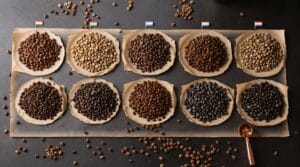

Congolese arabica is stepping further onto the global specialty stage as the third edition of the Best of Congo Cooperatives (BOCC26) competition and auction launches with 34 microlots from North and South Kivu and, for the first time, a slate of evaluated cacao lots. The 2026 program was announced on June 23, with the main competition cupping held June 19 at Pact Coffee’s London headquarters, according to Daily Coffee News and organizers African Coffee Connect and CongoAgri Platform.
Daily Coffee News reports that BOCC26’s 34 arabica lots come from cooperatives in eastern Democratic Republic of Congo’s Kivu provinces, processed as fully washed, natural, and anaerobic coffees. The same report notes that six cacao lots are undergoing quality evaluation in Antwerp, Belgium, by technicians from logistics firm Vollers alongside independent experts, marking the initiative’s first move beyond coffee.
The competition’s organizers frame BOCC26 as the latest step in a short but fast-moving trajectory for Congolese specialty coffee. The program first ran in 2024 and, according to Comunicaffe and Nombase, that inaugural edition broke the world record for the highest price ever paid for a Congolese coffee. In 2025, top competition lots scored above 88 points, African Coffee Connect reported, underscoring a rising quality profile that organizers say is now drawing attention well beyond central Africa.
That quality push has been mirrored on other regional stages. Belgian outlet MO* notes that North Kivu’s Kawa Kabuya cooperative reached 88.25 points and fourth place at the 2025 AFCA Taste of Harvest competition, becoming the first Congolese coffee to place in the top five. In an interview with MO*, cooperative representative Shakes described Kawa Kabuya as a reference point in the region for farmer prices, quality for buyers, and transparent governance.
Organizers say BOCC26 is designed to make this emerging quality more accessible to buyers in multiple markets. According to the official information page on African Coffee Connect, cupping events for the 2026 lots are taking place in London, New York, Seattle, Colorado, Seoul, and at World of Coffee in Brussels. Daily Coffee News adds that a public cupping was scheduled at World of Coffee Brussels on June 27.
The London judging on June 19 brought together 20 industry experts, including buyers from Harrods, Skylark Coffee, Lucid Coffee Roasters, Dark Woods Coffee, and Union Handroasted, according to Comunicaffe and Nombase. Prior BOCC events have handled microlots ranging between 300 and 1,500 kilograms, Barista Magazine reported in 2025, indicating that volumes are calibrated for specialty buyers seeking traceable, competition-vetted coffees rather than large-scale procurement.
For the farmer organizations behind these lots, organizers present the competition and auction as a channel linking high scores to real-world resilience. In the 2026 announcement, Executive Director of CongoAgri Platform Ghislain Kamondo told Daily Coffee News that purchasing BOCC coffees means “you’re not just buying a coffee bean” but “giving hope to producers who see the quality of their coffee as a source of resilience.” African Coffee Connect’s founder Richard Hide similarly stated on the BOCC26 information page that farmers are “producing these wonderful coffees in the most stressful of circumstances” and that the impact of buying them “can be literally life changing.”
Those circumstances include ongoing conflict and constrained finance in eastern DRC. MO* reports that Kawa Kabuya has mapped 1,800 coffee fields, with 700 still inaccessible because of M23 rebel occupation, and notes that four micro-washing stations in an area affected by ADF/MTM rebels only became operational again after fighting shifted and the International Fund for Agricultural Development supplied new pulping machines. The same article states that lender Incofin withdrew from eastern DRC following loan defaults in the region, despite Kawa Kabuya having repaid its own loan, complicating access to credit even for higher-performing cooperatives.
Within this context, BOCC organizers emphasize both quality and compliance credentials. The 2026 competition lots include Organic, Fairtrade, Rainforest Alliance, and EU Deforestation Regulation (EUDR) compliance options, according to the BOCC26 announcement on African Coffee Connect and a summary on CoffeeTalk, and the initiative highlights participation by women-led groups, young farmers, and Batwa communities. According to African Coffee Connect, the competition results are scheduled for announcement on July 2, with sample sets then available via Cupping Collective and a live auction on M-Cultivo planned for late August or early September.
Summarizing the 2026 London event, Hide told Nombase that, despite Congo’s challenges, the coffees presented at BOCC26 “stem from a refusal to give up and be defeated,” and said that even small microlots function as “calling cards” for cooperatives seeking allies among specialty buyers in the UK and worldwide.