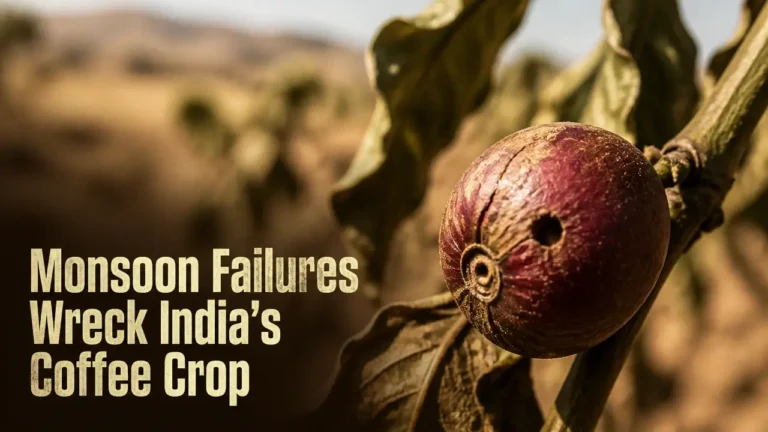

India’s main coffee districts are entering a crucial part of the 2026/27 season under intense weather stress, as official data confirm steep early‑monsoon rainfall deficits following unseasonal downpours and heat earlier in the year that growers say have already hurt Robusta and Arabica prospects.
From June 1–17, the Indian Meteorological Department recorded cumulative monsoon rainfall deficits of 35% in Kodagu (169.3 mm versus a normal 262.2 mm), 37% in Chikmagalur (102.5 mm versus 161.2 mm), 29% in Hassan (57.7 mm versus 81.4 mm) and 45% in Wayanad (171.7 mm versus 311.2 mm), according to The HinduBusinessLine citing IMD data on June 18, 2026.
These shortfalls follow what the same publication described as “untimely” January 2026 rains across Kodagu, Chikkamagaluru, Hassan and Wayanad that interrupted the Robusta harvest and triggered premature flowering. In Chikkamagaluru, January rainfall was reported 730% above normal (15.8 mm against 1.9 mm), with excesses of 105% in Kodagu (9.4 mm versus 4.6 mm) and 64% in Wayanad (8.5 mm versus 5.2 mm).
USDA Foreign Agricultural Service’s Mumbai office has already trimmed its outlook for India, forecasting 2026/27 production at 6.14 million 60‑kg bags (3.68 lakh tonnes), about 4% lower than its estimate of 6.4 million bags (3.84 lakh tonnes) for 2025/26, according to a report summarized by The HinduBusinessLine on May 23, 2026. The breakout is 1.56 million bags of Arabica (93,600 tonnes) and 4.58 million bags of Robusta (2.74 lakh tonnes.
The same USDA FAS report projects Arabica yields at 452 kg per hectare, an 8% decline, and Robusta yields at 1,239 kg per hectare, down 2%. Daily Coffee News noted that India has around 250,000 coffee growers and that approximately 98% are smallholders farming less than 10 hectares, meaning even small percentage changes in yield can affect a large number of producers.
Grower representatives say the combination of delayed and erratic rains has complicated both the tail end of the last crop and the formation of the next. “The untimely January rains have added to the problems of growers, who are already facing labour shortage for the harvest. The rain has delayed the harvest and interrupted the drying process while triggering the flowering,” said M Salman Baseer, chairman of the Karnataka Planters Association, in comments reported by The HinduBusinessLine on January 30, 2026. He added in June that “due to the weak monsoon the berry development is bad” and that it was difficult to quantify the impact on the crop.
In the same January report, Karnataka Growers Federation president K G Shivanna described the rains as “a nightmare for the growers” and said that “as it is, the robusta crop is lower this year. The rains will further impact the crop this year and also next year.” Shivanna was cited as expecting a 10–20% loss of the then‑current Robusta crop and warning that 30% of the following year’s Robusta was at stake.
Pre‑monsoon rainfall between March and May 2026 also came in far below normal, adding to moisture stress before the weak monsoon onset. Commodity Board reported on March 17 that pre‑monsoon rainfall deficits reached 64% in Chikkamagaluru, 77% in Kodagu and 100% in Hassan. Its analysis suggested a 10–15% downside risk for Robusta yields in the worst‑hit areas in a normal monsoon year, and a possible decline of more than 15–20% if the monsoon proved poor.
By mid‑June, the monsoon’s inconsistent start was raising fresh concern among growers and trade bodies. “The coverage of monsoon has been extremely poor. We didn’t get the full force of the first wave of the monsoon,” said UPASI Coffee Committee chairman Sahadev Balakrishna, speaking to The HinduBusinessLine on June 18. He stated that it was too early to tell the impact on coffee crop size and advised waiting for the monsoon to play out, while noting that a poor monsoon would “definitely impact the wider ecological systems like water resources etc.”
At the farm level, pests and disease are compounding worries in some Arabica and Robusta blocks. In June comments reported by The HinduBusinessLine, Baseer highlighted “delayed pre-monsoon showers during March-May” and said that “the white stem borer infestation in Arabicas is huge” and that “even in Robusta the setting is poor except few regions around Mudigere and Aldur that received some decent showers.” Former Karnataka Growers Federation president B S Jayaram similarly noted “a flare up of stem borer and berry borers in some areas.”
The weather shock in India is unfolding as global markets digest contrasting signals from Brazil, the world’s largest producer. Brazil’s official supply agency CONAB has projected a 2026 crop of 66.7 million bags (45.8 million Arabica, 20.9 million Robusta), while StoneX has forecast 75.3 million bags (50.2 million Arabica, 25.1 million Robusta) and statistics agency IBGE has estimated 64.1 million bags (43.9 million Arabica, 20.2 million Robusta), according to Comunicaffe and Global Coffee Report.
Onmanorama reported on June 18 that untimely June rains in Brazil’s harvest regions had sparked supply concerns and lifted Robusta prices in Indian markets by up to ₹10 per kilogram, after a previous slide in Robusta cherry prices from ₹284/kg at the 2025 harvest peak to ₹214 in March–April and ₹195 by end‑May. The same article cited expert views that the resulting price surge might prove temporary if Brazil’s weather improves and harvesting resumes.
Against this backdrop, Commodity Board has noted that Indian coffee continues to trade at a premium to Vietnam and Indonesia and that high premiums risk demand destruction, while also reporting that India’s coffee exports reached a record 407,000 tonnes in 2025–26 with a value of €1.96 billion. Global Coffee Report, citing USDA figures, has put world coffee production for 2025/26 at 178.8 million 60‑kg bags against demand of 173.9 million bags.