
A global coffee price rally is transforming earnings for Tanzanian producers even as Brazil prepares a record harvest under sharply lower domestic prices, according to new government and trade data released in April–June 2026.
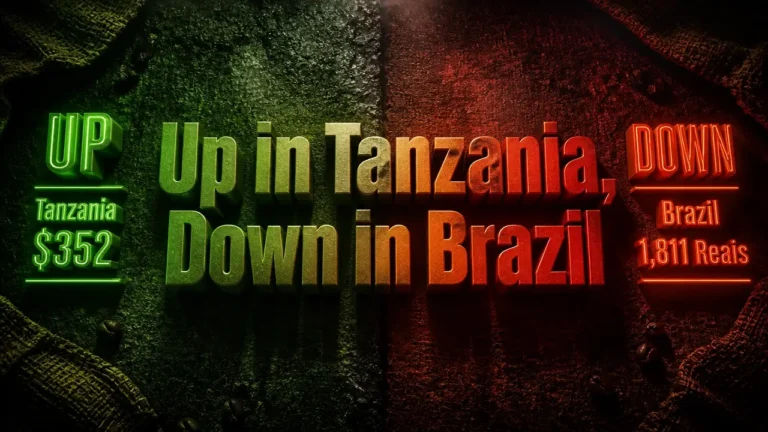
The Citizen reported on June 11 that Arabica prices in Tanzania climbed from $100 per 50‑kg bag in 2023/24 to $352 in 2025/26, while robusta rose from $100 to $218 over the same period. The paper linked the rally to climate-related disruptions in major producing countries and rising global demand. At the same time, Tanzania’s coffee production increased from 50.53 million kilograms in 2024/25 to 76.47 million kilograms in 2025/26, with about 92% of the latest crop sold via direct export for $413 million.
Those figures echo a broader surge in export earnings. According to The Guardian on May 12, coffee export revenues from Tanzania more than doubled to $389 million from $161 million, while producer prices reportedly rose from 1,000 Tanzanian shillings per kilogram to 6,000 shillings in 2025. The Guardian also cited an official Tanzania Coffee Board target for annual growth of around 10%.
New forecasts suggest Tanzania intends to sustain higher output. An overview of a USDA Foreign Agricultural Service report published by Daily Coffee News on June 1 projected Tanzania’s green coffee production at 1.6 million 60‑kg bags in 2026/27, up 10.3% year-on-year, with exports at 1.41 million bags, up 2.9%. The same report forecast domestic consumption at 90,000 bags and ending stocks at 157,000 bags, with cultivated area at 275,000 hectares and harvested area at 270,000 hectares.
Regional concentration remains pronounced. The Citizen reported that Tanzania’s Ruvuma and Songwe regions account for 77.4% of national Arabica output. At the 16th Coffee Industry Stakeholders Conference in Dodoma on June 4, Tanzania Coffee Board chairperson Prof Aurelia Kamuzora said the country had begun mapping coffee farms and was working with local authorities to build a traceability story aligned with modern consumer expectations, according to The Citizen’s coverage of her remarks.
Kamusora also highlighted new income streams linked to planting material. In The Citizen’s June 11 report, she stated that a single coffee seedling sells for between 200 and 1,500 Tanzanian shillings depending on quality, describing this as a significant opportunity for youth to participate in coffee-related businesses.
Daily Coffee News noted on June 1 that Tanzania signed a $30 million memorandum of understanding with Corus International covering seedling distribution and sector competitiveness, alongside ongoing reforms around climate-resilient varieties, farm mapping and digitalized auctions. The Guardian reported that President Samia Suluhu Hassan has called for 50% of Tanzania’s coffee to be processed locally by 2035, aiming to increase value addition and domestic consumption.
While Tanzanian farmers are benefiting from higher international prices, Brazilian producers face a different picture. A farmer survey by the Coffee Trading Academy (CTA), cited by KELO-AM / Reuters on April 29, projected Brazil’s 2026/27 crop at a record 71.4 million 60‑kg bags, up 11.5% from the previous season, with arabica at 47.9 million bags and robusta at 23.5 million. USDA FAS figures relayed by Street Food Spectacle on June 8 put the total even higher at 71.9 million bags, while Brazil’s official agencies CONAB and IBGE estimate 66.7 million and 65.1 million bags respectively.
Despite these record or near-record projections, Street Food Spectacle reported that Brazilian arabica prices in April 2026 stood at 1,811.87 Brazilian reais per 60‑kg bag, down 28% year-on-year, with robusta at 917.05 reais, down 46%. The same report noted that Brazil’s coffee-to-fertilizer exchange ratio worsened to 4.97 bags needed to purchase one ton of fertilizer in April 2026, compared with 2.25 bags a year earlier, and that the country’s coffee ending stocks are forecast at 4.425 million bags in 2026/27.
To support the sector through these conditions, Brazil’s Coffee Economy Protection Fund (FUNCAFE) has a budget of 7.37 billion reais (approximately $1.46 billion) for 2026/27, according to the USDA FAS summary cited by Street Food Spectacle. That report also forecast Brazilian coffee exports at 49.07 million 60‑kg bags in 2026/27, up 29.6% from the prior season.