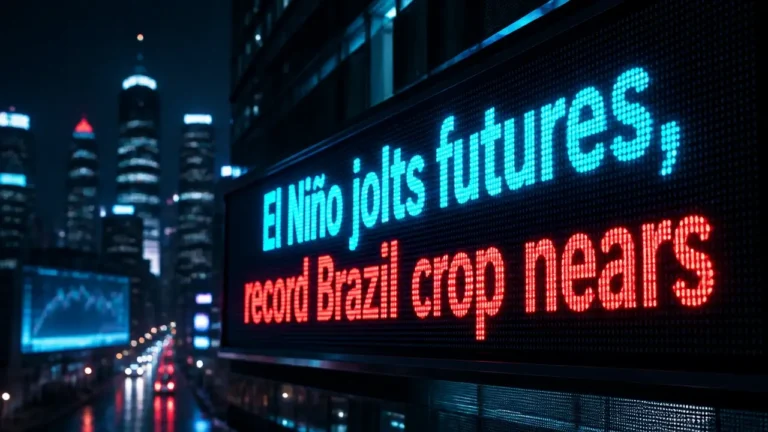

Confirmation of an El Niño weather pattern by Japan’s national meteorological agency has jolted global coffee markets, pushing futures higher just as traders were pricing in what several analysts call a record Brazilian crop. The Japan Meteorological Agency’s June 10 announcement was followed the same day by gains of about 1.8% in both arabica and robusta contracts, according to Barchart.
Barchart reported that July arabica coffee futures rose 4.55 cents, or 1.86%, while July ICE robusta gained $60, or 1.82%, in what the market data provider described as short covering after the El Niño confirmation. Those moves came immediately after arabica had fallen to a 19‑month nearest‑futures low and robusta to a two‑month low amid what Barchart called an improved global supply outlook over the past six weeks.
That supply outlook is anchored in Brazil, where forecasts for the 2026 crop have climbed steadily. Government agency CONAB is projecting a record 66.7 million 60‑kilogram bags for 2026, up 18% from the previous season, with 45.8 million bags of arabica and 20.9 million bags of robusta, according to reporting by Global Coffee Report. Private forecasts cited by Barchart go even higher, with Marex Group at 75.9 million bags, Sucafina at 75.4 million, and StoneX at 75.3 million.
Farmer‑based data broadly point in the same direction. A survey of 758 growers across all Brazilian regions by the Coffee Trading Academy, reported by KELO‑AM/Reuters, projected the 2026/27 crop at 71.4 million bags, an 11.5% increase and a record in that series. The survey estimated arabica production at 47.9 million bags, up 13.5% year‑on‑year, and robusta at 23.5 million bags, up 7.6%. Coffee Trading Academy’s April figure of 71.4 million bags was higher than its November 2025 estimate of 69 million bags but lower than the 73.7 million it reported in July 2025.
On the ground in Brazil’s main producing state, Minas Gerais, agronomists describe a strong crop. In an April 23 report from Valor International, state technical coordinator Sérgio Mário Regina of Emater‑MG said, “I have never seen the crop in such good condition. The beans are developing well and have good size. If there are no frost events, especially in southern Minas and the Cerrado, we will have a really strong harvest.” Emater‑MG estimates 32 million bags of arabica and 650,000 bags of conilon for 2026, increases of 27% and 11% respectively, according to Valor.
Yet even as volumes rise, many Brazilian producers are facing lower local prices. In April 2026, arabica in Brazil averaged 1,811.87 reals per 60‑kilogram bag, down 28% year‑on‑year, while robusta averaged 917.05 reals, down 46% from April 2025, according to a report from Street Food Spectacle citing the U.S. Department of Agriculture’s Foreign Agricultural Service. The same report noted that the coffee‑to‑fertilizer exchange ratio worsened sharply, from 2.25 bags of arabica per ton of fertilizer in April 2025 to 4.97 bags per ton in April 2026.
Global balances also help explain why futures had been under pressure before El Niño news emerged. Commodity broker StoneX forecast a 10‑million‑bag global surplus in 2026, up from 1.8 million bags in 2025, according to Barchart. Separately, the USDA’s Foreign Agricultural Service projected world coffee production at 178.848 million bags in 2025/26, an increase of 2% from the previous season, with robusta output rising 10.9% to 83.333 million bags while arabica falls 4.7% to 95.515 million bags, Barchart reported.
Despite those larger crops, inventories on the main futures exchanges have been tightening. On June 10, ICE arabica stocks fell to a 6.25‑month low of 409,897 bags, while ICE robusta inventories hit a two‑year low of 3,631 lots in mid‑May before standing at 3,713 lots on June 10, according to Barchart. Barchart also noted that the ongoing closure of the Strait of Hormuz has disrupted global coffee supplies by increasing shipping, insurance, fertilizer and fuel costs.
Scientists and traders are now watching how El Niño might interact with those supply dynamics. The U.S. Climate Prediction Center has assigned a 67% chance of a strong or very strong El Niño by the end of 2026, according to Barchart and specialty news outlet The Pourover. In Barchart’s coverage, one unidentified commercial coffee trader said the El Niño pattern may delay rains in Brazil this September and October, when tree flowering normally occurs, potentially hurting the country’s 2026/27 crop.
Elsewhere, a 2025 academic study from Vietnam quoted by The Pourover concluded that “the ENSO phenomenon has a significant impact on Vietnam’s coffee export price, with El Niño reducing price and La Niña tending to increase price.” At the same time, demand is still rising: Global Coffee Report noted that Brazil’s CONAB, citing USDA data, expects global coffee demand to grow 1.3% to 173.9 million bags.