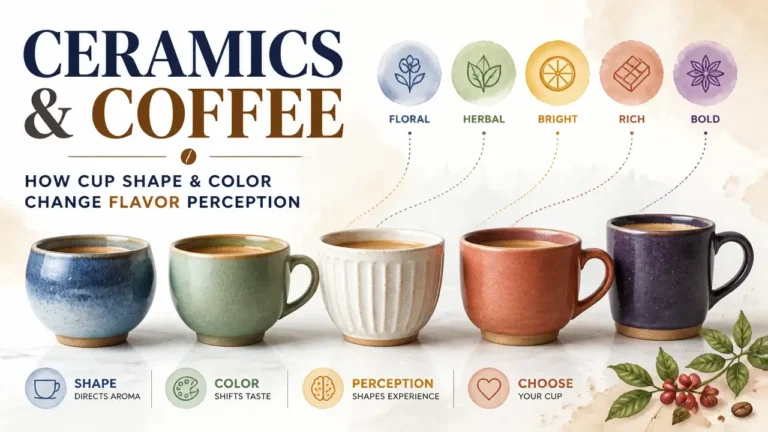

Ceramic coffee cups do more than hold your drink: they negotiate it. Through crossmodal perception, you fuse visual cues, weight, and aroma into a flavor verdict before the liquid ever touches your tongue.
Cup shape controls headspace dynamics, concentrating volatile aromatics or letting them scatter. Cup color shifts sweetness and bitterness expectations before you sip. A white cup makes the same coffee taste sharper; a dark one, heavier. What you think you’re tasting and what the cup is quietly engineering are rarely the same thing.
Beyond daily vessel psychology, professional evaluators rely on Coffee Cupping Defect Detection The protocol to isolate true bean faults from mere sensory illusions.
Your Cup Is Already Talking to Your Brain
Crossmodal perception is your brain’s real-time fusion of sight, smell, touch, and sound into a single, seamless flavour experience, before you’ve swallowed a drop. That’s not a metaphor. It’s the actual mechanism behind why the ceramic coffee cup in your hand shapes what you taste just as much as what’s inside it.
Here’s what makes that hard to accept: the coffee doesn’t change. The liquid sitting in a white cup is chemically identical to the liquid in a dark brown one. But hand the same espresso to a group of tasters in differently coloured cups, and they’ll consistently report it as more bitter in one and fruitier in another. Your brain didn’t passively receive the flavour: it built it, using every signal available, including the colour of the vessel.
This is where most people hit a mental wall. We assume taste happens on the tongue, full stop. But the tongue is actually a minor contributor. Olfaction (your sense of smell) accounts for roughly 80% of what you perceive as flavour. The aroma compounds rising off your coffee are doing the heavy lifting. Which means the geometry of your cup, the shape that either traps or releases that aroma before it reaches your nose, is a direct variable in flavour construction.
Crossmodal Correspondence vs. Learned Preference
The distinction matters here, because it changes everything about how you should think about your vessel choice.
A learned preference is personal and flexible: you associate a favourite mug with Sunday mornings and it feels warmer because of that memory. Crossmodal correspondence is something different: it’s a systematic, involuntary wiring in human neurology that makes certain sensory combinations predictably shift perception across almost everyone, regardless of background or experience.
Round shapes correspond to sweetness. Angular shapes correspond to bitterness. Heavier objects signal substance and duration. These aren’t cultural habits. They’re consistent enough to show up in controlled experiments with strangers who’ve never met.
Dr. Fabiana Carvalho, neuroscientist and lead researcher behind The Coffee Sensorium project at the University of Campinas, Brazil, frames it precisely:
“an anticipatory and constructive process instead of a mere passive and reactive process”
That phrase is doing a lot of work. Your brain isn’t waiting for the coffee to arrive and then judging it. It’s already building a flavour prediction the moment you pick up the cup: using weight, colour, and shape as its raw material. By the time the liquid hits your tongue, the verdict is already half-formed.
How Cup Weight Extends Aftertaste
You already know that a white plate makes food look more vivid. Now consider that a heavier cup can literally stretch how long the aftertaste lingers, and there’s controlled data behind that claim.
In a study presented at the Specialty Coffee Association, researchers added 20 grams of concealed weight to ceramic cups (hidden inside the base so tasters couldn’t see or feel the modification directly, only sense the added heft when lifting). Among 113 participants, both consumers and industry professionals, the weighted cup produced a statistically significant increase in perceived aftertaste duration, approximately 12% longer, even though the coffee was identical in both conditions.
That’s crossmodal priming in action. The sense of “substance” from a heavier vessel directs the brain to dwell on lingering flavour notes. It signals: this thing has weight, this experience has depth, stay with it.
The real-world gap here is significant. A well-made ceramic coffee cup typically runs 300–400 grams. A paper cup sits at 5–10 grams. That weight differential alone (before you account for heat retention, aroma concentration, or surface texture) is already shaping your finish. The ceramic isn’t just a container. It’s an input.

Shape, colour, weight, and texture all feed into this crossmodal network, and each one pulls a different lever. The sections ahead unpack them one by one, starting with the lever that has the most immediate mechanical effect on what reaches your nose: the shape of the cup itself.
How Cup Shape Rewires Aroma, Acidity, and Body
Cup shape isn’t decorating your coffee: it’s actively processing it. The geometry of a ceramic coffee cup controls three physical systems simultaneously: where volatile aroma compounds collect, how fast the liquid surface oxidizes, and which part of your palate receives the first wave of liquid. Change the shape, and you change all three. Same coffee, genuinely different drink.
Let’s work through each system, because once you see the mechanics, you’ll never look at a cup the same way.
Headspace Dynamics and Aroma Concentration
Headspace is the pocket of air sitting between the liquid surface and the rim of the cup. That air isn’t empty: it’s loaded with volatile aromatic compounds evaporating off the coffee. Those volatiles are what your nose detects before you even sip, and they account for the overwhelming majority of what you interpret as “flavor.”
A tulip shape with a narrow opening acts like a funnel for those volatiles. The tapered walls push the rising aroma column inward and upward, concentrating it at the opening. When you bring the cup to your face, you’re essentially inhaling a denser plume. Floral and fruity notes (the high-frequency volatiles in a light-roast Ethiopian or a delicate gesha) are particularly sensitive to this effect. They’re chemically fragile and disperse fast. A narrow headspace gives them less room to escape before they reach you.
A wide-mouthed cup does the opposite. The volatiles spread laterally and dissipate. You’re still smelling the coffee, but you’re catching a thinner slice of its aromatic range.
Surface Area, Oxygen, and Perceived Sweetness
Here’s where a wide opening earns its place. A larger liquid surface exposed to air means faster oxidation, and oxidation isn’t always the enemy. Bitter tannins in coffee are among the first compounds to mellow when exposed to oxygen. As they soften, the perception of sweetness and body moves forward in your sensory experience. The coffee doesn’t get sweeter chemically; it gets less bitter, and your palate reads that gap as sweetness.
This is why a wide U-shaped cup genuinely suits natural-process Brazils or Sumatrans. The oxidation effect works with those coffees’ inherent body and low acidity, rounding them further rather than stripping their character.
A narrow opening preserves the liquid from rapid oxidation. Volatile acids stay sharper and more prominent. Bright, high-altitude washed coffees (the kind where you want that clean citric snap) hold their edge longer in a tapered cup.
Flow Dynamics and Palate Targeting
The rim architecture does something most people never think about: it steers the liquid to specific regions of your tongue.
A narrow rim forces you to tilt your head back to drink. That angle directs the liquid toward the center and back of the palate, where you’re more sensitive to bitterness and body. A flared or wide rim lets you sip with your head level, spreading the liquid across the front and sides of the tongue (the zones most attuned to acidity and sweetness).
This isn’t subtle. You can test it yourself with the same cup of coffee poured into two different vessels. The flared rim cup will taste brighter. The narrow rim cup will taste heavier and more lingering.
Rim thickness adds another layer. A thick rim slows the flow rate and creates a broader contact zone with your lips, which reads as creamier mouthfeel. A thin, straight rim delivers the liquid cleanly and quickly (a sharper, almost tea-like sensation that emphasizes clarity over richness).
Three Shape Profiles Worth Knowing
These aren’t arbitrary categories. Each shape profile creates a specific sensory environment:
- Tulip / tapered: Concentrates headspace volatiles, preserves acidity, slows oxidation. Best match for light-roast Ethiopians, Kenyans, and geshas (any coffee where floral and fruity aromatics are the main event).
- Open / wide U-shape: Accelerates oxidation, softens bitterness, pushes sweetness and body forward. Best match for natural-process Brazils, Sumatrans, and medium-to-dark roasts where richness is the goal.
- Flared / split cup: Vents heat faster, spreads liquid to the sides of the palate, amplifies bright acidity. Best match for high-altitude washed coffees from Central America or East Africa where you want that clean, citric clarity front and center.
| Cup shape profile | Aroma | Acidity | Sweetness | Best coffee pairing |
|---|---|---|---|---|
| Tulip | Strongest / most concentrated aroma; narrower opening traps aromatics and boosts aroma perception | Usually less emphasized than in split cups; better for coffees that are lower in acidity or more grounded | Can make the coffee feel slightly sweeter by concentrating the stream and aroma-driven flavor impression | Lower-acidity, aromatic coffees; e.g., Brazilian or Indian coffees, or espresso-based drinks with rich aromatics |
| Open / wide U-shape | Balanced, more even aroma diffusion; less concentrated than tulip, more dispersed than split | Balanced / neutral; does not strongly push acidity one way or the other | Balanced / neutral; does not strongly heighten sweetness compared with split or tulip | All-round coffees where you want a clear view of balance and structure, rather than accenting one attribute |
| Split / flared | More expressive aroma release; wider mouth allows aromatics to bloom outward | Most accentuated acidity; commonly perceived as brighter and more lifted | Most accentuated sweetness; often perceived as sweeter and more vibrant | Bright, fruity, floral coffees with pronounced acidity and high notes |
Video: Artisan Ceramicist Shaping a Specialty-Coffee Tulip-Profile Cup on the Wheel
The Variable Nobody Mentions
Here’s something the shape guides floating around online consistently miss: none of them differentiate by brew method, and that changes everything.
A tulip cup’s aroma-concentration power is at its peak with espresso. The volatile load per unit of headspace in a two-ounce shot is enormous: the narrow opening captures a genuinely intense aromatic column. Run that same tulip cup with cold brew, and the effect shrinks considerably. Cold brew operates at lower volatility by design; there’s simply less aromatic energy to concentrate.
Similarly, a heavy ceramic cup’s aftertaste-extending effect is most pronounced with a bold dark roast. With a delicate light roast, the thermal mass might actually outlast the coffee’s flavor complexity, leaving you holding warmth without much to taste.
Any “one cup for all coffees” recommendation ignores this entirely. The shape principles above are real, but they interact with what’s in the cup, not just what the cup looks like. Match the vessel to both the coffee and the brew method, and you’re working with the physics instead of against it.

Key Takeaways on Ceramic Coffee Cups
- Your brain builds flavor before you sip, using the cup’s color, weight, and shape as predictive inputs.
- A heavy ceramic cup can extend aftertaste by 12%, but that same weight can mute delicate light roasts.
- Cup shape determines which part of your tongue gets the coffee first, directly shifting perceived acidity or body.
- A white cup doesn’t make coffee sharper—it sets a visual expectation your brain fulfills.
- The ideal cup isn’t universal; it must match the coffee’s roast and brew method.
- Rim thickness silently shapes mouthfeel, with thick rims adding creaminess and thin rims emphasizing clarity.
Frequently Asked Questions About Ceramic Coffee Cups
Q: Why is there no single best cup shape for all coffees?
A: The ideal cup shape depends on roast, brew method, and the flavor profile you want. A narrow tulip cup that intensifies a light roast’s floral notes can make a dark roast feel overly bitter. The match matters more than a universal rule.
Q: What’s the one variable in cup shape that most people ignore but changes everything?
A: Brew method. A tulip cup’s aroma-concentrating effect peaks with espresso’s dense volatiles. For cold brew, which releases far fewer aromatics, the shape’s impact shrinks dramatically—you’re mostly left with the visual cue alone.
Q: When does a ceramic cup’s heat retention hurt the coffee experience?
A: With delicate light roasts, the cup’s thermal mass can outlast the coffee’s flavor complexity. You’re left holding a warm but flat-tasting drink because the desirable notes evaporate before the cup cools.
Q: Does a paper cup actually diminish aftertaste compared to ceramic?
A: Yes. A paper cup weighs a fraction of a ceramic one, so your brain misses the heavy-cup cue that normally extends aftertaste. Without that sensory signal, the finish feels notably shorter and less rich.
Q: Can the color of a ceramic cup trick you into tasting sweetness that isn’t there?
A: Color sets an expectation. A white cup makes the same coffee taste sharper, which can mask perceived sweetness. Conversely, a dark cup adds perceived heaviness, potentially making the body feel sweeter even if the sugar level is unchanged.
Q: Why might a thick-rimmed cup be better for a creamy latte than a thin-rimmed one?
A: A thick rim slows liquid flow and creates a broader contact zone with your lips, reading as creamier mouthfeel. This magnifies a latte’s natural texture, while a thin rim delivers a sharper, almost tea-like sensation that works against the creaminess.
References
- Multisensory Perception of Flavors: Impact of Weight and Color on Coffee Evaluation – Specialty Coffee Association