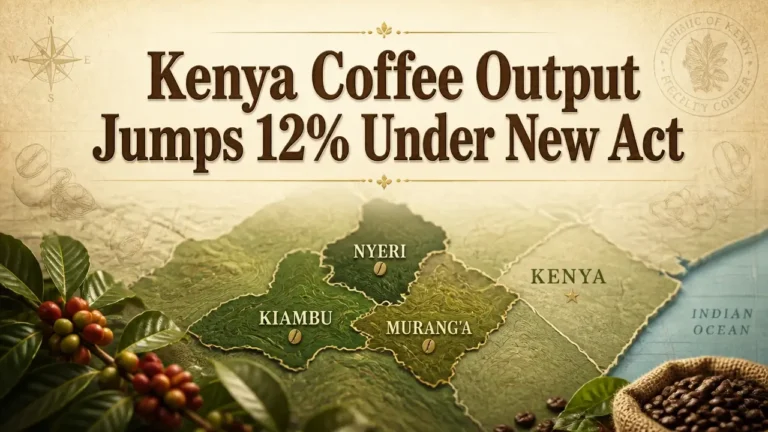

Kenya is entering a new phase in its coffee sector as the country’s revamped regulatory framework lines up with a USDA‑forecast 12% rise in production to 950,000 60‑kg bags in marketing year 2026/27. The forecast, released in late May by the USDA Foreign Agricultural Service and reported by Daily Coffee News, comes weeks after Kenya’s Coffee Act was enacted in March 2026, reshaping how the industry is governed.
According to Daily Coffee News, the USDA FAS outlook sees green coffee production in Kenya rising from an estimated 850,000 bags in 2025/26 to 950,000 bags in 2026/27, while harvested area is expected to increase slightly from 105,000 to 106,000 hectares. The same report notes that exports are projected to reach 940,000 bags in 2026/27, up from an estimated 840,000 bags in 2025/26, with ending stocks forecast at 120,000 bags, 23.7% higher than the previous season and mainly held by cooperative societies.
Recent national data point to a sector already edging upward before the new law took effect. Kenya’s Economic Survey 2026, reported by The Star, put coffee production at 49,500 tonnes in 2023/24 and 51,400 tonnes in 2024/25. Converted to 60‑kilogram bags, that 2024/25 figure is roughly 856,667 bags, broadly in line with the USDA FAS estimate of 850,000 bags for 2025/26 published in an earlier USDA FAS report.
The Coffee Act itself introduces a major institutional shift. As summarised by Daily Coffee News, the law moves regulatory oversight from the Agriculture and Food Authority back to a re‑established Coffee Board of Kenya and creates an independent Coffee Research and Training Institute. The Act also codifies reforms first introduced in 2022, including changes to the Nairobi Coffee Exchange and the implementation of a digital direct settlement system intended to speed payments to farmers.
This latest legislation builds on sector reforms dating to February 2023. In its 2025 report, the USDA FAS noted that the Nairobi Coffee Exchange had been placed under the supervision of the Capital Markets Authority, that brokerage activities were subject to licensing, and that responsibility for licensing coffee millers had been shifted to county governments.
Kenya’s export pipeline has also shown signs of acceleration. Daily Coffee News reported that export volume surged to a record 231,561 bags in January 2026, a spike attributed to retroactive duty‑free access under the United States’ African Growth and Opportunity Act (AGOA) and a one‑off shipment to Sudan. For the 2024/25 season, the same outlet said the United States remained Kenya’s largest export destination with 17.2% of volume, followed by Belgium at 15.5% and Germany at 12.7%.
Price signals have been more mixed. At the Nairobi Coffee Exchange, the average price fell to about $268.77 per 50‑kilogram bag in April 2026, a 28.4% decline from October 2025 levels, according to Daily Coffee News. That followed a period of strong prices highlighted in the 2025 USDA FAS report, which recorded a record high of $363 per 50‑kilogram bag in February 2025 and an April 2025 average of $329 per bag, after an earlier level of $254 in October 2024.
Export prices have moved differently from the auction averages. Citing the Economic Survey 2026, The Star reported that the export price of Kenyan coffee rose 35.9% in 2025 to reach 975 Kenyan shillings per kilogram. In the same period, the USDA FAS observed that the Kenyan shilling’s exchange rate held at about 129 to the US dollar in the first half of 2024/25, limiting exchange‑rate related volatility in farmer receipts.
Kenya’s positioning in the global Arabica market forms the backdrop to these domestic changes. Food Business MEA reported in May 2026 that Kenya exclusively produces Arabica coffee and that global coffee prices were elevated at that time because of supply shortages and weather‑related disruptions in major producing countries. The same article, drawing on USDA FAS data, cited reduced output in Vietnam, Indonesia and Brazil, and listed high production costs, ageing plantations, limited access to credit and climate variability among the challenges facing Kenyan producers.
On the domestic side, Food Business MEA and Daily Coffee News reported that the New Kenya Planters Co‑operative Union has been supplying subsidised seedlings and fertilisers through a revolving fund in key growing regions, while a stagnation in the real estate market has slowed the conversion of coffee farms to housing near Nairobi, Thika, Kiambu and Nyeri. Together with the Coffee Act’s institutional changes and the USDA FAS production and export forecasts, these developments set the parameters for how more Kenyan Arabica could reach international buyers in the 2026/27 season.