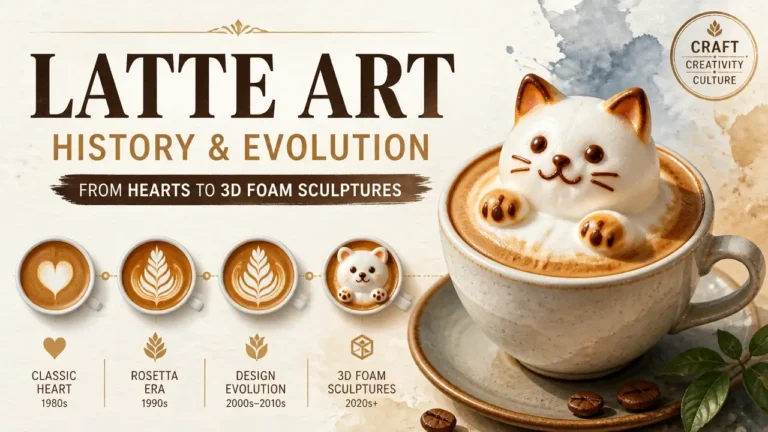

Deliberate latte art traces its roots to 1980s Seattle, where barista David Schomer first perfected the heart pattern in 1989, not as decoration, but as proof of technique. Getting microfoam right meant the milk, the espresso, the pour all aligned. The design was the receipt.
What started as a quality signal inside specialty coffee culture has since exploded into a global craft. Free-pouring gave way to etching, etching gave way to 3D foam sculpture, and Instagram turned a well-pulled shot into a canvas the whole world could judge.
Beyond its aesthetic appeal, understanding how your daily brew impacts wellness is detailed in our overall coffee benefits guide.
Beyond the visual appeal of latte art, the underlying chemistry of the brew determines its distinct aroma and body profile.
Just as brewing techniques have evolved to elevate the craft, understanding high altitude coffee science reveals why beans grown at peak elevations taste so remarkably distinct.
The Machine Age Behind Latte Art
Latte art needed two things before a single drop of milk could form a pattern: a surface that would hold a design, and milk textured fine enough to draw with. Neither existed until a pair of Italian inventors, decades apart, accidentally built the canvas and the brush without ever knowing they were making art supplies.
Before the 20th century, coffee was a dark, opaque liquid. You poured milk in, it mixed, and that was the end of the story. There was nothing on the surface to draw on, no contrast layer, no structure: just brown liquid in a cup.
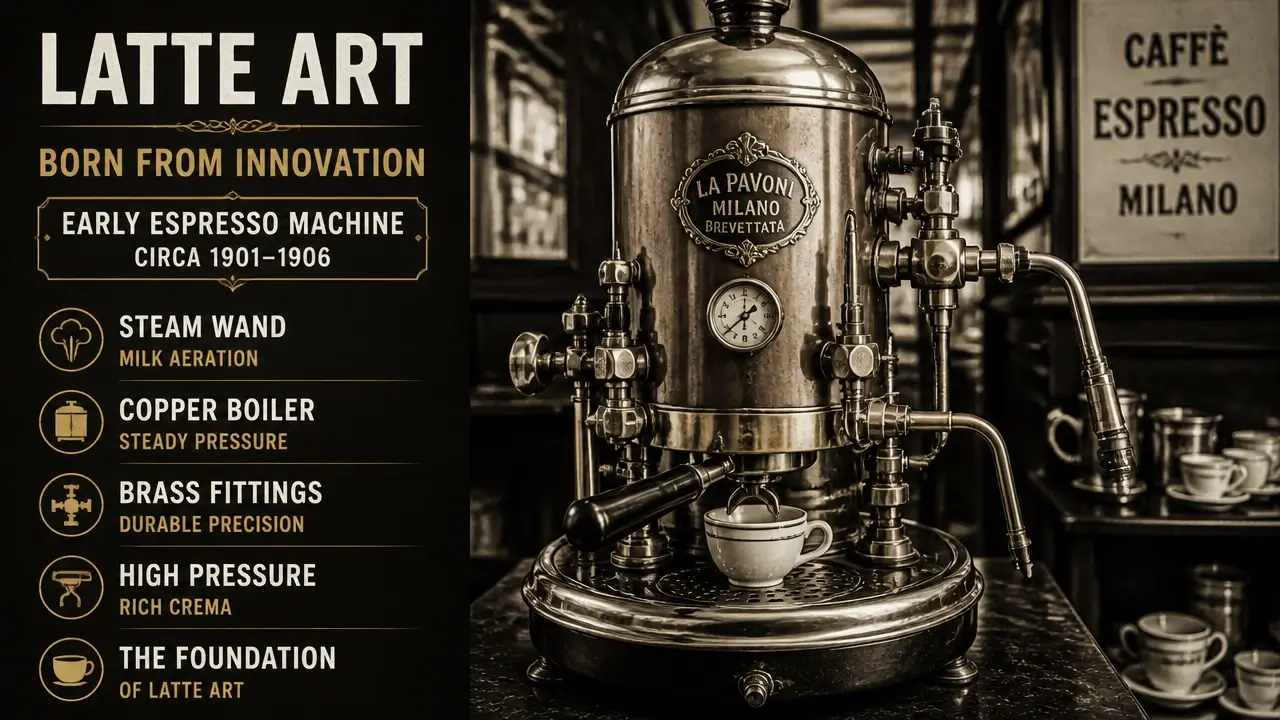
That started to change in 1901, when Luigi Bezzera filed his prototype for a steam-pressure espresso machine. The steam wand attached to that machine could do something no coffee equipment had done before: force steam through milk and heat it simultaneously. Desiderato Pavoni licensed the design and brought the first commercial version to market by 1906. Suddenly, a barista could aerate milk instead of just warming it. The brush existed, but the canvas didn’t yet.
Achille Gaggia’s Crema Layer
The canvas came from Achille Gaggia. In the 1940s, he replaced steam pressure with a spring-piston mechanism that drove hot water through finely ground coffee at dramatically higher pressure (somewhere around 8 to 9 bars). That pressure did something chemically interesting: it emulsified the natural oils in the coffee and suspended them in a stable, reddish-brown foam layer on top of the shot. Gaggia called it caffe crema. By the time his machines reached wide commercial adoption through the 1950s and into the 1960s, that crema layer was a standard feature of a properly pulled espresso.
That layer is the contrast surface. When you pour textured milk onto espresso, the white microfoam sits on top of the crema rather than sinking through it. The crema is dense enough to hold the milk in place long enough to form a shape. Without Gaggia’s spring-piston innovation, there’s no contrast, no surface tension, no pattern: just milk disappearing into dark coffee.
Why 1960s Foam Couldn’t Make Patterns
Here’s where it gets specific. Having a steam wand doesn’t automatically give you workable milk. The cappuccino foam of the 1960s and 1970s was stiff, dry, and full of large bubbles (the kind you could pile into a dome on top of a cup). It looked impressive in a different way, but it was structurally useless for pattern-making. Large bubbles pop, shift, and collapse. You can’t draw a rosetta in shaving cream.
Kelsey Kudak, an SCA 25 Magazine contributor who has documented the official history of the World Barista Championship, captures exactly what that pre-art era looked like:
“En lieu of latte art, milk drinks were etched or piled high with foam, and shots were tamped with anything from steel to plastic to aluminum.”
Piled high with foam. That’s the key concept. The aesthetic goal of that era was volume and height, not surface design. The tools weren’t refined enough, and neither was the technique.
What latte art actually requires is microfoam: milk steamed to a glossy, paint-like consistency where the bubbles are so small they’re invisible to the naked eye. That texture behaves like a liquid even while carrying the structure of a foam. It flows, it holds shape, and it sits on crema without breaking through it. That specific texture wouldn’t become a deliberate target until the specialty coffee movement started pushing steam wand technique in the 1980s.
By then, the hardware was fully in place. Bezzera’s steam wand, Gaggia’s crema, machines refined over six decades of Italian café culture: all of it sitting ready. The canvas and the brush existed. What was missing was someone who looked at a cup of espresso and thought to pick them up.
The Two Baristas Who Built Latte Art
Most coffee histories hand David Schomer a solo trophy and move on. The full record is more interesting, and more honest. Latte art didn’t emerge from one person in one city. It surfaced on two continents simultaneously, through two baristas who had never met, working toward the same idea without knowing the other existed.
Seattle’s Microfoam Laboratory
The story in the Pacific Northwest starts a step before Schomer. In the mid-1980s, Jack Kelly at Uptown Espresso was already experimenting with milk texture, pushing steam wands toward what he called “velvet foam,” a consistency closer to wet paint than the stiff, bubbly froth most cafés were producing. That tactile shift mattered. You can’t draw on shaving cream. You need something that flows, holds shape, and merges cleanly with crema.
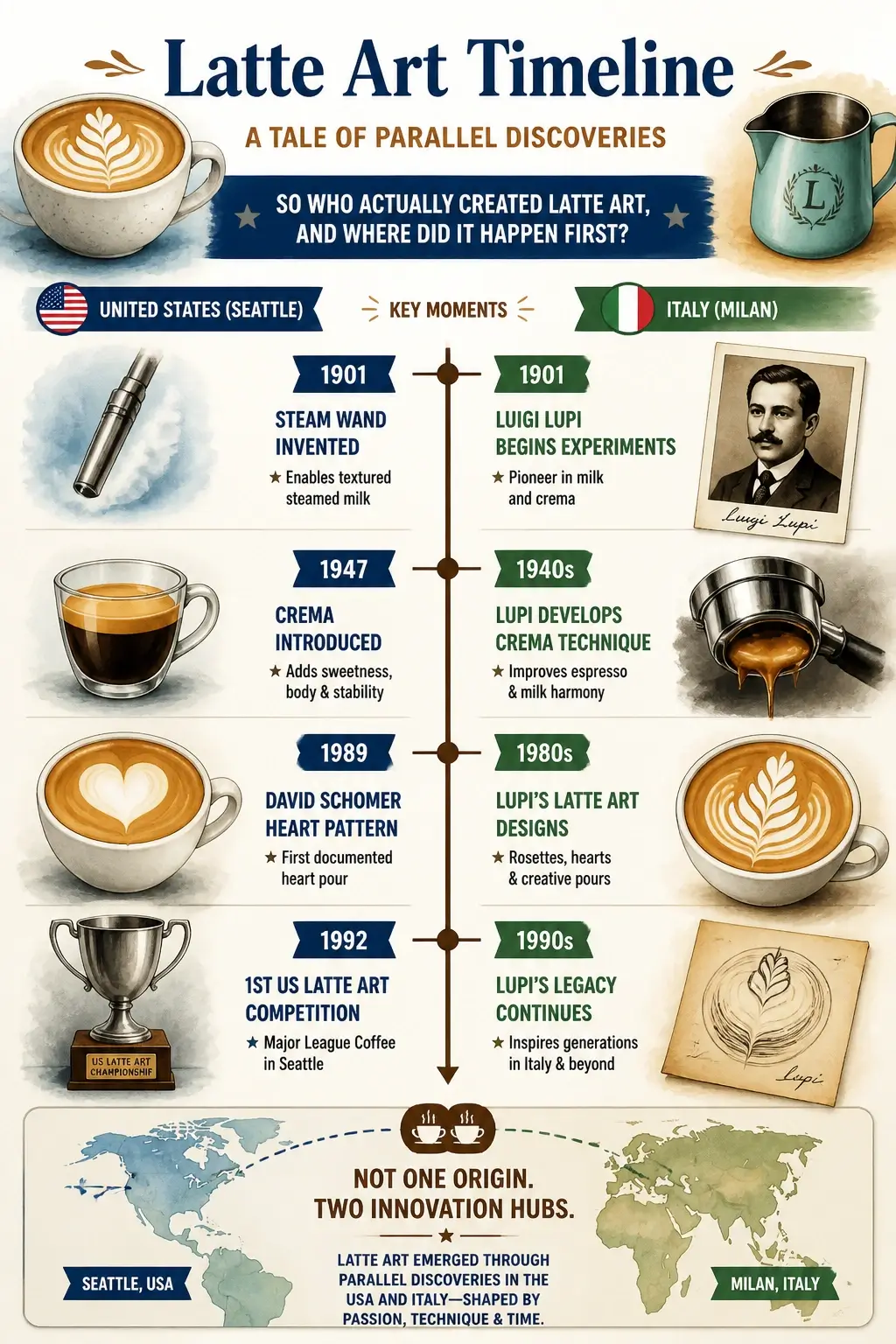
David Schomer at Espresso Vivace took Kelly’s velvet foam concept and turned it into a repeatable system. Where Kelly found the texture, Schomer engineered it, refining the microfoam technique until the results were consistent enough to teach. By 1989, he had standardized the heart pattern: a defined pour sequence that reliably produced the same shape, cup after cup. That’s the difference between a happy accident and a craft.
The rosetta came three years later, and its origin is one of the better details in latte art history. Schomer encountered a blurred photograph (barely legible) from a café called Café Mateki in Northern Italy. The image showed a fern-like pattern in a cup. He couldn’t make out the technique from the photo, so he reverse-engineered it from physics: figuring out what wrist motion and pour angle would produce those layered leaves. By 1992, he had it. He then built a course around everything he’d learned (“Caffe Latte Art”) and later a book, which became the primary vehicle for exporting the technique to baristas who had never seen it done in person.
That same year, 1992, the first documented US latte art competition moved the practice from café counters to judges’ tables, the moment pours stopped being a service gesture and started being a measurable skill.
Verona’s Parallel Discovery
While Schomer was decoding that blurry photograph, something quieter was happening in Verona. Luigi Lupi (barista, sommelier, and eventually a 2002 Italian Barista Champion) was learning from a man named Pietro Merlo at Caffè Musetti. Merlo had developed his own technique for finishing cappuccinos with small shapes in the milk cream. Not elaborate imagery. Just a heart, or a simple tulip. But the intention was deliberate, and the method was teachable.
Luigi Lupi, who would later co-create the Latte Art Grading System (LAGS) and found his own latte art school, describes that encounter directly:
“In 1992, I met Piero Merlo in Verona. This guy had a different technique for making cappuccino: when he poured the milk over the espresso shot, he finished the cup with a tiny design in the middle. It wasn’t a sketch like today, just a little heart or a simple tulip. But he taught me the basis of latte art and, after that, I spent many years perfecting the technique.”
Lupi went deep on the tulip, a pattern that requires a different pour logic than the rosetta, built on stacked pulses rather than a continuous sweep. He also brought latte art into formal competition at the 2002 World Barista Championship, where his fourth-place finish put the technique in front of a global professional audience for the first time at that scale.
The VHS Tapes That Named a Craft
The convergence happened in the late 1990s. Schomer and Lupi found each other, exchanged VHS tapes of their techniques, compared notes across the Atlantic, and in those exchanges, jointly settled on the phrase latte art to describe what they’d both been doing independently for nearly a decade.
That detail matters more than it might seem. The dominant blog narrative treats Schomer as the solitary inventor and the early 2000s as the origin era. Both claims are wrong. The documented milestones, Schomer’s 1989 heart, the 1992 US competition, Lupi and Merlo’s parallel work in Verona, predate the “Instagram era” origin story by a full decade. Latte art didn’t begin when it went viral. It began when two baristas, working independently in different hemispheres, decided that a cup of coffee deserved more than a flat white surface.
The timeline below maps that span, from the first steam wand to the first competition pour.
The heart and the rosetta and the tulip were now documented, named, and competitive. But they were still just patterns made by a pitcher. The next question baristas started asking was: what happens when you put down the pitcher and pick up a tool?
The Physics Behind Heart, Rosetta, and Tulip
Free-pouring sits at the intersection of fluid dynamics and muscle memory: a barista controls flow rate, spout distance, pitcher angle, and placement simultaneously, never once touching the cup’s surface. That’s what separates it from every other decorative technique: the pattern lives or dies entirely in the pour. And those three foundational designs (the heart, rosetta, and tulip) aren’t arbitrary shapes. Each one is a specific mechanical outcome of how microfoam behaves when it meets crema.
Heart, Rosetta, and Tulip: Three Free-Pour Patterns
The heart is where every barista starts, and for good reason: it’s the clearest demonstration of what free-pouring actually does. You tilt the cup toward you, drop the spout close to the surface, and hold the pour in one spot until a white bloom pushes through the crema. Then a single clean draw-through the center splits the circle into two lobes. That’s it. The bloom happens because the microfoam is dense enough to float on the crema layer rather than sink through it. David Schomer is credited with making this the first reliably repeatable design, not because the shape was new, but because he understood why it worked and could teach it.
The rosetta is where the physics gets interesting. Schomer was chasing a fern pattern he’d seen at Café Mateki in Seattle, and the technique he developed to replicate it is what made the rosetta the first design that felt genuinely artistic. You start the pour in the back of the cup, then introduce a side-to-side wiggle motion while slowly pulling the pitcher backward toward the rim. Each wiggle deposits a layer of microfoam that the crema pushes slightly outward, stacking into leaf-like fronds. The final draw-through the center anchors the stem. The pattern only holds if your wiggle is consistent: speed, amplitude, and backward pull all have to stay in sync. Any variation in flow rate mid-pour collapses the symmetry.
The tulip comes from a structurally different logic, associated with Rinze van den Berg and later refined through Luigi Lupi’s experiments in Verona. Instead of continuous motion, you pour in deliberate pulses: drop a blob, pause, drop another blob behind it, let each layer push the previous one forward. The result is a stacked, layered design that reads almost architectural compared to the organic flow of a rosetta. That layering mechanic is also why the tulip became the foundation for competition patterns. Once you understand that you can control where a layer lands by adjusting spout distance and timing, you can start building increasingly complex stacked structures.
Here’s where the standard teaching narrative gets a little oversimplified. Most training resources reduce latte art evaluation to symmetry and contrast, as if those two variables explain everything. In practice, World Latte Art Championship judging is multidimensional: pattern clarity, definition, placement, difficulty, and overall visual impact all carry independent weight. Symmetry matters, but a technically symmetric pour with poor definition or weak placement scores lower than a slightly asymmetric design with exceptional clarity. The flattening of that rubric into “symmetry and contrast” creates a distorted mental model for developing baristas.
Anita Tam, founder of Slow Pour Supply and latte art equipment designer, puts the biomechanics of the pour more precisely than most:
“It should be a straight line from your elbow to the tip of the spout. Your shoulder or elbow joint is more reliable than your wrist. You’re looking for some very consistent movement throughout this very fast process of a liquid exiting the pitcher into the cup through the crema, as well as the velocity of how fast this liquid exits. How stable you are to control the energy of this exit determines how good the latte art pattern is going to be.”
That’s the part most guides skip. The pattern isn’t drawn by the wrist, it’s stabilized by the whole arm. The wrist introduces too many micro-variations. When Tam talks about “the energy of this exit,” she’s describing the kinetic force of the liquid hitting the crema surface. Too much force and the microfoam punches through the crema instead of floating on it. Too little and the foam sinks before it can form a shape. The spout distance controls that energy directly: closer means less velocity at impact, which is why experienced baristas drop the pitcher low for the bloom phase and raise it slightly during draw-through.
Microfoam Dynamics and Crema: The Invisible Physics
None of this works without two things happening correctly before the pour even starts: the milk has to be textured right, and the espresso has to have a healthy crema layer.
When the steam wand hits cold milk, it’s doing two things at once. The heat and pressure denature the whey and casein proteins (essentially unfolding them from their natural coiled structure). Those unfolded proteins stretch around the micro-bubbles introduced by the steam, forming a thin elastic mesh that holds each bubble in suspension. That’s microfoam. Without protein denaturation, you get large unstable bubbles that pop immediately, which is why skim milk and heavily processed milks behave differently: their protein structures are already altered before you start.
The same heat also breaks down lactose into glucose and galactose: simpler sugars that taste noticeably sweeter. This is why properly steamed milk tastes sweeter than cold milk from the same carton. It’s not an additive. It’s a structural change.
The crema is the other half of the equation. That reddish-brown layer sitting on top of your espresso is an emulsion of CO₂ bubbles, water, and bitter oils extracted from the coffee grounds under pressure. It’s denser than plain liquid but less dense than well-textured microfoam, which is exactly what allows the white foam to float on top and create visible contrast. Without a solid crema layer, there’s no dark canvas, and no amount of pouring technique produces a readable pattern.
There’s also a fluid dynamics effect happening at the rim. As the pour progresses, the turbulence of the incoming milk pushes the bitter oils in the crema outward toward the edges of the cup. The center of the drink ends up sweeter and creamier on the first sip, while the final sips carry more of the espresso’s bitter complexity. The pattern you see isn’t just decorative: it’s a map of the flavor gradient you’re about to drink through.
Beyond the Pitcher: The Etching and Color Era
Etching cracked latte art wide open the moment a barista picked up a toothpick instead of a pitcher. Where free pouring is physics (milk folding into espresso at the right speed, angle, and height), etching is pure draftsmanship. You finish the pour, set the pitcher down, and then draw.
The tool is almost comically simple: a barista needle, a wooden stirrer, even the blunt end of a spoon. You drag it through the crema and microfoam surface, pulling dark espresso into light foam and light foam into dark crema. That contrast is your ink. Any line you can trace by hand, you can trace in the cup.
What Etching Tools Actually Do
The physics here are worth understanding because they explain why etching felt so liberating. Free pouring relies on laminar flow: milk subducting under crema in controlled streams. You can coax curves and layers, but you can’t backtrack. Etching has no such constraint. A needle lets you add a pupil to an eye, feather the edge of a wing, or cut a skyline into a flat white surface after the fact. Details that would require a decade of pouring muscle memory to attempt became accessible to any barista willing to practice their line work.
That accessibility mattered enormously. Etching didn’t replace the skill ceiling, it added a second ladder.
Food Coloring and Latte Art Drawing
The color era arrived when baristas realized the foam surface wasn’t just a canvas for contrast: it could hold pigment. Food-grade dyes, chocolate sauce, caramel drizzle, and fruit syrups introduced actual color to latte art drawing. A thin brush or a squeeze bottle became part of the toolkit alongside the needle.
Suddenly the cup could hold a red-and-green holiday wreath, a golden sunflower, a cartoon face with pink cheeks. Baristas were producing character portraits, cityscapes, and seasonal illustrations that had no relationship to the mechanics of espresso extraction: they were just drawings, executed on foam.
The medium was strange and perishable, but that was part of the appeal. You had maybe ten minutes before the surface degraded. Every piece was a limited edition of one.
Barista Competitions and the Spread of Etching
This movement took hold through the late 1990s and into the 2000s, carried by barista competitions and the early online forums that preceded Instagram. Competitors began submitting etched designs alongside (and eventually instead of) purely free-poured work. Forum threads shared photographs across time zones. A barista in Melbourne could see what someone in Tokyo had drawn that morning, iterate on it, and post their version by afternoon.
The competitive circuit became a proving ground for what etching could do. Judges and audiences who had grown up watching free-pour rosettas were suddenly looking at etched owls, skylines, and holiday scenes. The definition of latte art was visibly expanding in real time.
What that expansion meant culturally was significant: etching lowered the barrier without lowering the ceiling. A barista two months into the job couldn’t free-pour a rosetta worth photographing, but they could practice line work on failed pulls and develop a signature etched design. Latte art stopped being the exclusive territory of senior baristas with years of pitcher control and became something the whole floor could participate in.
Rie Moustakis, co-host of the World Coffee Championships Podcast for the Specialty Coffee Association, captures exactly why that distinction still matters to the competition world:
“So that one was a real game changer. He poured animals, including the eyes, without etching. So in the past to make great eyes like that, you usually have to use an etching tool, but he free‑poured everything, a rabbit running through the woods, you know, a fox in the woods, a deer looking backwards in the forest. All free‑poured, including the ears, the antlers, and eyes.”
The reason that performance registered as a game changer is precisely because etching had become the assumed solution for fine detail. Eyes, antlers, individual feathers: those were etching territory. Doing them in a free pour flipped the established grammar of the form. You can only appreciate that inversion if you understand what etching had normalized in the decade before.
The cup was still flat, though. Foam was still a surface. The next question (the one that would push latte art into genuinely strange territory) was whether it had to stay that way.
How 3D Foam Sculpture Reshaped Latte Art
Three-dimensional foam sculpture broke the most fundamental rule latte art had followed since the beginning: that everything happening in the cup was liquid moving through liquid. The moment baristas started stiffening foam to a consistency closer to meringue than milk, they crossed from pouring into building. The cup stopped being a canvas and became a platform.
The technique itself is a clean departure from what we’ve covered so far. Microfoam for pouring needs to flow, it has to be silky enough to move through crema in controlled ribbons. Sculpting foam is the opposite. You whip it until it holds its own shape, stiff enough to pile, pinch, and push with spoons and steam wands. Food coloring brushes add surface detail. The result doesn’t pour into anything. It sits on top of the drink like a tiny figurine placed by hand.
Kazuki Yamamoto’s Viral Foam Characters
The person who put this technique in front of the world was a barista from Osaka named Kazuki Yamamoto, working out of a small shop called Cafe 10g. His cats, bears, and pop-culture characters floating on lattes didn’t stay local for long. Nick Brown, Editor of Daily Coffee News by Roast Magazine, tracked the moment the work broke through:
“A Japanese barista with aspirations to someday open his own coffee bar has been blowing up the Internet in recent days with photos of his 3D latte art. The gamer blog Kotaku first identified Kazuki Yamamoto of Cafe 10g in Osaka last year as the artist behind creations including the following, which have gone completely viral since being picked up by major U.S. media outlets like ABC News and the Huff Post.”
What make Yamamoto’s work land so hard wasn’t just the technical skill, it was the playfulness. A small bear sitting in foam is immediately legible to anyone, anywhere, regardless of whether they know what a rosetta is. The images required no coffee literacy to appreciate, which is exactly why they traveled so fast.
The Asian Scene That Pushed the Boundary
Yamamoto was the most visible name, but he wasn’t working in isolation. By the mid-2000s, Japan, South Korea, and Taiwan had built a hyper-creative café culture that treated the cup as a legitimate medium for experimentation. Baristas in that scene were already pushing past classic shapes: multi-layered animal figures, free-pour work that blurred the line between pour and sculpture, etching techniques layered on top of poured designs. The 3D movement didn’t appear out of nowhere. It was the natural endpoint of a regional scene that had been accelerating for years.
The Drink Becomes a Spectacle
What 3D foam sculpture changed most wasn’t technical, it was social. A poured rosetta is beautiful, but it’s also ephemeral in a way that feels private. You look at it, you appreciate it, you drink it. A foam bear sitting on top of your cappuccino is something else entirely. It demands to be photographed before it’s touched. It turns the transaction between barista and customer into a tiny performance, a moment with a before and after.
That shift (from drink to spectacle) is what the viral social media posts actually captured. The image of Yamamoto’s characters spread because the work was genuinely surprising, but also because it fit perfectly into a format built around shareable moments. The cup became interactive in a way no poured design ever quite managed.
And technically, the skill set required had fundamentally changed. Flow control, the foundational discipline of every pour from the first heart onward, was no longer enough. Sculpting foam required physical fabrication: an understanding of how stiffened milk holds structure under its own weight, how color behaves on a foam surface, how much manipulation the medium can take before it collapses. Latte art had moved from fluid dynamics into something closer to pastry work. The barista’s hands were no longer guiding a pour. They were building something.
Latte Art as Specialty Coffee’s Quality Signal
Latte art has become the unspoken handshake between a skilled barista and a customer who hasn’t tasted a drop yet. A clean, symmetrical rosetta on the surface of your flat white tells you (before your lips touch the rim) that the milk was steamed correctly, the espresso was pulled well, and the person behind the bar has put in the hours. It’s a proxy signal, and it works because the physics don’t lie: sloppy microfoam can’t hold a pattern.
That’s the quiet power sitting inside something that looks purely decorative.
World Latte Art Championship Standards
The competition ecosystem made that signal official. The World Latte Art Championship, along with its national qualifiers, turned what was once a barista’s personal flourish into a scored sport. Competitors are judged on symmetry and contrast, technical consistency across multiple pours, and creative design rounds that push the boundaries of what a pitcher can do. Careers get made on those stages. More importantly, the WLAC gave the global coffee community a shared technical vocabulary: a benchmark that pulled training standards upward across cafés that never sent anyone to compete.
Instagram’s Role in Photogenic Cup Design
Then Instagram arrived, and the dynamic shifted again. Latte art was already beautiful. Now it was shareable. Industry data shows a 4,500% increase in coffee-related posts since 2015, and a meaningful portion of that flood is foam on a cup. Cafés began designing photogenic cup presentations with deliberate intention (the angle, the contrast, the rim-to-pattern ratio) because a single post from the right customer reaches more people than a week of foot traffic. Barista influencers built genuine audiences around their pours, and the line between craft practitioner and content creator quietly dissolved.
Agnieszka Rojewska, 2018 World Barista Champion, four-time Polish Latte Art Champion, and 2018 World Latte Art Championship finalist, put the mechanism plainly:
“It’s a good way to attract customers and build their interest. Before they are ready to learn more about coffee, they keep coming back to take pictures of latte art.”
That’s the gateway function in one sentence. Latte art doesn’t replace the coffee: it opens the door to it. And there’s now peer-reviewed evidence that the signal carries real economic weight: a study published on ResearchGate found that participants consistently offered an 11–13% price premium for identical milk-based coffee drinks when latte art was present, before tasting a single sip. The visual embellishment functions as a perceived quality signal that moves willingness-to-pay, even when the drink underneath is unchanged.
What’s striking is that despite this, no rigorous body of research has measured latte art’s full business impact: skill acquisition time, training ROI, long-term sales uplift. The entire phenomenon still runs on qualitative evidence and practitioner knowledge that lives in cafés, not archives. The economic case is real, but largely unwritten.
How Every Era Coexists Today
None of the eras that came before this moment got replaced. Free-pour classics (the heart, the rosetta, the tulip) still dominate competition floors and daily service counters worldwide because they remain the purest test of milk science and pouring control. Etching and color work live in theme cafés and specialty dessert menus, where the storytelling matters as much as the espresso. Three-dimensional foam sculptures stay a niche showpiece, the kind of thing that stops a room, but nobody’s ordering one with a Monday morning commute.
They coexist because they serve different functions. The free pour is craft. The etching is expression. The sculpture is spectacle. Specialty coffee is big enough now to hold all three.
What the Enthusiast Carries Forward
So when you lift your next latte, here’s what’s actually in your hands. Forty years of engineering decisions about steam pressure and milk fat. A transatlantic rivalry between two cities that both claimed the first rosetta. Decades of baristas pushing a simple pour further than anyone thought it needed to go. A competition circuit that turned a decorative habit into a technical discipline. A social platform that made the whole thing visible to the world.
The history of latte art isn’t hanging in a museum. It’s sitting on your table, cooling slowly, waiting for you to either photograph it or drink it. Both are the right answer.
Key Takeaways on Latte Art
- Latte art wasn’t possible until Gaggia’s crema and microfoam technique converged—the canvas and brush took decades to align.
- The ‘invention’ of latte art was a transatlantic parallel discovery, not a solo act by David Schomer.
- Proper microfoam texture is a balance of denatured proteins and tiny bubbles; it’s science, not just aesthetics.
- Etching expanded latte art by lowering the skill barrier, letting beginners create detailed designs with simple tools.
- 3D foam sculptures turned coffee into a viral performance, but the base drink still requires correct milk steaming.
- Latte art’s value signal is real: studies show customers will pay 11-13% more just for a pattern on their drink.
Frequently Asked Questions About Latte Art
Q: What’s often misunderstood about the invention of latte art?
A: It wasn’t a solo invention. David Schomer in Seattle and Luigi Lupi in Verona independently developed latte art in the late 1980s and early 1990s, both working from earlier techniques. Schomer perfected the heart, Lupi advanced the tulip, but they only connected years later via VHS tapes, coining the term ‘latte art’ together.
Q: What made Pietro Merlo’s contribution to latte art so significant?
A: Piero Merlo taught Luigi Lupi the basis of finishing cappuccinos with small designs—hearts and tulips—in 1992. Though he never sought fame, his technique was the spark that Lupi refined into competition-ready pours and later the Latte Art Grading System, making Merlo a quiet foundational figure.
Q: Why can’t you steam milk a second time?
A: Re-steaming milk degrades its texture and taste. The proteins that form microfoam denature during first steaming; reheating breaks them down further, causing bubbles to collapse and releasing sulfurous notes. The milk also loses sweetness because lactose already converted to simpler sugars gets burnt, resulting in a flat, scorched flavor.
Q: How did the first US latte art competition impact the specialty coffee scene?
A: The 1992 competition moved latte art from a café flourish to a measurable skill with judging criteria. It legitimized pouring as a craft, spurred technique refinement, and created a competitive ladder that eventually led to the World Latte Art Championship, turning baristas into recognized artists and raising global standards.
Q: Do latte art designs change the taste of the drink?
A: Yes, indirectly. The pour pushes bitter crema oils to the rim, making the center sip sweeter and the finish more complex. A well-poured pattern maps a flavor gradient: the white foam integrates microfoam sweetness, while the dark edges retain espresso intensity. So the design subtly structures your tasting experience.
Q: Is symmetry overrated in latte art competitions?
A: Judging criteria go beyond symmetry. The World Latte Art Championship evaluates pattern clarity, definition, placement, difficulty, and visual impact. A perfectly symmetrical pour with weak definition scores lower than a slightly asymmetric one with exceptional crispness. Symmetry matters, but it’s not the ultimate metric.
References
- Calling the Shots: 20 Years of the World Barista Championship – sca.coffee
- What is the Latte Art Grading System? – perfectdailygrind.com
- Slow Pour Supply Unveils the Kimera Tri-Spout Pitcher – dailycoffeenews.com
- Spectacular Latte Art: The Man and the Mystery – dailycoffeenews.com
- Understanding the History of Latte Art – perfectdailygrind.com
- Latte Art Influences both the Expected and Rated Value of Milk-Based Coffee Drinks – researchgate.net
- Paint a Picture (World Coffee Championships Podcast) – sca.coffee