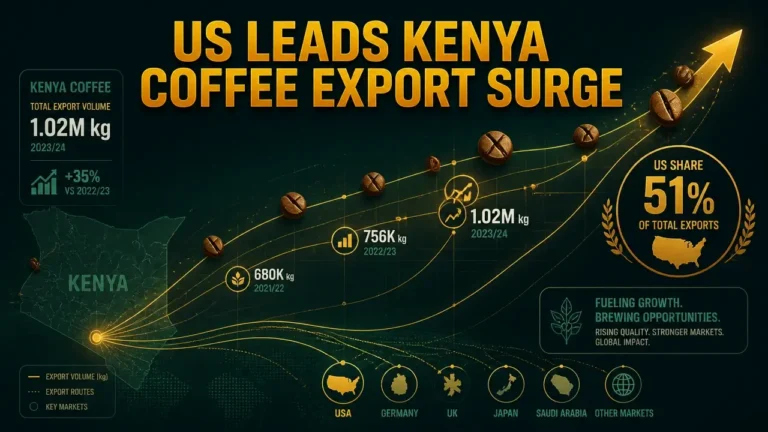
Kenya’s coffee exports are surging into 2026, with the United States taking just over half of the country’s March shipments as international buyers pay sharply higher prices at auction. According to
Kilimo News, Kenya exported
1.02 million kg of coffee in March 2026, underscoring a strong start to the year for one of Africa’s most recognized origins.Kilimo News reports that the United States imported 521,177 kg of Kenyan coffee in March, representing 51 % of that month’s exports. Germany followed with 148,800 kg, or 15 %, while other notable destinations included Japan with 60,060 kg, the United Kingdom with 54,219 kg, Australia with 53,520 kg, China with 48,970 kg, South Korea with 39,000 kg, Somalia with 1,830 kg, and Norway with 13,320 kg.Asian and regional buyers paid some of the highest prices for these volumes. Kilimo News notes that Japan paid an average of USD 522 per 50‑kg bag, South Korea paid USD 651, and Somalia paid USD 735 per 50‑kg bag, the highest overall price reported for March 2026. Germany’s average price was USD 450 per 50‑kg bag, the United Kingdom and China each paid USD 480 per bag, Australia paid USD 403, and Norway paid USD 521.These destination figures sit alongside a broader lift in Kenyan coffee earnings.
Africa Business Intelligence reports that Kenya’s coffee sector generated KSh 24.7 billion (about US$187 million) from exports of more than 540,000 bags, roughly 33.2 million kg, in the first six months of the 2025/2026 season, with an average farm‑gate value of around 45,600 KES per 60‑kg bag. In parallel,
Dawan Africa states that auction sales brought in about KSh 24 billion over the first six months of the current marketing season, with weekly auction turnover averaging between KSh 1.4 billion and KSh 2.5 billion.On the volume side, exports are also rising year on year.
Streamline reports that Kenya shipped 12,500 metric tonnes of coffee in the first quarter of 2026, up from 10,200 tonnes in the same period of 2025. During the last four auction weeks covered by Streamline, the average auction price increased by 22 %, helping to push total farmer payouts through the Direct Settlement System above KSh 15 billion over the previous six months.Activity at the Nairobi Coffee Exchange reflects this robust demand. In Sale 27 on 21 April 2026, the Exchange traded 10,848 bags, equivalent to 670,185 kg, for a total value of USD 3.66 million (about KSh 471 million), according to
Kilimo News. The same report notes that prices at the auction “remained steady,” with an average of USD 272.73 per 50‑kg bag, or roughly USD 5.45 per kilogram, and that lower‑priced Mbuni grades (MH and ML) accounted for about 33 % of the volume in that sale.Longer‑term export data underscores how important key destinations have become for Kenya’s coffee trade. In a 2023 overview,
Deepbeez records that Kenyan coffee export earnings fell to US$259.3 million in 2023, with green coffee beans valued at US$246.4 million. The United States was the top destination that year, importing coffee worth US$58.8 million, and held a 38.88 % share of Kenyan coffee exports by value, ahead of Germany at 23.56 %, Sweden at 15.47 %, the Republic of Korea at 9.09 %, and Belgium at 13 %.Even as earnings fluctuated in 2023, Kenya’s coffee income has been recovering on a seasonal basis. According to
sauce.co.ke, export earnings rose to Sh39.9 billion in the 2023/24 coffee year, up from Sh34.1 billion in the previous season, with 49.5 million kg shipped to more than 60 countries and Belgium and the United States listed as the top destinations by volume and value.Regulatory changes in Europe are also shaping how some of this coffee moves.
Food Business MEA reports that Kenya exported its first shipment of coffee compliant with the European Union Deforestation Regulation (EUDR) to Poland: 320 bags of 60 kg each, sourced from 13 cooperatives and coordinated by the New Kenya Planters Cooperative Union. In that report, NKPCU managing director Timothy Mirugi states that the shipment “reflects our alignment with international sustainability standards, particularly in the context of climate action and responsible trade.”Alongside shifting regulations, several structural and macroeconomic forces are influencing Kenya’s coffee earnings. Africa Business Intelligence cites currency fluctuations, including a weakening Kenyan shilling against the euro, as affecting export revenues, while Streamline notes that climate variability, such as weather conditions in Brazil, is influencing price premiums for Kenyan coffee. Africa Business Intelligence also points to longstanding challenges, including aging plantations and farmer attrition, as factors that have historically limited output even as recent export values have risen.

 By | May 23, 2026