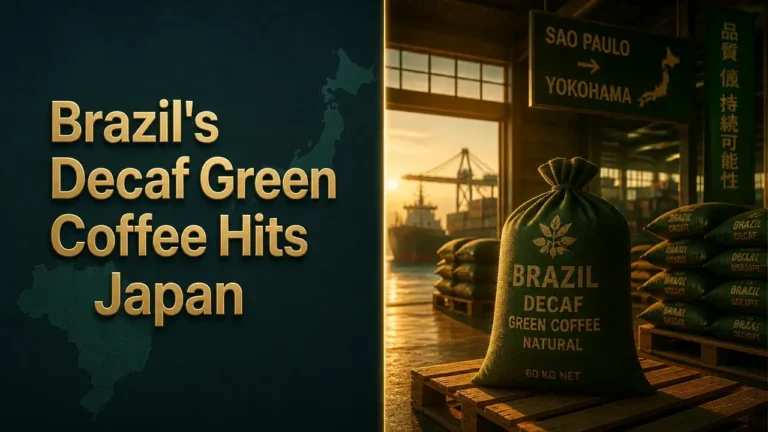

A Brazilian coffee cooperative has quietly opened a new niche in the country’s export portfolio, sending a record but modest shipment of naturally decaffeinated specialty green coffee to Japan at the end of April 2026. According to MarketScreener (Reuters), Expocacer, based in Patrocínio in the Cerrado Mineiro region, exported 8.4 metric tons, or 140 bags of 60 kilograms each.
Notícias Agrícolas (Reuters) reports that this type of naturally decaffeinated specialty green coffee is “practically unknown” in Brazil’s export mix, despite the country’s role as the world’s largest Arabica producer and second-largest Canephora producer, exporting tens of millions of 60-kilogram sacks annually. In 2025, Brazil shipped just 832 kilograms of green decaffeinated coffee, according to the same source, underscoring how unusual this new export is.
The decaffeination process used for the Expocacer lot relies on water and soluble solids extracted from the beans, without added chemicals, MarketScreener (Reuters) notes. The coffee was exported still in green form, to be roasted in Japan, marking a departure from Brazil’s typical focus on conventional green or fully processed decaffeinated coffees.
Commercial director Italo Henrique said the operation is less about immediate volume and more about building a foothold. “A exportação das 140 sacas de café especial ‘decaf’, produzido e naturalmente descafeinado no Brasil, para o Japão, neste primeiro momento, é mais voltada à construção de mercado do que focada em escala imediata,” Henrique stated in comments reported by Notícias Agrícolas (Reuters).
Henrique added that such initiatives normally start with smaller, tightly managed consignments. “Esse movimento normalmente começa com embarques mais controlados, voltados à validação comercial, ao alinhamento de perfil e à consolidação da relação com o cliente, em meio a uma tendência de consumo com público crescente,” he said, describing the shipment as part of a broader consumption trend.
Expocacer’s recent performance in the international arena provides some context for this test of naturally decaffeinated green coffee. The cooperative exports coffee to more than 35 countries, including France, Belgium, Japan, Italy, the United Kingdom, Spain, South Korea and the United States, according to Notícias Agrícolas (Reuters). In 2024, it sold over 550,000 60-kilogram bags abroad, a year-on-year increase of 41 percent, with turnover of about 840 million reais (approximately US$139 million), Global Coffee Report said.
Global Coffee Report also quoted Expocacer chief executive officer Simão Pedro de Lima as saying that “the growth in the number of conscious consumers has been one of the main factors behind the increase in our exports.” In an earlier interview with Revista Caféicultura, commercial director Ítalo Henrique highlighted the cooperative’s focus on quality, saying, “Na Expocacer trabalhamos continuamente para oferecer cafés de alta qualidade, o que é resultado do empenho e dedicação de nossos produtores.”
Beyond the new decaf shipment, Expocacer has been expanding its international infrastructure. Global Coffee Report notes that in 2024 the cooperative grew its commercial representation in South Korea and the United Kingdom and established a logistics hub in the United States to strengthen its competitiveness in export markets.
MarketScreener (Reuters) reports that Expocacer aims to use the April shipment to build market opportunities for Brazilian coffee in Japan through further “market-building” consignments rather than an immediate focus on scale.