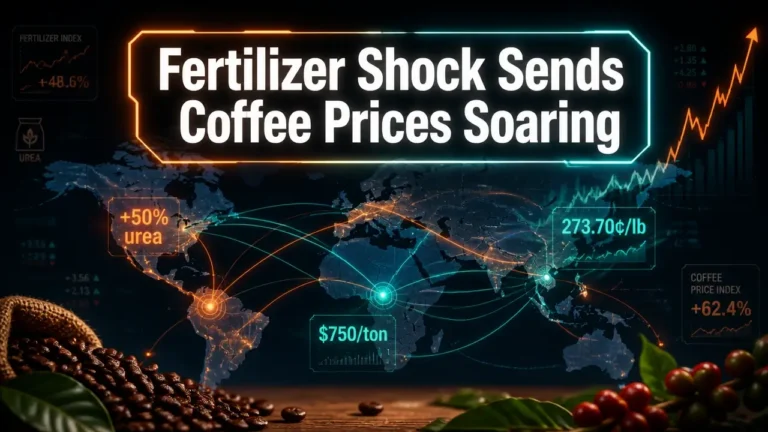

Coffee producers across major origins are facing a sharp rise in fertilizer and energy costs after the U.S. and Israel launched strikes on Iran on 28 February 2026 and the Strait of Hormuz closed, a disruption that institutions say is already feeding through into higher global coffee prices.
The International Coffee Organization (ICO) reported that its Composite Indicator Price averaged 273.70 cents per pound in March 2026, up 2.3% from February, and attributed the increase to the conflict in the Middle East despite what it described as improved production prospects. Separately, Barchart said coffee prices were “sharply higher” as traders priced in supply risk from the Iran–U.S. conflict.
Behind those market moves, fertilizer costs have surged in regions that supply much of the world’s coffee. In Colombia, imported urea prices used by coffee growers rose from $414 per ton before the war to $750 per ton, according to Daily Coffee News, which also reported that fertilizer typically represents 18–20% of the cost of producing parchment coffee. For many Colombian farms, that makes fertilizer one of the single largest line items in their budgets.
Brazil, the world’s largest coffee producer, is heavily exposed to the fertilizer shock. The Rio Times reported that Brazil imports roughly 85% of its fertilizer supply, with 41% of its urea transiting the Strait of Hormuz. The Center for Advanced Studies on Applied Economics (CEPEA) figures cited by Daily Coffee News show that of the 7.7 million tons of urea Brazil imported in 2025, 33% originated in the Middle East, underlining the country’s dependence on disrupted routes.
Prices for key nitrogen products have jumped worldwide since the war began. CNBC reported that urea and ammonia prices had risen by roughly 50% and 20%, respectively, and that free-on-board granular urea in Egypt climbed to about $700 per ton, up from $400–$490 before the conflict. In the United States, an analysis from Farmdocdaily found that fertilizer costs in central Illinois had increased by more than $20 per acre since the conflict began, with anhydrous ammonia moving from $828 per ton before the conflict to $1,123 per ton by 17 April 2026.
The World Bank said in its April 2026 Commodity Markets Outlook that fertilizer prices are expected to rise by 31% in 2026, driven by a forecast 60% jump in urea prices [UNVERIFIED]. The same report projected energy prices to increase by 24% and overall commodity prices by 16% in 2026 [UNVERIFIED], linking these trends to disruptions around the Strait of Hormuz.
Producers and farm groups are warning about the strain on their members. In Brazil, Bruno Lucchi, technical director of the Brazilian Agriculture Confederation (CNA), described the situation as a “delicate” scenario for Brazilian farmers and told reporters that “this is a much bigger crisis than the one we faced before” during the early stages of the Russia–Ukraine war, according to Valor International. Daily Coffee News reported that agricultural leaders have warned rising fertilizer costs could erode farmer incomes and threaten future yields.
The shock is also affecting fuel costs in Brazil, another key input for coffee production and transport. Valor International reported that diesel prices in the country rose from around 1 real per liter to 2 reals per liter following the escalation of the conflict, compounding the impact of fertilizer price increases on farm operating costs.
Signs of stress are visible in Europe and North America as well. Farmdocdaily reported that only about 30% of estimated fertilizer volumes for the 2026/27 crop had been purchased so far, compared with a historical average of around 40%, and it linked this shortfall to higher prices and uncertainty following the Iran conflict. CNBC similarly noted that fertilizer futures markets had become less liquid amid price spikes and reported that 54 agricultural groups wrote to U.S. President Donald Trump calling for “much-needed market relief for America’s farmers.”
Despite these pressures, analysts cited by Barchart still expect a record Brazilian coffee crop for 2026/27, with Marex projecting 75.9 million bags and StoneX forecasting 75.3 million bags. At the same time, Barchart reported that world coffee exports for the October–September marketing year fell 0.3% year-on-year to 138.658 million bags.
Daily Coffee News reported that many sector analysts consider the current 2025/26 coffee crop unlikely to be significantly affected by the fertilizer shock, while warning that the 2026/27 crop faces greater risk if disruptions to fertilizer supply and prices persist.