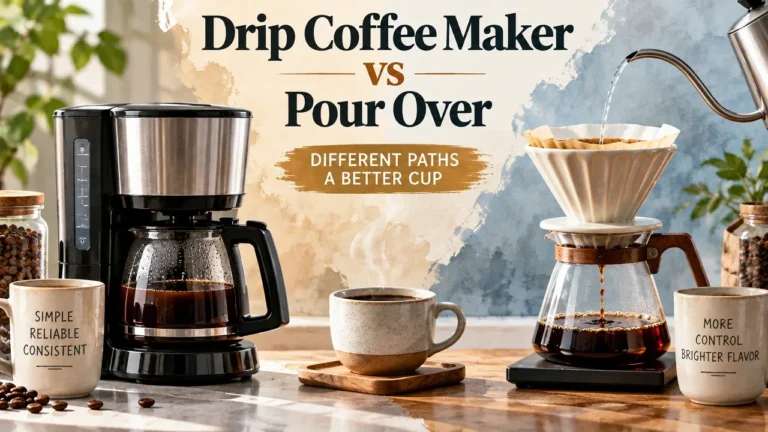

The drip coffee maker vs pour over debate has been running long enough to calcify into clichés – “drip is convenient,” “pour over is precise,” end of story. Neither label tells you what actually happens inside the brew bed, why a $20 drip machine and a $200 Moccamaster are not the same comparison, or why a poorly executed V60 will lose to a well-dialed SCA-certified drip every single time.
What settles this comparison isn’t brand loyalty or brewing aesthetics. It’s water temperature stability, dispersion geometry, bloom control, hygiene burden, and whether your morning routine can absorb the difference. Once you understand those levers, the right choice becomes obvious.
Key Takeaways on Drip Coffee Maker vs Pour Over
- Equipment quality within each method matters more than the method label – a budget drip machine and an SCA-certified one are not the same comparison.
- Temperature stability between 195–205°F is the single most important mechanical variable; budget drip machines routinely miss this window.
- Pour over delivers higher flavor clarity and extraction control; drip delivers volume, hands-off convenience, and consistent repeatability at the right machine tier.
- Active hot plates degrade coffee into bitter quinic acid within 15–20 minutes; a thermal carafe is non-negotiable for drip if you don’t drink the whole pot immediately.
- Drip machine reservoirs can harbor biofilm and scale in inaccessible internal water tubes – monthly descaling is maintenance, not optional.
- Hybrid use – drip for weekday volume, pour over for weekend special beans – is the highest-value practical answer for most households.
What Actually Matters When Comparing These Two Methods
Most people walk into this comparison asking the wrong question. “Which one makes better coffee?” is not a useful question until you define what better means for your specific situation – your household size, your beans, your tolerance for morning effort, and your willingness to clean internal water tubes.
“Drip coffee is a little less precise. Not to say this coffee is bad in any way, it just won’t give you a layered, perfectly extracted coffee like a pour-over. Drip coffee is brewed without precision, allowing for more variables, and sometimes that leads to an average cup.” – Shonali Paul, Founder of Paul John Caffeine, via Real Simple
That observation is accurate – but it applies to the method category, not to every machine within it. The practical scoring rubric for this comparison should cover: flavor potential, temperature stability, saturation and bloom control, extraction consistency, hygiene burden, batch capacity, time and effort, durability, skill required, and total cost. Strip those down and you have the actual decision criteria.
Drip coffee makers are automated batch percolation systems. You load the basket, press a button, and the machine heats water and delivers it to the grounds through a showerhead or spout. Pour over is manual flow-control brewing – a dripper (V60, Chemex, Kalita Wave), a paper or metal filter, a gooseneck kettle, and your hands doing the work.
When keeping your batch brew hot without sacrificing taste, choosing between thermal carafe and glass carafe options becomes just as important as the brewing method itself.
Because internal water tubes can harbor mineral buildup, performing regular maintenance for drip coffee makers is essential to protect both your machine’s longevity and your coffee’s flavor.
The method label matters less than equipment quality. A well-executed drip brew from an SCA-certified machine can match or exceed a careless pour over. Conversely, a $20 drip machine that peaks at 175°F will under-extract regardless of how good your beans are. SCA certification confirms that a machine was tested against temperature and bloom standards – but it’s a floor, not a guarantee, and manufacturer-funded testing creates a real conflict-of-interest worth keeping in mind. Treat it as one input, not a verdict.
Internal hygiene deserves a place in this rubric from the start, not as an afterthought. It affects how the machine performs over months of ownership, and it’s one of the starkest differences between the two methods.
Head-to-Head Mechanics: Temperature, Saturation, and Extraction
Machine Architecture and Thermal Stability
The mechanical gap between these two methods starts at the heating element. Optimal brewing temperature sits between 195–205°F (90–96°C). Budget drip machines routinely miss this window – some peak at 175°F, leaving sugars and acids under-extracted and producing a thin, grassy cup; others overshoot at 210°F and scorch the grounds. A gooseneck kettle with a built-in thermometer or PID controller gives the pour over brewer exact temperature input at every pour.
This is where the “drip is consistent” claim needs a qualifier: it’s consistent within machine tier. A premium or SCA-approved drip machine holds temperature reliably because it’s engineered to do so. A generic $20 machine is consistent only in the sense that it will consistently miss the window.
A peer-reviewed immersion brewing study published in Scientific Reports found that brew temperature strongly affects the rate of extraction – hotter water reaches equilibrium TDS faster – but does not appreciably change the final equilibrium extraction yield across the 80–99°C range tested. Equilibrium extraction yield for full immersion brews landed around 21%, and adjustments to temperature, grind size, or brew ratio didn’t meaningfully shift that ceiling. What temperature stability actually controls is how quickly and how evenly the grounds extract, not a hard ceiling on yield. This matters because drip machines that fluctuate mid-brew don’t just slow extraction – they create uneven extraction across the bed.
Dispersion Patterns and Degassing Dynamics
Even if temperature is dialed in, water has to reach the grounds evenly. This is where showerhead design separates machines from each other and from manual brewing.
A narrow single-stream spout – common on budget drip machines – dumps water in one spot, leaving dry pockets at the edges of the basket. Wide-dispersion showerheads, found on better machines, spread water more uniformly. Manual pour over replaces the showerhead entirely with a controlled spiral pour from a gooseneck kettle, which lets the brewer saturate the entire bed deliberately.
The bloom phase compounds this difference. Freshly roasted coffee releases CO₂ when it contacts hot water, and that gas physically blocks water from penetrating the grounds if it isn’t vented first. A proper bloom – 30–45 seconds of pre-wetting with roughly twice the coffee weight in water – lets the slurry swell and degas before full extraction begins. Pour over makes this trivially easy; you pour, you wait, you watch the crust rise. Many drip machines either skip the bloom entirely or offer a limited pulse-wet that doesn’t fully saturate the bed. Even the Moccamaster, widely respected in the specialty coffee world, has attracted criticism for its showerhead coverage pattern. The machine’s thermal performance is excellent; its dispersion geometry is a known compromise.
Here’s a useful breakdown of how drip machines actually perform at each of these stages:
Flow Agitation and Yield Measurement
Manual pouring doesn’t just distribute water – it agitates the slurry. The velocity of water from a gooseneck kettle creates turbulence in the brew bed, which keeps grounds moving and prevents channeling. Channeling is what happens when water finds a preferential path through the bed and flows through it repeatedly while bypassing other grounds entirely, producing a cup that’s simultaneously over- and under-extracted in different zones.
In a drip basket, water pools passively after the showerhead delivers it. Gravity pulls it through, but there’s minimal agitation. The result is often uneven extraction – darker, more extracted grounds near the water entry point and lighter grounds at the basket walls.
TDS (Total Dissolved Solids) is the measurable outcome of all these variables. The SCA’s target for a balanced brew sits between 1.15–1.35% TDS, corresponding to an extraction yield of 18–22%. Pour over, executed with consistent technique, tends to land in this window reliably. Drip machines hit it too – when the temperature, dispersion, and contact time are all aligned. When they’re not, the cup tells you.
Flavor Clarity, Mouthfeel, and What Happens After the Brew
The mechanics above translate directly into what ends up in your cup. Pour over produces a clean, high-clarity cup with vibrant acidity and pronounced floral or fruit notes – especially with light roasts – because the paper filter strips most oils and fine particles, and the controlled extraction highlights individual flavor compounds. Drip coffee tends toward a heavier, more uniform body. It’s not muted in a pejorative sense; it’s a different sensory profile that many people prefer, especially with medium and dark roasts where body and sweetness dominate over acidity.
Mouthfeel tracks directly with TDS and filter type. A metal filter in pour over lets more oils through, pushing mouthfeel closer to French press territory. A paper filter in drip produces a cleaner result, though still heavier than a V60 pour because the bed geometry and extraction dynamics differ.
What neither method can fix is what happens after the brew. A drip machine with an active hot plate starts degrading coffee within 15–20 minutes of brewing. The heat drives a reaction that converts chlorogenic acids into quinic acid – the compound responsible for the harsh, bitter aftertaste of gas-station coffee. A thermal carafe avoids this entirely by holding temperature without active heating.
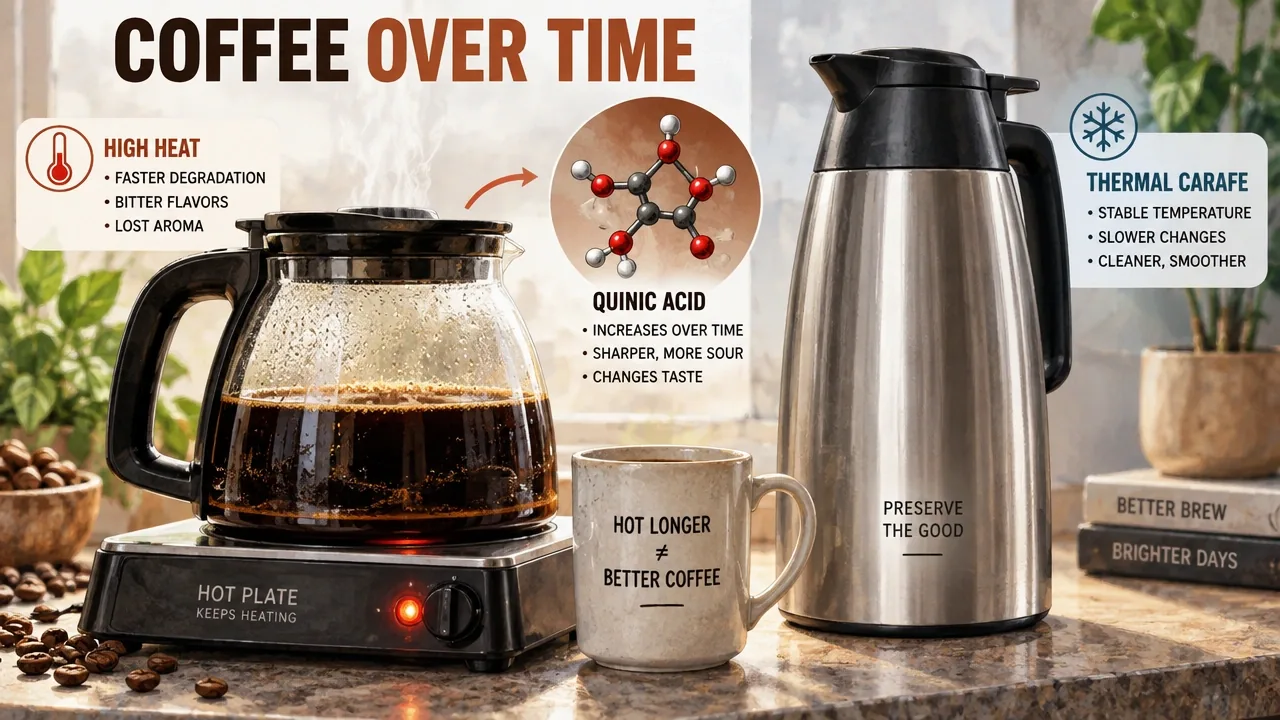
Pour over has no hot plate to worry about – but it also has no carafe unless you brew directly into one. Brew into a glass server, and the coffee cools within 20 minutes. Brew into a thermal carafe, and you’re in the same position as a well-equipped drip machine.
The honest caveat here: flavor is not guaranteed by method. Grind consistency, water quality, and repeatable technique mediate the result in both directions. A burr grinder and filtered water will do more for your cup than switching methods.
Hygiene, Mold, and What You’re Actually Maintaining
Reservoir Contamination and Biofilm Risk
This is the comparison axis that almost every blog skips, and it’s one of the most consequential for long-term ownership. Drip machine reservoirs are warm, dark, and intermittently wet – ideal conditions for biofilm formation. An NSF International study found that 50% of coffee machine reservoirs tested positive for yeast or mold. The water tube that runs from the reservoir to the heating element is essentially inaccessible for manual cleaning, which means descaling with a vinegar or citric acid solution is not optional maintenance – it’s the only maintenance available.
Scale buildup compounds the problem. Mineral deposits from hard water narrow the water tube over time, reduce flow rate, and insulate the heating element, which directly degrades temperature stability. A machine that used to hit 200°F starts hitting 185°F a year later – and you may not notice until the cup quality has already declined.
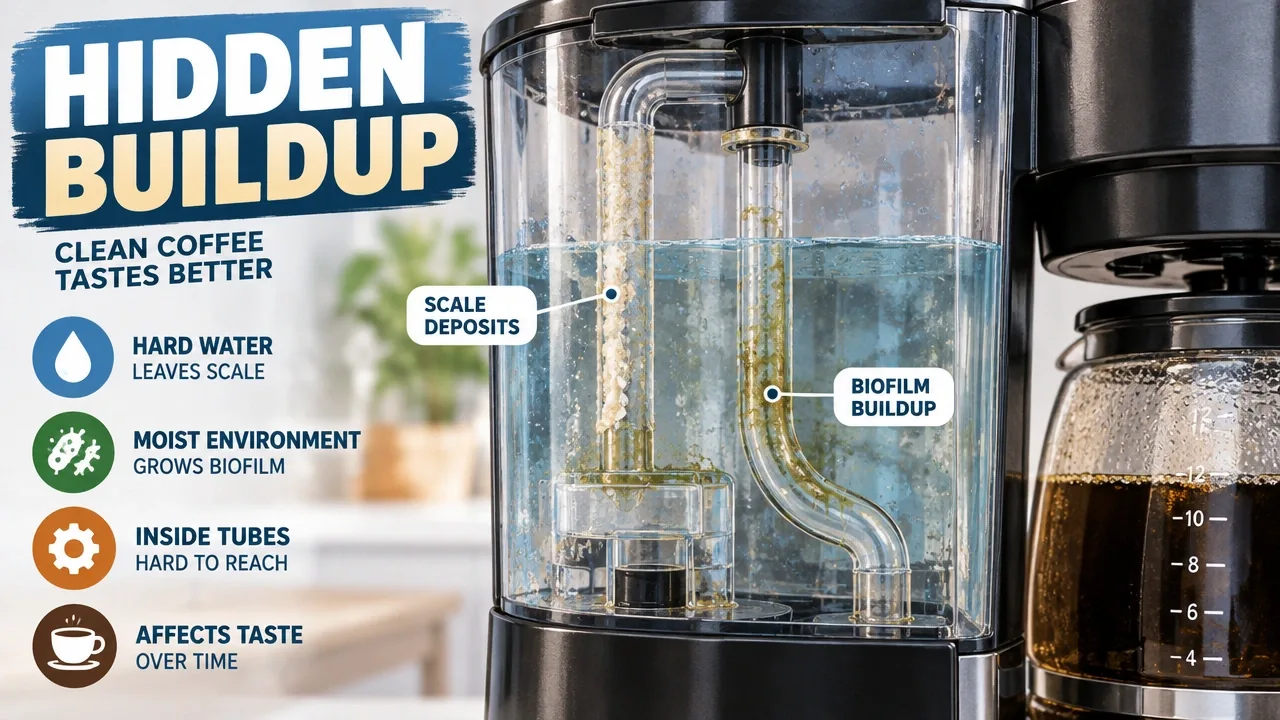
Pour over drippers – ceramic, glass, or stainless – are a different category entirely. They’re open, smooth, and rinse clean in seconds. There are no internal water tubes, no reservoirs, and no inaccessible surfaces. The filter handles the grounds and gets discarded. The dripper itself is essentially sterile after a hot rinse. The only real hygiene failure mode in pour over is leaving a wet filter in the dripper for hours, which can transfer off-flavors to the next brew.
Routine Maintenance and Product Lifespan
The daily maintenance burden for pour over is minimal: rinse the dripper, discard the filter, done. Periodically, give it a soap wash. A ceramic or glass dripper will outlast most drip machines by a decade if you don’t drop it.
Drip machines require a different cadence. Daily cleaning of the carafe and basket is straightforward. Monthly descaling is where most people fall behind, and skipping it shortens the machine’s effective life and degrades cup quality simultaneously. Plastic components in contact with hot water also raise a long-term concern – both for flavor (plastic can leach into hot water over time) and for durability (seals and fittings degrade). A high-quality machine with stainless internals mitigates this; a budget machine with an all-plastic water path does not.
Pour over can clog – particularly with very fine grinds or oily dark roasts that saturate a paper filter – but this is a technique problem, not a hardware failure. Drip machines, by contrast, eventually fail as hardware: heating elements burn out, pumps clog, and the machine becomes a recycling problem rather than a repair project.
The Real Trade-Offs: Convenience, Batch Size, Cost, and Your Morning
Household Volume and Hands-Off Timing
Batch capacity is the most straightforward dimension in this comparison. Drip machines brew 4–12 cups in 10–13 minutes with minimal active involvement – load the basket, press start, walk away. Pour over produces 1–2 cups per brew in roughly 3–4 minutes of active pouring, plus 5 minutes of kettle heat time. If you’re brewing for a family of four before 7 a.m., pour over is not a realistic daily driver.
The comparison shifts for a single-person household or a couple who drink one cup each in the morning. At that volume, pour over is faster to set up and clean than pulling out a 10-cup drip machine, running it half-full, and then descaling monthly.
Here’s how those practical specs stack up side by side:
For households requiring maximum volume without sacrificing body, exploring alternative full-immersion methods is often worthwhile, as detailed in The Ultimate Guide to 12 cup brewing systems.
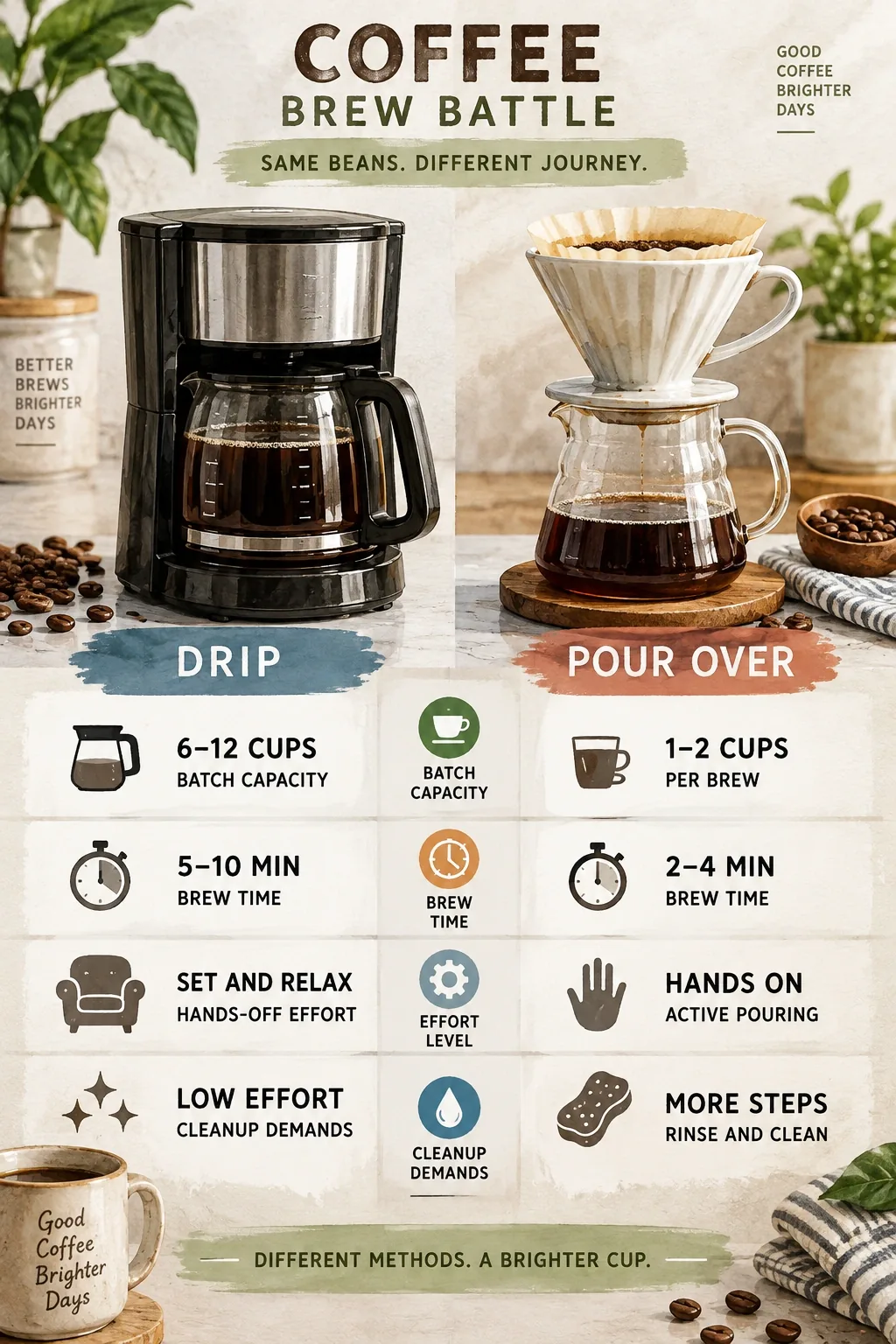
| Dimension | Drip Coffee Maker | Pour Over |
|---|---|---|
| Batch capacity | 4–12 cups | 1–2 cups per brew |
| Active brew time | 10–13 min (hands-off) | 3–4 min active + ~5 min heat |
| Equipment count | 2 (machine + filter) | 4 (dripper, filter, kettle, scale) |
| Entry cost | $25–$325+ | $15–$60 dripper + $40–$180 kettle |
| Daily cleaning | Basket + carafe rinse | 30-second dripper rinse |
| Periodic maintenance | Monthly descaling | Occasional soap wash |
| Durability | 3–7 years typical | Indefinite (ceramic/glass) |
Setup Complexity and Financial Outlay
Pour over has a reputation for being cheap to start – and the dripper itself often is. A Hario V60 costs around $15–$25. The gooseneck kettle is where the budget climbs: a basic model runs $40–$60, and a variable-temperature kettle with a PID controller runs $80–$180. Add a burr grinder (which matters for both methods but is more immediately apparent in pour over’s flavor output) and a scale, and you’re at $150–$300 before buying a single bag of coffee.
Drip machine costs scale with tier. A budget machine runs $25–$50 and will likely fail on temperature. SCA-certified machines – which have passed independent testing for temperature, bloom cycle, and extraction time – start around $150 and run up to $325 for the Moccamaster, which has sold over 10 million units globally. At that price point, you’re buying proven thermal engineering. The Hamilton Beach Brewstation, often rated 8.5–9 out of 10 in consumer value rankings, sits well below the SCA threshold but outperforms its price class.
The honest cost framing: both methods can be done well for under $200 total if you’re selective. Both can be done poorly for under $50. Equipment tier is the controlling variable, not method category.
Operator Skill and Workflow Fit
Drip is low-skill and repeatable by design. Once you’ve dialed in your grind and ratio, the machine reproduces the result. That’s genuinely valuable if your morning routine involves being half-asleep, managing children, or multitasking through a work call. The machine doesn’t need your attention.
Pour over rewards technique – and punishes its absence. Inconsistent pour rate, wrong water temperature, uneven spiral, skipping the bloom: each variable shifts the cup. For someone who finds that process meditative and satisfying, it’s a feature. For someone who wants coffee to be invisible infrastructure in the morning, it’s a friction point they’ll eventually resent.
The highest-value framing for most households isn’t “which method should I commit to” – it’s hybrid use. Drip for daily volume on weekday mornings; pour over for weekend brewing with a special bag of beans you actually want to taste. Many serious coffee drinkers run both without conflict.
Per-Persona Verdict: Who Should Buy Which
Neither method is inherently superior. That’s not a hedge – it’s the most accurate statement the mechanics support. A well-dialed SCA-certified drip machine can rival a competent pour over on cup quality. A sloppy pour over with stale beans and tap water will lose to almost anything. The decision is about matching method to situation.
Here’s how that breaks down by persona:
High-volume household (4+ people, daily brewing): Drip is the right tool. At this scale, pour over isn’t a method – it’s a second job. Invest in an SCA-certified machine with a thermal carafe (not a hot plate) and a quality burr grinder. The Moccamaster or OXO Brew 9-Cup are the honest recommendations at this tier.
Affiliate Disclosure
This post contains affiliate links, meaning I may earn a commission if you make a purchase through these links, at no additional cost to you. As an Amazon Associate, I earn from qualifying purchases. I only recommend products I genuinely believe will add value.

Technivorm Moccamaster 53923 KBGV Select 10-Cup Coffee Maker, Juniper, 40 ounce, 10-Cup, 1.25L
- Perfect Coffee Every Time: This pump-free coffee maker heats water to the correct temperature for coffee extra…
- Brew-Volume Selector switch for brewing half or full carafes Easy to Use: The Moccamaster brews a full 40 oz p…
- Easy to Use: The Moccamaster brews a full 40 oz pot of coffee in 4-6 minutes using one switch
- Quiet and Safe: The Moccamaster Select quietly brews your coffee and automatically turns off after 100 minutes
- Delicious Coffee and Peace of Mind: Moccamaster coffee brewers have a 5-year warranty

OXO Brew 9-Cup Drip Coffee Maker – Programmable Machine, Stainless Steel
- BetterBrew Precision Brewing controls water temperature and optimizes brew cycles for rich, flavorful coffee '…
- Fully programmable and easy to use, a single dial lets you choose cups, program the time and set the automatic…
- Temperature-controlled brewing keeps the water between 197.6'204.8'F /92-96'C ' the ideal range for drip coffe…
- Rainmaker shower head evenly disperses water over coffee grounds for better flavor extraction
- Internal mixing tube ensures your last sip is as delicious as your first
Small household (1–2 people) prioritizing low maintenance and clean flavor: Pour over, AeroPress, or French press all outperform a budget drip machine at this volume. The cleaning burden is lower, the cup quality ceiling is higher, and the equipment lasts longer. A V60 or Kalita Wave with a mid-range gooseneck kettle is a complete setup under $100.
Specialty bean enthusiast or weekend brewer: Pour over – specifically V60, Chemex, or Kalita Wave – gives you the extraction control to actually taste what you paid for in a single-origin light roast. Drip’s showerhead dispersion and fixed contact time flatten those distinctions. This is the use case where pour over’s manual control delivers a genuinely different result.

Hario V60 Ceramic Pour Over Coffee Set, Size 02, White
- Everything you need for a professional, pour-over cup of Coffee at home or work; just add Coffee and water!
- Kit includes: Hario V60 Coffee dripper, Hario V60 Coffee server, Hario Coffee scoop and Hario V60 Disposable p…
- Heatproof borosilicate glass server with BPA-free handle, lid and measuring spoon
- V60 Size 02 makes 1-4 cups
- Made in Japan
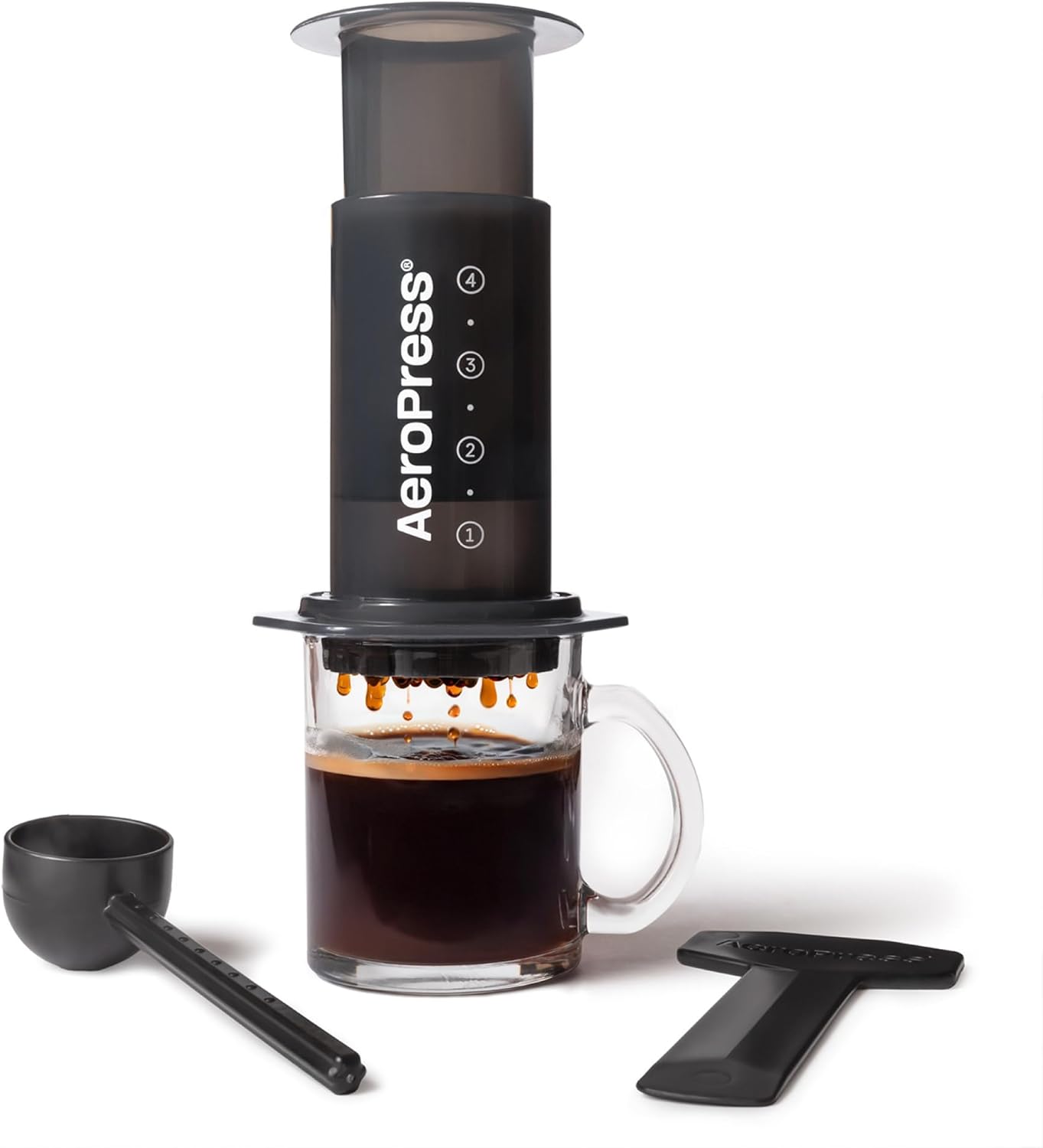
AeroPress Original Coffee Press, French Press, Pour-Over & Espresso Style
- The Brewer That Started It All – AeroPress Original was the first single cup coffee maker to combine 3 brew me…
- A New Standard in Coffee Flavor – Equal parts French press, pour-over, and espresso, AeroPress patented 3 in 1…
- The Secret to AeroPress Superior Flavor – Air Pressure and micro-filtration work together to speed up extracti…
- Brew and Clean in 2 Minutes – To brew, simply add coffee and water, wait 30 seconds, then press for a clean, w…
- Brew Like a Pro, Wherever You Go – One of the only coffee makers that offers full control over brew time, temp…
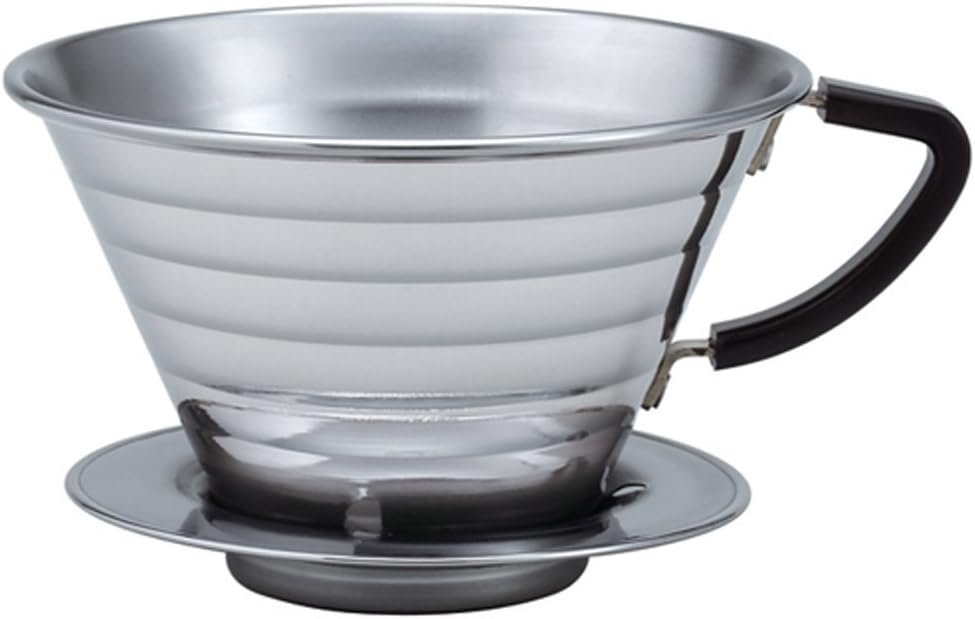
Kalita Wave 185 Drippers
- PULLS THE PERFECT CUP: The pantented wave design reduces contact between the brewing space and the filter itse…
- TOP CHOICE OF COFFEE PROFESSIONALS: You'll find the Kalita Wave pour over coffee dripper in the world's top sp…
- PREMIUM CONSTRUCTION: Made in Japan out of polished stainless steel, the Kalita Wave 185 is more durable than …
- FITS MOST CUPS AND CARAFES: The Kalita Wave's flat-bottomed coffee bed has a dripping area diameter of 2", whi…
- SATISFACTION GUARANTEED: Kalita is a family-owned Japanese compaany that adheres to the highest standards of m…
Risk-averse buyer who can’t decide: Buy both. A $20 dripper and a $60 kettle alongside whatever drip machine you were already considering. Run them side by side for two weeks with the same beans and grind. Return whichever one you use less. You’ll know after the first week.
Budget buyer focused on light or medium roasts: Avoid cheap drip machines – they will under-extract at 175°F and waste good beans. A manual pour over setup or a quality AeroPress will produce a better cup for less money than a $30 drip machine. If drip is non-negotiable, save for the SCA tier.
The final verdict signal is this: drip wins on volume and hands-off convenience; pour over wins on extraction control and special-bean clarity; hybrid use is the most honest answer for anyone who cares about both. Equipment quality within each method matters more than the method label itself – and internal hygiene, thermal carafe design, and temperature stability are the variables that will define your ownership experience, not the marketing copy on the box.
Frequently Asked Questions About Drip Coffee Maker vs Pour Over
Is pour over actually better than drip coffee?
Not categorically. A well-calibrated SCA-certified drip machine can match a competent pour over on cup quality. Pour over gives you higher extraction control, which matters most with specialty light roasts – but a careless pour over will lose to a well-dialed drip machine every time.
What are the real downsides of a drip coffee maker?
The hidden ones are temperature instability in budget models, showerhead dispersion that misses the edges of the basket, biofilm and scale buildup in inaccessible internal water tubes, and hot plate degradation that turns a good brew bitter within 20 minutes.
What’s the biggest disadvantage of pour over coffee?
It doesn’t scale. One to two cups per brew is the practical ceiling, and the process requires your active attention for the entire brew – which is a genuine friction point for multi-person households or half-awake mornings.
Do I need a burr grinder for pour over but not for drip?
You need one for both if you want consistent results, but the impact is more immediately audible in pour over. Pour over’s controlled extraction amplifies grind inconsistency; drip’s longer contact time and heavier body mask it slightly more.
Can a cheap drip machine produce good coffee with quality beans?
Rarely. If the machine peaks at 175°F, it will under-extract regardless of bean quality. Good beans deserve a machine that reaches 195–205°F. Spending money on specialty coffee and running it through a $20 drip machine is one of the most common mismatches in home brewing.
Is pour over healthier than drip coffee?
Both methods produce similar caffeine content. The paper filter in pour over removes more diterpenes (cafestol and kahweol) – compounds linked to LDL cholesterol elevation – than a metal filter. If you use a paper filter in drip as well, the health profile is comparable. The method matters less than the filter type.
How often should I descale a drip coffee maker?
Monthly is the standard recommendation for daily use in average hard-water areas. If your water is especially mineral-heavy, every three weeks is more appropriate. Skipping descaling narrows the water tube, reduces temperature performance, and shortens the machine’s lifespan – all of which show up in the cup before they show up as a visible failure.
Can I use both methods and switch between them?
Yes, and for many serious coffee drinkers it’s the most honest answer. Drip handles weekday volume without friction; pour over handles weekend brewing with beans worth tasting carefully. The equipment investment for both is modest if you already own a kettle and grinder.
References
- Shonali Paul on Pour Over vs Drip Coffee | realsimple.com
- An equilibrium desorption model for the strength and extraction yield of full immersion brewed coffee | nature.com