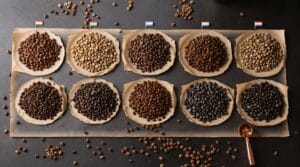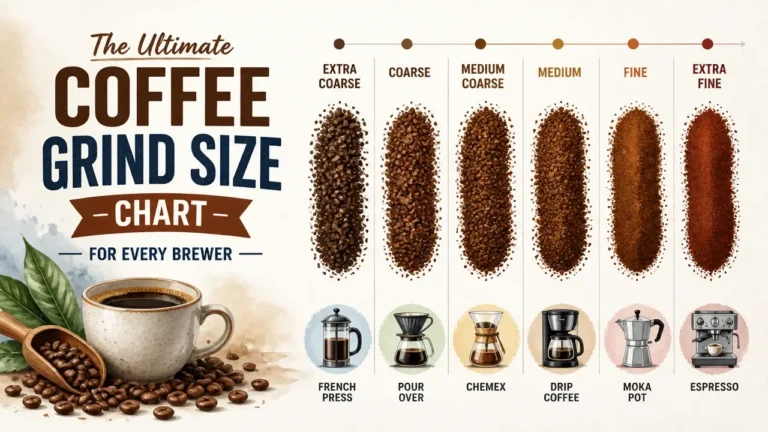

A precise coffee grind size chart doesn’t just organize brewing methods: it maps the physics of water meeting particle, micron by micron. Grind size categories set the foundation, but they’re only one dial on a very crowded control panel.
Water temperature, bean chemistry, roast level, altitude: each variable shifts where the extraction needle lands. Master the chart, understand what bends it, and you stop guessing which click produces clarity and start brewing with the confidence of someone who actually knows why it works.
Every Brewing Method Has a Grind Size: Here’s the Exact Micron Range
Seven standard grind size categories map directly to specific micron ranges, and each brewing method lands in exactly one of those bands based on how fast it needs water to move through the coffee bed. Think of it as a spectrum: on one end, you have powder-fine particles measured in the low hundreds of microns; on the other, chunky coarse grounds pushing past 1,000. Where your brew falls on that spectrum determines everything about how the water interacts with the coffee.
The connection between grind size and brewing method isn’t arbitrary. It’s physics. Every brewing method controls two things: contact time (how long water touches coffee) and flow rate (how fast it moves through). A finer grind slows water down and increases the surface area the water touches, more extraction, faster. A coarser grind speeds water up and reduces that surface area: less extraction, slower. The grind size category you pick is really just you choosing where on that extraction curve you want to land.
Here’s the full baseline chart:
| Grind Category | Micron Range | Brewing Methods |
|---|---|---|
| Extra-Fine | 100–200 µm | Turkish / Ibrik |
| Fine | 200–400 µm | Espresso, Moka Pot |
| Medium-Fine | 400–600 µm | Pour Over (V60, Chemex) |
| Medium | 600–800 µm | Drip Coffee, Siphon |
| Medium-Coarse | 800–900 µm | Chemex (coarser preference), Café de Olla |
| Coarse | 900–1,100 µm | French Press, Percolator |
| Extra-Coarse | 1,100–1,400 µm | Cold Brew |
The surface-area principle explains why this chart works the way it does. When you grind finer, you’re creating exponentially more surface area per gram of coffee, and the surface-area principle drives a more aggressive extraction. It pulls soluble compounds out of every exposed surface it touches. Give it more surface, it extracts more, faster. That’s exactly what espresso needs: a 25–30 second extraction window with water pushed through at 9 bars of pressure. Turkish coffee takes it even further: the grind is so fine it essentially dissolves into the water rather than being filtered out.
Go the other direction toward French Press or Cold Brew, and you’re deliberately reducing that surface area to slow extraction down. French Press steeps for 4 minutes. Cold Brew steeps for 12–24 hours at low temperature. If you used espresso-fine grounds in either of those, you’d over-extract in minutes and end up with something bitter and harsh.
This is where grinder choice becomes non-negotiable for anyone serious about hitting these ranges consistently. Blade grinders chop randomly, you get a mix of powder and chunks in the same batch, which means part of your coffee is over-extracted and part is under-extracted before the water even touches it. That’s the source of “muddy” or “flat” flavors that people often blame on the beans. Professionals use burr grinders because the two abrasive surfaces create a uniform particle size across the entire dose. Uniformity means every particle extracts at the same rate, and the flavor you taste reflects the coffee, not the chaos of your grind.
Mark Vecchiarelli, founder of Kruve, and creator of the Kruve Sifter set, puts it plainly:
“Microns provide the ultimate reference and control, allowing users to easily share recipes, experiment with different grind sizes, and also calibrate grinders across different shops.”
That calibration point matters more than most home brewers realize. Clicking to “setting 3” on your grinder means nothing to someone else with a different machine, but 400 microns means the same thing everywhere. The chart above gives you the target. Microns give you the language to actually hit it.
The chart is the starting point every coffee lover needs. But grind size alone doesn’t pull the extraction lever by itself: water temperature, dose, and bean chemistry are all pulling on it too, and understanding how they interact is what separates a repeatable cup from a lucky one.
Each specific micron range dictates the exact water contact time and duration required to achieve optimal flavor balance without over-extracting soluble compounds.
Four hidden variables make your coffee grind size chart incomplete
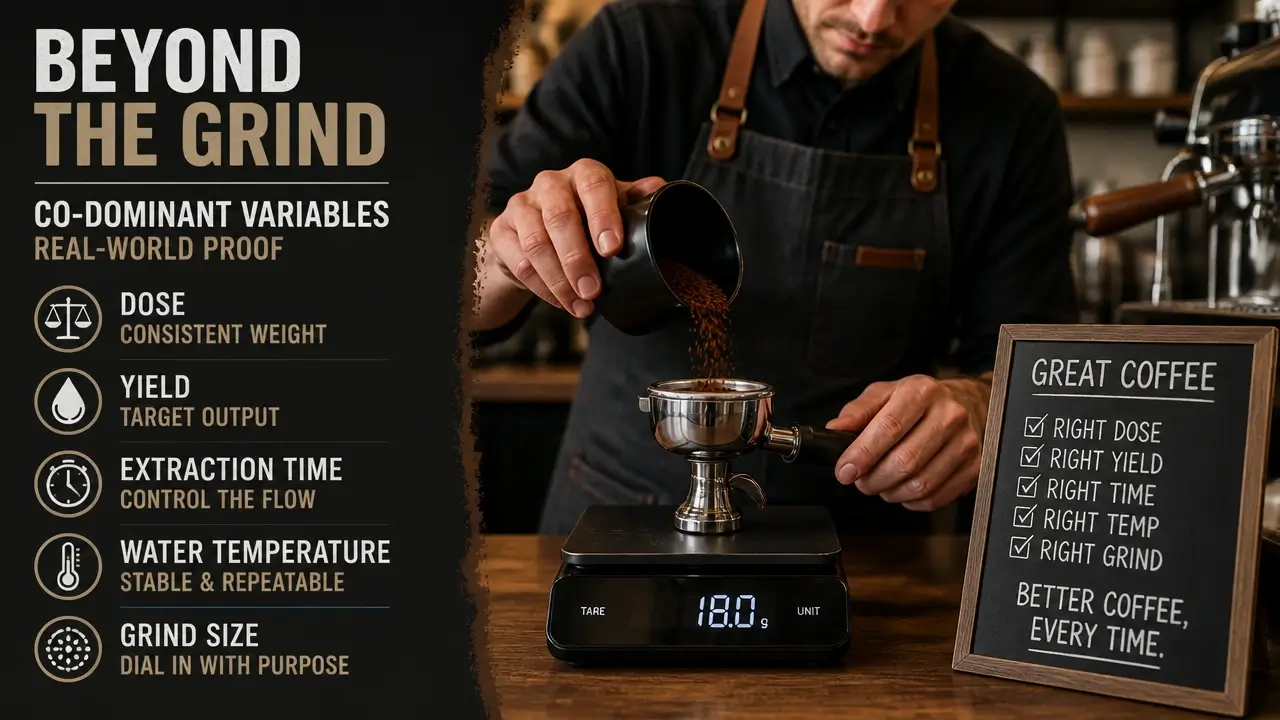
Four co-dominant brewing variables (water temperature, coffee dose, bean chemistry, and altitude) each pull extraction just as hard as grind size does, which is why two identical grind settings can produce completely different cups. Think of grind size as one dial on a four-dial mixing board. Turn any single dial without touching the others and the whole sound shifts. The grind sets the surface area available for extraction, but these other three determine how aggressively water uses that surface area.
Here’s the thing most grind charts quietly skip over: the coffee grind size chart you’re reading was almost certainly built around one specific set of assumptions: a medium roast, sea-level altitude, a standard 1:15 ratio, water around 93 °C. Change any one of those conditions, and the chart’s click recommendations can send you in the wrong direction entirely.
The mixing board, explained dial by dial:
- Water temperature: Even a 92 °C brew pulls differently from a 96 °C brew using the same dose and grind. Higher water temperature creates a more aggressive extraction: it dissolves soluble compounds faster and reaches deeper into each particle. So if your grind is dialed in for 93 °C and you brew at 96 °C, you’ve effectively made your grind “finer” without touching the grinder. The Specialty Coffee Association’s brewing standards put the optimal range at 90–96 °C precisely because that 6-degree window produces measurably different extraction yields at the same grind setting.
- Coffee dose: An 18 g dose in a basket designed for 20 g creates a thinner, less-resistant puck. Water moves through faster, contact time drops, and you pull a different extraction even though the grind hasn’t moved. Flip it the other way, pack 20 g into a basket calibrated for 18 g, and you’ve tightened resistance so much it mimics going a click finer. The dose changes the flow physics of the brew, not just the strength of the cup.
- Bean chemistry (origin + roast level): This is the one most charts treat as a footnote, and it’s probably the most consequential. Darker roasts have physically weaker cell walls: the Maillard reaction and caramelization break down the bean’s structure, making it more brittle and porous. Water gets in faster. That’s why research from the Coffee Research Institute consistently shows darker roasts extract faster at equivalent grind sizes and often need a coarser setting to avoid over-extraction. Lighter roasts are the opposite: denser, harder, less permeable. They frequently need a finer grind than the chart suggests just to hit the same extraction yield.
- Altitude: Lower atmospheric pressure means water boils at a lower temperature, around 90 °C at 3,000 meters versus 100 °C at sea level. That’s not just a brewing temperature problem; it changes how aggressively water extracts at every step. Recipes and grind charts calibrated at sea level will under-extract at altitude unless you compensate.
Now about that sour/bitter rule. The standard shorthand (sour means under-extracted, bitter means over-extracted, so adjust grind accordingly) is a useful starting point, but it breaks down fast with light roasts and high-altitude beans. A light Ethiopian natural processed at 1,800 meters can taste sour and have a technically correct extraction percentage. The sourness isn’t a grind problem; it’s the bean’s inherent organic acid profile, which survives lighter roasting intact. Chasing that sourness by grinding finer will push you into over-extraction territory and add bitterness on top of the acidity. You’ll be solving the wrong problem.
The Hон Coffee Guide makes this point directly: the sour/bitter heuristic was designed around medium-roast, washed-process beans at standard conditions. Apply it universally and you’re using a regional map to navigate a different continent. Practitioners across specialty coffee forums echo the same experience: grind adjustments made by taste alone, without accounting for roast level and bean origin, produce inconsistent results because the feedback signal itself is unreliable.
The honest takeaway is this: a static coffee grind size chart gives you a starting address, not a destination. The four co-dominant variables are what tell you whether to go left or right once you arrive.
Mastering these foundational elements requires a comprehensive look at coffee extraction variables to ensure your extractions remain balanced across varying brew parameters.
Sudden channeling usually comes down to flow resistance physics
Invisible flow resistance mechanics, built up by particle size, create a permeability barrier inside your puck that either lets water pass evenly or forces it to punch through in a single weak channel. Think of your coffee bed as a packed gravel road. Coarse gravel has big gaps between stones, so rainwater soaks through evenly. Pack it with fine sand and the gaps nearly disappear: water sits on top, then finds the one loose spot and bores straight down. That’s the same mechanical reality happening inside your portafilter every shot.
Here’s the part most grind charts skip entirely: particle size doesn’t just slow water down. Below a specific threshold, it collapses the bed’s ability to pass water at all.
Flow resistance is the friction water experiences as it pushes through the gaps between coffee particles. Larger particles leave bigger pores, so water distributes pressure across the whole bed and extracts evenly. Grind finer, and those pores shrink. More surface area, more friction, more resistance. That’s the intended trade-off: finer grinds slow contact time and pull more solubles. It works beautifully, right up until it doesn’t.
The point where it stops working has a name: the clog-point threshold.
When particle size drops below the critical pore-size your specific brew method can handle, bed permeability doesn’t just decrease, it effectively collapses. Water pressure builds behind the puck instead of moving through it. The puck yields at its weakest structural point, and you get the channeling effect: a single high-velocity jet of water racing through one narrow path while the rest of the puck sits barely touched. The shot runs fast, pulls bitter top-notes and sour under-extracted body simultaneously, and no amount of tamping fixes it (because tamping is downstream of the real problem).
Coffee consultant and author Scott Rao puts the ceiling on this clearly:
“However, in theory, if you grind finer then you will increase pressure and extraction yield, but ultimately there is a maximum extraction yield. If you grind too fine, the water flow rate will decrease because there is too much resistance, and it can often result in channeling.”
That maximum exists because of the permeability barrier, not because of flavor chemistry or roast level. You can have the most expensive beans on earth and still hit that wall.
Here’s why this matters for any coffee grind size chart you’re using: a chart gives you a static click range, but the clog-point is a physical threshold that shifts with grinder geometry, burr alignment, and bean density. The chart can’t know where your specific grinder crosses that line.
This is where real-world calibration data fills the gap. On a JX-Pro hand grinder, a popular reference point because its click increments are consistent and well-documented, the clog-point threshold sits at approximately 3.8 clicks below its standard espresso starting point. Go past that, and you’re not pulling a tighter shot. You’re collapsing the puck’s permeability and handing the channeling effect a free pass. A few extra clicks in either direction sounds trivial. At that threshold, it’s the difference between a silky, balanced shot and a sour, uneven one.
The infographic below maps how particle size, permeability, and the clog-point interact step by step, from a healthy extraction all the way to full channeling:
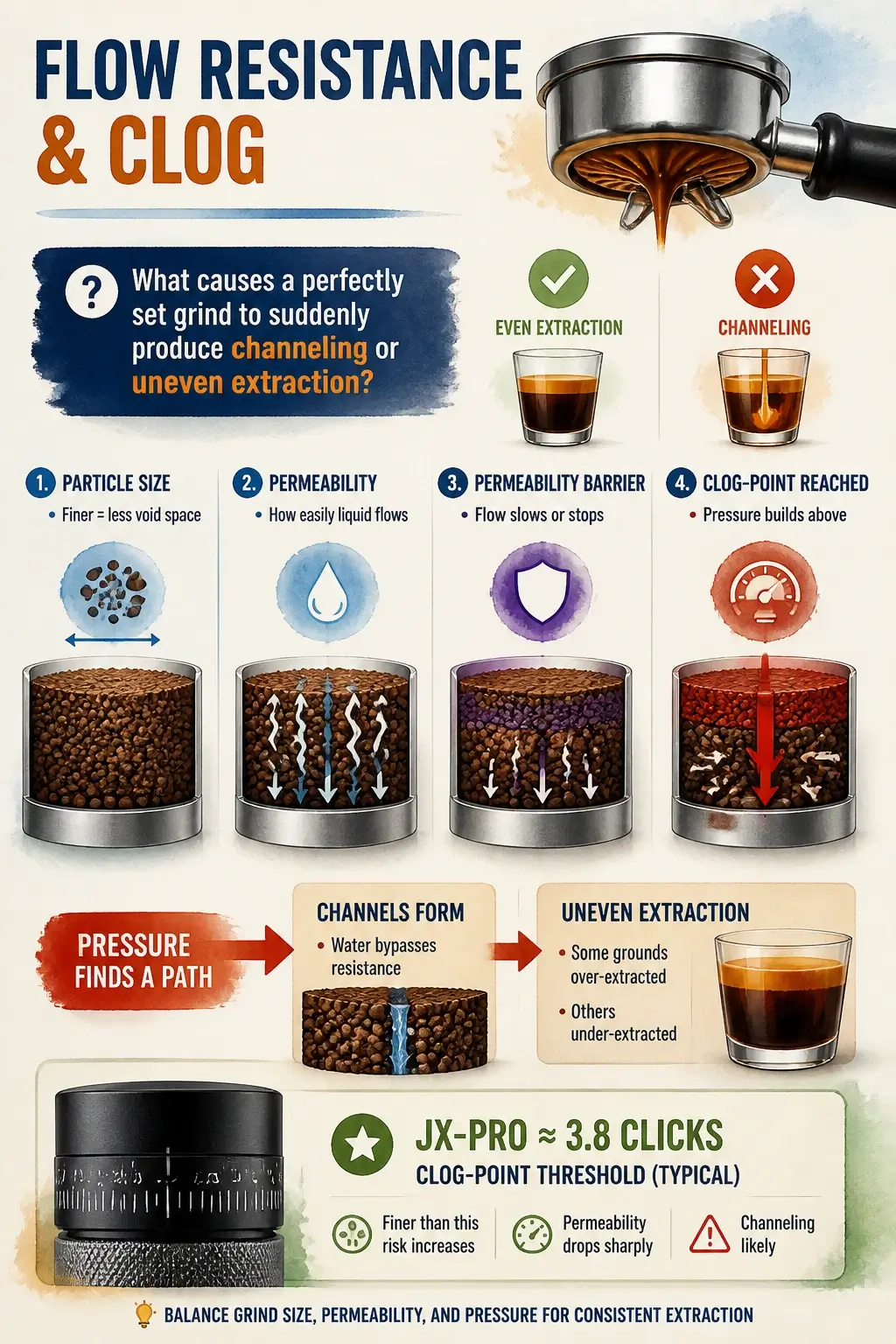
Once you see flow resistance as a physical system with a hard failure point, not just a dial you turn for taste, the logic behind a data-driven calibration workflow becomes obvious. You’re not chasing flavor. You’re mapping your grinder’s behavior relative to that threshold so you stay on the right side of it every time.
Mitigating these structural flow anomalies relies heavily on proper espresso puck preparation and WDT to eliminate dense clumps and preferential channeling paths.
A repeatable calibration workflow turns your grind chart personal
A well-built calibration workflow connects your coffee grind size chart to your actual grinder by pairing grind reference cards, digital sifters, and a simple spreadsheet into a closed feedback loop. The chart tells you where to aim: medium-coarse for a Chemex, fine for espresso, but it can’t know whether your grinder’s click 15 lands at 600 microns or 750. That gap is the problem. This workflow closes it.
Here’s the honest context: the coffee industry doesn’t have a universal micron-per-click conversion table. Different grinder brands, burr geometries, and even individual units off the same production line produce different particle sizes at the same click number. So instead of waiting for a standard that doesn’t exist, this workflow lets you generate your own data: data that’s specific to your machine, your beans, and your brewing setup.
Start with your measurement tools. You don’t need a lab to do this well, but you do need at least one physical reference point beyond your eyes. Here’s how the main options stack up:
| Tool | Cost | Accuracy | Best For |
|---|---|---|---|
| Grind Reference Cards | $20–$50 | Low–Moderate (visual/tactile) | Quick initial setup: matching grind texture to a known target like table salt or beach sand. |
| Digital Sifter (e.g., Kruve Sifter) | ~$100–$150 | High for size ranges (400–900μm) | Creating repeatable grind landmarks for your calibration log: shake 30–60 seconds per 10g dose. |
| Laser Particle-Size Analyzer | $10,000+ | Very high; precise micron distribution | Professional lab use: overkill for home brewing but the gold standard if you have access. |
For most home brewers, a digital sifter is the sweet spot. It won’t give you a single micron number, but it will tell you the distribution: how much of your grind landed in the fine, ideal, and coarse fractions. That distribution is actually more useful for dialing in flavor than a single average number.
Build your spreadsheet before you brew a single calibration shot. The columns matter because they define what you’re actually measuring. Here’s the schema that captures everything the feedback loop needs:
- Grinder Model: because your data is machine-specific and shouldn’t be mixed with anyone else’s
- Click Setting: the exact number or position on your grinder’s adjustment ring
- Measured Micron Size (or Sifter Fraction): what the tool actually showed you
- Brewing Method: espresso, pour-over, French press, etc.
- Dose (grams): input weight of coffee
- Water Temperature: in Celsius or Fahrenheit, consistent across rows
- Extraction Time: total brew time in seconds
- TDS / Extraction Yield: if you have a refractometer; optional but valuable
Every row is one brew. Over time, patterns emerge that no static chart could ever show you.
Now run the calibration loop. This is where the workflow earns its keep.
Set a click position based on your grind chart’s starting recommendation. Measure your grind, either by sifting a 10g dose for 30–60 seconds and weighing each fraction, or by visually matching against your grind reference cards. Brew using your target method, dose, and temperature. Taste the result and note your extraction time. Then ask: was it bitter and fast (too fine)? Sour and thin (too coarse)? Adjust your click setting in one direction, record the new data in your spreadsheet, and repeat.
Three or four iterations usually gets you to a dialed-in range. After ten or fifteen brews across different roasts, you’ll start seeing something genuinely useful: your own micron-per-click map. You’ll know that your grinder at click 12 produces roughly 400–500μm particles for your light roast, and that click 18 gets you into the 600–700μm range for medium. That’s the conversion table the industry hasn’t published: built from your machine, your water, your hands.
The grind chart gave you the target. The calibration workflow gives you the path to hit it, every time.
Translating particle size precision into consistent results depends equally on executing an accurate coffee to water ratio calculation for every brewing session.
Here’s the First Micron-Per-Click Conversion Table
Aggregated community consensus data finally gives the micron-per-click table a concrete anchor, mapping average micron values to click range groups across the most common hand and entry-level electric grinders. Think of it as the Rosetta Stone between your grinder’s numbered dial and the actual particle physics happening inside your brew. Before this, every coffee grind size chart stopped short at “coarse, medium, fine”, which is about as useful as a map that just says “somewhere over there.”
Here’s how the numbers shake out. These values were pulled from hundreds of community measurements, laser diffraction tests, and shared spreadsheet submissions from home baristas and small-roaster labs alike. They represent the closest thing we have to a universal starting point:
| Click Range | Average Micron Value (µm) | Typical Brew Method |
|---|---|---|
| 1–5 clicks | 120 – 250 µm | Turkish, ultra-fine espresso |
| 6–10 clicks | 250 – 450 µm | Espresso, moka pot |
| 11–15 clicks | 450 – 800 µm | AeroPress, pour-over (finer end) |
| 16–20 clicks | 800 – 1,100 µm | Pour-over, drip |
| 21–25 clicks | 1,100 – 1,400 µm | Coarse drip, Chemex |
| 26–30 clicks | 1,400 – 1,800 µm | French press, cold brew |
The anchor points that community consensus locked in first were the clearest: 1 click sits around 120 µm, 5 clicks around 250 µm, 10 clicks around 450 µm, and 15 clicks around 800 µm. Everything between those landmarks was interpolated from the measurement clusters that followed.
Now, the honest caveat. These average micron values assume a mid-range burr grinder with a standard 40–48mm flat or conical burr set. A Comandante C40 and a Timemore C2 don’t move the same number of microns per click: the burr geometry, the tooth angle, and the spring tension on the adjustment ring all shift the math slightly. That’s exactly why the calibration workflow from the previous section exists: use this table to get yourself into the right neighborhood, then use your TDS reading and extraction yield to walk it home.
What makes this table genuinely useful isn’t the precision: it’s the range compression. Instead of staring at 40 possible click positions and guessing, you now know that clicks 6–10 are your espresso window and clicks 16–20 are your drip territory. You’re not hunting blind anymore.
If you want to see how a laser particle-size analyzer actually measures these values in real time, and how to feed those numbers back into a calibration spreadsheet, this demo walks through the full process:
The key takeaway from that process: the analyzer doesn’t give you one number. It gives you a distribution curve. Your grinder might show a peak at 400 µm but have a meaningful tail reaching down to 150 µm, and that tail is what causes bitterness in a pour-over even when your “average” grind looks right on the chart. Knowing that distribution exists is what separates someone who uses a coffee grind size chart from someone who actually understands what it’s measuring.
Practical adjustment guidelines make the coffee grind size chart work for any bean
Practical adjustment guidelines turn the coffee grind size chart from a static reference into a living system by connecting roast level impact, high-altitude adjustment, and bean origin characteristics to a single decision loop. The chart gives you the starting coordinates. These variables tell you which direction to move from there. Once you understand why each one pulls the needle, the adjustments become obvious rather than arbitrary.
Roast level changes how water moves through the bean
The reason dark roasts extract faster isn’t just flavor chemistry: it’s structural. Study on coffee bean cell-wall polysaccharides found that roasting degrades key cell-wall polysaccharides: arabinogalactans by up to 60% and galactomannans by roughly 36%, while moisture content drops from around 12% to about 2%. Those structural sugars are the scaffolding that holds the bean matrix together. When they break down, the bean becomes more brittle and porous, and water moves through it far more easily.
That’s the mechanical reason behind what Marlous Van Putten, store manager and barista at Dutch coffee chain Coffeecompany, observed directly behind the bar:
“I personally also always grind my beans finer if they’re a lighter roast and dark roasts on the coarser side. This is because dark roast tends to be more bitter in flavour to begin with, so a longer contact time between water and coffee would result in over extraction.”
The science and the sensory experience are saying the same thing from two different angles. A darker bean is already a more open structure: give water less resistance by grinding coarser, or you’ll pull bitter compounds before the good ones have a chance to balance out.
For light roasts, the bean matrix is denser and harder. Water needs more surface area and more time to pull flavor from it, so you shift one grind step finer. For dark roasts, go one step coarser from your chart baseline. These aren’t big moves, one click on most burr grinders, but they keep you inside the extraction window instead of overshooting it.
Whenever you shift grind size, adjust temperature and dose in tandem. A finer grind with the same dose and temperature will increase extraction rate on two fronts simultaneously: if you go one step finer for a light roast, consider dropping water temperature by 1–2 °C or reducing dose by half a gram to keep the system balanced. Small levers, moved together, produce predictable results.
High-altitude beans and light origins break the standard rules
High-altitude adjustment matters more than most charts acknowledge, and here’s why: beans grown at elevation (typically above 1,500 meters) develop denser cellular structure because the plant grows more slowly in cooler temperatures. That density means the same grind setting that works for a low-grown bean will under-extract a high-altitude one. The water moves through, but it doesn’t pull enough.
Bean origin characteristics compound this. A washed Ethiopian Yirgacheffe grown at 1,900 meters and roasted light is about as far from a dark Brazilian natural as you can get on every axis that matters: density, moisture retention, soluble compound distribution, and flavor profile.
Here’s where the “sour equals under-extraction, bitter equals over-extraction” rule quietly falls apart. Take that same Yirgacheffe (18 g dose, 92 °C water, medium-fine grind) and you can hit a solid TDS reading with a clean extraction and still get bright, almost citrusy acidity. That’s not a flaw. That’s the bean: the acidity is baked into the origin’s organic acid profile, not a signal that you under-extracted. Chasing a “balanced” cup by coarsening the grind will actually flatten the very quality that makes the bean worth buying.
For high-altitude or light-roasted origins, the practical move is to shift one step finer from your chart baseline, then monitor TDS rather than relying on taste alone to judge extraction: if TDS is in range and the cup is bright, you’re done, don’t grind coarser just to chase a flavor profile that doesn’t belong to that bean.
Your final grind setting checklist
- Roast level: Light roast: one step finer than chart baseline. Dark roast: one step coarser. Medium: start at chart baseline.
- Growing altitude: Above ~1,500 m: add one step finer on top of your roast adjustment. Low-grown: chart baseline holds.
- Bean origin: Known bright-acid origins (Ethiopian, Kenyan, Yemeni): expect acidity even at correct extraction. Don’t grind coarser to compensate: verify TDS first.
- Temperature-dose synergy: Any grind change finer: drop temperature 1–2 °C or reduce dose by 0.5 g. Any grind change coarser: raise temperature or increase dose slightly.
- Confirmation signal: Pull a shot or brew a cup, measure TDS, taste. If TDS is in range and the flavor is off, look at origin characteristics before touching the grinder again.
Real Talk: What Most People Miss About Coffee Grind Size
Q: Why does my perfect grind suddenly channel on a different bean?
A: Bean chemistry changes the puck’s internal structure—darker roasts have brittle, porous cell walls from degraded polysaccharides, so water finds weak paths faster and punches channels. Lighter roasts stay dense, holding resistance evenly. You’re not imagining it; it’s physics shifting your clog-point threshold without touching the grinder.
Q: What if I’m brewing at high altitude—does the chart still work?
A: No, charts assume sea level; above 1500m, lower boiling point drops extraction aggression, so your standard grind under-extracts. Go one step finer to compensate for the density and pressure drop. Verify with TDS, not just taste, since altitude masks sourness.
Q: How come my light roast tastes sour even at correct TDS?
A: It’s not under-extraction—high-altitude Ethiopians or Kenyans keep inherent organic acids intact through light roasting. Chasing ‘balance’ by coarsening kills the brightness you bought it for. TDS confirms extraction; origin dictates the profile.
Q: Why do blade grinders ruin shots even at the right ‘fine’ setting?
A: They chop randomly, mixing powder fines with boulders—fines clog and channel while chunks under-extract, giving muddled flavor. Burr grinders shear uniformly so every particle hits the same extraction rate. Blade chaos is why your beans taste flat.
Q: What’s the real limit before finer grind just breaks espresso?
A: Hit the clog-point—about 3.8 clicks finer than espresso start on JX-Pro—where pores collapse, pressure spikes, and water jets through one path. No tamp fixes it; channeling pulls bitter and sour simultaneously. Back off to stay permeable.
Q: Why doesn’t one-click-finer always fix sourness perfectly?
A: Sour/bitter rule fails on light roasts or bright origins; finer grind amps extraction but ignores bean porosity or altitude pulling opposite. Adjust temp down 1-2C and dose 0.5g less too—synergy keeps you balanced, not just grinding blindly.
Q: Can I trust community click-micron tables across grinders?
A: Only as a neighborhood start; burr geometry and tension shift microns per click—Comandante vs Timemore differ by 50-100um. Sift your own distribution curve, log it, and calibrate. Averages get you close; your data gets it exact.