


The best quiet coffee grinder is a more complicated ask than it sounds – because “quiet” in the electric grinder world still means somewhere around 80 decibels, which is closer to a busy restaurant than a library. The gap between marketing copy and your 6 a.m. kitchen is where most buyers get burned.
This guide works through four models – the Eureka Mignon Silenzio, the Fellow Ode Gen 2, the DF64 Gen 2, and the Baratza Sette 270 – with a frank look at noise character, workflow fit, build quality, and the ownership costs that never make it onto the spec sheet.
Key Takeaways on the Best Quiet Coffee Grinder
- No electric grinder is silent – quiet electrics land around 80 dB; manual grinders remain the only near-silent baseline at 72–74 dB.
- Noise character (pitch, frequency, tone) determines how intrusive a grinder feels, often more than the raw decibel number alone.
- The Eureka Mignon Silenzio is the strongest quiet espresso pick, built specifically around noise reduction rather than retrofitted with a quiet label.
- The Fellow Ode Gen 2 at 79.4 dB is the best quiet option for filter drinkers, with workflow timing that minimizes real-world disruption.
- The DF64 Gen 2 and Baratza Sette 270 are frequently overrated for quiet use – both carry noise penalties that quiet-focused buyers should weigh honestly.
- Total cost of ownership – replacement burrs, maintenance consumables, repairability – is the most overlooked factor in long-term grinder satisfaction.
Quiet Coffee Grinder Buying Criteria: Know This Before You Spend
Before any product gets evaluated here, the rules of the game need to be clear. “Quiet” is one of the most abused words in coffee gear marketing, and if you walk into this purchase without a framework, you’ll end up with a grinder that’s quieter than your old one but still wakes your partner up at 6:15.
The Real Sources of Grinder Noise
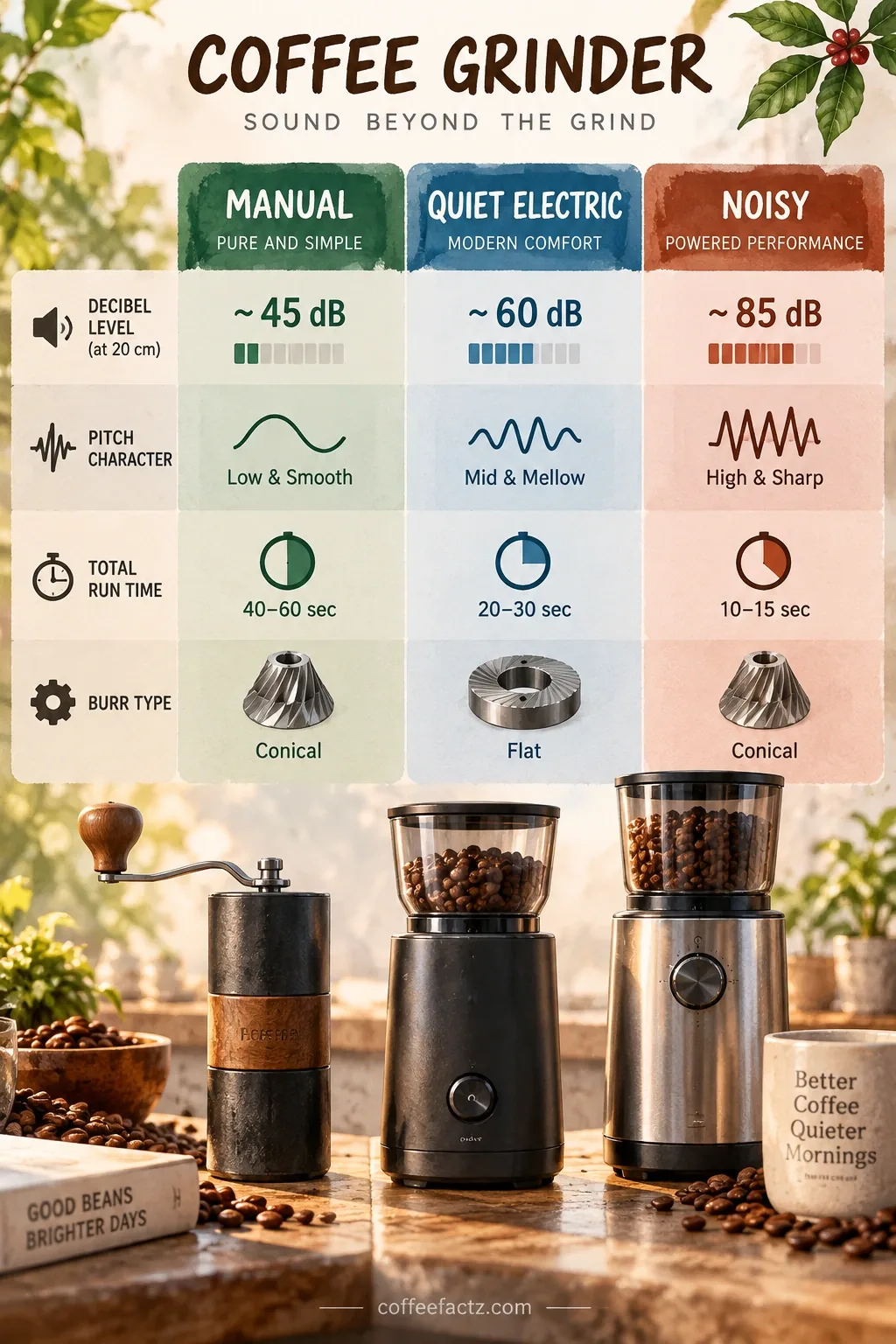
Here’s the baseline that every honest conversation about quiet grinders has to start with: manual grinders are the only near-silent option. A hand grinder produces around 72–74 dB – the sound of a quiet conversation. Once you plug something in, you’re dealing with a fundamentally different noise floor. Quiet electrics land around 80 dB. Noisy ones push 88–92 dB. Nothing electric under $100 is worth considering if quiet mornings are your actual priority.
And it’s not just one noise source you’re managing – it’s several stacked on top of each other. The motor generates a base hum. The burrs add a grinding tone. Beans shattering and compressing against the burrs create percussive cracking sounds. Vibration travels through the chassis and into whatever surface the grinder sits on, and benchtop amplification can make a 79 dB grinder sound significantly louder in a tiled kitchen than it measures in a lab.
That last point matters more than most buyers realize. Research published in Acoustical Physics confirms that the standard A-weighted decibel scale – the one used in virtually every grinder review – is actually inadequate for evaluating noise annoyance when the sound has tonal, pulsed, or low-frequency character. Annoyance is also driven by sharpness, roughness, fluctuation strength, and tonality. In plain terms: a grinder that measures 80 dB with a low, smooth hum can feel less intrusive than one that measures 78 dB with a high-pitched whine. The number alone doesn’t tell you how it will feel at 6 a.m.
So “quiet” isn’t “silent,” and decibel level is a starting point, not a verdict.
How These Grinders Are Ranked and Compared
The comparison framework here goes beyond a single number. Each grinder is evaluated on:
- Noise level measured at approximately 20 cm (manual baseline: 72–74 dB; quiet electric target: ~80 dB; noisy tier: ~90 dB)
- Noise character – pitch, frequency, and whether the tone is harsh or damped
- Total run time per dose, because a faster grinder at 82 dB can be less disruptive than a slower one at 79 dB
- Bean-crunch and knocker noise during loading
- Burr type and motor speed – lower burr speeds (around 300–550 RPM) generally produce less aggressive noise profiles
- Workflow fit – espresso vs. filter vs. single-dose
- Maintenance friction and total cost of ownership
- Counter footprint
Here’s how the four models stack up across those dimensions at a glance:
| Model | Quiet Tier | Noise Character | Burr / Motor | Best Workflow | Maintenance / TCO | Buy / Skip Signal |
|---|---|---|---|---|---|---|
| Eureka Mignon Silenzio | Quiet electric (~80 dB) | Low-frequency, damped | 55mm flat / low-speed | Espresso | Moderate; burrs replaceable | Buy for quiet espresso |
| Fellow Ode Gen 2 | Quiet electric (79.4 dB) | Damped, smooth | 64mm flat / PID motor | Filter / pour-over | Low; straightforward cleaning | Buy for quiet filter |
| DF64 Gen 2 | Mid-tier (~85 dB) | Moderate; motor audible | 64mm flat / variable | Espresso + filter | Moderate; burr upgrades available | Buy if versatility > quiet |
| Baratza Sette 270 | Noisy tier (~88–90 dB) | High-pitched, grating | Conical / high-speed | Espresso | Good; warranty + parts | Skip if quiet matters |
To help visualize how noise pitch, run time, and burr type interact across these models, here’s a reference infographic:
Matching the Grinder to Your Actual Workflow
Raw specs tell you how loud a grinder is – they don’t tell you whether it will disrupt your morning. That depends on your kitchen layout, your household, and how your grinding fits into your routine. A grinder used while the kettle is boiling and the exhaust fan is running lands differently than one used in a silent apartment at 5:30 a.m.
The evaluation questions that actually matter: How much counter space do you have? Is your kitchen tiled or carpeted (tile amplifies vibration)? Are you grinding espresso doses of 18–20g or filter doses of 25–35g? Do you have shared walls or sleeping people nearby?
Build materials matter here too. Plastic chassis components transmit vibration differently than die-cast aluminum or steel – and they fatigue over time. A grinder that feels solid at purchase can develop rattles and resonance after 12–18 months of daily use, effectively getting louder without any mechanical change to the motor.
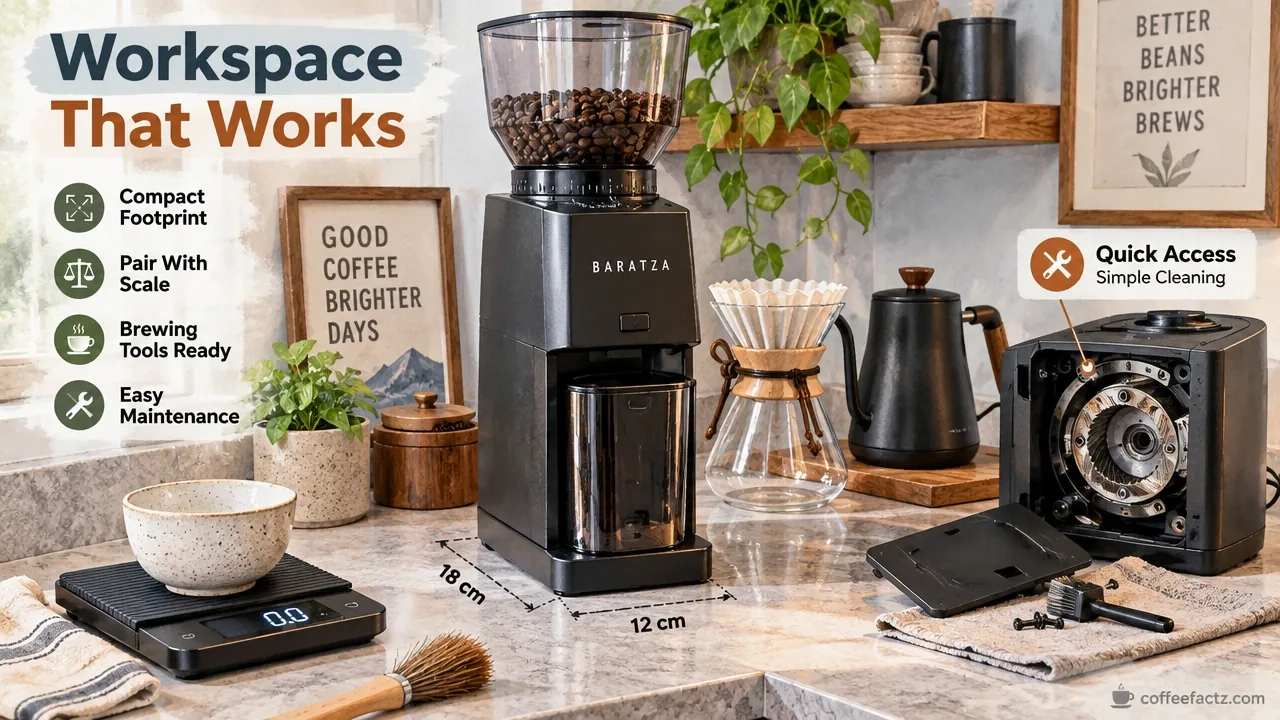
Each product evaluation below follows the same structure: observable fact, the trade-off behind it, the real-world impact, and a direct advisor verdict. Every section ends with a clear buy/skip signal.
Eureka Mignon Silenzio: The Quiet Espresso Benchmark
The Eureka Mignon Silenzio Espresso Grinder (White) is the grinder the quiet-espresso conversation keeps coming back to. It’s not the cheapest, it’s not the flashiest, and it’s not silent – but it’s the most purpose-built quiet espresso grinder in this comparison, and that specificity is exactly why it earns the top spot for that use case.
Fellow Products, the maker of the Ode Gen 2, describes their approach as engineering grinders to reduce grind noise while keeping mornings calm without compromising grind quality or performance.
This philosophy – treating noise reduction as a design constraint rather than a marketing footnote – is what separates the Silenzio from most of its competition. The Eureka engineers applied the same thinking with their patented Silent Technology.
The core design fact: The Silenzio uses 55mm flat steel burrs driven at low RPM, housed inside a chassis fitted with sound-dampening rubber mounts that isolate the motor vibration from the outer shell. Stepless adjustment gives you precise espresso dialing, and timed dosing removes the need for a scale-based workflow if you prefer a simpler routine.
The reason this matters: most grinder noise at the espresso end of the market comes from high-RPM motors spinning large burrs at speed. Eureka’s choice to slow the burr speed and decouple the motor from the chassis with dampening mounts attacks two of the four main noise sources simultaneously – motor vibration and chassis resonance. Bean-crunch noise and burr tone remain, but they’re the quieter half of the equation.
The real-world impact is a grinder that sits firmly in the quiet-electric tier – not the silent manual tier, but meaningfully below the 85–90 dB mid-range crowd. Here’s the nuance worth knowing: practitioners who have measured both the Eureka Mignon Zero (a related model) and the Fellow Ode Gen 2 found that the Mignon Zero actually registered higher on the dB meter, yet was judged less bothersome in use. The reason is exactly what the acoustical research predicts – the Mignon series produces a low-frequency, damped tone that the ear finds less intrusive than a higher-pitched grind at the same or lower decibel level. A lower number can feel worse if the pitch is sharp.
On build quality: the Silenzio’s chassis is predominantly die-cast aluminum and steel, which is the right answer for vibration management and long-term durability. There’s no meaningful plastic fatigue concern at the structural level. The burrs are replaceable and widely available. Counter footprint is compact for an espresso grinder – it won’t dominate a small kitchen.
The learning curve is real. Stepless adjustment is powerful, but it requires patience during the initial dial-in. If you’re coming from a stepped grinder, budget a week of shots before you find your sweet spot. Timed dosing is consistent once dialed, but it’s dose-by-weight in disguise – temperature and humidity shifts will nudge your output slightly, so occasional recalibration is part of ownership.
Maintenance friction is moderate. The burrs are accessible, and cleaning is straightforward with a brush and occasional burr removal. There are no proprietary consumables to worry about.
Affiliate Disclosure
This post contains affiliate links, meaning I may earn a commission if you make a purchase through these links, at no additional cost to you. As an Amazon Associate, I earn from qualifying purchases. I only recommend products I genuinely believe will add value.

Eureka Mignon Silenzio Espresso Grinder, Black, 55mm
- Sound-Insulated Case: A thick metal case filled with rubber mounts, gaskets, and covers make for muted sound a…
- Stepless 55mm Burrs: The Silenzio's upgraded 55mm burrs are built from resilient, hardened steel
- Bottom-Burr Adjust: By adjusting below the motor mount, you can remove the top burr for cleaning without losin…
- Timed Dosing: Adjust the timer on the side of case to grind your dose with precision and consistency
- Italian-Made Design: Designed in Italy, the Silenzio 55 features quality craftsmanship that complements most e…
Here’s a setup walkthrough that covers the Silenzio’s adjustment and workflow in practical detail:
Buy this if: Espresso is your primary brew method, quiet mornings are non-negotiable, and you want a grinder built from the ground up around noise reduction rather than retrofitted with a “quiet” label. The Silenzio is the most honest answer to the quiet espresso question at its price tier.
Skip this if: You primarily brew filter coffee, or you want a single-dose workflow with no hopper. The Silenzio is an espresso tool – using it for filter is like buying a chef’s knife to spread butter. It works, but it’s the wrong tool.
Fellow Ode Gen 2: The Quietest Electric for Filter-First Mornings
The Fellow Ode Gen 2 is the grinder that makes the most sense for filter drinkers who’ve been told to “just get a hand grinder” and rejected that advice for entirely reasonable reasons. It’s not an espresso grinder. It’s not trying to be. And that clarity of purpose is a significant part of why it works.
The core design fact: The Ode Gen 2 measures 79.4 dB under controlled conditions – the lowest measured figure of any electric grinder in this comparison. It achieves this through a PID-controlled motor that holds consistent RPM without the speed surges that create noise spikes, combined with a damped chassis that absorbs rather than amplifies vibration. The 64mm flat burrs are sized for filter grinding, where coarser particle targets mean less mechanical stress and a smoother noise profile.
The design trade-off behind those numbers: Fellow optimized the Ode Gen 2 for a specific job. The burr geometry and grind range are calibrated for pour-over, drip, and French press – not espresso. If you try to push it into fine espresso territory, you’ll hit the limits of the adjustment range and the burr design simultaneously. This isn’t a flaw; it’s a deliberate choice to do one thing exceptionally well.
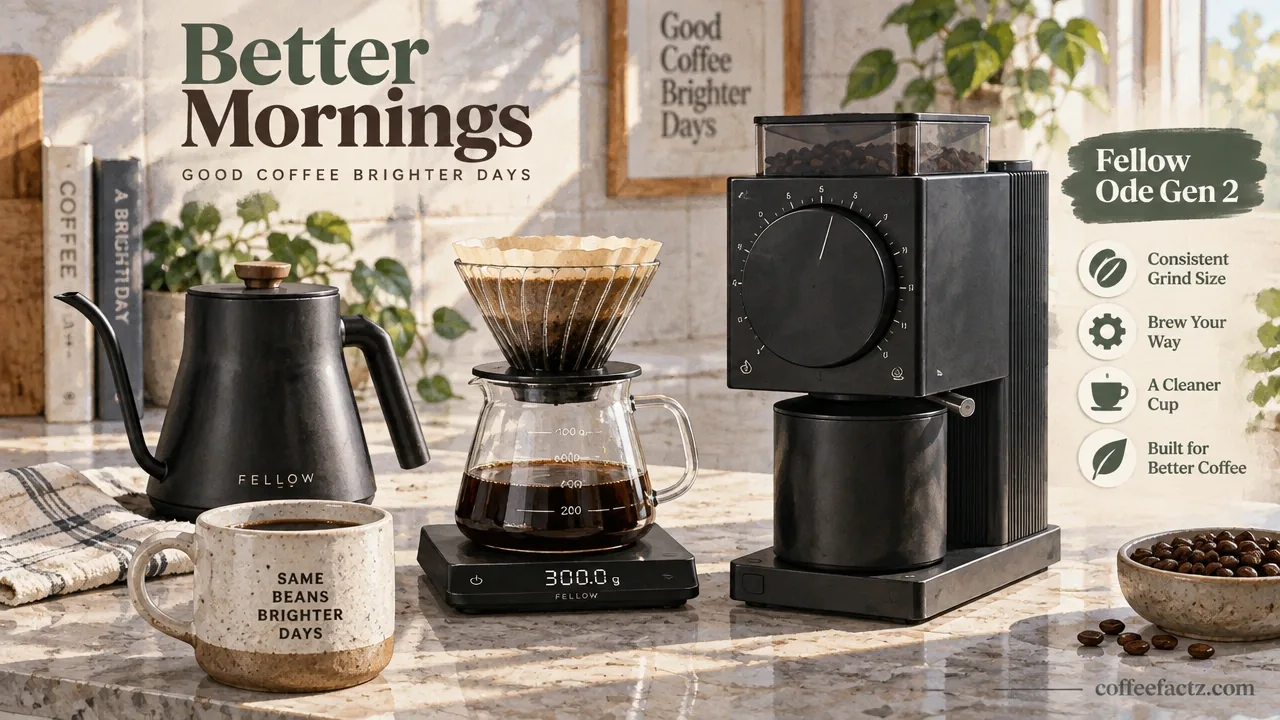
The real-world impact of the damped, PID-stabilized operation is meaningful in a practical morning context. Filter grinding takes longer than espresso grinding – you’re processing 25–35g of beans versus 18–20g. But the Ode Gen 2’s grind time overlaps naturally with water heating. You start the grinder, walk to the kettle, and by the time the water is at temperature, the grind is done. The disruption window is short, the noise character is smooth rather than harsh, and the overall footprint in your morning is smaller than the spec sheet suggests.
The practitioners who talk about quiet grinders in real-world terms – baby naps, shared apartment walls, partners who sleep late – consistently land on the Fellow Ode Gen 2 as the electric option that causes the least friction. Not because it’s the quietest on paper, but because its noise character and workflow timing minimize actual disruption.
Build quality is solid. The chassis uses a mix of machined aluminum and reinforced polymer – the polymer components are structural rather than cosmetic, and Fellow’s build tolerances are tight enough that rattle and resonance aren’t common complaints even after extended use. The 64mm burrs are replaceable and available directly from Fellow. Cleaning is a weekly brush-out and occasional burr removal – genuinely low friction.
The counter footprint is moderate. It’s not a compact grinder, but it’s not oversized either. Single-dose workflow is supported – the Ode Gen 2 has minimal retention, which means you load what you need and get back approximately what you put in.
One honest limitation: the Ode Gen 2 is a filter-first tool, and if your household’s coffee needs span both espresso and filter, you’ll need a second grinder or a compromise elsewhere. That’s not a criticism – it’s a use-case boundary.

Fellow Ode Gen 2 64mm Flat Burr Coffee Grinder Electric, Single Dose
- BUILT FOR BREWED COFFEE – With 31 grind settings optimized for pour-over, drip coffee, French press, and cold …
- PRECISION GRIND QUALITY FOR BETTER FLAVOR – Professional-grade 64 mm flat burrs with a unique two-stage grindi…
- LOW GRIND RETENTION + LESS MESS – Anti-static technology, a built-in knocker, and an optimized grind path redu…
- GRIND ONLY WHAT YOU NEED – The 100 g single dose load bin is designed to hold only the beans you’re about to b…
- MAGNETIC CATCH CUP – A magnetically aligned catch cup locks securely into place beneath the burrs, helping eve…
Buy this if: Filter coffee is your primary method, you want the quietest electric option with a genuinely damped noise character, and your morning routine involves a kettle or pour-over setup where grind time and water heating naturally overlap.
Skip this if: You pull espresso shots. The Ode Gen 2 will not serve you there, regardless of how quiet it is.
DF64 Gen 2: Single-Dose Versatility With a Noise Compromise
The DF64 Gen 2 Single Dose Coffee Grinder (Black, Small) has built a loyal following in the enthusiast community, and for good reason – its single-dose workflow, low retention, and flexibility across espresso and filter make it one of the most versatile grinders at its price point. But versatility and quiet are not the same thing, and the DF64 Gen 2 doesn’t earn a place in the quiet-electric tier.
The core design fact: Community and practitioner measurements consistently place the DF64 Gen 2 around 85 dB – solidly in the mid-tier, not the quiet tier. The single-dose loading design does reduce hopper rattle, which is a real noise source on traditional hopper-fed grinders. But the motor and burr noise are not engineered for low-noise output the way the Silenzio or Ode Gen 2 are. You’re getting a variable-speed motor and 64mm flat burrs in a chassis that prioritizes retention and versatility over acoustic dampening.
The trade-off is deliberate: the DF64 Gen 2 is designed for the home barista who wants to switch between espresso and filter without committing to two grinders, and who wants to experiment with aftermarket burr options. Sweet Lab burrs and other third-party sets are widely compatible, and the variable speed motor gives you meaningful control over grind texture. These are genuine engineering priorities – they’re just not noise-reduction priorities.

The real-world impact is straightforward: if you’re grinding in a household where 85 dB matters – sleeping children, shared walls, a partner who wakes easily – the DF64 Gen 2 will cause friction. If you’re grinding in a context where noise is a secondary concern and workflow versatility is primary, the 85 dB is a tolerable tax on a capable machine.
Build quality is the area where some honest skepticism is warranted. The DF64 Gen 2 uses a combination of aluminum and plastic components, and some users in enthusiast communities report that the plastic elements show wear over time – particularly around the dosing area and adjustment ring. This is consistent with what you’d expect from the design: the plastic isn’t structural failure, it’s cosmetic and tactile fatigue. For the price point, it’s a reasonable trade-off, but it’s worth noting if you’re comparing against the Silenzio’s all-metal construction.
If single-dose workflow is what you specifically want but you need to push closer to the quiet tier, the DF64V or DF83V with Sweet Lab burrs is the more honest recommendation within the DF family – practitioners report these configurations hitting around 85 dB with a smoother noise character than the standard DF64 Gen 2. Still not quiet-quiet. But a meaningful improvement.

DF64 Gen 2 Single Dose Coffee Grinder (Official Seller) (Black), Small
- Innovative Plasma Generator: Addressing Static Build-Up in Coffee Grinding
- Plasma Generator (Ionizer): The exit chute is equipped with a plasma generator to eliminate static.
- Anti-Popcorn: Integrated disc prevents beans from jumping, increasing grinding speed.
- 58mm Transparent Plastic Dosing Cup: Includes a 58mm food-grade transparent plastic dosing cup for convenient …
- True Zero Retention: <0.1 gram; the grinder achieves almost zero retention even without a bellow.
Buy this if: Single-dose versatility across espresso and filter is your primary requirement, you’re willing to experiment with aftermarket burrs, and 85 dB is an acceptable noise level in your household. The DF64 Gen 2 is an excellent grinder for its intended purpose – that purpose just isn’t quiet mornings.
Skip this if: Noise is your first constraint. The Eureka Mignon Silenzio does quiet espresso better, and the Fellow Ode Gen 2 does quiet filter better. The DF64 Gen 2 splits the difference on workflow at the cost of splitting the difference on noise.
Baratza Sette 270: A Workflow Workhorse, Not a Quiet Grinder
The Baratza Sette 270 Conical Burr Coffee Grinder appears on enough “best espresso grinder” lists that buyers naturally assume it belongs on a quiet grinder shortlist too. It doesn’t. And the gap between its general reputation and its noise reality is wide enough to warrant a direct conversation.
The core design fact: The Sette 270 is a conical burr espresso grinder engineered for speed and workflow convenience. Its unique through-grind design – where the lower burr rotates and the grounds fall directly into the portafilter – minimizes retention and produces fast, consistent espresso doses. It is genuinely excellent at that job. The noise it produces while doing that job falls into the noisy tier, around 88–90 dB, with a high-pitched character that multiple measured testers and enthusiast community members flag specifically as grating.
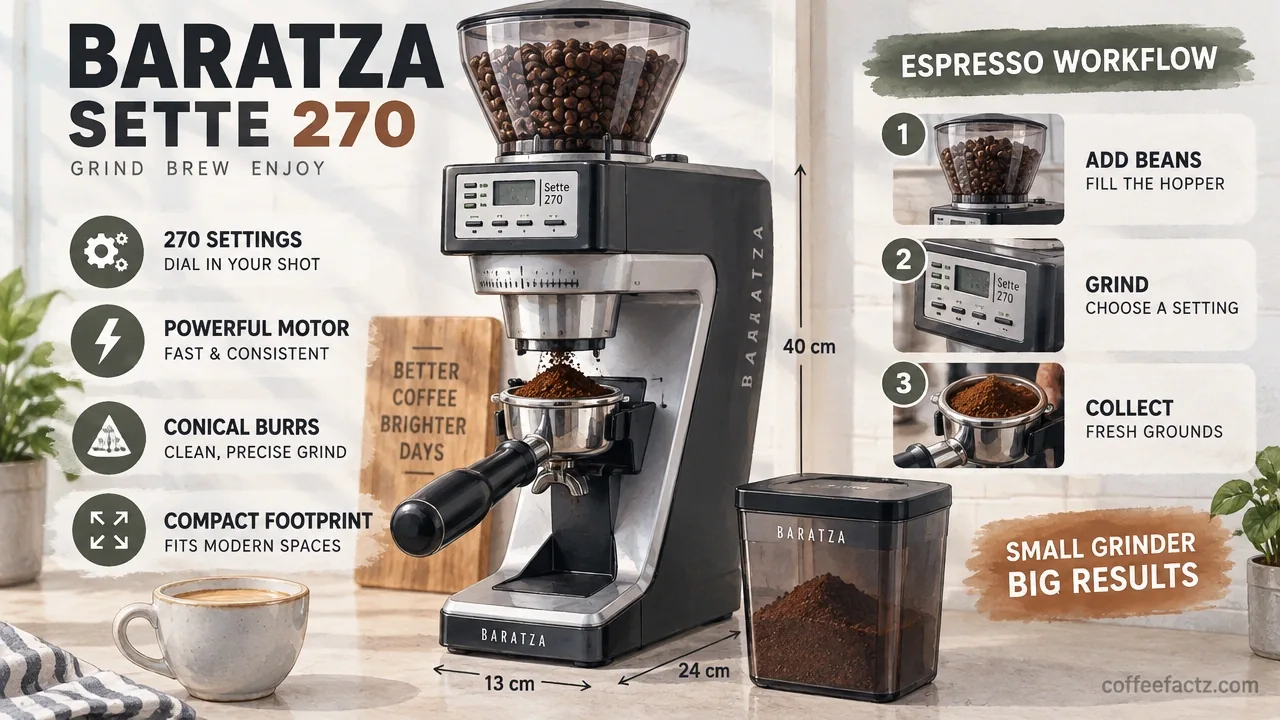
The reason for the noise profile is mechanical. The Sette 270’s conical burr set spins at relatively high RPM to achieve its fast grind times, and the through-grind design – while brilliant for retention – creates an acoustic path where motor, burr, and bean noise all exit the chassis in the same direction. There’s no acoustic dampening architecture comparable to what Eureka built into the Silenzio. This isn’t cost-cutting; it’s a design that prioritized throughput and retention over noise reduction.
The real-world impact is a grinder that practitioners specifically call out when the topic is quiet mornings. The community pushback on the Sette 270 for noise-sensitive use is consistent and specific – not a handful of complaints, but a recurring pattern from people who bought it on general recommendation and found the noise character particularly jarring. High-pitched grinding noise at 88–90 dB in a quiet kitchen at 6 a.m. is a different experience than the same decibel level from a low-frequency hum.
Where the Sette 270 genuinely earns its reputation: Baratza’s warranty and parts ecosystem is one of the best in the consumer grinder market. Replacement parts are available, the company supports repair, and the machine is designed to be serviced rather than discarded. If you need to replace a burr set or a motor component, you can. That’s worth real money over a 3–5 year ownership horizon.
It’s also worth noting that the Baratza Forte – a different model in the same family – doesn’t carry the same noise reputation. The Forte is a different engineering exercise. But the Sette 270 specifically is not a quiet grinder, and recommending it as one does buyers a disservice.

Baratza Sette 270 Conical Burr Coffee Grinder
- SPECIALTY COFFEE ASSOCIATION AWARD WINNING GRINDERS - Baratza grinders are preferred by coffee professionals a…
- DOSING - 3 programmable dosing buttons for accurate, consistent dosing to within a 10th of a second. This allo…
- EXCEPTIONAL ESPRESSO GRINDER - The Sette delivers beautiful espresso and is also capable of grinding for manua…
- 270 GRIND SETTINGS - Macro/Micro adjustment for the most precise dial-in capabilities. A built-in convertible …
- HIGH SPEED GRINDING - Up to 5g/second and minimal retention in the innovative straight-thru grind mechanism.
Buy this if: Espresso workflow speed and convenience are your primary requirements, noise is not a meaningful constraint in your household, and you want the backing of Baratza’s parts and warranty ecosystem. On those terms, it’s a legitimate choice.
Skip this if: Peaceful mornings are non-negotiable. The Sette 270 is a workflow pick with a noise tax, and for quiet-focused buyers, that tax is too high.
Verdict: Which Quiet Coffee Grinder Fits Your Morning?
The central question isn’t “which grinder is quietest?” – it’s “which grinder’s noise level, noise character, and workflow I can actually live with every single day?” Those are different questions, and the answer depends on what you’re brewing.
Here’s the direct answer:
Best quiet espresso grinder: Eureka Mignon Silenzio. The Silent Technology, sound-dampening mounts, and low-frequency noise character make it the most purpose-built quiet espresso option in this comparison. It’s not cheap, but it’s honest about what it is.
Best quiet filter grinder: Fellow Ode Gen 2. At 79.4 dB with a smooth, damped noise profile and a workflow that fits naturally around water heating, it’s the right tool for pour-over and drip drinkers who want minimal morning disruption.
DF64 Gen 2: Buy it if single-dose versatility and burr experimentation matter more than noise. Skip it if quiet is your first constraint – the 85 dB mid-tier noise level is a real penalty, and both the Silenzio and Ode Gen 2 serve their respective workflows better on the quiet dimension.
Baratza Sette 270: Buy it if espresso speed and Baratza’s parts ecosystem are what you need and noise isn’t a meaningful concern. Skip it entirely if peaceful mornings drove you to this list – the high-pitched 88–90 dB noise character is specifically what quiet-focused buyers are trying to avoid.
| Model | Best For | Buy Signal | Skip Signal |
|---|---|---|---|
| Eureka Mignon Silenzio | Quiet espresso | Noise + espresso = non-negotiable | Filter-primary or single-dose workflows |
| Fellow Ode Gen 2 | Quiet filter / pour-over | Filter-first; damped morning routine | Espresso drinkers |
| DF64 Gen 2 | Single-dose versatility | Workflow flexibility over quiet | Noise-sensitive households |
| Baratza Sette 270 | Espresso speed + repairability | Noise is acceptable; want parts ecosystem | Peaceful morning priority |
One thing every spec sheet and dB chart leaves out: ownership math. The cheapest sticker price can become the most expensive grinder over three to five years if replacement burrs are hard to source, cleaning requires proprietary consumables, or the chassis develops rattle that can’t be fixed. The Silenzio and Ode Gen 2 both have accessible burr replacement and straightforward maintenance. The Sette 270’s Baratza parts ecosystem is genuinely strong. The DF64 Gen 2’s aftermarket burr availability is a feature, not just a workaround.
Choose the grinder whose noise character you can tolerate at 6 a.m. on a Tuesday, whose maintenance routine you’ll actually follow, and whose ownership costs make sense over the years you plan to use it. That’s the grinder that earns a permanent spot on your counter.
Frequently Asked Questions About the Best Quiet Coffee Grinder
Who makes the quietest coffee grinder?
Eureka makes the most purpose-built quiet espresso grinder with the Mignon Silenzio, while Fellow’s Ode Gen 2 holds the lowest measured dB figure among quiet electric filter grinders at 79.4 dB. No single brand owns the quiet category – it depends entirely on whether you’re brewing espresso or filter.
What is the quietest coffee maker with a built-in grinder?
Built-in grinder machines almost universally use fast-spinning blade or low-cost burr mechanisms that push noise into the 88–92 dB range. If quiet is your priority, a separate dedicated grinder paired with your brewer will always outperform an all-in-one machine on noise.
Does a lower dB rating always mean a less disruptive grinder?
No – and this is the most important thing to understand before buying. A grinder with a harsh, high-pitched tone at 78 dB can feel more intrusive than a low-frequency hum at 82 dB. Noise character matters as much as the number itself.
Can I make an electric grinder quieter without replacing it?
Placing a thick rubber mat or anti-vibration pad under the grinder reduces benchtop amplification noticeably, especially on tiled counters. It won’t drop the dB significantly, but it addresses one of the four main noise sources – chassis-to-surface vibration transfer.
Is pre-grinding the night before a practical solution for quiet mornings?
It works for filter coffee if you store the grounds in an airtight container and brew within 12 hours. For espresso, pre-grinding kills the shot – stale grounds lose CO2 rapidly and produce flat, under-extracted results. Filter drinkers can use this strategy; espresso drinkers can’t.
What burr speed range is best for quiet electric grinders?
Burr speeds in the 300–550 RPM range generally produce less aggressive noise profiles than high-speed motors. Lower RPM means less mechanical stress on the beans, smoother particle fracture, and reduced motor whine – all of which contribute to a more tolerable noise character.
How much should I expect to spend on a genuinely quiet electric grinder?
Honest quiet starts around $300–$400 for filter grinders and $400–$600 for espresso grinders. Anything marketed as quiet under $150 is almost certainly in the 85–90 dB range and doesn’t belong in the same conversation as purpose-built quiet designs.
Does grinder maintenance affect noise over time?
Yes – significantly. Worn or coffee-oil-coated burrs require more motor effort to grind, which increases noise and vibration. A simple monthly brush-out and periodic burr cleaning keeps the grinder operating at its designed noise level rather than gradually getting louder as residue builds up.
References
- Acoustical Physics – Evaluations of the Annoyance Effects of Noise | link.springer.com
