

Dunkin caffeine content is one of the most misread numbers in the coffee world. A Large Iced Coffee clocks in around 396 mg, beating Cold Brew at roughly 371 mg, while the darkest roast on the menu quietly delivers less caffeine than the house blend.
The gap between what people assume and what’s actually in their cup is wide enough to matter. This guide breaks down every drink, every size, and the brewing mechanics that explain why the numbers land where they do.
Key Takeaways on Dunkin Caffeine Content
- Large Iced Coffee (~396 mg) outpacks Large Cold Brew (~371 mg) because it’s brewed as a double-strength hot concentrate, not because of volume.
- Dunkin Midnight Dark Roast carries slightly less caffeine than Original Blend; roast color changes flavor, not caffeine content.
- Energy Cold Brew Large (~432 mg) is the only single menu item that exceeds the FDA’s 400 mg daily limit by itself.
- Ice melt and milk additions lower caffeine concentration per sip but don’t reduce the total milligrams you absorb if you finish the cup.
- The half-decaf strategy lets you dial in a specific dose: a half-decaf Large Iced Coffee delivers roughly 180–200 mg instead of 396 mg.
- All published Dunkin caffeine figures, including official app values, should be treated as directional ranges rather than lab-certified exact numbers.
What “Small,” “Medium,” and “Large” Actually Mean in Ounces
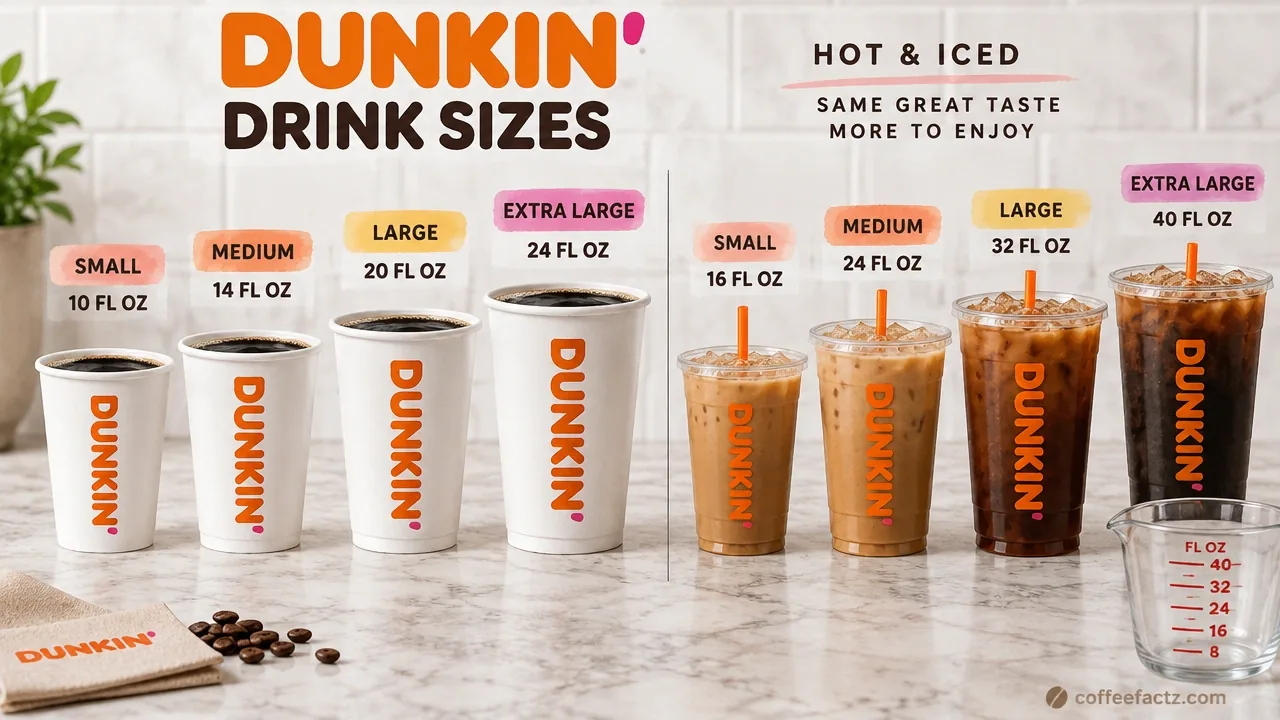
Dunkin drink sizes don’t map cleanly onto what most people picture, and that gap matters before any milligram number can be meaningful. The size tiers run roughly like this: Small is around 10–12 oz, Medium lands at 14–16 oz, Large sits at 20–24 oz, and Extra Large stretches to 24–32 oz depending on the drink category.
Here’s where it gets less obvious: hot and iced drinks don’t share the same ounce-for-ounce measurements. Iced drinks skew larger on paper because they’re served in bigger cups to accommodate ice. That ice occupies real volume. So a Large hot coffee and a Large iced coffee are not the same amount of liquid, even if the menu calls them both “Large.”
This is why comparing drinks by cup size alone is a trap. The metric that actually tells you what you’re getting is mg per fluid ounce, or caffeine density. Caffeine density is the only fair metric to compare a 12 oz black coffee against a 32 oz iced coffee. A drink with 200 mg spread across 20 oz hits very differently than 200 mg in 10 oz.
For a practical anchor: a Medium hot coffee is roughly the size of a standard coffee mug plus a splash, around 14–16 oz. That mental image calibrates everything else.
The Complete Dunkin Caffeine Chart: Every Drink, Every Size
The Master Caffeine Grid
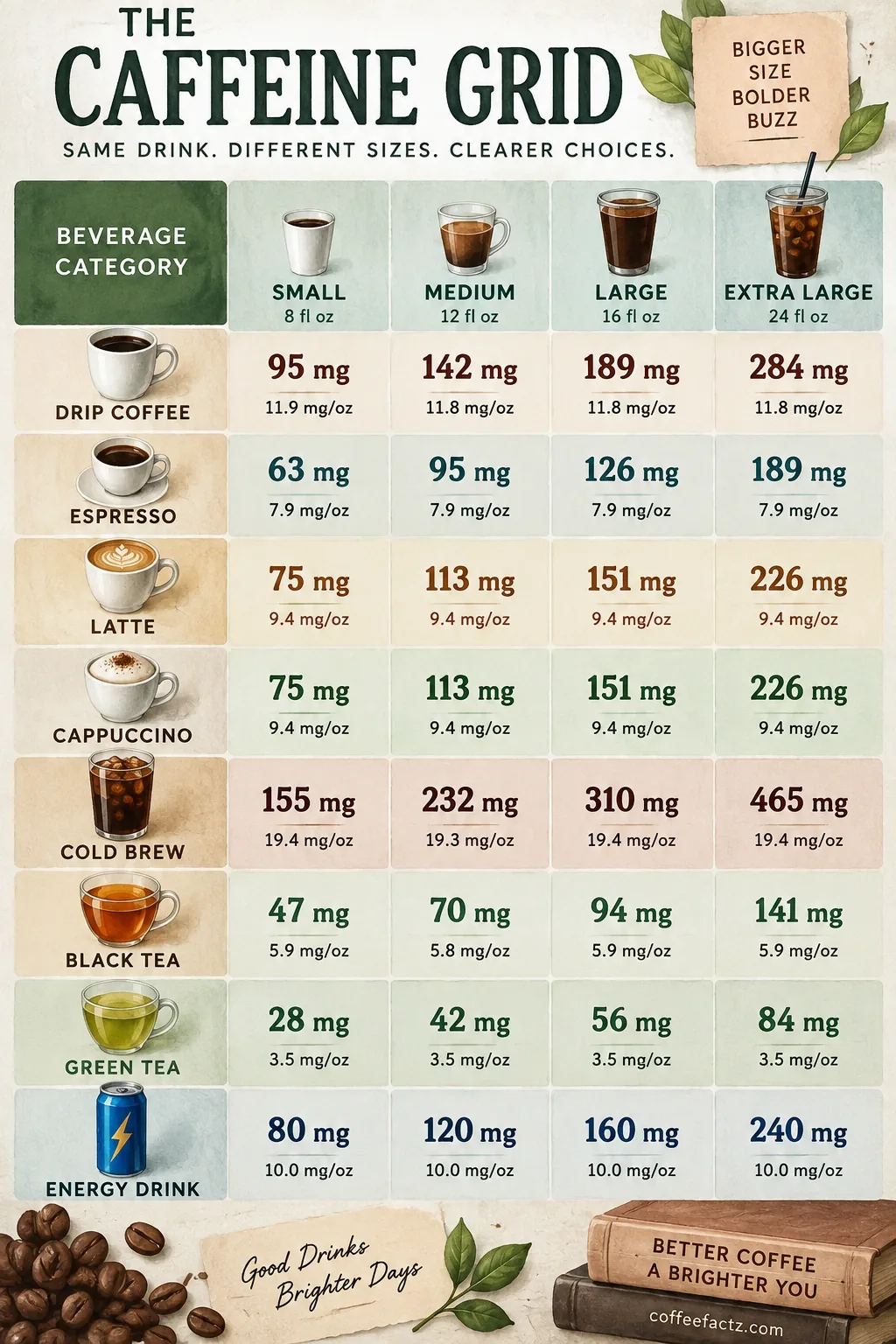
The table below covers the full Dunkin menu by beverage category and size. Milligram totals are listed alongside mg per fluid ounce so you can sort by whichever axis matters to you: total dose or sip-by-sip density.
| Beverage | Small (~10–12 oz) | Medium (~14–16 oz) | Large (~20–24 oz) | Extra Large (~24–32 oz) |
|---|---|---|---|---|
| Original Blend (Hot Drip) | ~150 mg / ~13 mg/fl oz | ~210 mg / ~14 mg/fl oz | ~300 mg / ~13 mg/fl oz | ~359 mg / ~13 mg/fl oz |
| Midnight Dark Roast (Hot Drip) | ~130 mg / ~11 mg/fl oz | ~180 mg / ~12 mg/fl oz | ~270 mg / ~12 mg/fl oz | ~340 mg / ~12 mg/fl oz |
| Decaf (Hot Drip) | ~2 mg / ~0.2 mg/fl oz | ~3 mg / ~0.2 mg/fl oz | ~4 mg / ~0.2 mg/fl oz | ~5 mg / ~0.2 mg/fl oz |
| Cold Brew | ~174 mg / ~17 mg/fl oz | ~260 mg / ~17 mg/fl oz | ~371 mg / ~16 mg/fl oz | ~432 mg / ~16 mg/fl oz |
| Energy Cold Brew | ~201 mg / ~19 mg/fl oz | ~290 mg / ~19 mg/fl oz | ~432 mg / ~19 mg/fl oz | ~471 mg / ~17 mg/fl oz |
| Iced Coffee | ~198 mg / ~17 mg/fl oz | ~281 mg / ~18 mg/fl oz | ~396 mg / ~12 mg/fl oz | ~N/A |
| Americano | ~94 mg / ~9 mg/fl oz | ~141 mg / ~9 mg/fl oz | ~235 mg / ~10 mg/fl oz | ~N/A |
| Macchiato | ~94 mg / ~9 mg/fl oz | ~141 mg / ~9 mg/fl oz | ~235 mg / ~10 mg/fl oz | ~N/A |
| Latte | ~94 mg / ~9 mg/fl oz | ~141 mg / ~9 mg/fl oz | ~235 mg / ~10 mg/fl oz | ~N/A |
| Frozen Coffee | ~196 mg / ~16 mg/fl oz | ~247 mg / ~15 mg/fl oz | ~295 mg / ~13 mg/fl oz | ~N/A |
| Refreshers | ~66 mg / ~6 mg/fl oz | ~99 mg / ~6 mg/fl oz | ~132 mg / ~6 mg/fl oz | ~N/A |
One thing to be clear about: nearly every figure in circulation, including the ones above, originates from third-party aggregation rather than published Dunkin lab results. Treat these numbers as directionally accurate, not forensically precise. The Dunkin mobile app is the best real-time source for current posted values, though even those can vary by location and preparation.
Anchor Milligram Values and Key Lookups
A few numbers deserve explicit callouts because they answer the questions that bring most people to this topic.
Large standard Cold Brew runs around 371 mg. A Large Iced Coffee lands near 396 mg, making it the stronger choice by total dose despite the “cold brew is strongest” reputation. Frozen Coffee at Large size is roughly 295 mg, well below both. Energy Cold Brew Large sits at approximately 432 mg, the highest on the menu. And Decaf is effectively zero, hovering around 2–5 mg across all sizes.
For the direct lookup: a 12 oz black coffee (Small Original Blend) comes in around 150 mg. That’s a useful baseline.
The medium iced coffee figure is where the data gets genuinely messy. Published and community sources range widely on this one.
A typical medium iced coffee (usually 16 oz) contains anywhere from 120 mg to 250 mg of caffeine. – Source: Eat Healthy 365
That spread isn’t a rounding error. It reflects real variation in brew concentration, ice ratio, and the absence of a verified lab value behind any single published number. The chart note for medium DD iced coffee should be read as “roughly 200–280 mg” rather than any single figure.
Espresso Scaling and Refresher Source Notes
Lattes, Macchiatos, and Americanos work differently from drip and cold brew. Their caffeine scales with the number of espresso shots pulled, not with cup size alone. A Small and a Large Americano may share the same shot count, making the Large simply a more diluted version of the same caffeine load.
Refreshers draw their caffeine from green coffee extract, not from brewed espresso or drip coffee. The mechanism is different, the flavor profile is entirely different, and the caffeine density is lower than any brewed coffee on the menu, around 6 mg per fluid ounce.
Why a Large Iced Coffee Packs 396 mg: The Double-Strength Brew
Large Iced Coffee’s caffeine load surprises almost everyone who sees it for the first time. At roughly 396 mg, it beats Cold Brew and rivals the strongest espresso-based drinks on the menu. The reason is the brewing method itself.
Dunkin brews its iced coffee as a double-strength hot concentrate. The coffee is extracted at twice the normal grounds-to-water ratio, then poured directly over ice. As the ice melts, it dilutes the concentrate back toward a drinkable strength. This means the original liquid going into the cup is far more concentrated than standard drip coffee, and even after dilution, the caffeine load per ounce remains high.
The arithmetic is straightforward. A 32 oz Large iced coffee at ~396 mg works out to roughly 12+ mg per fluid ounce. That’s a competitive density. A same-volume hot drip cup of Original Blend sits closer to 300 mg total. The extra caffeine in the iced version isn’t coming from more liquid. It’s coming from the extraction method.
This matters because caffeine density, not total volume, determines how hard a drink lands physiologically. The Large Iced Coffee’s density rivals several espresso drinks of the same size. Flat rank-order charts that sort only by total milligrams miss this entirely.
The practical takeaway: the “iced” label here signals a stronger brew, not a lighter one. Most casual drinkers assume the opposite.
Cold Brew vs Iced Coffee: Why the “Stronger” Drink Isn’t
Cold Brew’s caffeine reputation is one of the most durable misconceptions in coffee. The reality at Dunkin is straightforward: Large Cold Brew comes in around 371 mg, while Large Iced Coffee lands near 396 mg. Cold brew loses.
The cold brew process works like this: Arabica beans steep in cold water for roughly 12 hours, producing a concentrated batch that is diluted before it’s served. The steep time, water temperature, and grounds ratio are fixed at commercial scale. You can’t easily push the extraction higher without changing the process. Post-steep, the concentrate gets cut with water or milk before it reaches the cup, which pulls the final caffeine density back down.
That fixed commercial ceiling is what limits cold brew. The double-strength hot extraction used for iced coffee has more room to concentrate before the ice dilution step, and it ends up delivering more caffeine per ounce as a result.
Some sources list standard Large Cold Brew closer to 347 mg rather than 371 mg. The absolute number shifts between sources, but the direction holds consistently: iced coffee outpaces cold brew at Dunkin, regardless of which figure you use.
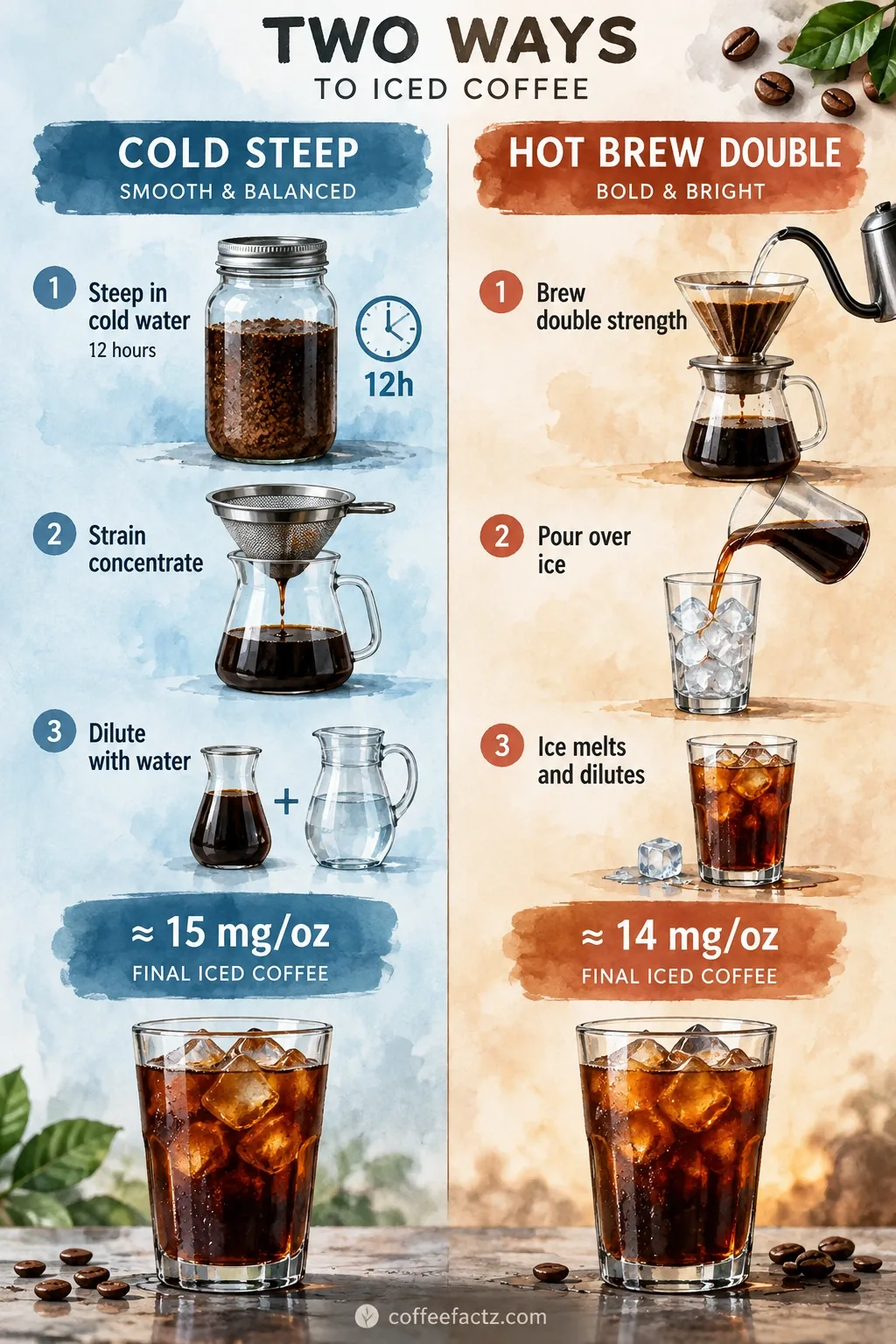
The misconception worth naming directly: “cold brew equals highest caffeine” is a category error. Cold brew is often more concentrated than drip coffee at independent cafés that serve it straight or with minimal dilution. But Dunkin’s commercial formulation, with its batch dilution step, puts it below the double-strength iced coffee. The brew strength of the iced coffee wins here, not the cold-brew method.
Roast Color Signals Flavor, Not Caffeine
Dunkin Midnight Dark Roast carries slightly less caffeine than Original Blend. That’s the fact most people don’t expect, and it directly contradicts the common assumption that darker means stronger.
Decaf sits near zero across all sizes, as expected. But Midnight, despite its heavier, smokier flavor, lands measurably below Original Blend in milligrams per fluid ounce.
The root cause is what roasting actually does to caffeine. Roast color is a record of how long and how hot the bean was processed. That process drives off moisture, develops aromatic compounds, and breaks down chlorogenic acids. Caffeine is chemically stable through all of it. It largely survives the roasting process intact.
A large-scale study published in the Journal of Agricultural and Food Chemistry on industrial roast sets (113 Arabica samples, 38 Robusta samples) found that caffeine showed only weak correlation with roast color in Arabica beans, with Spearman’s ρ values between −0.18 and 0.11. By contrast, other bioactives like trigonelline and chlorogenic acids correlated strongly with roast color. The study also found that caffeine extraction was nearly complete (up to 98%) once the water-to-coffee ratio exceeded 16, pointing to bean-to-water ratio as the dominant variable in final brew caffeine, not roast level. The authors noted that achieving a product rich in multiple bioactives requires blending coffees of different roast levels, which confirms that blend composition matters more than roast color alone.
So when Midnight tastes darker and more intense, that’s real. The roasting process genuinely changed the flavor compounds. But the caffeine content barely moved. The “darker = stronger caffeine” assumption is a taste expectation getting misread as a chemical fact.
Ice, Milk, and Swirls: How Customization Changes Your Cup
Dunkin customization changes how caffeine feels in the cup, but it doesn’t change how much of it you absorb. That distinction is worth understanding precisely.
Ice melt is the clearest example. Over a 60-minute drinking window, melting ice dilutes the caffeine concentration, meaning fewer milligrams per fluid ounce as you drink. But as long as you finish the cup, the total milligrams absorbed stays exactly the same. The caffeine doesn’t disappear. It just spreads across more liquid.
Add-in displacement works on the same logic. When dairy milk, oat milk, a flavor shot, or a swirl goes into the cup, it adds fluid volume. That extra volume displaces some coffee, which nudges caffeine-per-sip down. The total milligrams in the package stays fixed, but each sip delivers a smaller fraction of it.
Flavor shots and swirls are a separate question. They affect sugar load and taste. They don’t directly affect caffeine content. Sugar-free flavor shots swap sweetener type; they don’t add or remove caffeine.
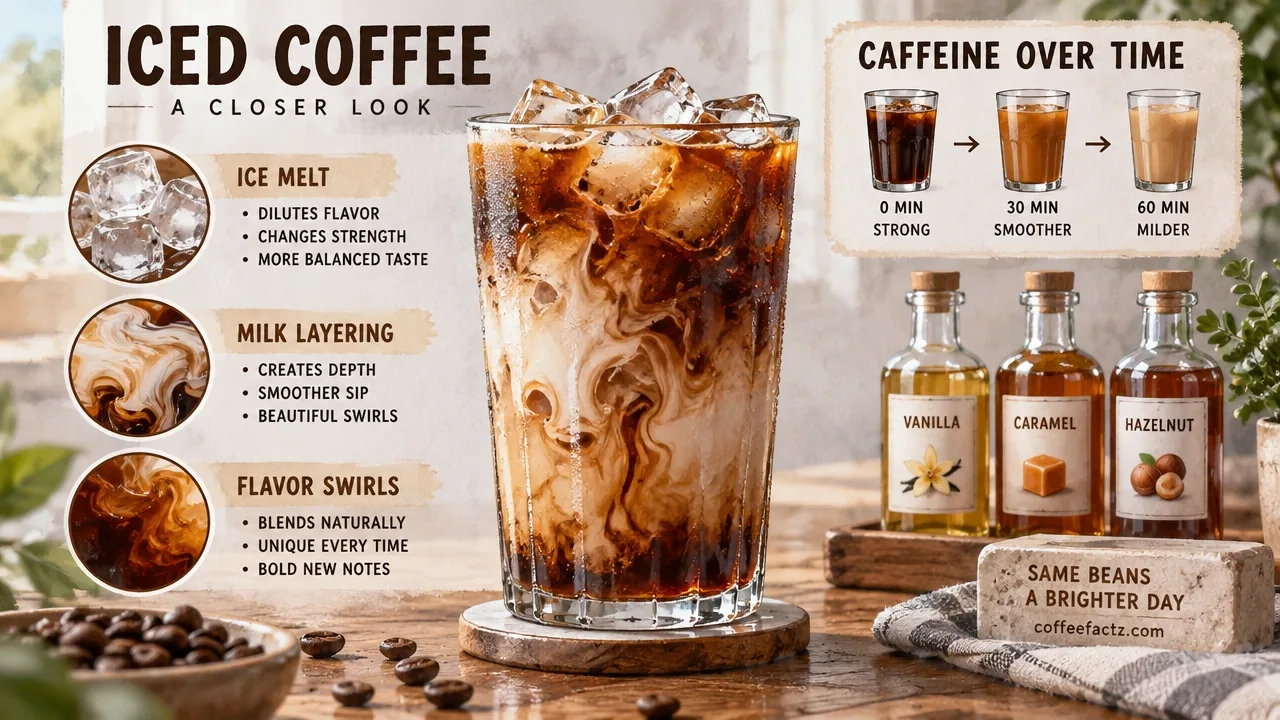
The practical correction here: a drink that tastes mild is not necessarily a low-caffeine drink. A milk-heavy, ice-heavy iced coffee can feel smooth and gentle and still deliver the full dose of caffeine from the base brew. The dose-control levers that actually matter are total cup volume and how long you take to drink it, not how sweet or creamy it tastes.
The Quick-Scan Caffeine Finder: Highest to Zero
Caffeine density at Dunkin doesn’t follow the order most people expect. Here’s the full menu ranked from highest to lowest, by both total milligrams (Large size) and approximate mg per fluid ounce.
| Rank | Drink | Large Total (mg) | Approx. mg/fl oz |
|---|---|---|---|
| 1 | Energy Cold Brew | ~432 mg | ~19 mg/fl oz |
| 2 | Iced Coffee | ~396 mg | ~12 mg/fl oz |
| 3 | Cold Brew | ~371 mg | ~16 mg/fl oz |
| 4 | Original Blend (Hot Drip) | ~300 mg | ~13 mg/fl oz |
| 5 | Midnight Dark Roast (Hot Drip) | ~270 mg | ~12 mg/fl oz |
| 6 | Americano / Macchiato / Latte | ~235 mg | ~10 mg/fl oz |
| 7 | Frozen Coffee | ~295 mg | ~13 mg/fl oz |
| 8 | Refreshers | ~132 mg | ~6 mg/fl oz |
| 9 | Decaf | ~4 mg | ~0.2 mg/fl oz |
One persistent claim worth addressing directly: Frozen Coffee is not the most caffeinated item on the Dunkin menu. At roughly 295 mg for a Large, it sits well below standard Cold Brew (371 mg) and Energy Cold Brew (432 mg). The “Frozen Coffee is the strongest” story circulates because the drink doesn’t look like a caffeine vehicle. It looks like a dessert. But the ranking is clear.
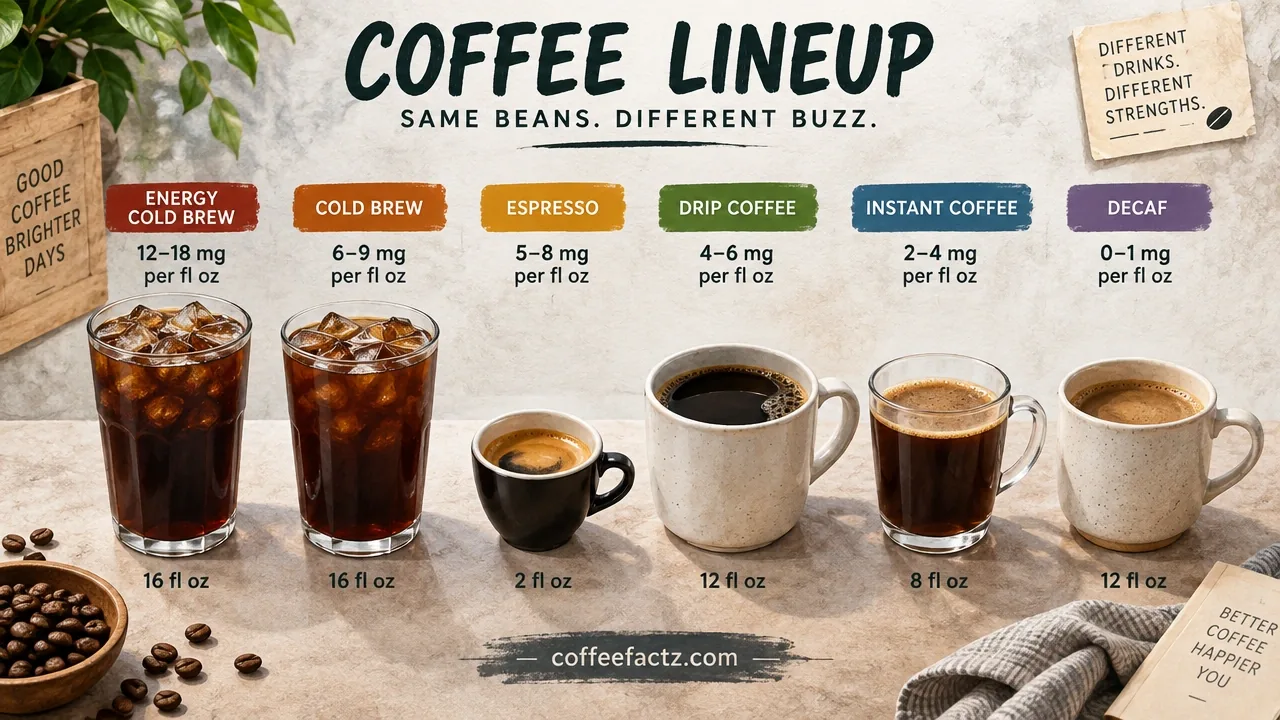
The true high-caffeine tier is the cold and iced coffee column. Not the frozen drinks. Not the dark roast drip. If you’re managing your intake, that’s the column to watch.
Your Safety Playbook: FDA 400 mg, Pregnancy 200 mg, and Half-Decaf Math
Daily Intake Ceilings and Vulnerability Warnings
The FDA’s recommended daily caffeine ceiling for healthy adults is approximately 400 mg. For pregnant or breastfeeding individuals, that ceiling drops to 200 mg. So when someone asks “is 200 mg a lot?”, the answer depends entirely on who’s asking: for a healthy adult, it’s half the daily limit and a moderate single dose. For someone pregnant, it’s the entire day’s allowance in one drink.
Certain groups need to apply tighter limits regardless of those guidelines. People with caffeine sensitivity, individuals on specific medications (including some antidepressants, antibiotics, and blood pressure drugs that interact with caffeine metabolism), and those with heart conditions or arrhythmias should treat 400 mg as a ceiling that doesn’t apply to them, not a target.
Menu Item Risk Mapping
Mapping the Dunkin menu against those ceilings makes the risk picture concrete. Most standard orders, a Medium Original Blend, a Large Latte, a Cold Brew, land within the healthy-adult range for a single order. The outlier is Energy Cold Brew Large at approximately 432 mg, which exceeds the FDA’s 400 mg daily limit on its own in a single cup.
That’s not a drink to order casually. For a pregnant person, it delivers more than twice the daily safe limit in one sitting. For a healthy adult who plans to drink anything else with caffeine that day, it’s already over the line before the second cup. The practical rule: don’t order it if you’re pregnant; split it with someone if you’re not.
Blended Ratio Calibration and Bedtime Cutoff
The half-decaf strategy is the most underused tool on the Dunkin menu. You can ask for any drink made with a blend of regular and decaf coffee. A half-decaf Large Iced Coffee lands near half the caffeine of the standard version, roughly 180–200 mg instead of 396 mg. That puts it squarely in a range that works for most adults and approaches the pregnancy ceiling with some headroom.
You can dial the ratio further. A one-third regular, two-thirds decaf blend on a Large Iced Coffee brings you to roughly 130 mg, which is a genuinely low dose for a large-format drink.
On timing: stop caffeine intake roughly 4–6 hours before bed. Caffeine’s half-life in the body averages around 5–6 hours, meaning a 3 PM large iced coffee at 396 mg still has roughly 200 mg active in your system at 8–9 PM. That’s not a sleep-friendly number. And avoid caffeine on an empty stomach if you’re prone to jitteriness or GI discomfort. Food slows absorption and blunts the spike.
For pregnant readers specifically: the half-decaf approach across every order is the most practical way to stay under 200 mg daily while still drinking Dunkin coffee. A half-decaf Medium hot Original Blend runs around 100–105 mg. Two of those over a full day keeps you under the ceiling with room to spare.
Frequently Asked Questions About Dunkin Caffeine Content
How much caffeine is in a medium DD iced coffee?
Published figures range widely, from around 200 mg to 280 mg for a Medium Iced Coffee, with no single verified lab value behind any source. Treat it as roughly 200–260 mg and adjust your daily intake accordingly.
Is 200 mg of caffeine a lot?
For a healthy adult with a 400 mg daily ceiling, 200 mg is a moderate single dose, about half the limit. For someone pregnant or breastfeeding, 200 mg is the entire recommended daily maximum, so a single medium-to-large drink can use it up in one cup.
How much caffeine is in a 12 oz cup of black coffee at Dunkin?
A Small Original Blend, which runs around 10–12 oz, contains roughly 150 mg of caffeine. That’s the closest match to a standard 12 oz black coffee on the Dunkin menu.
How many ounces is a small Dunkin iced coffee?
A Small Dunkin iced coffee is typically around 12 oz, though the cup is sized to accommodate ice, so the actual liquid volume is somewhat less than the stated size.
Why does cold brew have less caffeine than iced coffee at Dunkin?
Dunkin’s cold brew is steeped in batches at fixed commercial parameters and then diluted before serving. The iced coffee starts as a double-strength hot concentrate, which means its caffeine load before dilution is higher. After ice melt, it still lands above the cold brew.
Does adding oat milk or a flavor swirl change how much caffeine I get?
No. Milk and swirls add fluid volume and change the flavor, but they don’t add or remove caffeine from the base brew. They dilute the concentration per sip, but the total milligrams in the cup stays the same.
Can I order a half-decaf drink at Dunkin to control my caffeine intake?
Yes, and it’s one of the most practical tools on the menu. Ask for a blend of regular and decaf in whatever ratio fits your target. A half-decaf Large Iced Coffee brings the dose from ~396 mg down to roughly 180–200 mg.
What’s the lowest-caffeine hot coffee option at Dunkin that still tastes like coffee?
Decaf is the obvious answer at near-zero milligrams, but if you want some caffeine with a genuine coffee flavor, a half-decaf Small Original Blend runs around 70–75 mg, which is low enough for most sensitive drinkers.
References
- The Exact Caffeine Amount in a Medium Iced Coffee | eathealthy365.com
- Cold vs. Iced: Using Sensory Analysis to Test the Claim That Cold Brew Is Sweeter and Less Acidic | sca.coffee
- Quantitative Studies on Roast Kinetics for Bioactives in Coffee | docksci.com
