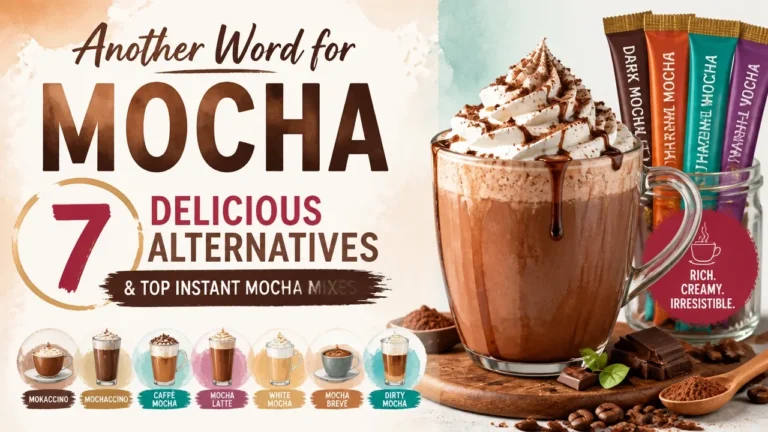

Mocha coffee is one of those words that feels specific until you actually order it – and then suddenly you’re holding something completely different from what you pictured. The word traces back to a real place, carries at least three distinct meanings, and splinters into half a dozen café names that aren’t interchangeable.
Once you understand why the word is slippery, choosing the right drink – or the right synonym – stops being guesswork. That’s what this guide is for.
Quick Answer: Mocha Synonyms and the Word’s Three Meanings
Mocha coffee goes by several names in cafés: Caffè Mocha, Mochaccino, Mocaccino, Chocolate Cappuccino, Marocchino, and Bicerin. Each of those is a real synonym – but they’re not interchangeable. Some describe a specific drink build with a defined ratio of espresso, milk, and chocolate. Others are regional defaults that vary by country or coffee shop.
Beyond the café menu, “mocha” carries two other meanings that have nothing to do with what’s in your cup. Mocha color is a rich dark-brown associated with roasted coffee and dark chocolate, used widely in interior design and fashion. The second is geographic: Al Mokka (also spelled Al Mukha), a historic port city on the Red Sea coast of Yemen. A peer-reviewed article by architectural historian Nancy Um documents how the name mocha entered European consciousness through the high volumes of Arabica coffee shipped from Al Mokka’s shores during the seventeenth through twentieth centuries – and how the city’s association with a local Sufi leader’s coffee-drinking legacy cemented that connection in trade and language alike.
So when someone says “mocha,” they might mean a drink, a color, or a city. In a café, even the drink meaning forks into multiple recipes. That’s the root of the confusion – and the reason knowing the synonyms alone doesn’t fully solve the problem.
The Real Problem: “Mocha” Is a Family of Drinks, Not One Recipe
You can order a mocha in two different cafés on the same block and get two genuinely different drinks. That’s not a mistake – it’s a structural feature of how the word works. Mocha coffee has no universal recipe, which means every shop fills that gap with its own default build.
Modern Café Baseline Builds
A mocha latte is the most common default in U.S. cafés. When someone walks up to a counter and orders “a mocha” without further specification, most baristas interpret that as a mocha latte: espresso shots pulled into steamed milk with chocolate syrup, usually topped with whipped cream. But that’s a convention, not a rule. One barista noted that roughly 99% of unmodified mocha orders are really mocha latte requests – but that still leaves a gap for the other 1%, and the whipped cream itself is inconsistent. Some third-wave shops don’t stock it, don’t add it by default, or actively skip it on specialty builds.
The builds you’re likely to encounter beyond the mocha latte include:
- Mocha cappuccino – espresso with chocolate and a higher ratio of dry foam to milk, closer to a cappuccino texture
- Mocha au lait – drip coffee (not espresso) with chocolate and steamed milk, which produces a gentler, less intense cup
- Mochaccino / Mocaccino – terms used interchangeably with mocha latte in many shops, though some cafés treat them as distinct drinks with a different milk-to-foam ratio
The important thing to understand is that a mocha is not simply “a latte with chocolate.” A latte has a specific espresso-to-milk ratio and a thin layer of microfoam. Adding chocolate to that doesn’t automatically make it a mocha – some shops use different espresso volumes, different chocolate-to-milk balances, or entirely different bases. The word mocha describes a flavor profile and a broad category, not a fixed construction.
Regional Menu Naming Friction
The naming friction gets worse when you cross regional lines. In some European cafés, mochaccino or mocaccino is the standard menu term for what Americans call a mocha latte. In others, “mocha latte” appears as a separate, distinct item from “mocha.” Some shops treat “mocha latte” as redundant – as if every mocha is already a latte – while others use the full compound name to signal a specific size or milk volume.
What this means practically: the synonym you use in one city may trigger a completely different drink in another. Knowing the name isn’t enough. Knowing the components is what saves you.
7 Delicious Alternatives to a Mocha: By Craving, Not Just Name
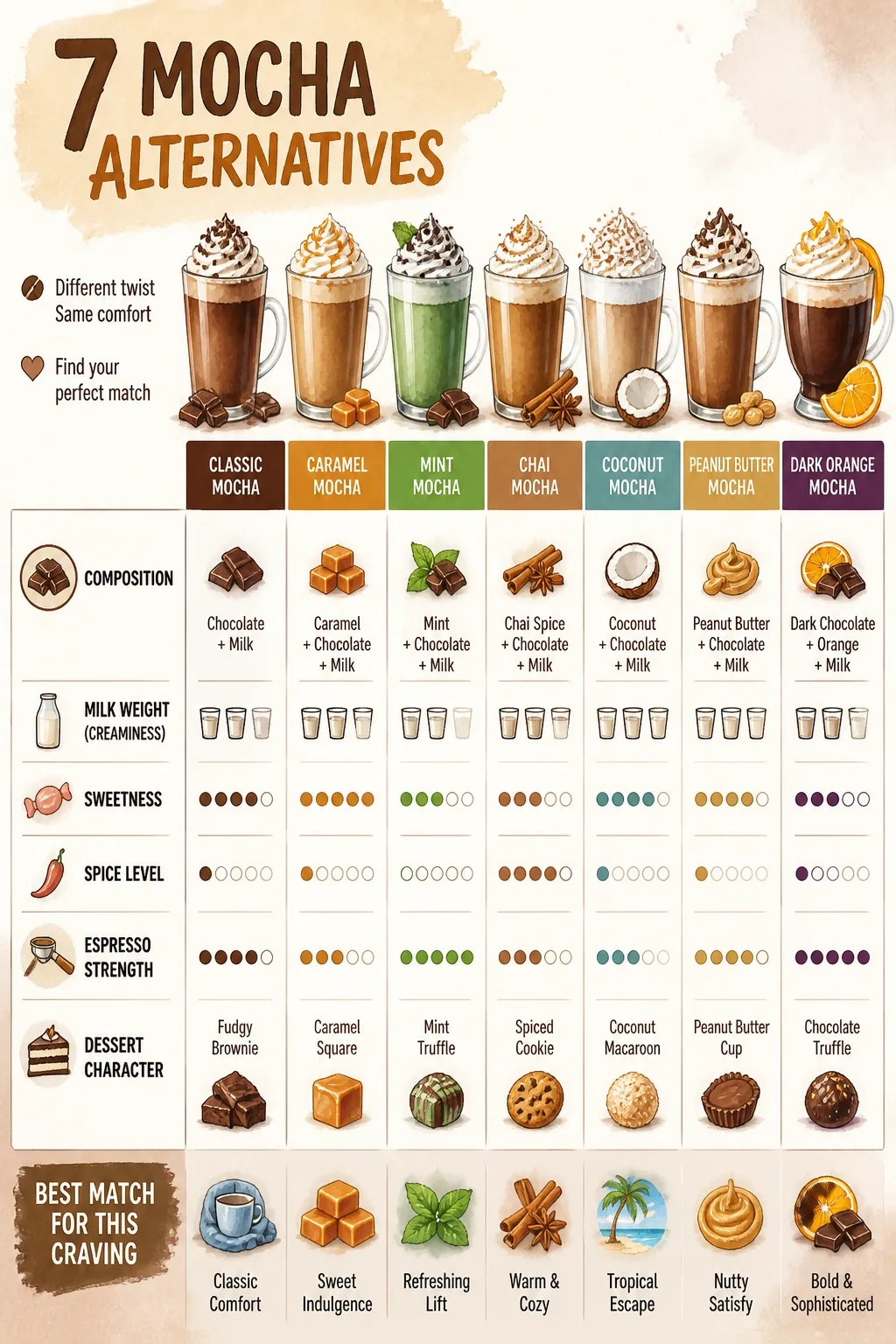
If you want something in the mocha coffee family but with a different character, the seven alternatives below cover every direction the craving can pull. Each one shares the chocolate-coffee DNA but diverges in texture, intensity, or sweetness in a meaningful way.
Here’s a visual overview of how these alternatives compare before diving into each one:
The infographic below maps all seven options against the craving they satisfy best.
1. Bicerin – Originating in Turin, Italy, this is a layered drink of dark chocolate, espresso, and heavy cream served in a small glass. Nothing gets stirred. You drink through the layers in sequence, which means the flavor changes from sip to sip. It’s far less milky than a mocha latte and closer to a dessert experience. Best for: thick, layered, no-milk intensity.
2. Marocchino – Also Italian, the Marocchino is a small espresso shot served in a glass dusted with cocoa powder, topped with a small amount of frothed milk and more cocoa on top. It’s compact, not sweet, and espresso-forward. Think of it as the minimalist cousin of the mocha. Best for: cocoa aroma without sweetness.
3. Dirty Chai Latte – This replaces chocolate entirely with warm baking spices: cinnamon, cardamom, ginger, clove. A shot of espresso goes into a spiced black tea base with steamed milk. The result is aromatic and warming in a completely different direction from chocolate. Best for: spice-forward drinkers who want caffeine without sweetness.
4. Nutella / Hazelnut Latte – Instead of plain chocolate syrup, this uses a hazelnut-chocolate spread (or hazelnut syrup) as the flavor base. The result is nuttier, less bitter, and slightly richer than a standard mocha. Best for: people who find mocha too sharp and want a rounder, sweeter cup.
5. White Chocolate Mocha – Swaps dark or milk chocolate for white chocolate sauce, which is creamier, sweeter, and lacks the bitter cocoa notes of a standard mocha. Starbucks popularized this build, but most cafés can make it on request. Best for: sweet and creamy with no bitterness.
6. Cortado with Cocoa Dusting – A cortado is equal parts espresso and warm (not frothed) milk, making it one of the most espresso-forward small drinks on a café menu. A dusting of cocoa powder on top adds just enough chocolate aroma without sweetness or syrup. Best for: strong espresso drinkers who want a hint of chocolate, not a chocolate drink.
7. Affogato al Cioccolato – A shot of hot espresso poured directly over a scoop of chocolate gelato. The gelato melts into the espresso as you eat it, creating a hot-cold, bitter-sweet contrast that no other drink on this list can replicate. Best for: dessert-first occasions where you want the coffee to be part of the experience, not the vehicle.
Top Instant Mocha Mixes for Quick Cravings
Not every mocha craving happens near a café. The instant mocha category exists for exactly that gap – but the quality range between options is real, and picking the wrong packet is a fast way to end up with something thin, artificially sweet, or barely chocolatey.
Packaged Sachet Comparison
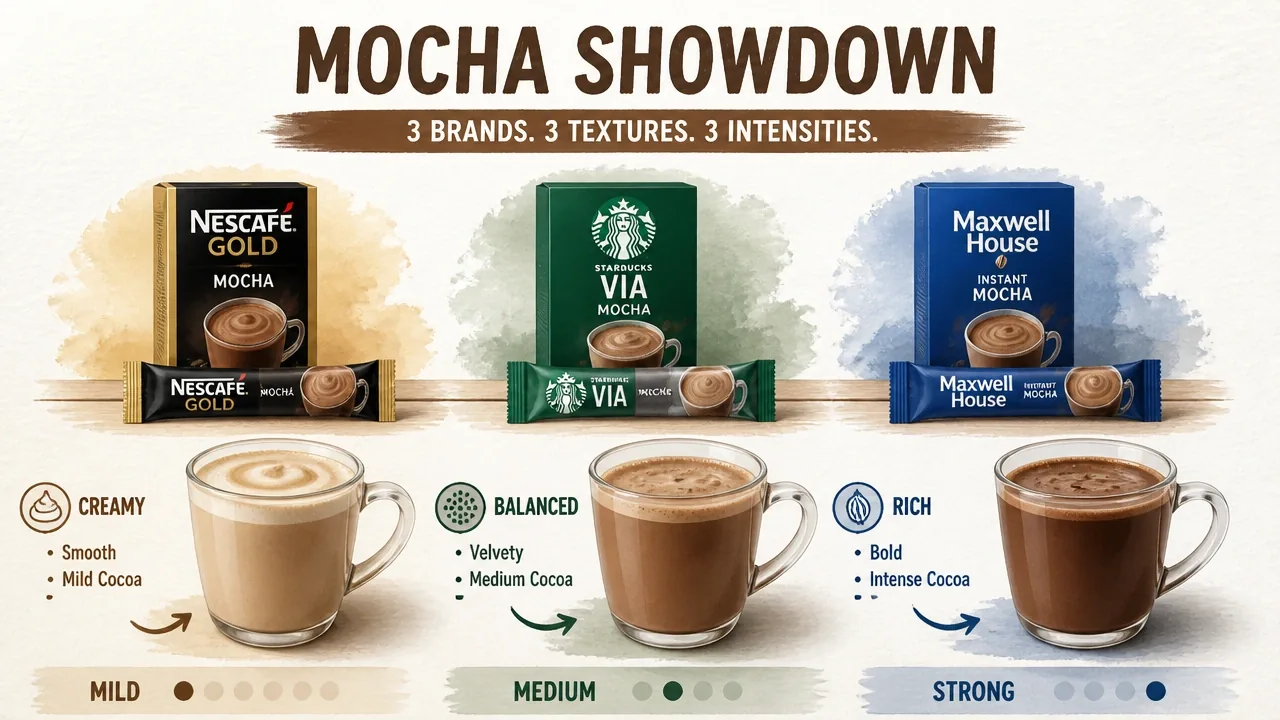
Three packets dominate the accessible end of this category, and each one wins on a different dimension:
Check out how these three stacks up side by side before deciding which one belongs in your pantry:
| Packet | Best For | Key Differentiator |
|---|---|---|
| Nescafé Gold Mocha Sachets | Texture-first drinkers | Velvety microfoam topping that mimics a café finish |
| Starbucks VIA Instant Caffè Mocha | Cocoa intensity | Highest cocoa concentration with a bold espresso base |
| Maxwell House Café Vienna / Suisse Mocha | Budget and pantry staple | Classic sweetened mix, widest availability, lowest cost |
One thing worth being clear about: these are instant mixes, not espresso-based café drinks. They belong to a separate category from the Bicerin or Marocchino discussed earlier. The goal here is convenience and consistency, not craft. If you’re choosing between these three, use this triage – Nescafé Gold if you care most about texture, Starbucks VIA if cocoa intensity is the priority, and Maxwell House if you want a reliable, inexpensive pantry staple.
Clean-Label DIY Recipe
If you want to control exactly what goes into your cup – no artificial sweeteners, no mystery powders – the cleanest at-home option skips the sachets entirely. Combine 1 tsp of premium instant coffee with 1 tbsp of unsweetened Dutch cocoa powder, 1 tbsp of maple syrup, and warm oat milk. That’s it.
Here’s the mise en place for this simple DIY build:
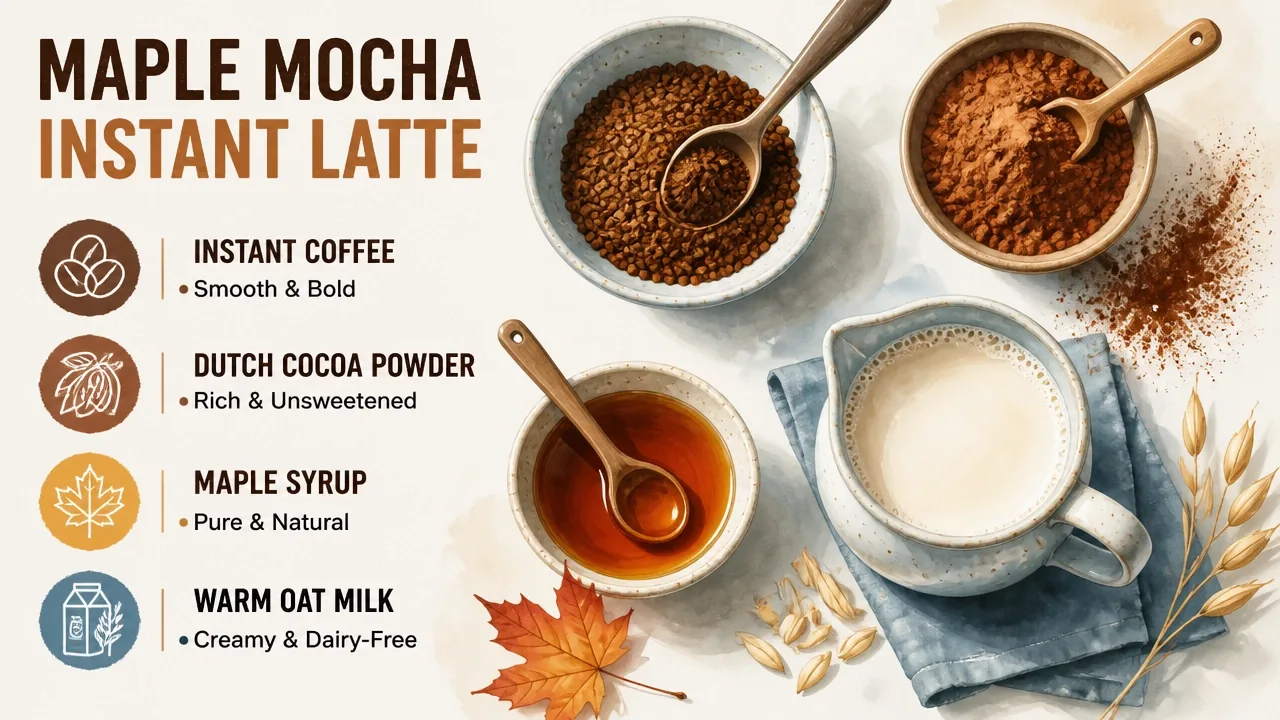
The Dutch cocoa powder matters – it’s alkalized, which means it’s less bitter and dissolves more smoothly than natural cocoa. The maple syrup gives you real sweetness control: start with one tablespoon and adjust from there. Oat milk adds body without dairy and froths reasonably well if you have a small handheld frother.
Barista Hacks: How to Upgrade Instant Mocha at Home
Instant mocha mixes have a reputation for tasting thin or artificially bitter, and that reputation is earned – but it’s fixable. Most of the problem comes from preparation errors, not the mix itself.
The single most important rule: never use boiling water directly on the powder. Boiling water scorches cocoa solids, which is what creates that harsh, flat bitterness. Instead, dissolve the powder in about 1 oz of warm water first – just enough to form a smooth paste – then add the rest of your liquid. If you’re ever brewing fresh coffee as a mocha base rather than using instant, the water temperature rule flips: you want it just off the boil at 195–205°F to properly extract the coffee grounds without burning them.
For the video below, you’ll see three progressively better methods for making a mocha at home – from a quick basic build to a genuinely café-quality result:
Once the powder is dissolved, substitute warm frothed whole milk or oat milk for plain water entirely. This single swap changes the texture from watery to velvety. A handheld frother takes 20 seconds and makes a measurable difference.
The finishing touch that most people skip: a tiny pinch of sea salt or a small shake of ground cinnamon. Salt suppresses the perception of bitterness without making the drink taste salty. Cinnamon enhances the chocolate note and adds warmth. Either one works; both together is not too much.
If you eventually want to graduate from instant coffee to fresh-brewed as your mocha base, here’s the beginner guardrail: start with a 1:15 coffee-to-water ratio, grind your beans just before brewing with a burr grinder (not a blade grinder, which produces uneven particle sizes), and use a French press or pour-over before considering an espresso machine. Espresso machines have a steeper learning curve and more variables to control. The simpler brew methods will teach you how coffee actually tastes before you add the complexity of pressure extraction.
Valrhona’s chef Quentin Jacquemaire takes a similar approach to the espresso base when building a proper mochaccino from scratch:
Quentin Jacquemaire, chef at Valrhona, recommends starting with a double espresso – ideally a ristretto, brewed at a 1-to-2 coffee-to-water ratio – as the backbone of any serious mocha build. The concentrated extraction keeps the coffee flavor from being drowned out by chocolate and milk.
That logic applies even when you’re working with instant: the stronger and more concentrated your coffee base, the better it holds its character against the sweetness of chocolate and milk.
How to Order a Mocha Alternative Without Guesswork
The ordering problem with mocha coffee is that the word itself is ambiguous at the point of purchase. Saying “I’ll have a mocha” hands the decision about milk texture, chocolate amount, and whipped cream entirely to the barista’s default – which varies by shop, region, and whoever is working that shift.
The fix is to order by base and components, not by a single label. Instead of “mocha,” try:
- “Mocha latte” – signals espresso, steamed milk, chocolate, latte texture
- “Mocha cappuccino” – signals espresso, chocolate, more foam and less milk
- “Mochaccino” – use this if it’s the term on the local menu; don’t fight the shop’s vocabulary
- “Latte with chocolate” – the most explicit and least ambiguous phrasing in any café
Beyond the base name, two clarifications are worth making explicit every time: your milk base (whole milk, oat milk, or no milk) and whipped cream (yes or no). These two variables account for the majority of “this isn’t what I expected” moments after the first sip.
If you want something that isn’t a latte build at all – say, a stronger, less milky cup – use component-order language rather than a drink name. Something like “double shot with a pump of chocolate, no milk” removes every assumption the barista might make about your default. You’re not relying on a synonym to carry the meaning; you’re specifying the construction directly.
Adapt to whatever the local menu says. If the café’s board uses “mocaccino” as the default term, use that word. Imposing a generic synonym onto a shop that already has its own naming convention adds friction without gaining anything.
Final Verdict: The Best Mocha Alternative to Try First
If you’ve read this far and you just want a single clear recommendation, here it is.
For a café first step, the choice depends on what you’re chasing. If you want creamy, sweet, and immediately approachable, order a White Chocolate Mocha – it’s the most beginner-friendly alternative because it removes the bitterness of dark chocolate entirely. If you want something more interesting and less milky, order a Bicerin and experience what a layered chocolate-espresso-cream drink actually feels like when the components aren’t blended together.
For an at-home first step, pick up Nescafé Gold Mocha Sachets and apply the upgrades from H2-5: dissolve the powder in warm water first, use frothed oat milk or whole milk instead of plain water, and finish with a pinch of sea salt or cinnamon. That combination will produce a noticeably better cup than following the packet instructions alone.
Going forward, use the ordering rule in every café: say the base and the components explicitly. Don’t chase the perfect synonym – synonyms describe categories, not constructions. The barista who knows you want a double shot, oat milk, chocolate syrup, and no whip will always get your order right, regardless of what the menu calls it.
Key Takeaways on Mocha Coffee
- “Mocha” has three separate meanings: a café drink family, a dark brown color, and the historic Yemeni port Al Mokka where Arabica coffee trade began.
- Caffè Mocha, Mochaccino, Mocaccino, Chocolate Cappuccino, Marocchino, and Bicerin are real synonyms – but each describes a distinct drink build, not just a flavor.
- An unmodified “mocha” order defaults to a mocha latte in most U.S. cafés, but this isn’t guaranteed everywhere.
- For café alternatives, White Chocolate Mocha suits sweet-and-creamy cravings; Bicerin suits layered, less-milky intensity; Cortado with Cocoa Dusting suits espresso-forward drinkers.
- Never dissolve instant mocha powder in boiling water – it scorches cocoa solids and creates artificial bitterness; use warm water first.
- Order by base and components (“double shot, oat milk, pump of chocolate, no whip”) rather than a single synonym to eliminate ordering ambiguity.
Frequently Asked Questions About Mocha Coffee
What are other names for mocha?
The most common synonyms are Caffè Mocha, Mochaccino, Mocaccino, Chocolate Cappuccino, Marocchino, and Bicerin. They all share a chocolate-and-coffee foundation but differ in milk ratio, foam texture, and build.
What is another name for the color mocha?
The color mocha is most closely described as dark taupe, warm chocolate brown, or café au lait depending on the exact shade. In design contexts it sits between beige and dark brown, leaning toward roasted coffee tones.
What is a fancy name for coffee?
Espresso-based drinks with Italian names tend to read as more elevated: Ristretto, Macchiato, Cortado, Bicerin, and Affogato all carry more specificity and heritage than a plain “coffee” order.
Are mochaccino and mocha latte the same drink?
Usually, but not always. Most cafés use the terms interchangeably for an espresso-chocolate-steamed milk drink. Some shops treat them as distinct builds with different milk-to-foam ratios, so it’s worth checking the local menu.
What’s the difference between a mocha and a hot chocolate?
A mocha contains espresso shots alongside the chocolate and milk; hot chocolate contains no coffee at all. The espresso is what makes a mocha a coffee drink rather than a chocolate drink.
Can I make a mocha without an espresso machine?
Yes. Strong drip coffee or French press coffee works as a base, though the flavor will be less concentrated than espresso. The 1:15 coffee-to-water ratio with freshly ground beans gives you the strongest non-espresso result.
Why does my mocha taste bitter when I make it at home?
The most common cause is dissolving cocoa powder or instant mix directly in boiling water, which scorches the cocoa solids. Dissolve the powder in a small amount of warm water first, then add your heated milk.
What’s the least sweet mocha alternative I can order?
A Cortado with Cocoa Dusting is the least sweet option – it’s equal parts espresso and warm milk with just a cocoa powder dusting, no syrup. A Marocchino is similarly restrained and also skips added sweeteners.
References
- Spatial Negotiations in a Commercial City: The Red Sea Port of Mocha, Yemen during the First Half of the Eighteenth Century | orb.binghamton.edu
- Valrhona Mochaccino Recipe | worldwidechocolate.com