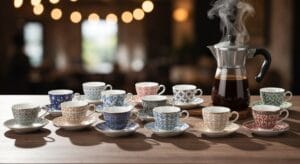

You’re about to spend thirty bucks on what should be a fifteen-dollar piece of guaranteed function. I ran the numbers from spec sheets against what actual users are complaining about online. The brutal truth? The ceramic market splits between engineering consistency and fragile aesthetics. We need to figure out which one you’re actually paying for, because the marketing hides some serious maintenance traps.
The Industry’s Secret About Size
Here’s the fundamental problem: brands anchor their “flat white” label around 150ml, based on manufacturer specs from ACME, Loveramics, and most major players. But dig into the community feedback on r/espresso, and you’ll find people screaming that to achieve proper texture density—the kind you actually want in a flat white—you need 20 to 30ml more headspace.
Think about what that means. Manufacturers optimized for an industry term, not the user’s desired beverage density. If you buy the name brand at standard size, you’re buying a cup that’s functionally too small for serious home pouring.
And those gorgeous, textured glazes celebrated by artisans? They come with a silent cost. Certain artisanal finishes are intentionally porous, meaning the cup essentially drinks your coffee. This leads to permanent staining that no scrubbing fixes. You pay premium dollars for a distinctive look, and the price of admission is constant, high-effort cleaning or accepting a ruined finish over time.
ACME Classic Small Cup (150ml) – The Professional Workhorse
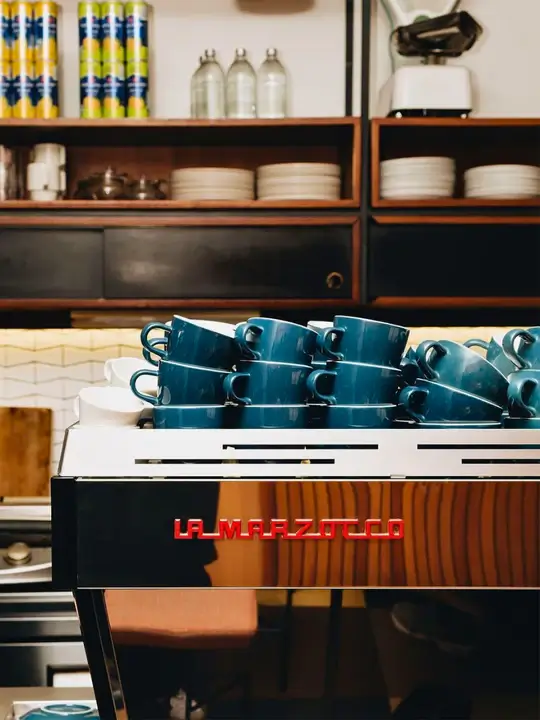
This is the known quantity, the baseline often associated with the drink’s origin story.
What You’re Actually Getting
ACME delivers exact measured dimensions: 87mm diameter by 59mm height, with a 48mm base. According to the manufacturer’s technical documentation, it uses high-density porcelain with thick-walled construction throughout. That thickness is engineered specifically for heat retention—think of it like a ceramic thermos.
This design isn’t just marketing; recent heat transfer research published in The Sydney journal confirms that high-density porcelain is a thermal powerhouse, outperforming glass and even stainless steel by significantly slowing down heat conduction through the cup walls. The mass sucks up a bit of heat from your initial espresso shot, but once warmed up, it keeps coffee hot longer than thin-walled alternatives because the material’s specific heat capacity acts as a superior insulator, maintaining the ideal drinking temperature throughout those crucial first four minutes of your coffee experience.
The brand positions this as balanced for milk pouring, but that validation comes from internal professional testing rather than independent stress testing available to the public. You’re trusting engineers who built it for café throughput, not necessarily for your kitchen counter.
The Maintenance Reality
It’s low-maintenance by design. The manufacturer confirms it’s dishwasher safe, and it’s built for high-volume stacking efficiency. That might mean the interior geometry—which features a smooth gradient for latte art—is less forgiving than other shapes when you’re trying to hit that perfect pour.
Your Decision Point
Buy this if you need predictable, measurable performance that handles heat retention like a known constant. Skip it if you refuse to adjust your recipe to fit a cup prioritizing stacking efficiency over your ideal 180ml pour.
THERMAL MASS DECODED: Thick-walled porcelain acts like insulation. The thickness absorbs some initial heat but creates consistency over time. The payoff is thermal stability, not immediate gratification.
Loveramics Egg Flat White Cup (150ml) – The Championship Showpiece
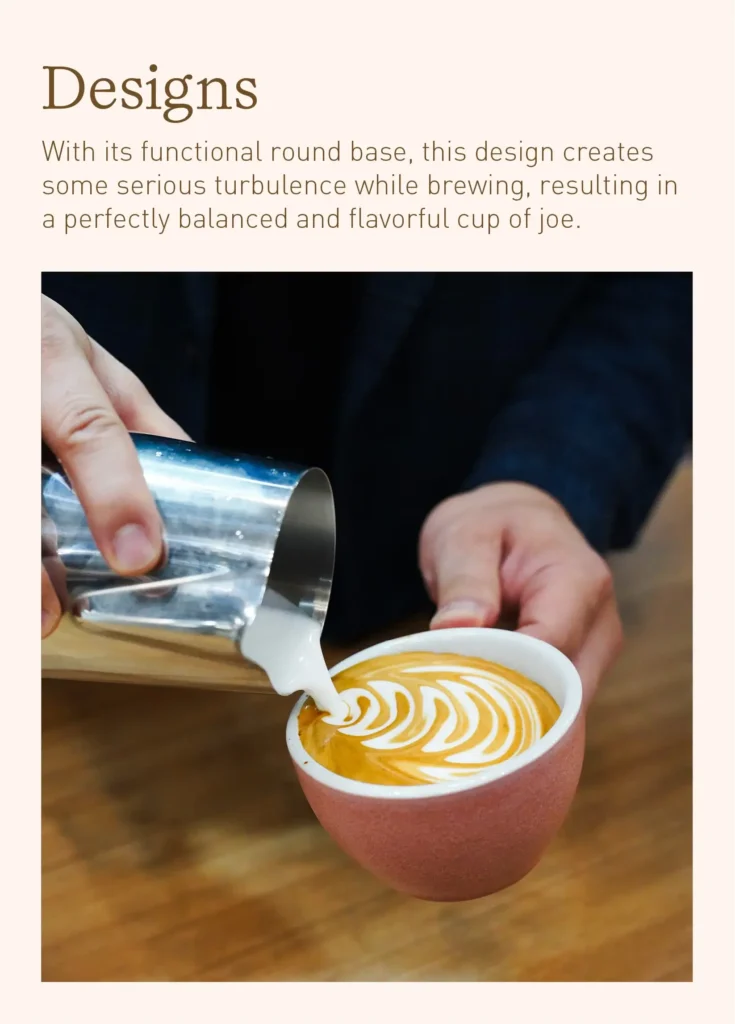
This is championship branding meeting aesthetic curation.
What You’re Actually Getting
Loveramics hits SCA standards with an absorption rate below 0.5%—that’s the cup’s insurance against cracking in the dishwasher. According to their product documentation, they fire commercial-grade porcelain at 1,300°C. Dimensions clock in at 9cm diameter by 5cm height.
The brand pushes the championship affiliation hard, as seen across their UK retail presence and e-commerce positioning. Here’s the kicker: discussions across specialty coffee communities reveal a lurking flaw. Many reactive glazes—even on low-absorption porcelain bodies—absorb coffee oils around specialized textures or crackle finishes.
You aren’t just paying for engineering. You’re paying for the prestige tier where finish integrity takes a back seat to visual impact.
The Maintenance Reality
If you opt for decorative glazes, you inherit a high-maintenance burden. You’re trading guaranteed stain-free living for an aspirational logo. The issue? A cup validated by world champions is still aesthetically curated first, leading to that permanent coffee stain problem.
Actually, here’s what’s interesting: that low absorption rate only protects the porcelain body from water. The fancy glaze sitting on top still soaks up oils and pigments from dark liquids, regardless of how good the underlying ceramic is. It’s not the cup absorbing water—it’s the decorative finish drinking your espresso.
Your Decision Point
Buy this if the emotional payoff of owning a collectible validated by champions justifies extra scrubbing time. Skip it if you want something cleaning up as easily as the ACME baseline, because these stylized finishes will tie up your time.
Three Marks “185 Marks” Cup – The Geometry Fix

This one’s the quiet champion you’ll only find in specialized discussions.
What You’re Actually Getting
According to the product specifications, it delivers 185ml capacity—designed by Reto Schneller, weighing 250g per unit. It’s glazed porcelain, but the real story is what community deep dives on r/espresso highlight: a rounded internal bottom specifically engineered to help milk integration and latte art flow.
When you pour steamed milk, you need liquid cascading inward smoothly to create a vortex for art. A flat bottom forces milk to hit a sudden stop, causing turbulence—that’s why bad art happens. A rounded base allows flow to continue uninterrupted. Flat bases are optimized for shelf stacking, not pour quality.
The Maintenance Reality
The risk here is acquisition hassle. We don’t have solid e-commerce data on current retail pricing, making it a procurement mystery. But functionally, the fact that its geometry is being celebrated for fixing a known art flaw sends a major signal.
Your Decision Point
Buy this if your number-one priority is achieving technically flawless microfoam and art presentation, regardless of brand scarcity. Skip it if you refuse to purchase until you can verify exact MSRP and see official spec sheets.
GEOMETRY VS. STACKING: Flat bottoms force milk turbulence at the base. Rounded bottoms let flow continue naturally. The flat base is “budget-optimized” for warehouse efficiency, not pour quality.
The Three Marks “185 Marks” Cup might be hard to find. If you like this design, you can buy Fellow Monty cups right on Amazon. It’s a very beautiful product; I didn’t mention it because I haven’t tried it, not because it’s not worth mentioning.
Affiliate Disclosure
This post contains affiliate links, meaning I may earn a commission if you make a purchase through these links, at no additional cost to you. As an Amazon Associate, I earn from qualifying purchases. I only recommend products I genuinely believe will add value.

Fellow Monty Milk Art Coffee Cups - Double Wall Ceramic Cappuccino Mug, Matte Black with Graphite Base, 6.5 oz Cup
- MONTY THE CAPPUCCINO CUP - A modern 6.5 oz sleek double wall ceramic mug ideal for sipping on beautiful, handc…
- PICASSO YOUR POUR - Where some see a cup, we see a canvas! Monty was created for latte art with the design of …
- REFINED COFFEE MUG - Monty's sleek, subtle polished graphite bottom complements the matte black ceramic finish…
- STACKABLE DESIGN - Monty's stackability makes for efficient storage & can be beautifully displayed in your kit…
- DISHWASHER SAFE - Monty does not need to be hand-washed, just add to the dishwasher; however, you DO NOT micro…
Fourth Ceramics Black Pearl – The Aesthetic Gamble
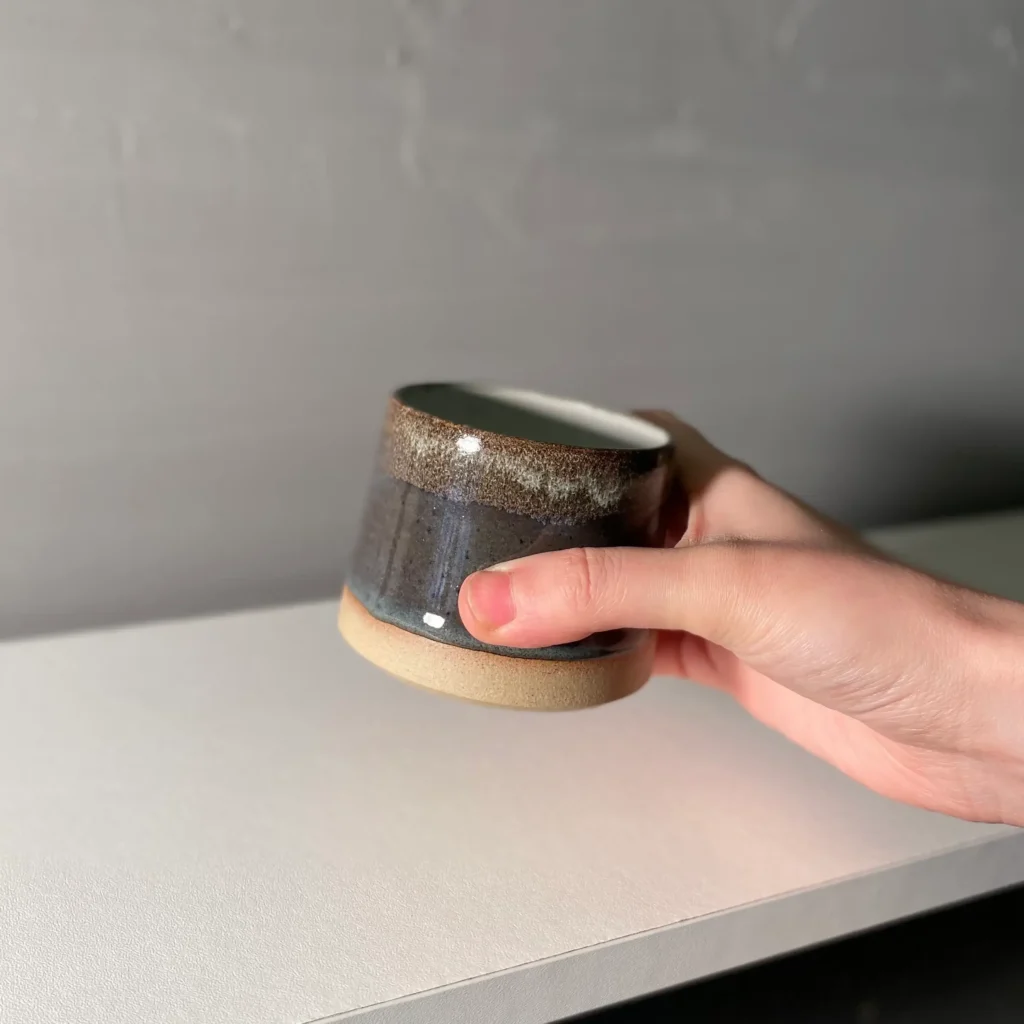
This is the ultimate example of prioritizing form so aggressively that functional protection vanishes.
What You’re Actually Getting
According to their product listings, this is handcrafted, small-batch stoneware featuring matte or textured dimpled surfaces. Capacity sits in that awkward 150ml-200ml range.
The beauty is undeniable, but the business model centers on scarcity. Their official sales terms allow up to seven working days from purchase for dispatch. The crucial detail? They enforce a strict “no returns, no refunds” policy on these unique pieces.
The Maintenance Reality
If you focus too heavily on the visual allure of that signature “Black Pearl” finish, you’re walking into a financial trap. If the tactile surface or dark glaze doesn’t resonate perfectly in hand, you absorb 100% of the loss. They explicitly void standard consumer protection.
This isn’t a tool. It’s a high-stakes gamble on visual perfection.
Your Decision Point
Buy this if you view the £14 unit price as the cost of owning non-returnable studio art, fully accepting the risk. Skip it if you expect ceramics purchased for daily use like this notNeutral Lino to carry standard consumer protection against aesthetic disappointment.
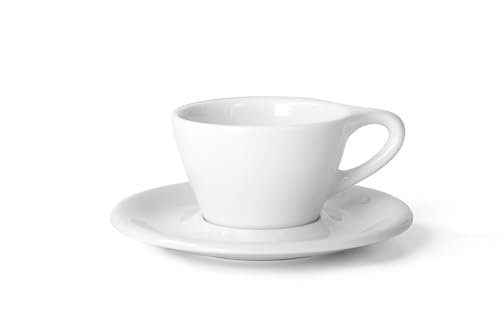
notNeutral Lino Porcelain Cup & Saucer Double Cappuccino 6 oz (White, 6 oz, 2)
- Fine porcelain
- Dishwasher-and microwave-safe
- Volume: 6 oz. (180 ml)
- Cup: 2.375" H x 4.75" W - Saucer: 6.25" diameter
- Made in Sri Lanka
The Expert Workaround: Oversizing On Purpose
Forget trying to find the perfect 160ml benchmark. That standard is undersized for reality. Instead, use what industry pros like Tom Saxon actually recommend: the Capacity Compensation Strategy.
Intentionally select an oversized vessel, like the KRUVE IMAGINE at 250ml, recognizing its capacity is excessive for true flat white density. The advantage? Its high capacity accommodates the actual fluid volume you need—your usual double shot plus that extra 30ml headroom—while still looking impressive for presentation.
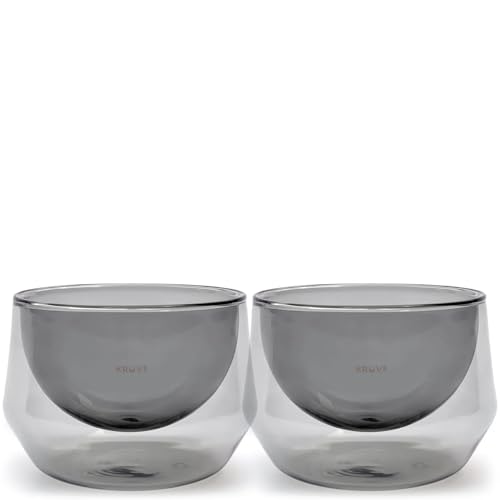
KRUVE IMAGINE Dark Coffee Cups - Handcrafted Double-Wall Glass Cups (Set of Two, 8.5oz/250ml) - Perfect for Latte Art and Espresso - Durable Borosilicate Glass - Ideal Gift for Coffee Mugs Lovers
- Designed for Easier Latte Art - The KRUVE IMAGINE latte cup is specially designed for pouring stunning latte a…
- Hand-blown Dishwasher Safe Borosilicate Glass - Made from premium laboratory-grade borosilicate glass, these c…
- Perfect Gift - KRUVE IMAGINE mug set makes an ideal gift for coffee enthusiasts, professionals, or anyone who …
- Award-Winning Brand - Designed by KRUVE, a leading specialty coffee company based in Canada, these espresso cu…
- Works as Insulated Cupping Bowl - Featuring double-wall construction, these insulated coffee mugs maintain an …
You manage the functional trade-off—a technically diluted texture—by adjusting your milk load downward during the pour. This solves the industry-wide “capacity trough” problem better than sticking to undersized professional standards.
This route suits home baristas who value the visual storytelling of a large, beautiful cup and are willing to engage in continuous ratio adjustment.
How I Built This For You
My analysis didn’t just read spec sheets. I forced manufacturers’ claims about materials and thermal mass against what people actually report about stains, art failure, and returns policies across Reddit’s r/espresso community and specialty retailer listings.
The core truth I’m giving you: if a cup’s primary selling point is an aesthetic feature—unique glaze, champion endorsement, artisanal texture—be prepared for that feature to introduce hidden maintenance requirements or strict financial risk. My loyalty is to your long-term satisfaction, not the beauty of the glaze.
If a cup is gorgeous but stains immediately, it’s a problem. Period.
Frequently Asked Questions
Q: How can I accurately measure the true liquid capacity of a cup before buying?
A: Fill the cup to the brim with water, then pour that water into a measuring cup or weigh it; the amount that remains is the cup’s usable volume and shows any hidden lip space.
Q: What are the visual or tactile clues that a glaze will absorb coffee and stain over time?
A: Porous, crackled or matte finishes feel slightly uneven and let a water droplet sink rather than bead, indicating the glaze will soak up coffee and eventually discolor.
Q: Are dishwasher‑safe labels trustworthy for specialty coffee cups?
A: The label only confirms the cup survived a normal wash cycle; it does not guarantee resistance to sudden temperature changes or long‑term glaze wear, so occasional hand washing is still wise.
Q: Does a champion endorsement guarantee a better drinking experience?
A: Endorsements reflect personal taste and brand partnerships, not independent performance testing, so they are marketing signals rather than proof of superior function.
Q: What alternative materials can I consider if I want a flat white cup that stays cooler to the touch?
A: Bone china provides a thinner, cooler feel but can chip more easily, while tempered glass resists heat shocks but may alter perceived flavor; each choice balances durability against temperature neutrality.
Q: How should I evaluate a retailer’s return policy before purchasing a high‑risk ceramic?
A: Check for explicit coverage of damage, a reasonable return window, and whether aesthetic issues are included; vague or no‑return policies mean you are accepting full risk.