
Synchronized coffee flowering doesn’t happen because conditions were favorable – it happens because the tree was stressed first. The dry season is not downtime between harvests. It is the physiological trigger that switches an arabica tree from vegetative growth into reproductive mode, and without it, no amount of nutrition or irrigation will force a heavy, uniform bloom.
Understanding that mechanism changes how you plan everything: your labor calendar, your input timing, your response to off-cycle rain events. The water cycle is not something you work around. It is the primary management lever on your farm.
To fully optimize your cultivation strategy, it helps to understand how the unique characteristics of coffee bean plants respond to these shifting moisture levels throughout the year.
Understanding this intricate water-driven cycle also sheds light on the very beginning of the supply chain, particularly how coffee seeds are grown before they ever reach this crucial reproductive stage.
Understanding these rigorous environmental dynamics also clarifies why certain production regions consistently achieve higher cup profiles, as detailed in our guide on Specialty vs Commercial Coffee Grade.
Key Takeaways on Coffee Flowering
- The dry season triggers flower bud differentiation through ABA accumulation; without water stress, arabica trees stay vegetative regardless of nutrition or temperature.
- Ethylene dynamics at re-watering – not ABA itself – initiate anthesis; the rain releases what the drought programmed.
- A dry period of two to three months produces more differentiated buds per node, leading to heavier, more synchronized blooms and a more manageable single harvest pass.
- Rainfall exceeding 40 mm during the blossoming period can reduce total yield by up to 60%; heavy rain at near-ripe harvest stage causes splitting, mold, and premature cherry drop.
- Off-cycle fly crops triggered by unseasonal rain require a decision framework based on main crop stage; no standard agronomic protocol exists, so producers must build their own.
- Three to five seasons of field-by-field rainfall and flowering date records will give you more predictive power over your harvest window than any generic production calendar.
The Coffee Plant’s Water-Driven Phenological Clock
The coffee phenological cycle in tropical arabica-growing regions runs on water, not temperature. That distinction matters enormously. Unlike temperate crops where day length or cold snaps set the reproductive clock, arabica coffee reads the rise and fall of soil moisture as its primary seasonal signal. Rainfall seasonality is the metronome.
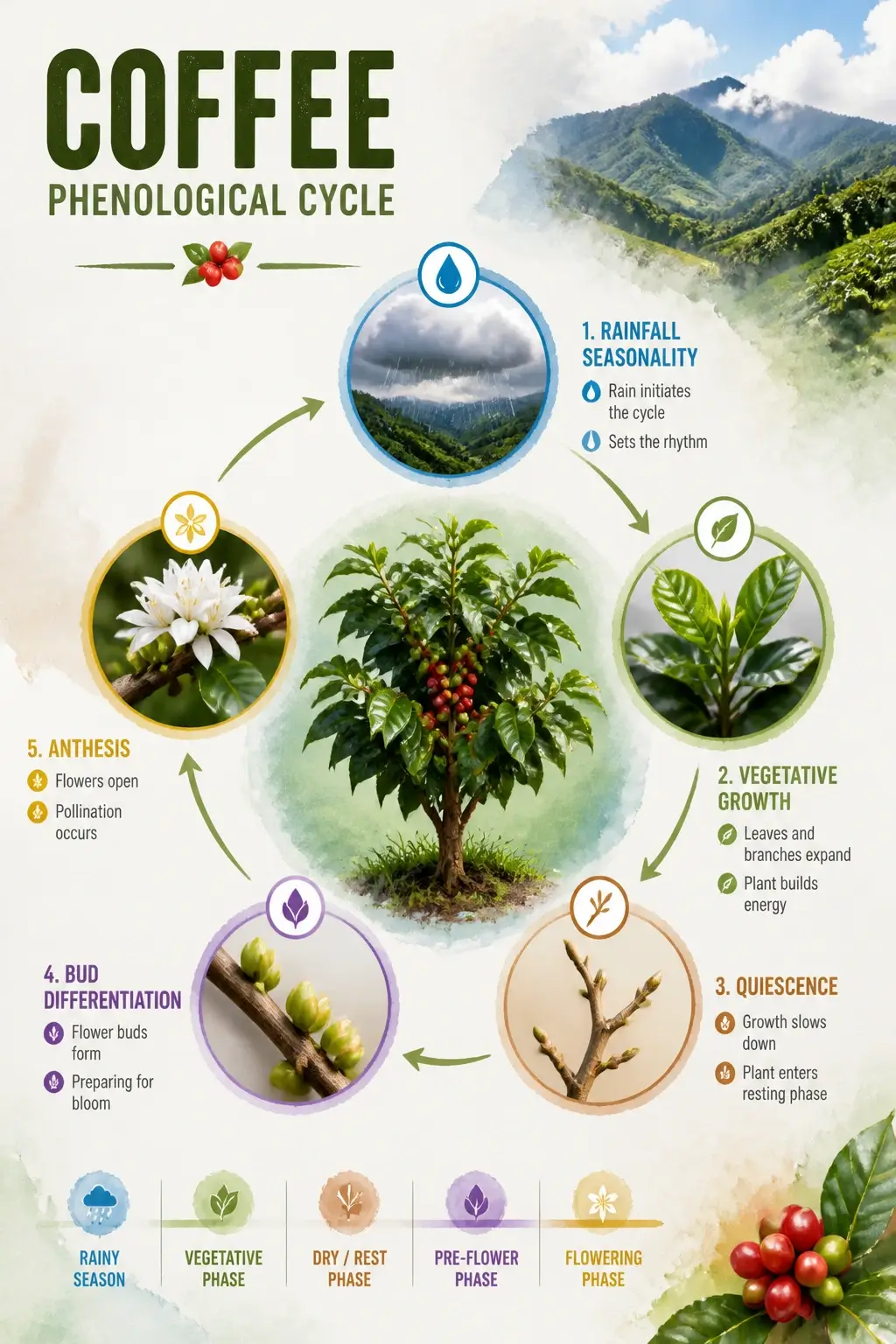
The sequence is predictable once you see it as a chain of events, not a calendar. During the rainy season, the tree is in full vegetative mode: canopy expansion, new node formation, root growth. As moisture drops at the onset of the dry period, growth slows and eventually stalls. Latent axillary buds along the branches enter a state of quiescence. This is not dormancy in the strict botanical sense – the buds are alive and metabolically active – but vegetative development is suppressed.
What happens inside those buds during the dry spell is the subject of the next section. The critical point here is that flower bud differentiation only begins under water stress. The tree is not waiting for rain. It is using the absence of rain to reprogram its buds from leaf formation to inflorescence primordia. The dry season is the instruction, not the obstacle.
Then the first substantial rains arrive. Bud tissue rehydrates rapidly, and anthesis – the synchronized opening of flowers – follows within days. That single event, a mass bloom of fragrant white blossoms, sets the entire downstream calendar: fruit set, bean fill, maturation, harvest.
How many times does coffee flower in a year? The honest answer is: it depends entirely on how many distinct dry-wet cycles the trees experience. In a bimodal rainfall zone – parts of Colombia, Kenya, or Uganda – two meaningful dry periods can produce two flowering events and two harvest windows per year. In a unimodal system like Brazil or much of Ethiopia, one defined dry season produces one major bloom and one harvest. Where rainfall is erratic and dry spells are short or interrupted, trees may produce several small, staggered flowering events that result in uneven ripening and difficult harvests. The rainfall pattern is not just a background condition. It is the architecture of your production year.
One common misread deserves correction here: water availability in each phase is not primarily about keeping the tree alive. It is about sending the right signal at the right time. Too much moisture at the wrong phase keeps the tree vegetative. Too little at the wrong phase stresses developing fruit. The tree is not simply consuming water – it is reading it.
Here’s a visual summary of how the phenological cycle maps to rainfall seasonality across the full year:
One transition sentence before the infographic: the cycle below shows how each phenological phase aligns with the seasonal water curve, making the dry period’s role as a reproductive trigger visually apparent.
Understanding these macro phenological rhythms provides the foundation necessary for proper step-by-step coffee plant care throughout the changing seasonal phases.
Why the Dry Season Builds the Bloom
Flower bud differentiation is the mechanism that separates a heavy, synchronized bloom from a scattered one – and it runs on water deficit, not abundance. When soil moisture drops consistently over several weeks, the tree’s hormonal balance shifts. Abscisic acid (ABA) accumulates in bud tissue. Gibberellic acid, which promotes vegetative elongation, is suppressed. The buds stop trying to make leaves and start forming inflorescence primordia – the structural precursors to flower clusters.
That hormonal shift is well-documented, but the full picture is more nuanced than the simple “drought = flowers” model suggests.
Academic Evidence: ABA levels in coffee tissue rise during drought stress and then drop sharply when re-watering begins, just before anthesis. The transition to actual flowering is associated with increased ACC (1-aminocyclopropane-1-carboxylate) levels and ethylene dynamics – not with ABA accumulation itself. – From a peer-reviewed study in Frontiers in Plant Science on crosstalk between ethylene and ABA during soil water changes in coffee anthesis.
What this means in practice: ABA during drought is the lock, not the key. It holds the buds in a primed, dormant state. Ethylene dynamics triggered by re-watering are what actually open the door to flowering. The dry season builds the potential. The rain releases it.
The severity and duration of the dry period directly shape how many buds differentiate per node. A mild dry spell of three or four weeks, or one interrupted by unseasonal showers, produces fewer fully differentiated primordia. The resulting bloom is sparse and asynchronous – what farmers often describe as “lazy” flowering, with open blossoms spread across two or three weeks instead of concentrated in a single five-to-ten-day event.
The major arabica origins that run single-harvest systems – Brazil, Colombia‘s main crop, Ethiopia – typically have a defined dry season of two to three months. That window is long enough to accumulate sufficient ABA-mediated dormancy across the majority of nodes simultaneously. When rain arrives, the release is synchronized farm-wide. That synchrony is not incidental to quality. It is the foundation of a manageable, predictable harvest.
Here is where a common assumption breaks down. Many producers believe that intensifying fertilizer applications can compensate for a weak or absent dry period – that heavy nutrition will force a productive bloom regardless of moisture conditions. The mechanism does not support this. Nutrition can support the formation of floral primordia once water stress has initiated the hormonal shift, but it cannot substitute for that shift. Heavy nitrogen applications during water stress actively work against flowering: nitrogen drives vegetative growth, and a tree pushed into new leaf production during the dry period is a tree that is not differentiating flower buds. Feeding before the dry season to build tree reserves is sound agronomy. Feeding during it to force flowering is, at best, wasted input and, at worst, counterproductive.
Rain’s Arrival: Anthesis, Pollination, and the Fragile Fruit Set Window
Coffee bloom and fruit set happen faster than most producers expect. When the first substantial rainfall – typically 10–15 mm over one to three days – rehydrates primed bud tissue, anthesis can follow within 48 to 72 hours. A single rain event can synchronize flowering across an entire farm block. Walk your field the morning after the first real rain of the season and you will see why it’s called a “star bloom” – every node that differentiated during drought opens nearly simultaneously.
The bloom itself lasts five to ten days. The white blossoms are intensely fragrant, short-lived, and structurally delicate. Arabica is largely self-pollinating, which removes the dependency on bee populations that washed-arabica farmers in some regions worry about, but successful fertilization still requires specific physical conditions. Moderate humidity supports pollen viability. Heavy downpours during peak bloom physically dislodge open flowers and wash away pollen before fertilization completes. Prolonged wetness on open blossoms creates ideal conditions for Botrytis and other fungal pathogens.
The practical implication: the timing of that first triggering rain matters enormously, but so does what follows it in the next ten days. A well-timed rain on fully primed buds, followed by moderate conditions, can produce fruit set rates above 70% of open flowers. A triggering rain followed immediately by heavy storms, or a drizzle that triggers partial flowering without full bud hydration, leads to staggered anthesis and a fruit set that stretches over weeks. That stretch is the origin of uneven ripening four to six months later.
Once fertilization succeeds, the young fruit enters the pinhead stage – tiny green nodules, roughly 2–3 mm in diameter, clustered along the same nodes that flowered. The tree’s relationship with water now shifts entirely. The dry season’s job is done. The rainy season’s job begins: supplying consistent moisture for cell division, fruit expansion, and eventually sugar development in the developing cherry.
Any significant moisture deficit in the four to six weeks after fruit set suppresses cell division in the endosperm. The result is not crop failure – the cherries survive – but the ceiling on bean size is set here. Recover from drought stress later in development and you will not recover those cells. Screen size, and the premium price it commands in many markets, is partly determined by what the rain does in these first weeks after bloom.
Where Rainfall Breaks the “Uniform Flowering = Predictable Harvest” Model
Rainfall’s impact on harvest does not end at fruit set. This is where the oversimplified model – uniform flowering guarantees a predictable harvest – runs into real farm data and falls apart.
The growth phases from fruit set to harvest span roughly 24 to 36 weeks in most arabica origins, varying with altitude and temperature. Within that window, rainfall plays a different role in each phase, and the consequences of getting it wrong compound.
During the fruit expansion phase (approximately weeks 2–10 after set), consistent moisture drives cell division and determines ultimate bean size and density. Insufficient moisture here produces smaller, lighter beans – lower screen sizes, lower weight per volume, and in many auction systems, lower prices. This is where altitude-moisture interactions become critical: high-altitude farms often have more stable moisture from cloud cover, which is one reason mountain-grown coffees tend toward larger, denser beans.
During the maturation and ripening phase, the picture gets more nuanced. Moderate water stress in the final weeks before harvest can concentrate flavor precursors – acids, sugars, aromatic compounds – producing the intense, complex profiles associated with Ethiopian naturals and some dry-processed lots from high-altitude farms. But that stress must be calibrated. Severe moisture deficit during bean fill produces underweight, shriveled beans with harsh rather than complex cup notes. The line between “productive stress” and “damage” is narrow and site-specific.
The most operationally damaging rainfall event is also the most common: heavy rain on nearly ripe cherries. Cherries at 80–90% maturity have thin, taut skin and a high internal sugar content. A substantial rain event causes rapid water uptake through the stem, the skin splits, mold colonizes the exposed pulp within 24–48 hours, and cherries begin dropping prematurely. A producer who has managed the crop well for eight months can lose a significant portion of their ripe yield in 72 hours.
The research on this is stark.
Statistical Data: Rainfall exceeding 40 mm during the blossoming period reduces total coffee yield by up to 60% in certain regions. – Source: CIRAD Agritrop
That figure applies specifically to bloom timing, but the mechanism – physical disruption of a critical reproductive event by excessive water – applies equally to harvest timing. The rain that triggers flowering is essential. The same quantity of rain at harvest is catastrophic.
Uneven ripening is the downstream cost of staggered flowering, and it compounds the labor problem. When cherries mature in waves rather than a single window, selective harvesting requires multiple passes through the same blocks. Each pass costs labor. Each pass captures a lower percentage of fully ripe cherries relative to the total still on the tree. The labor cost per unit of quality rises sharply.
The ochratoxin risk deserves a direct mention. When cherries split or drop during heavy pre-harvest rain, and drying is delayed by continued wet weather, Aspergillus ochraceus finds ideal conditions for colonization. Ochratoxin A contamination is a genuine food safety concern and a market access issue for producers exporting to the EU. The rainfall variability between flowering and harvest is not just a yield and quality problem. It is a compliance risk.
Producers who plan labor recruitment, milling scheduling, and financing around a fixed nine-month calendar from bloom date are exposed to this entire chain of risks. The uniform flowering event sets the earliest possible harvest date. Everything between that event and harvest – the specific pattern of subsequent rainfall – determines the actual date, the quality spread, and the labor requirement. Planning from the bloom date alone is planning from incomplete information.
Off-Cycle Flowering: What a Fly Crop Actually Means for Your Farm
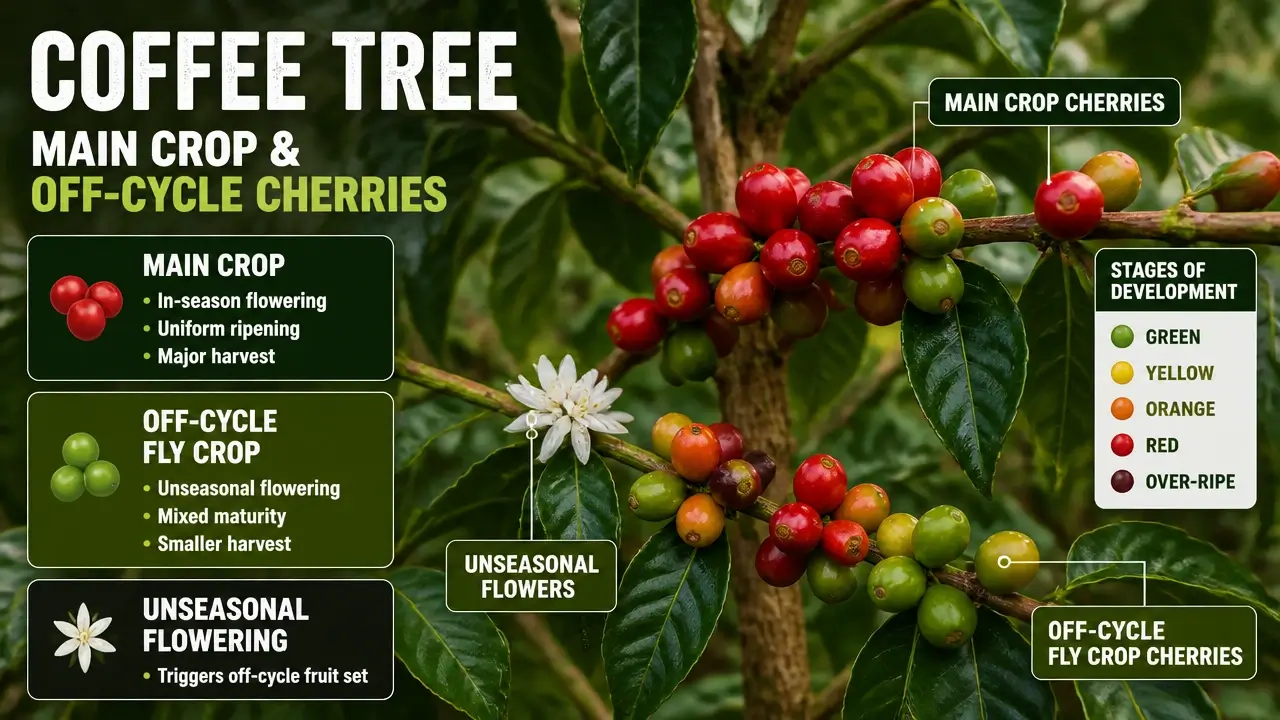
Off-cycle flowering is the edge case that most technical guides skip entirely, and it is exactly where producers need the most support. A tropical storm, an early wet front, an anomalous rain event in the middle of a dry period – any of these can force buds that were not yet fully dormant into anthesis. The result is a fly crop: a secondary, unplanned crop maturing under different and usually less favorable conditions than the main harvest.
Off-Cycle Flowering: The Mechanism and Its Quality Ceiling
The dry-wet trigger in arabica coffee is deeply hardwired. Any significant rain after a period of relative dryness can activate buds that retain enough primordia development to flower, even if the calendar says it is the wrong time of year. The tree does not consult the calendar.
The outcome for the fly crop cherries is almost always inferior to the main crop. The reasons are physiological and climatic. Fly crop cherries mature during a season with different temperature, humidity, and light conditions than those under which the main crop develops. Cell division during fruit expansion is often compromised by variable moisture. Sugar accumulation in the ripening phase is frequently lower. The result is lower cherry density, less uniform ripening within the same cluster, and cup quality that typically does not reach the main crop’s ceiling.
That said, “inferior to the main crop” does not automatically mean “worthless.” At altitude, with careful selective harvesting and separate processing, a fly crop can produce commercially viable coffee. The risk is in mixing it with the main crop – either physically during picking or during milling – which dilutes the quality of the entire lot.
Producer Challenges: Harvest Uncertainty and the Protocol Gap
The dominant emotional response to an unexpected fly crop is not optimism about a bonus harvest. It is fear about timing, resource allocation, and the main crop’s integrity. Producers facing cyclone-induced or storm-triggered off-cycle flowering frequently cannot agree on the harvest date – estimates for the same event on the same farm can diverge by two months or more, depending on altitude, aspect, and the exact rainfall pattern that follows the trigger event.
The logistical concerns compound quickly. Will the fly crop draw carbohydrate reserves away from the main crop during fruit fill? When will milling capacity be available? Should the same labor force handle both crops, and if so, in what sequence? Is it worth harvesting the fly crop at all, or does the cost of selective picking exceed the value of the beans?
There is no standard protocol in any widely used agronomic manual for managing off-cycle flowering. This is not a gap that has been quietly solved elsewhere – it is a genuine knowledge hole that forces producers into reactive, improvised decisions at exactly the moment when a clear decision framework would have the most value.
The producer forums where these questions surface reveal a consistent pattern: existing industry content on coffee flowering is written for buyers and logistics planners who need to know when shipments will be ready. Producers facing an off-cycle event need something entirely different – decision trees, risk assessments, and concrete guidance on protecting the main crop’s quality. That content largely does not exist.
Managing Water Cycles for Predictable Production
Water-stress management strategies are not about controlling nature. They are about reducing the variance of your response to it. The producers with the most consistent quality and the most manageable harvest windows are not the ones with the best weather. They are the ones who treat the dry period as a managed input rather than a waiting room.
For irrigated farms, the tool is regulated deficit irrigation. The goal is to simulate the hormonal conditions of a natural dry season under controlled conditions: reduce soil moisture gradually over four to six weeks until the tree shows mild stress indicators (slight leaf curl in the early afternoon, slowing of shoot extension), then apply a single “trigger irrigation” of sufficient volume to fully rehydrate bud tissue. Some well-managed irrigated farms in Brazil and parts of Central America achieve more than 80% of their crop in a single harvest pass using this approach, because the bloom was synchronized by design rather than by chance.
The critical discipline here is resisting the temptation to irrigate during the stress phase. An irrigation event that relieves drought stress prematurely – before adequate primordia differentiation has occurred – can trigger a weak, early bloom and reset the hormonal clock. You then face a longer wait for full differentiation to recur, or a scattered bloom that complicates the rest of the season.
For non-irrigated farms, the lever is information. Weather forecasting tools – including satellite-based soil moisture monitoring and seasonal rainfall outlooks from national meteorological services – allow a producer to anticipate when the dry window will end, even if its exact timing shifts year to year. That anticipation is the difference between having a harvest labor crew ready when the main bloom finishes and scrambling for pickers six weeks later.
On nutrition timing, the research and the field experience align. Potassium and phosphorus applications in the weeks before the dry period support floral primordia formation and improve fruit set percentage once bloom occurs. Heavy nitrogen during the dry period is counterproductive – it drives vegetative growth at precisely the time the tree should be channeling energy into bud differentiation. The experimental claim that intensive feeding can force monthly flowering ignores the hormonal mechanism entirely. Nutrition shapes the quality of the bloom. Water stress triggers it.
Systematic record-keeping is the highest-leverage low-cost action available to most producers. Map the exact date and estimated intensity of each flowering event, field by field. Record the rainfall pattern between flowering and harvest. Record yield per block and, where possible, quality per block. Do this for three to five seasons and you will have a site-specific model that no generic guide can replicate. Your farm’s water-stress-flowering-harvest relationship is unique to your altitude, soil type, and microclimate. The only way to know it precisely is to measure it.
For an off-cycle fly crop, a simple decision framework reduces the reactive chaos:
- If the main crop is within six to eight weeks of harvest: Strip the fly crop flowers or young fruit from affected blocks. The resource competition and quality-mixing risk outweigh any potential secondary yield.
- If the main crop is at early fruit expansion (weeks 2–8 after set): Leave the fly crop to develop, but plan for separate harvesting and processing. Isolate the fly crop lots entirely. Price and market them separately – never blend them into your main crop lots.
- If the fly crop is already at pinhead stage and separation is not feasible: Accept the quality risk, intensify selective picking discipline, and build the mixed lot into your lower-grade commercial channel rather than your specialty channel.
The predictability gap – the difference between your planned harvest date and your actual harvest date – cannot be eliminated. But it can be narrowed. The farms that consistently narrow it are the ones that treat the dry season as their most important management period, not their most boring one.
The Dry Season as Your Primary Production Lever
The dry season as a management lever is the reframe that changes how every other decision on your farm gets made. Once you see it clearly, the entire production calendar reorganizes itself around a different anchor point.
The dry period sets the clock for bloom. It determines the synchrony of ripening. It shapes cup quality through moisture regulation during fruit fill. Every other input – nutrition, pruning, labor, milling – derives its timing from where the dry season falls and how long it runs. Back-calculate from there. Your pruning schedule should be completed before the dry period begins, so the tree enters water stress with a clean canopy and maximum bud-bearing wood. Your potassium and phosphorus program should peak in the weeks before moisture drops. Your labor contracts should be signed based on a projected harvest window that starts from your dry period’s expected end date, not from a fixed calendar date.
Climate volatility is real and it is accelerating. Dry seasons are shifting in onset and length. Off-cycle rain events from tropical systems are more frequent in many arabica-growing regions. The producers who treat rainwater management as a core competency – who understand the hormonal mechanism well enough to recognize when an unseasonal rain event has fired the trigger – will have a genuine edge over those who are still reading the calendar.
The industry’s technical literature on coffee flowering is written primarily for buyers who need stable shipment schedules. It describes what flowering is and approximately when it happens. It does not tell a producer what to do when a cyclone fires an off-cycle bloom in the middle of their main crop’s fruit expansion phase. That protocol does not exist in any published guide. It must be built farm by farm, from the principles of water-stress physiology and from your own observational data.
No two neighboring farms experience a fly crop identically. Altitude, shade canopy, soil water-holding capacity, and the tree’s nutritional status at the time of the unseasonal rain all modulate the hormonal response. A farm at 1,400 meters with deep volcanic soil retains moisture longer during a dry spell and requires a more intense or prolonged rain event to trigger anthesis than a farm at 900 meters on shallow, well-drained soil. Mastery is not a formula applied uniformly. It is watching your own trees’ response to drought across multiple seasons and learning to anticipate what they will do next.
Start this season by recording the exact date and estimated millimeters of each rainfall event, field by field, alongside the date you first observe open flowers. That single data set, accumulated over three seasons, will give you more predictive power than any generic flowering guide ever could.
Frequently Asked Questions About Coffee Flowering
Can you trigger coffee flowering with irrigation on a non-irrigated farm design?
If you have any water source, yes – a single substantial irrigation event after a controlled dry period will trigger anthesis the same way natural rain does. The key is completing the stress phase first; irrigating before adequate bud differentiation produces a weak, early bloom that desynchronizes your harvest.
How long does the dry period need to be for full bud differentiation?
Most arabica origins require six to ten weeks of consistent water deficit for thorough differentiation across the majority of nodes. Shorter or interrupted dry spells produce fewer differentiated primordia per node and a less synchronized bloom.
Does shade cover change when and how heavily a tree flowers?
Yes, meaningfully. Shade moderates soil moisture loss during the dry period, which can extend the time needed to reach the hormonal stress threshold. Shaded farms often require a longer or more intense dry spell to achieve the same synchrony as open-sun farms at the same altitude.
What’s the difference between a fly crop and a ratoon crop?
A fly crop is an unplanned secondary flowering event triggered by off-season rain on the same tree that produced the main crop. A ratoon crop refers to regrowth from stumped or heavily pruned trees – a planned rejuvenation technique. They are physiologically distinct events with different management implications.
If my bloom was uniform but my harvest is still uneven, what’s the most likely cause?
Post-bloom rainfall distribution is the most common culprit. Uneven moisture across different blocks – from soil variation, slope, or shade – causes cherries to develop at different rates even when they set on the same day. Block-level yield and quality records over multiple seasons will reveal which areas are most susceptible.
Does altitude affect how much rain is needed to trigger anthesis?
Yes. Higher-altitude farms have lower temperatures and often higher ambient humidity, which slows water loss from soil and tissue. The triggering rain event may need to be larger or more sustained to cause the rapid bud rehydration that initiates anthesis, compared to lower-altitude farms with faster drying rates.
How do I know if my trees are fully differentiated before the first rains arrive?
There’s no reliable visual cue from outside the bud. The practical proxy is dry period length and consistency: if you’ve had six or more weeks of well-below-average rainfall with no significant rain events, and shoot growth has visibly stopped, differentiation is likely well advanced. Cutting a sample bud and examining the internal structure under magnification can confirm primordia development, though most producers rely on seasonal experience with their specific blocks.
Should I be worried about ochratoxin if I had heavy rain just before harvest?
If cherries split or drop and drying is delayed by continued wet weather, the risk is real. Separate any rain-damaged or fallen cherries from the main picking, dry them on raised beds with maximum airflow, and consider having those lots tested before committing them to export channels with strict mycotoxin limits, particularly the EU market.
References
- Crosstalk Between Ethylene and Abscisic Acid During Changes in Soil Water Content Reveals a New Role for 1-Aminocyclopropane-1-Carboxylate in Coffee Anthesis Regulation | frontiersin.org
- Rainfall and Coffee Yield Impact Study | agritrop.cirad.fr