
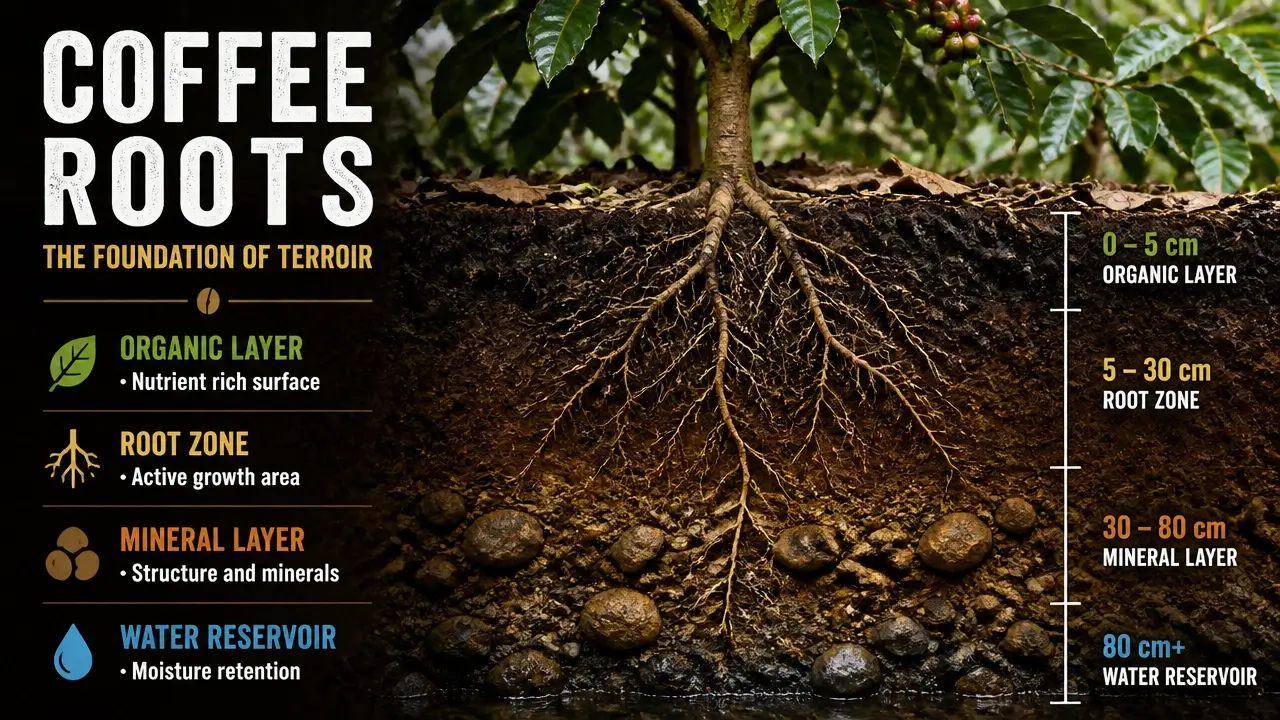
Serious coffee terroir analysis doesn’t start with altitude charts or origin maps. It starts about 30 centimeters below the surface, where root hairs are pulling dissolved mineral ions out of the soil matrix and loading them into the vascular tissue of a Coffea arabica plant. That process – ion uptake, carbohydrate loading, acid synthesis – is where flavor is actually built.
The story told on most coffee bags skips this entirely. Soil gets a romantic mention; the chemistry never follows. This article closes that gap, tracing the path from bedrock mineralogy through plant physiology to the specific flavor compounds that land on your palate.
While Arabica’s complex flavor profiles are heavily dictated by such nuanced subterranean chemistry, other species tell a different survival story, as highlighted in this examination of robusta coffee bean resilience.
Beyond basic flavors, these mineral precursors also dictate the development of various coffee bioactive compound groups that drive the beverage’s physiological effects.
While soil chemistry lays the groundwork for a bean’s initial chemical profile, further transformations occur during processing and roasting, heavily influencing characteristics like light and dark roast acidity in the final cup.
Beyond the soil chemistry that shapes your morning cup, exploring Coffee Benefits Unlocked The Definitive reveals how these organic compounds also support overall wellness.
Key Takeaways on Coffee Terroir
- Soil is the plant’s nutrient reservoir; its mineral composition directly shapes the organic acids, sugars, and amino acids that become flavor during roasting.
- The three primary coffee soil types – volcanic, basaltic red, and clay – each create a distinct flavor tendency, not a flavor guarantee.
- The pH window of 6.0–6.5 is not arbitrary; it is the range where the widest array of minerals stays in plant-accessible ionic form.
- Processing can account for 30–50% of the final flavor profile, meaning heavily fermented naturals can mask soil character almost entirely.
- Altitude does not directly create flavor; it slows ripening, which extends the window for sugar accumulation – and that effect depends on soil fertility to deliver the raw material.
- To isolate soil influence at the cupping table, compare washed coffees of the same variety from different soil types, and scan for minerality, mouthfeel, and savory structure rather than fruit notes.
The Terroir Lens: Soil Is the Flavor Foundation
Coffee terroir is the sum of environmental forces – soil composition, climate patterns, altitude, and topography – that interact to shape the flavor chemistry of the bean. The concept is borrowed from viticulture, but the parallel is imperfect. Wine terroir discussions lean heavily on the mystical. Coffee terroir, handled properly, is an applied science.
This article brackets altitude and climate. Not because they are unimportant – they are essential – but because soil is the literal medium through which most mineral-driven flavor precursors enter the plant. Altitude moderates temperature. Climate determines rainfall. Soil delivers the actual raw material: the dissolved ions that become organic acids, sugars, and amino acids inside the developing seed.
Here is the professional baseline: ideal coffee soil is well-draining yet moisture-retentive, slightly acidic at pH 6.0–6.5, and rich in organic matter. That description covers the minimum viable condition. The real story lies in what happens when you move away from that baseline – when you substitute volcanic ash for alluvial clay, or iron-saturated basalt for weathered limestone. Each substitution changes the nutrient profile the plant works with, and that change propagates all the way to the cup.
The practical value of understanding soil is this: it gives you a predictive tool. You are no longer reaching for a post-hoc explanation after tasting a coffee. You are building a hypothesis before you even open the bag.
According to Rachel Eubanks, a coffee professional at Balzac Brothers, the San Marcos region of Guatemala is routinely passed over in favor of the more celebrated Huehuetenango and Antigua designations. Yet the region’s combination of high elevation, heavy rainfall, and a soil profile carrying centuries of accumulated volcanic ash gives San Marcos coffees a distinct, recognizable acidity that sets them apart from their more famous neighbors.
The San Marcos case makes the broader point concrete. The acidity Eubanks describes is not an accident of processing or roasting. It is a direct output of what the soil contains. When a region’s mineral fingerprint is consistent enough, it produces a flavor signature consistent enough to define a commercial identity – even one that the market undervalues because it hasn’t looked at the ground beneath its feet.
The Soil Spectrum: Types, Minerals, and What They Bring to the Bean
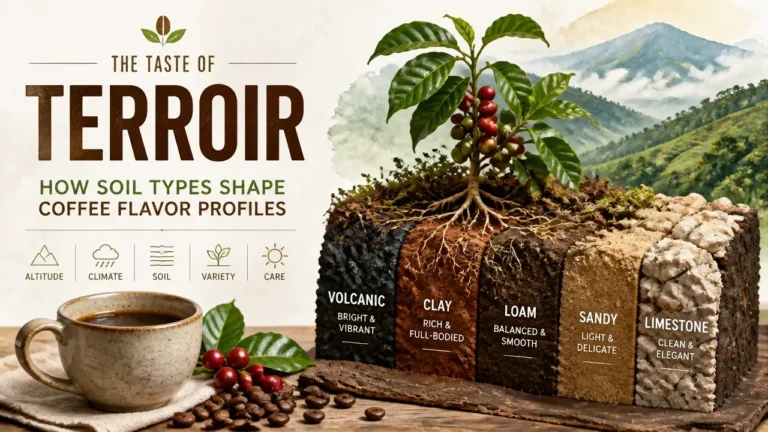
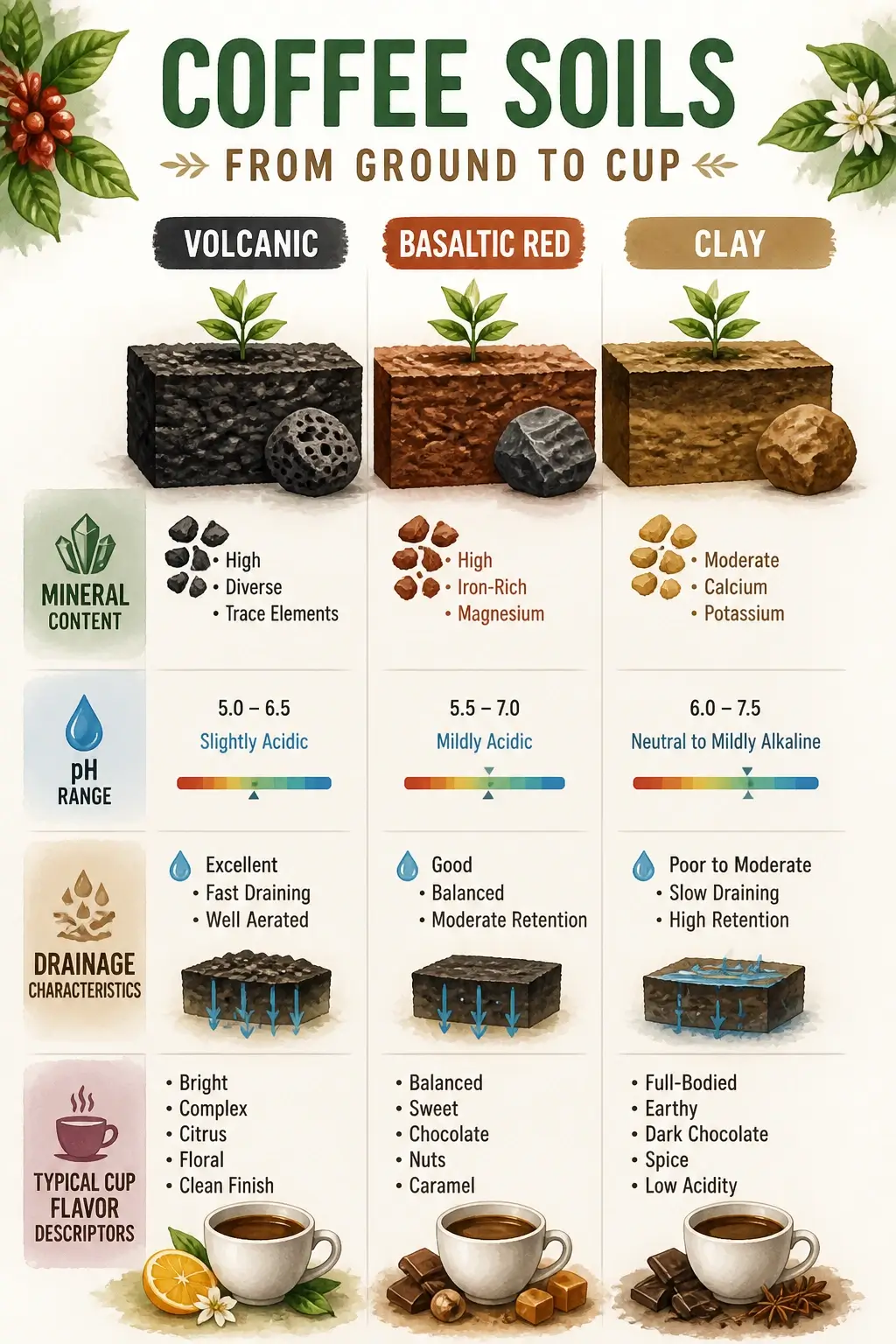
Soil type is not a single variable. It is a cluster of properties – texture, mineral composition, organic content, drainage rate, and cation exchange capacity (CEC) – that together determine what the coffee plant can access, how fast, and in what quantities. The three soil categories that appear most consistently across major coffee-growing regions are volcanic, basaltic red, and clay. They sit on a spectrum from high-drainage/high-mineral-load to high-retention/complex-drainage, and each creates a distinct starting condition for flavor development.
Volcanic Soil: Origin, Mineral Profile, and Regional Impact
Volcanic soils form from weathered igneous material – lava, ash, and pyroclastic deposits that break down over geological time into mineral-rich, loose-textured growing media. The breakdown process releases phosphorus, potassium, and a wide array of trace elements at concentrations that most other soil types cannot match. Because the particle structure is coarse and porous, water drains efficiently while still retaining enough moisture in the pore spaces to sustain root activity through dry periods.
The mineral load is the defining characteristic. Potassium availability in volcanic soils is often elevated, which matters for sugar transport and acid regulation in the plant. Phosphorus supports energy metabolism during seed development. The combination creates conditions for beans with higher metabolic vigor – meaning more complete sugar loading and more complex organic acid development.
Regions built on volcanic geology include Hawaii’s Kona coast, the highlands of Costa Rica, and several growing zones in Guatemala. The flavor profiles consistently associated with these regions – clean body, bright but restrained acidity, sometimes a faint mineral salinity – are not coincidental. They are predictable outputs of the soil chemistry underneath them.
Basaltic Red and Clay Soils: Structure, Mineral Content, and Cup Characteristics
Basaltic red soil gets its color from oxidized iron – specifically, the ferric oxide that forms when iron-bearing basalt weathers in warm, humid conditions. The iron content is high, and magnesium concentrations are typically elevated as well, because both elements are abundant in the basaltic parent rock. The soil structure is denser than volcanic ash-derived soils, but still provides good water-holding capacity and a different nutrient-release profile: minerals become available more gradually as the rock matrix continues to weather.
This soil type dominates large portions of Brazil’s coffee-growing landscape, particularly in the Cerrado and parts of Minas Gerais, and appears in sections of India’s coffee belt. The heavy iron and magnesium loading, combined with the soil’s relatively neutral behavior and good water retention, is associated with the full-bodied, low-acid, chocolate-and-nut cup profile that Brazilian specialty coffee is known for globally.
Clay soils operate on a different principle. Their fine particle size creates an enormous surface area, which translates into high cation exchange capacity – clay can hold and slowly release mineral ions far longer than coarser soils. The trade-off is drainage. In heavy clay, water moves slowly, and poorly managed drainage can create hypoxic root conditions that stress the plant and reduce nutrient uptake efficiency. When drainage is managed well, clay soils produce beans with thick, coating mouthfeel and muted, lower-brightness acidity. This profile appears in parts of Mexico, Sumatra, and other regions where clay-dominant soils interact with high organic matter accumulation.
The Ideal pH Range and the “Best Soil” Question
The PAA question – what type of soil is best for coffee cultivation? – has a technically correct but practically incomplete answer: well-draining, organically rich, slightly acidic soil in the pH 6.0–6.5 range. Every agronomist working in coffee will give you that answer. It is accurate as a survival threshold. It tells you almost nothing about flavor.
“Best” is meaningless without specifying the flavor outcome you are optimizing for. Volcanic soil is better if you want clean, bright, mineral acidity. Basaltic red is better if you want body and chocolate depth. Clay, managed correctly, is better if you want viscous texture and savory undertones. Each soil type steers plant physiology in a different direction.
The pH range matters for a specific mechanical reason: mineral solubility and availability are pH-dependent. At pH levels below 6.0, aluminum and manganese become soluble at concentrations that are toxic to the plant. Above 6.5, phosphorus begins to bind with calcium and become unavailable for uptake. The 6.0–6.5 window is not arbitrary – it is the zone where the widest array of minerals stays in plant-accessible ionic form. Outside that window, the soil’s mineral richness becomes irrelevant; the plant simply cannot reach it.
From Bedrock to Brew: How Soil Chemistry Translates Into Flavor
The biochemical chain from mineral ion to flavor compound is not metaphorical. It is a physical, traceable sequence of events that begins at the root surface and ends in the volatile aromatic compounds released during roasting.
Root hairs absorb dissolved mineral ions through two mechanisms: active transport, where the plant expends energy to pull specific ions across cell membranes against a concentration gradient, and mass flow, where water moving through the soil toward the root carries dissolved ions along with it. Transpiration drives mass flow – the more water the plant moves, the more ions arrive at the root surface. Once inside the root, ions travel through the xylem, the plant’s vascular highway, upward into the developing cherry tissues.
The functional roles of the key minerals are distinct and specific:
- Potassium (K) regulates stomatal opening – the mechanism the leaf uses to control water loss and CO₂ intake. More importantly for flavor, potassium governs sugar transport from leaves into the developing seed. Higher potassium availability correlates with more efficient carbohydrate loading into the bean, which means more substrate available for Maillard reactions during roasting.
- Magnesium (Mg) sits at the center of the chlorophyll molecule. Without adequate magnesium, photosynthesis slows, and the entire sugar pool shrinks. Magnesium also functions as a cofactor in enzyme complexes involved in organic acid synthesis – meaning it directly influences the citric, malic, and other acids that define a coffee’s acidity profile.
- Phosphorus (P) is the energy currency mineral. It is essential for ATP synthesis and for genetic replication during cell division in the developing seed. Beans grown in phosphorus-adequate soils tend to be denser and metabolically more vigorous – they have more complete cellular development at harvest.
- Iron (Fe) and other micronutrients serve as cofactors in the enzyme complexes that produce secondary metabolites: the precursor molecules for volatile aromatics. These are the compounds that, after roasting, become the identifiable flavor notes in the cup.
A foundational study in New Phytologist reconstructed the metabolic pathways governing biosynthesis of the main storage compounds in Coffea arabica seeds – including cell wall polysaccharides, sucrose, triacylglycerols, and chlorogenic acids – using integrated transcriptomic and metabolite analysis. That work maps the intracellular machinery through which precursor molecules are assembled in the bean. Those same precursors – organic acids, sugars, lipids – are what Maillard and Strecker degradation reactions consume during roasting to generate volatile aroma compounds. The study does not directly investigate soil nutrient modulation, but it establishes the biochemical architecture that makes soil-nutrient effects on flavor mechanistically coherent, not speculative.
The practical translation: a bean grown in potassium-rich volcanic soil is more likely to develop the bright, citric acidity associated with high sugar metabolism and efficient carbohydrate loading. A bean from iron-rich basaltic soil is more likely to express savory, roasted, or earthy by-products driven by the enzyme complexes iron activates. These are tendencies, not guarantees. Soil creates a probabilistic bias in the plant’s chemistry. Processing, genetics, and roast profile all interact with that bias – amplifying it, masking it, or redirecting it entirely.
Soil in the Wild: Regional Profiles That Show Terroir Clearly
Three coffee regions make the soil-to-flavor connection legible enough to be useful. Each has a well-documented soil type, a consistent flavor consensus across industry sources, and a processing tradition that doesn’t completely overwhelm the soil signal.
Kona, Hawaii – Volcanic Loam
Kona sits on the western slopes of Mauna Loa, on soils derived from relatively young lava flows. The volcanic loam here is loose, mineral-dense, and drains rapidly. Phosphorus and potassium availability is high. The Bean Belt climate delivers afternoon cloud cover that moderates temperature during the hottest part of the day, but the soil composition is the structural foundation.
The industry consensus on Kona cup profile: smooth, medium body; low-to-medium acidity with a clean, sometimes salty-mineral edge; nutty and caramel flavor notes with occasional chocolate depth. The brightness is present but restrained compared to East African volcanic origins – likely because Kona’s soils, while volcanic, have higher organic matter accumulation than the more recently active East African Rift geology. Specialty buyers and Cup of Excellence-adjacent evaluations consistently flag the clean mineral clarity as Kona’s defining characteristic.
Brazilian Cerrado – Basaltic Red Clay-Loam
The Cerrado plateau in Brazil sits on deep, well-weathered basaltic soils with high iron and magnesium content. The red color is visible from the road. Drainage is adequate because the clay fraction, while present, is mixed with coarser material and the topography is flat enough to prevent waterlogging. The nutrient release is steady and long-duration, which supports consistent cherry development across large farm footprints.
Cup profile consensus: full body, low acidity, chocolate and roasted-nut dominance, occasional caramel sweetness. The profile is predictable enough that Brazilian Cerrado has become a global benchmark for espresso blending – buyers use it specifically because its soil-driven characteristics are consistent and stackable. Iron-heavy soils bias the plant toward the savory, roasted secondary metabolite pathway, and the Cerrado cup reflects that directly.
Sumatra Mandheling – Clay-Dominant Volcanic Highland
The Mandheling growing region in North Sumatra combines volcanic geology with heavy clay accumulation and high rainfall. The soil retains water aggressively, drainage requires active management, and the CEC is high. Wet-hulling (Giling Basah), the processing method dominant in Sumatra, interacts with the soil signal in complex ways – but the soil’s contribution to body and mouthfeel is legible even through that processing lens.
Cup profile consensus: heavy, syrupy body; low, soft acidity; earthy, cedar, and dark chocolate notes with occasional tobacco or mushroom undertones. The thick mouthfeel is partly a processing artifact and partly a soil outcome – clay-heavy soils produce beans with a different cellular density profile than volcanic soils, and that structural difference survives roasting. Specialty buyers working with Sumatran lots who have tasted the same farm across multiple processing variations consistently report that the body and savory earthiness persist regardless of how the fermentation is managed.
A practical note for all three: individual farm practices – fertilization, shade management, harvest timing – create variation within each regional profile. These soil-type descriptions are the baseline tendency, not a per-bag guarantee.
When Processing and Genetics Outshine Soil
Soil is one input in a system with several other powerful variables. A professional who attributes all flavor to origin is making an attribution error that distorts sourcing decisions, misleads consumers, and ultimately erodes trust in terroir as a useful concept.
Processing as a Dominant Flavor Driver: Fermentation and the Attribution Error
Coffee processing – washed, natural, honey, anaerobic – is now widely recognized in the specialty industry as a flavor driver capable of contributing a decisive share of the final cup. The industry consensus holds that processing can account for 30–50% of the final flavor profile. Heavily manipulated fermentations, particularly extended anaerobic natural processing, can produce dominant notes of tropical fruit, wine, and spice that wholly obscure the soil signature.
Here is the attribution error in practice: a consumer tasting a deeply fruity coffee cannot reliably distinguish between fruitiness driven by Ethiopian terroir and fruitiness driven by anaerobic processing applied to a Brazilian bean. The flavor outcome can be nearly identical. The origin is completely different. If the bag says “origin-driven complexity” and the processing was a 96-hour anaerobic ferment, the soil story is largely marketing.
The corrective is straightforward. A washed process strips fermentation residue from the bean before drying, which reduces processing-derived flavor contributions and allows the soil-driven mineral and acid structure to become more legible in the cup. When you want to read the soil, look for washed coffees from well-documented origins. When you encounter a heavily fermented natural, expect the soil character to be partially or fully masked – and evaluate accordingly.
The deeper principle: processing and soil are not competing narratives. They are sequential inputs. Soil determines the raw material inside the cherry. Processing determines how much of that raw material survives, transforms, or gets overwritten on the way to the green bean. A professional needs both data points to make a coherent evaluation.
Genetics, Altitude, and the Terroir Definition: Beyond Soil
Coffee variety is a variable that some authoritative definitions of terroir exclude entirely – treating terroir as a purely environmental concept – while others include the variety-terroir interaction as a core element. This is not a semantic dispute. It directly affects how you interpret a floral note.
If you exclude variety from terroir, a floral Gesha expresses its soil. If you include the interaction, the soil merely created the conditions for the Gesha’s genetic potential to express. Both frameworks have practical merit. A professional must know which one they are operating under, because the two lead to different sourcing conclusions.
The mechanics are concrete: two different varieties grown in identical soil will produce different flavor profiles because their metabolic pathways respond differently to the same nutrient set. Gesha reliably produces jasmine, bergamot, and stone fruit regardless of whether it is grown in Panama, Ethiopia, or Colombia. Bourbon produces classic sweetness and balance with a different acid structure. The soil modulates the intensity and specific character of those outputs, but it cannot redirect the fundamental metabolic tendency that genetics establishes.
Altitude is the other variable that gets misread. The simple claim that higher altitude equals higher quality collapses quickly under scrutiny. The actual chain of events: altitude lowers ambient temperature, which slows cherry ripening, which allows more sugar to accumulate in the bean and produces higher density. That chain is real. But it breaks when frost damages the crop, when persistent cloud cover reduces photosynthesis and shrinks the sugar pool, or when a variety is mismatched to its elevation. Soil quality at moderate altitude can produce superior coffee to exhausted or poorly structured soil at extreme altitude. Using elevation as a pricing proxy without understanding the soil beneath it is a systematic sourcing error.
The productive framing: altitude and soil interact. High altitude slows ripening; mineral-rich soil gives the plant more to work with during that extended ripening window. The combination is where the best profiles emerge. Either variable in isolation tells an incomplete story.
From Theory to Cup: A Practical Guide to Tasting Soil Influence
The gap between understanding terroir and being able to use it at the cupping table is where most educational content fails. Theory without method produces informed passivity. Here is the method.
A Practical Cupping Protocol to Isolate Soil Influence
Comparative cupping is the most direct tool available. The setup: select two coffees with the same variety and the same processing method, but sourced from regions with documented differences in soil type. A washed Caturra from Kona against a washed Caturra from the Brazilian Cerrado, for example. Same genetics, same processing, different soil. The flavor differences that emerge are your best available signal for soil influence.
During the cupping, redirect your attention away from fruit-forward notes – those are more likely processing artifacts – and toward structural characteristics: minerality, mouthfeel texture, and any savory or earthy undertones. A clean, slightly saline brightness points toward volcanic mineral loading. A coating, heavy body with roasted-nut character points toward basaltic iron dominance. Clay-influenced profiles often present as thick and muted, with less defined acidity.
The second discipline is interrogating your supplier. Ask: what is the soil type at this farm? What is the pH? Has the farm done any soil analysis? If your roaster cannot answer those questions, that tells you something. It tells you the terroir narrative on the bag is origin storytelling rather than traceable, documented fact. Roasters who work with genuine traceability know their soil data because they asked for it. The ones who don’t know it are selling geography, not chemistry.
Sensory Lexicon, Brewing Adjustments, and a Closing Heuristic
The sensory bridge from mineral profile to flavor descriptor is learnable. Connect the soil chemistry from earlier in this article to what you are scanning for at the table:
- Volcanic soil – clean, bright, sometimes salty-mineral acidity; lighter body; clear, high-frequency flavor definition
- Basaltic red soil – chocolate, roasted nuts, heavy body; low, soft acidity; savory depth
- Clay-dominant profiles – thick, coating mouthfeel; muted acidity; earthy, sometimes musty or cedar undertones
These are starting positions, not fixed destinations. But they give you a sensory hypothesis before you taste, which sharpens your attention during the evaluation.
Brewing adjustments follow the same logic. High-density beans – common in mineral-rich volcanic soils at altitude – have tighter cellular structure and require more extraction energy to fully release their flavor compounds. A slightly finer grind or a higher extraction temperature (approaching 96°C rather than 92°C) will open them up more completely. Lower-density beans from clay-dominant, lower-altitude origins extract faster; pushing extraction too hard produces astringency. Understanding the soil type gives you a rational basis for your brew parameters before you dial in by trial and error.
The closing heuristic: when you encounter an unfamiliar single-origin, run through three questions in sequence. What is the soil? What is the processing? What is the variety? Then ask: how do the flavors I am detecting map onto that combination? A bright, clean, mineral coffee from a washed Gesha on volcanic soil is doing exactly what the model predicts. A fruity, wine-forward natural from that same soil is showing you the processing, not the ground. A heavy, earthy cup from a washed Caturra on clay is showing you the soil clearly.
That sequence – soil, processing, variety, then cup – is the difference between tasting and evaluating. It turns terroir from a story into a diagnostic tool.
Frequently Asked Questions About Coffee Terroir
Does coffee actually have terroir the way wine does?
Yes, but the mechanism is more direct in coffee than wine. Soil minerals enter the coffee plant through root uptake and physically become part of the bean’s chemistry – the organic acids, sugars, and amino acid precursors that roasting converts into flavor.
Can two farms with identical soil types produce completely different cups?
Absolutely. Variety, processing method, harvest timing, shade management, and fermentation all interact with whatever the soil provides. Soil establishes a probabilistic tendency; everything else either amplifies or overrides it.
How do I know if a roaster’s terroir claims are actually traceable?
Ask them directly: what is the soil type at the source farm, and has the farm done a soil analysis? Roasters with genuine traceability know this because they requested it. If they can’t answer, the origin story on the bag is geography, not documented soil science.
Why does washed processing reveal soil character better than natural processing?
Washed processing removes fermentation residue before drying, which strips away a large portion of the processing-derived flavor contribution. With less fermentation noise in the cup, the mineral structure and acid profile the soil created become easier to isolate and identify.
Is higher altitude always better for coffee quality?
No. Altitude lowers temperature and slows ripening, which can increase sugar accumulation and bean density – but only when soil fertility, variety suitability, and climate cooperate. Poor soil at extreme altitude can produce inferior coffee to well-managed soil at moderate altitude.
What does “cation exchange capacity” actually mean for a coffee buyer?
It’s a measure of how much mineral charge a soil can hold and slowly release. High-CEC clay soils retain nutrients longer but drain slowly. Low-CEC volcanic soils release minerals quickly but may require more active fertility management. For a buyer, it signals how consistent and sustained the mineral input to the plant is across a growing season.
Can I taste the difference between volcanic and basaltic soil in a blind cupping?
With training and controlled conditions – same variety, same processing – yes. Volcanic soil profiles tend toward clean, bright, salty-mineral acidity. Basaltic red profiles tend toward full body, chocolate, and roasted-nut character. The signal is real, but it requires eliminating the processing and variety variables first.
Does organic matter content in soil affect flavor, or just plant health?
Both. Organic matter improves soil structure, water retention, and microbial activity, which affects nutrient availability. It also contributes nitrogen during decomposition, which influences amino acid synthesis in the plant – and amino acids are direct precursors in Maillard reactions during roasting. So yes, organic content has a flavor-chemistry pathway, not just an agronomic one.
References
- Coffee Origins: The Distinct Acidity of San Marcos, Guatemala | perfectdailygrind.com
- Metabolic pathways in tropical dicotyledonous albuminous seeds: Coffea arabica as a case study | nph.onlinelibrary.wiley.com