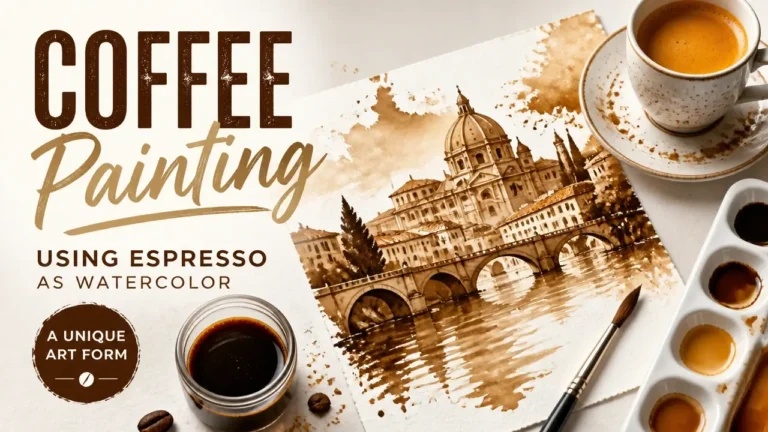

Coffee painting turns your morning brew into a sepia-toned medium with surprising artistic depth. Brewed espresso or dissolved instant coffee granules behave remarkably like watercolor paint: layerable, washable, and alive with warm amber tones that synthetic pigments rarely match.
What makes it genuinely compelling isn’t just the aesthetic. The medium costs almost nothing, smells extraordinary while you work, and connects art-making to something already sitting on your counter. Artists like Karen Eland have built entire careers on it. The humble cup, it turns out, has a lot left to say.
What Coffee Painting Actually Is
Coffee painting is a monochrome art form where instant coffee or espresso serves as a water-soluble pigment, producing warm, brown-toned works that carry the unmistakable look of sepia-style watercolors. You’re not recreating something that already exists in a tube: you’re pulling color directly from one of the most common ingredients in any kitchen. That shift in source material changes everything about how the medium feels, both to make and to look at.
The sepia effect isn’t a stylistic choice you dial in (it’s baked into the chemistry). Coffee’s natural tannins and organic pigments produce that warm, amber-to-dark-brown range automatically, giving finished pieces a vintage, emotive quality that a standard brown watercolor paint simply can’t match. Manufactured pigments are engineered for consistency. Coffee carries the ghost of something organic, something grown and roasted, and that history shows up on the paper.
That’s also part of why coffee painting keeps pulling people in who never considered themselves painters. There are no toxic solvents, no expensive starter kits, no intimidating art-store decisions. The material is already in your cabinet.
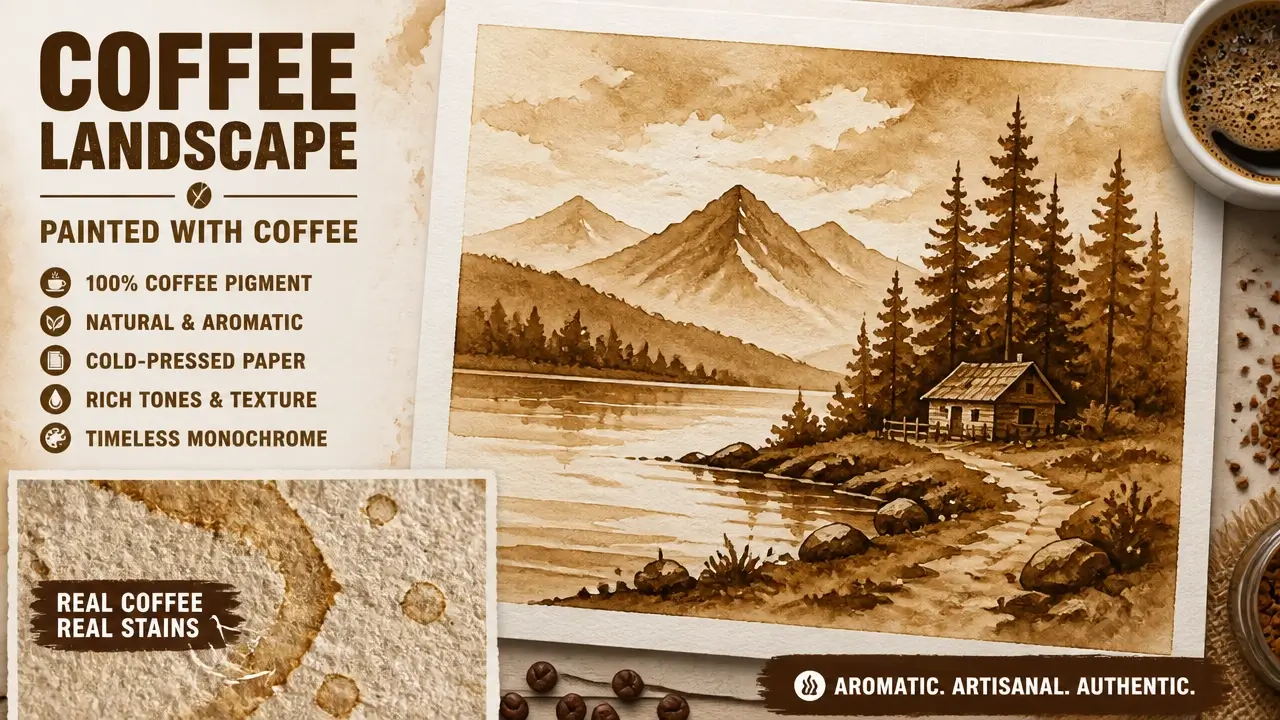
If you’ve worked with watercolor before, the learning curve here is shorter than you’d expect (coffee shares watercolor’s transparency and its capacity for layering wash over wash). But it’s not a direct substitute. It has its own handling quirks: how it blooms when wet, how it darkens as it dries, how it responds to humidity. Watercolor knowledge gives you a strong foundation. Willingness to adapt is what gets you the rest of the way.
There’s one more dimension that doesn’t show up in any technique guide: the smell. Working with coffee as a material is a sensory experience that synthetic pigments can’t touch. The aroma is present the entire time you’re painting, and for a lot of artists, that emotional layer is part of why the medium holds their attention in a way that a tube of burnt sienna never quite does.
Nuria Salcedo, a self-taught coffee illustrator and architect based in Ontinyent, Spain, puts it precisely:
“Using coffee as a medium is unique and singular on its own but going beyond that, it is an interesting technique. The color scheme is really wide and it has the quality of giving warmth to an illustration. It is like if all the feelings around drinking a cup of coffee (comfort, ease, rest, quiet, or peacefulness) were also applied in an illustration painted with it. But it is also special because it is a household ingredient that everyone has at their disposal. A lot of techniques are really expensive, so coffee becomes an interesting choice to people interested in art who want to practice with something similar to watercolors, but are a lot cheaper.”
That accessibility isn’t a consolation prize: it’s a genuine feature of the medium. Coffee painting sits at the intersection of fine art technique and everyday ritual, and that combination is exactly what makes it worth taking seriously.
The Right Coffee Painting Supplies
Good coffee painting supplies aren’t expensive, but the wrong ones will fight you every step of the way. The difference between a wash that flows cleanly and one that buckles, bleeds, or turns sticky usually traces back to material choices made before you picked up a brush. Get these four categories right, and the medium starts cooperating.
Paper: The One Place Not to Cut Corners
Watercolor paper is non-negotiable here, and the spec matters. You want cold-pressed, minimum 140 lb (300 gsm), and ideally acid-free. Here’s why each of those numbers earns its place: cold-pressed gives you a slightly textured surface that holds washes without pooling uncontrollably; 140 lb means the paper is dense enough to absorb moisture repeatedly without warping into a taco; acid-free matters because coffee is mildly acidic on its own (pair it with acidic paper and you’re accelerating the degradation clock from day one). Thin sketching paper or standard printer stock will buckle under your first wet wash and stay buckled.
Instant Coffee: Your Most Reliable Pigment
Instant coffee is the preferred “paint” for one mechanical reason: it dissolves completely. No oils, no sediment, no residue that dries into a gritty film on your brush hairs. It produces the darkest, most consistent pigment concentration you can achieve in this medium. Espresso can work, but its concentration varies shot to shot depending on your machine and grind, which makes tonal consistency harder to control across a session.
One firm rule: only pure, black coffee or plain instant granules. The moment you introduce sugar, cream, or flavored syrups, you’ve changed the chemistry of your paint. Sugar coatings dry tacky, attract pests over time, and create uneven tones that no amount of layering will fix. Keep it clean.
Brushes: Three Is Enough to Start
You don’t need a full brush roll. Three brushes cover the full range of what coffee painting demands:
- Large flat wash brush: for laying in backgrounds and broad tonal fields
- Medium round brush: your workhorse for general shapes and mid-detail work
- Fine round or detail brush: for line work, edges, and anything that requires a controlled tip
Standard synthetic watercolor brushes work fine. Natural hair (sable, squirrel) gives you a better water-holding belly, but synthetics are more than adequate for learning the medium. Coffee won’t damage either type as long as you rinse thoroughly (the tannins can stain bristles over time, but they won’t degrade the fibers).
Supporting Tools That Earn Their Place
A small bowl or set of ceramic/glass cups for mixing your concentrations is worth having from the start (you’ll want two or three pre-mixed strengths sitting ready rather than adjusting on the fly mid-wash). Two water containers matter more than they seem: one for mixing your coffee solutions, one dedicated to rinsing brushes. Cross-contaminating them muddies your lightest washes faster than anything else.
Masking tape along the paper edges does two jobs at once: it keeps the paper flat against your board during wet work, and it leaves a clean white border when you peel it off at the end.
Fernando Mosca, a Buenos Aires-born visual artist based in Sydney who specializes in recycled and live coffee art, found that the material constraints of the medium were actually part of its appeal:
“As a personal challenge, I just wanted to discover if it was possible for me to hold an art exhibition on a subject I was very passionate about and I found an endless supply of materials out there: Recycled coffee grounds (my painting medium); coffee sacks (my canvas); recycled timber backings (my mounting).”
Mosca’s list is a useful reminder that coffee painting supplies don’t require a specialty art store run. Most of what you need is already in your kitchen or one hardware store trip away (the discipline is in knowing which variables actually matter and which ones don’t).
Mixing Your Coffee Washes: From Pale Stain to Deep Espresso
Precise coffee wash mixing protocols give coffee painting its full tonal range, and the only variable you’re adjusting is how many granules dissolve into how much water. More granules per drop means a darker stain. Fewer granules means a lighter, more transparent wash. That’s the whole engine.
Think of it the way a photographer thinks about exposure stops. You’re not changing the color: you’re changing the density of pigment suspended in water, and that density is what your paper will absorb and hold.
Three Ratios, Three Tonal Zones
Before you touch a brush, mix three separate concentrations of instant coffee granules in palette cups. These are your working values:
- Light wash: 2 parts water to 1 part coffee. Thin, almost tea-like. This is your sky, your skin highlights, your first foundation layer.
- Medium wash: 1 part water to 1 part coffee. Your mid-tone workhorse. Shadows on fabric, tree bark, background depth.
- Dark wash (thick paste): just a few drops of warm water to 1 part coffee. This should feel like a loose syrup, not a liquid. This is your deepest shadow, your line work, your anchor tones.
Use warm water (not boiling). Boiling water won’t ruin your coffee chemically, but it can warp paper fibers on contact and shorten the life of your brush bristles over repeated sessions. Let all three concentrations cool to room temperature before you start painting.
Testing Before You Commit
Here’s where most beginners lose an hour of work: wet coffee always looks darker than its dried result. That deep, satisfying brown in your palette cup will dry roughly 20–30% lighter on paper. Experimental tests on instant-coffee pigments on watercolor paper show an average lightening of approximately 25%, measured by L\* value increase after drying (a figure Coffee Art FAQ cites as the standard rule of thumb for compensating pigment loss when planning mixing ratios).
That means your “dark” wash might dry into a medium. Your medium might read as a light. Test every concentration on a scrap of the same paper you’re painting on (not a napkin, not printer paper) and let it dry completely before you decide the mix is right. This single habit will save you from repainting entire sections.
Treat your three cups the way a watercolorist treats a limited palette: everything is already mixed and waiting, so when you’re mid-stroke you’re not improvising chemistry, you’re making creative decisions.
Dirceu Veiga, a Brazilian designer, caricaturist, and coffee artist who paints exclusively with 100% espresso, describes the same principle at work in his own practice:
“However, by adding a dab of water here and there I manage to create a variety of different shades from the coffee and some of my work is rather remarkable, both in its beauty and sometimes its complexity.”
What Veiga is describing isn’t guesswork: it’s a calibrated, repeatable adjustment of the coffee-to-water ratio mid-session. The shades don’t come from different coffees or additives. They come from water, controlled deliberately.
Once your three washes are mixed, tested, and cooled, you have a functional monochrome palette. The ratios give you the values. What you do with them on paper: that’s where the real decisions begin. And the first one that will test you isn’t making the darks dark enough. It’s keeping the lights from disappearing once the darks arrive.
How Coffee Painting Techniques Shape Every Mark
Coffee painting techniques work through the same fundamental logic as watercolor: water carries pigment, concentration controls value, and drying time controls everything else. The difference is that coffee pigment is more eager to lift, bleed, and stain than most watercolor paints, which means the techniques that feel optional in watercolor become non-negotiable here. Once you internalize that single fact, the whole toolkit makes sense.
Wet-on-Dry Glazing and Layering
Glazing is how you build depth without muddiness, and the rule is absolute: each layer must be bone dry before the next one touches it.
Here’s why. Coffee pigment doesn’t fully bond to paper the way professional watercolor pigment does. When you drag a loaded brush across a damp coffee wash, the water in your new layer reactivates the layer beneath it. The two mix on the surface, edges dissolve, and what looked like a clean shadow becomes a gray smear. Waiting for complete dryness (not just “looks dry,” but cool-to-the-touch dry) keeps each layer crisp and independent.
In practice, glazing works beautifully for building form. Start with your lightest diluted wash as a base. Let it dry fully. Add a second slightly darker wash over the shadow areas. Dry again. Each pass deepens the tone without disturbing what’s underneath, and the layering creates a luminosity that a single heavy wash never achieves.
Wet-on-Wet Blending for Soft Edges
For skies, soft backgrounds, and atmospheric gradients, wet-on-wet is your tool. Brush clean water onto dry paper first, then drop or stroke coffee into the damp zone. The pigment feathers outward on its own: you’re not pushing it, you’re inviting it.
The key is controlling how wet the paper is. Very wet paper gives you wide, diffuse blooms. Slightly damp paper gives you softer edges with more control. If the paper is too dry when you add coffee, you get a hard edge instead of a blend, which defeats the purpose.
This technique is particularly useful for backgrounds you want to recede: soft washes that sit behind a sharper, glazed foreground naturally create the illusion of depth.
Texture Effects with Coffee Crystals and Salt
This is where coffee painting pulls away from watercolor and develops its own character.
While a wet wash is still glistening, sprinkle undissolved instant coffee crystals directly onto the surface. Each crystal acts as a concentrated pigment deposit (as it dissolves into the surrounding moisture, it radiates outward in a dark starburst pattern). The result looks like organic cellular structures, aged wood grain, or stone texture depending on how densely you scatter them.
Table salt works differently. Salt is hygroscopic (it pulls moisture toward itself, displacing pigment as it does). The result is a speckled, granular pattern that reads as weathered texture, snow, or starfield effects. Sprinkle it on, let the wash dry completely, then brush the salt away gently. What remains is a field of soft light spots where the pigment was displaced.
Neither technique is fully controllable, and that’s the point. You set the conditions and let the chemistry do the work.
Protecting Highlights Before You Paint
Coffee stains paper permanently if you let it sit, which means recovering white highlights after the fact is nearly impossible. The solution is to protect them before you start.
Masking fluid applied to highlight areas creates a latex barrier that coffee can’t penetrate. Let it dry fully before painting over it, then peel it away once the coffee is completely dry to reveal clean white paper underneath. Wax crayons and candle stubs do the same job with a softer edge: the wax resists water, so coffee beads off the surface and leaves a slightly textured light area rather than a hard clean edge.
The choice between masking fluid and wax depends on how sharp you need the highlight. Masking fluid gives you precision. Wax gives you a more painterly, integrated look.
Dry-Brush Detail and Blotting
For fine lines, fur, bark, and rough surface textures, switch to a nearly dry brush loaded with dark, concentrated coffee paste. Fan the bristles slightly and drag across the paper with light pressure. The paint catches only on the raised texture of the paper’s grain, leaving the valleys white: that broken, scratchy mark is exactly what reads as texture from a distance.
Keep a folded tissue in your non-painting hand at all times. Coffee’s staining speed is its biggest demand on your reflexes. A drop in the wrong place, a line that went too dark, an edge that bled: blot it immediately, before it has 30 seconds to set. Once it dries, it’s there.
The patience requirement is real. Rushing layers is the single most common reason coffee paintings go flat and muddy. The golden rule is simple: dry between every layer, without exception.
There’s actually a materials science angle worth knowing here. ScienceDirect Research Authors studying coffee-lignin-based coatings found that:
“We report a novel super-hydrophobic coating fabricated with coffee lignin and beeswax by a simple, low-cost, and scalable spray-coating method. This coating possesses super-hydrophobicity, good thermal stability and excellent adhesion to the substrate.”
That adhesion behavior is exactly what you’re working with at the painting surface: coffee’s lignin compounds bond aggressively to paper fibers, which is why the medium stains so readily and why patience during layering isn’t just good advice, it’s a material property you’re managing.
Here’s a real-time walkthrough of wet-on-wet blending, crystal texture effects, and dry-brush detail work (watching the pigment move during drying makes the timing instincts click faster than any written description):
Video: Coffee Painting Tutorial – Easy and Textured
Overcoming Pitfalls & Ensuring Your Artwork Lasts
Every coffee painting beginner hits the same wall: you lay down a second wash and watch your highlights dissolve into a murky, flat brown. It’s not a skill problem: it’s a chemistry problem. And once you understand what’s actually happening at the surface, fixing it becomes straightforward.
Preserving Highlights in Coffee Paintings
Highlight preservation in coffee painting fails for one specific reason: coffee pigments are highly water-soluble, and every wet brush you drag across a dried layer re-dissolves what’s already there.
Most online tutorials frame coffee painting as a forgiving, foolproof medium. Experienced artists find out fast that’s not the whole story. Coffee paint inherently lacks the opacity and lightfastness of real watercolor: it won’t behave like professional paint, and expecting it to will frustrate you every time. Setting that expectation early isn’t discouraging; it’s the thing that actually lets you work with the medium instead of against it.
Here’s what’s happening mechanically: the organic compounds responsible for coffee’s brown color (primarily melanoidins) remain soluble even after drying. When your second wash hits a dried first layer, it doesn’t just sit on top. It picks up and redistributes pigment from below, blurring the boundary between light and dark. A peer-reviewed study published in PubMed confirmed this directly: dried coffee layers lost measurable pigment when subsequently exposed to water and brushing, with lower-concentration applications leaving less removable material available for re-dissolution. That last detail is the key.
The practical fix follows directly from the science: start with a pale, diluted first wash (roughly 1 part coffee to 4 parts water) and let it dry completely before touching it again. A fully dried, low-concentration layer has less soluble pigment sitting at the surface, which means your next wash lifts less of it. You’re not eliminating re-dissolution; you’re minimizing how much material is available to move.
For bright white highlights you want to protect from the start, apply masking fluid before your first wash. It creates a physical barrier that no amount of wet layering can penetrate. Once your painting is finished and dry, peel it off to reveal clean paper beneath. If you missed a highlight and the painting is already done, a white gel pen recovers it cleanly: it’s not a workaround, it’s a standard watercolor technique that transfers perfectly here.
The research community working with coffee-derived materials has also confirmed something worth noting about coffee’s surface behavior. ScienceDirect research authors studying coffee-lignin-based coatings noted:
“We report a novel super-hydrophobic coating fabricated with coffee lignin and beeswax by a simple, low-cost, and scalable spray-coating method. This coating possesses super-hydrophobicity, good thermal stability and excellent adhesion to the substrate.”
That finding matters for painters because it tells us something coffee painting tutorials never mention: coffee’s organic compounds, when properly sealed, can bond durably to a substrate. The instability isn’t permanent: it’s a surface condition that fixatives and sealants can address. Which brings us directly to the second problem.
Ensuring Longevity and Archival Quality
Archival quality is the blind spot in every coffee painting guide ever written. Not a single tutorial mentions it. That gap is worth closing, because the material science here is unambiguous: coffee is acidic, and acid degrades paper over time. Left unsealed and unprotected, a coffee painting on standard watercolor paper will yellow, fade, and eventually become brittle at the contact points.
Before you even think about framing, deal with the sticky surface first. Heavy coffee concentrations dry to a tacky, slightly glossy film (especially in humid environments). Run a low-heat hairdryer across the finished piece at a comfortable distance until the surface feels matte and dry to the touch. Don’t skip this step before framing; a tacky surface pressed against glass will bond to it.
Speaking of framing: never mount a coffee painting flush against glass. Always use an acid-free mat or a spacer to create an air gap between the surface and the glass. This prevents condensation from wicking back into the paper and reactivating the soluble pigments.
For sealing, the process is simple but non-negotiable:
- Wait at least 24 hours after the final layer before applying any fixative: the full depth of the paper needs to be dry, not just the surface.
- Apply an archival UV-resistant matte fixative spray in thin, even passes. This does two jobs simultaneously: it seals the water-soluble pigments so moisture can’t re-dissolve them, and it filters UV light that would otherwise accelerate fading.
- Frame with acid-free mat board and backing. Standard cardboard is acidic and will transfer that acidity to your paper over time.
Finally, keep the framed piece out of direct sunlight. Coffee lacks the lightfastness of artist-grade pigments: it will fade under prolonged UV exposure regardless of fixative. A UV-filtering glass or acrylic glazing adds another layer of protection if the piece is going somewhere with significant light exposure.
None of this is complicated. It’s just the information the tutorials left out, and once you have it, coffee painting stops being a frustrating experiment and starts being a medium you can actually control.
Coffee Painting Artists Who Built the Medium
Several dedicated coffee painting artists turned a kitchen experiment into gallery-worthy work, and their careers answer the quiet question every new practitioner asks: Can this actually be taken seriously?
The short answer is yes, and the proof is in the range. These artists don’t share a subject matter or a style. What they share is a willingness to push coffee past its obvious limitations and find something personal on the other side.
Karen Eland’s Espresso Masterpieces
Karen Eland is the name most people encounter first, and for good reason. She built her reputation by repainting some of the most recognizable works in art history (think Vermeer, da Vinci, Rembrandt) entirely with espresso, then added her own twist: a cup of coffee worked into the scene itself. A figure holds a steaming mug. A carafe sits on the table where the original had none. It’s a quiet, witty act of authorship that makes the work unmistakably hers.
Her palette is warm sepia throughout, and that constraint turns out to be a strength. Without color to lean on, the tonal range carries everything, and Eland’s control of light-to-dark washes across these familiar compositions proved that coffee could hold its own against ink, watercolor, or any other monochromatic medium. That body of work did real cultural work: it moved coffee painting from novelty into a conversation about medium and meaning.
Angel Sarkela-Saur’s Layered Natural World
Angel Sarkela-Saur works in a completely different register. Where Eland reinterprets existing imagery, Sarkela-Saur builds her own: intricate flora, animals, and spirit-inflected figures rendered in fine, layered coffee washes that accumulate texture the way sediment accumulates over time. The mood is earthy and quiet, almost meditative.
Her work demonstrates something technically important for anyone learning the medium: coffee’s natural granularity, which beginners often fight against, becomes an asset when you layer slowly and let each wash dry completely. The slight graininess that shows up in her botanical pieces isn’t a flaw: it’s the texture of the material being honest. Sarkela-Saur leans into it, and the result feels like it grew rather than was painted.
Ghidaq al-Nizar’s Coffee on Dried Leaves
Ghidaq al-Nizar takes the material logic one step further. He paints with coffee sediment directly onto dried leaves, using one form of organic matter to mark another. The subjects tend toward portraiture and natural forms, but the real statement is the support itself. A dried leaf is already mid-decay when he begins. The coffee stains settle into its veins and surface irregularities in ways no paper could replicate.
The work carries an implicit argument about impermanence: the medium fades, the leaf continues to age, and the image exists in a state of slow disappearance. For anyone thinking about coffee painting as purely a technical exercise, al-Nizar is a useful counterweight. He’s using the same material to ask different questions entirely.
| Artist | Subject Matter | Key Techniques | Signature Style | | :— | :— | :— | :— | | Karen Eland | Classic masterpiece recreations; portraits and scenes with coffee objects embedded | Coffee and water washes; tonal layering | Warm sepia reinterpretations of iconic works: coffee as medium and subject simultaneously | | Angel Sarkela-Saur | Flora, fauna, spirit imagery | Slow, fine layering; exploiting coffee’s natural granularity for texture | Earthy, meditative naturalism with a mystical undercurrent | | Ghidaq al-Nizar | Portraiture, natural forms | Coffee sediment on dried leaves; working with organic surface irregularities | Impermanence as aesthetic: the support and medium age together |
| Artist | Subject Matter | Key Techniques | Signature Style |
|---|---|---|---|
| Karen Eland | Classic masterpiece recreations; portraits and scenes with coffee objects embedded | Coffee and water washes; tonal layering | Warm sepia reinterpretations of iconic works: coffee as medium and subject simultaneously |
| Angel Sarkela-Saur | Flora, fauna, spirit imagery | Slow, fine layering; exploiting coffee’s natural granularity for texture | Earthy, meditative naturalism with a mystical undercurrent |
| Ghidaq al-Nizar | Portraiture, natural forms | Coffee sediment on dried leaves; working with organic surface irregularities | Impermanence as aesthetic: the support and medium age together |
What these careers collectively prove is that coffee painting has no fixed identity. Eland pulled it toward art history and conceptual wit. Sarkela-Saur pushed it into fine natural detail. Al-Nizar used it to think about time and decay. The medium accommodated all three.
That flexibility is the real invitation. Tokyo-based artist and designer Zenya Toyama (known for her upcycled coffee filter installations) described the moment she first saw the potential in coffee’s residue:
“One day, while making pourover coffee at home, I looked at the used filter and was struck by the intuitive beauty of the stained coffee tones. Over time, the interaction of materials created subtle patterns that reminded me of wabi‑sabi (the Japanese aesthetic of impermanence and imperfection). That moment sparked the idea of using disposable coffee filters as a canvas for expression.”
Toyama’s observation lands on something true about the whole medium: coffee painting tends to reward the moment you stop fighting the material and start reading it. The stain, the grain, the sepia drift (those aren’t obstacles). They’re the signature of the thing. Every artist here found their style by accepting what coffee actually does, then making that behavior the point.
Coffee Painting as a Sustainable Cultural Act
Coffee painting carries a story that starts long before the brush touches paper: it starts at the bottom of your morning cup.
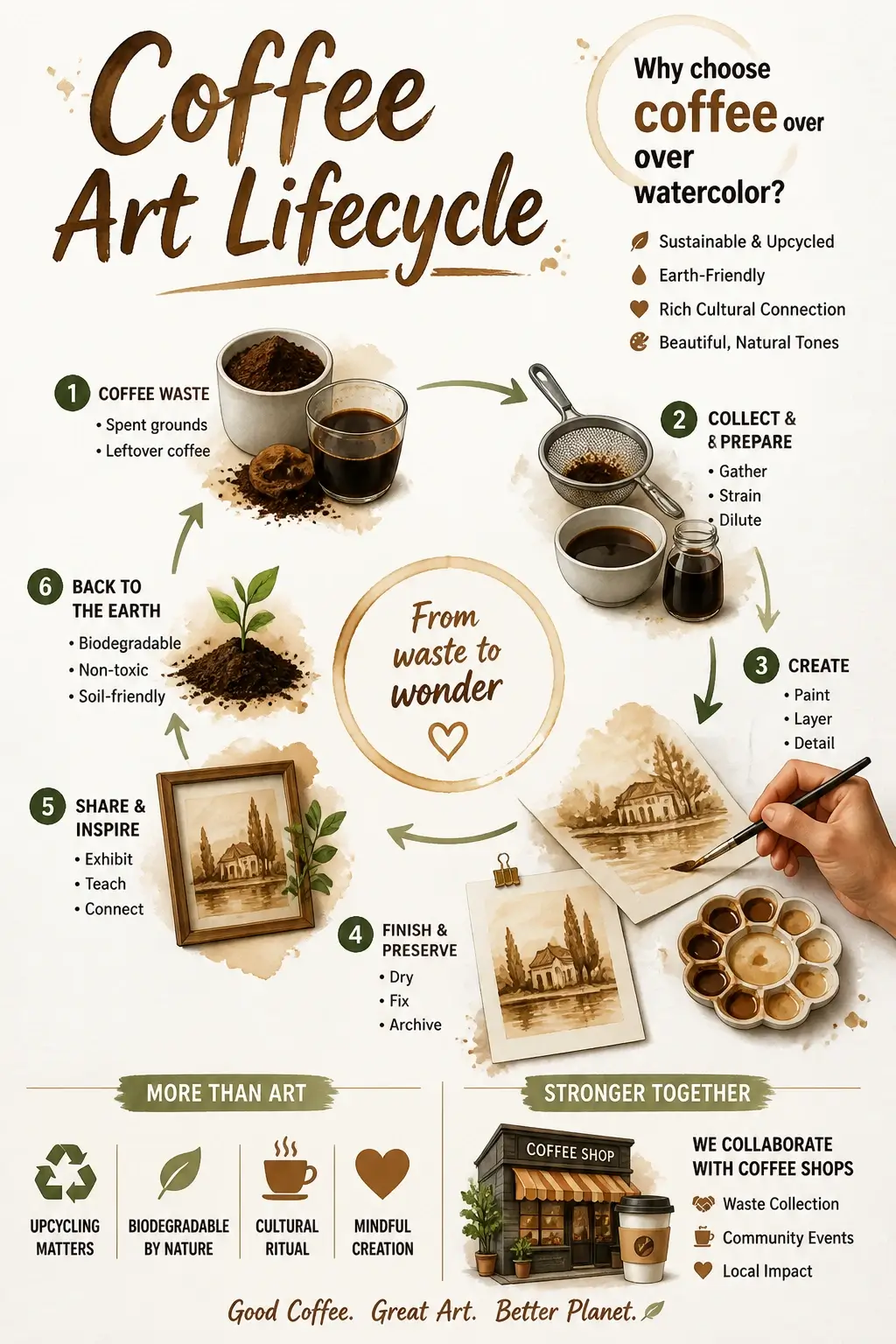
Most people rinse spent grounds down the drain without a second thought. Coffee painting flips that habit entirely. Those grounds, that cold leftover in the pot, the half-inch sitting in yesterday’s French press: all of it becomes pigment. That’s upcycling in its most literal, lowest-friction form: no processing, no purchasing, no packaging. The raw material is a by-product of something you were already doing.
Why Biodegradable Materials Matter in Art
Conventional acrylic paints carry synthetic polymers that don’t break down (they fragment into microplastics). Many oil paints require petroleum-based solvents just to clean a brush. Coffee, by contrast, is fully biodegradable. It returns to the earth the same way it came from it. The eco-art movement has been making this argument for years: the materials an artist chooses are themselves a statement, not just a medium.
Coffee sits comfortably inside that philosophy. It’s non-toxic, water-soluble, and leaves no chemical trace. For artists who want their practice to align with their values, that’s not a small thing.
Coffee Painting’s Roots in Coffee Culture
There’s a cultural layer here that goes deeper than sustainability. Coffee is one of the few substances that touches nearly every human society: economically, socially, sensorially. It’s traded across continents, debated by farmers and baristas alike, and ritualized in kitchens and coffee shops from São Paulo to Seoul. When you paint with it, you’re not just borrowing a convenient pigment. You’re extending a relationship with something that already carries enormous human meaning.
Many coffee artists have leaned into that connection deliberately. Collaborations between coffee painters, local roasters, and sustainability fairs have become a real thread in the specialty coffee world: artists using their work to trace the bean’s journey from farm to cup, drawing attention to fair-trade sourcing and the environmental cost of industrial coffee production. The painting becomes a conversation about the whole chain, not just the final cup.
Fernando Mosca, a Buenos Aires-born visual artist who specializes in recycled materials and live coffee art, put the underlying logic plainly:
“What I love about using organic and recycled materials for my artwork is the sustainability in resourcing. I spent months approaching local industries in my community to ask what their company was throwing out so I could create my artwork… So my development in creating a recycled art product is a bit of an ‘up yours’ to the manufacturers and suppliers of artist materials.”
That attitude (treating industrial waste as creative raw material, and doing it with intention) is exactly what coffee painting embodies at its best. The medium isn’t just practical. It’s a position.
The Only Step Left Is to Brew a Cup
You now have everything you need. The technical roadmap (ratios, paper, brushes, layering logic, troubleshooting) is already in your hands. The contextual “why” is here too: a medium that costs almost nothing, harms nothing, and connects your creative practice to something culturally and ecologically larger than a single painting.
The remaining step is the simplest one. Brew your coffee. Don’t throw out what’s left. Pull out a sheet of watercolor paper, mix your first wash, and let the morning routine become something you made with your own hands, and something that means a little more than it did yesterday.
Key Takeaways on Coffee Painting
- Coffee’s lignin bonds make it stain aggressively, so each layer must be bone dry before the next.
- Instant coffee’s complete dissolution prevents oily residue that ruins wash consistency.
- A diluted first wash reduces soluble pigment, protecting highlights from later layers.
- Without UV-resistant sealant and acid-free framing, coffee art will yellow and fade.
- Using coffee as paint turns a daily ritual into a zero-cost, biodegradable creative practice.
Frequently Asked Questions About Coffee Painting
Q: What’s the one layering mistake that ruins most coffee paintings before they dry?
A: Rushing layers before the previous wash is completely dry. Coffee pigment re-dissolves instantly when wet, lifting the underlayer and mixing into mud. You don’t see the damage until it dries, so wait until the paper feels cool and no longer damp.
Q: Why does instant coffee give more reliable washes than brewed espresso?
A: Instant coffee dissolves entirely, leaving no oily residue or sediment that can cause uneven pigmentation. Espresso concentration varies shot by shot, so you can’t predict the tonal value. Instant gives consistent, repeatable mixing ratios every time.
Q: What invisible chemical reaction shortens a framed coffee painting’s lifespan even in the dark?
A: Coffee’s natural acidity slowly breaks down paper fibers over decades, causing brittleness and yellowing. Even without light exposure, the acid continues its work. That’s why an acid-free mat and backing board are essential to intercept that slow chemical migration.
Q: Sealing a coffee painting: why isn’t any clear spray enough?
A: Regular acrylic or varnish sprays don’t block UV light, which accelerates coffee’s fading. Coffee lacks lightfastness, so a UV-resistant archival fixative is non-negotiable. It seals the water-soluble pigment and filters damaging light, doubling as a protective barrier.
Q: Why do some coffee artists embrace the gritty texture instead of filtering it out?
A: The slight granularity from undissolved particles creates a natural, earthy texture that mimics aged parchment or stone. When artists like Angel Sarkela-Saur lean into it, the grit becomes an intentional aesthetic—turning a perceived flaw into the artwork’s signature quality.
Q: Can you mix coffee with ink or watercolor, or does it cause a reaction?
A: Mixing isn’t inherently destructive, but coffee’s acidity can degrade some watercolor pigments over time. More critically, it undermines the monochrome sepia effect. Most artists keep coffee pure to preserve its unique warm tonal range and avoid unexpected color shifts.
References
- Coffee On Instagram: Nuria Salcedo Of Nuriamarq – Sprudge
- Exploring The Amazing Live Coffee Art Of Fernando Mosca – Daily Coffee News
- Coffee Art FAQ – Coffee Artworks
- Espresso Art: Some For Drink, Some For Ink – Sprudge
- Peer-reviewed study on coffee pigment re-dissolution – PubMed
- Super-hydrophobic coating fabrication with coffee lignin and beeswax – ScienceDirect
- A Conversation With Zenya Toyama: The Creative Turning Coffee Filters Into Art – Barista Magazine