
Coffee’s visual language speaks before the first sip lands. From La Marzocco machines gleaming on the bar to microfoam pulled into rosettes mid-pour, every surface in a specialty café is a deliberate sentence in a larger aesthetic argument.
Spatial design, latte art, ceramics, packaging, even the playlist, none of it is superficial. Together they form a cohesive café identity that shapes how quality is perceived, how culture is transmitted, and how a single cup becomes something worth remembering.
Once those visual cues set your expectations, you can begin to evaluate aromas and flavors with greater precision and confidence.
Understanding these sensory cues and flavor evaluations is essential across various professional career paths in the specialty coffee industry.
To truly understand how we evaluate the quality of a brew today, it helps to look back at the real history of coffee evaluation methods that shaped modern sensory standards.
Once those visual cues set your expectations, you can take your appreciation further by learning How to Perform Coffee Cupping to evaluate the bean’s true flavor profile without any distractions.
The Silent Syntax of Coffee’s Visual Language
Jackie Chan once said, “Coffee is a language in itself.” He was right, but if coffee is a language, then its visual form is the grammar you’re already reading before the first word is spoken, before the first sip is taken.
That grammar has a name: visual coffee grammar (the combined system of design, material, and sensory cues that a café broadcasts through its architecture, equipment, vessels, packaging, liquid appearance, and art). Together, these elements tell you what this place believes in and what you should expect from the cup. You don’t consciously decode it. You just know whether you’re in a place that takes coffee seriously the moment you walk through the door.
Here’s why that matters more than most café owners realize.
Sight is the first sense you engage, by a wide margin. Neuroscience has shown repeatedly that visual cues shape taste perception and satisfaction before consumption even begins. The color of a cup, the clarity of a pour, the weight of a ceramic vessel in your hand, these signals are already calibrating your expectations, priming your palate, and building or breaking your trust in the coffee before extraction is complete.
But this isn’t about making things pretty. That’s where most people misread it.
Coffee visual language is a functional code. A minimalist chalkboard menu signals a roast-forward philosophy and a slower, more deliberate service style. An industrial-style bar with visible grinders and a row of single-origin bags on the shelf says we want you to understand what’s in your cup. Dark walls, heavy furniture, and a drip batch brewer behind the counter says something else entirely, and so does the price point on the board. No words needed. The grammar does the work.
Pine & Gilmore’s foundational work on the experience economy gives this a rigorous frame: a café isn’t just selling a drink, it’s staging a personal, subjective, and often emotional response to that drink. Visuals are the stage set. The study linking their “esthetic realm” to coffee-shop pricing makes the stakes concrete: minimalist typography, premium packaging, and specific color palettes function as predictive signals that set price expectations before a customer orders. The visual system is doing economic work, not just aesthetic work.
And here’s the part that gets genuinely interesting. The consumer isn’t a passive audience reading a fixed message. Prahalad & Ramaswamy’s co-creation framework (specifically their DART model) shows that visual cues like origin labels, flavor wheels, and open bar layouts provide access and initiate dialogue. The customer completes the meaning. A light-roast single-origin label means one thing to a specialty coffee enthusiast and something entirely different to someone who just wants a strong morning cup. The grammar is shared; the interpretation is personal. That gap between the two is where the most interesting tensions in café culture live, and we’ll come back to it.
Just as every spoken language has dialects, coffee visual language varies by café persona. A third-wave roastery in Portland reads differently than a traditional Italian espresso bar in Naples, but both are drawing from the same underlying vocabulary of sensory cues, just with different accents.
What are those cues, exactly? They fall into five pillars we’ll work through across this piece: the physical space and layout, the equipment and vessels at the bar, the beverage’s appearance in the cup, the graphic identity on packaging and walls, and the ambient atmosphere built through sound and cultural reference. Each one speaks. Together, they’re the full sentence.
The Physical Canvas: Space, Architecture, and First Impressions
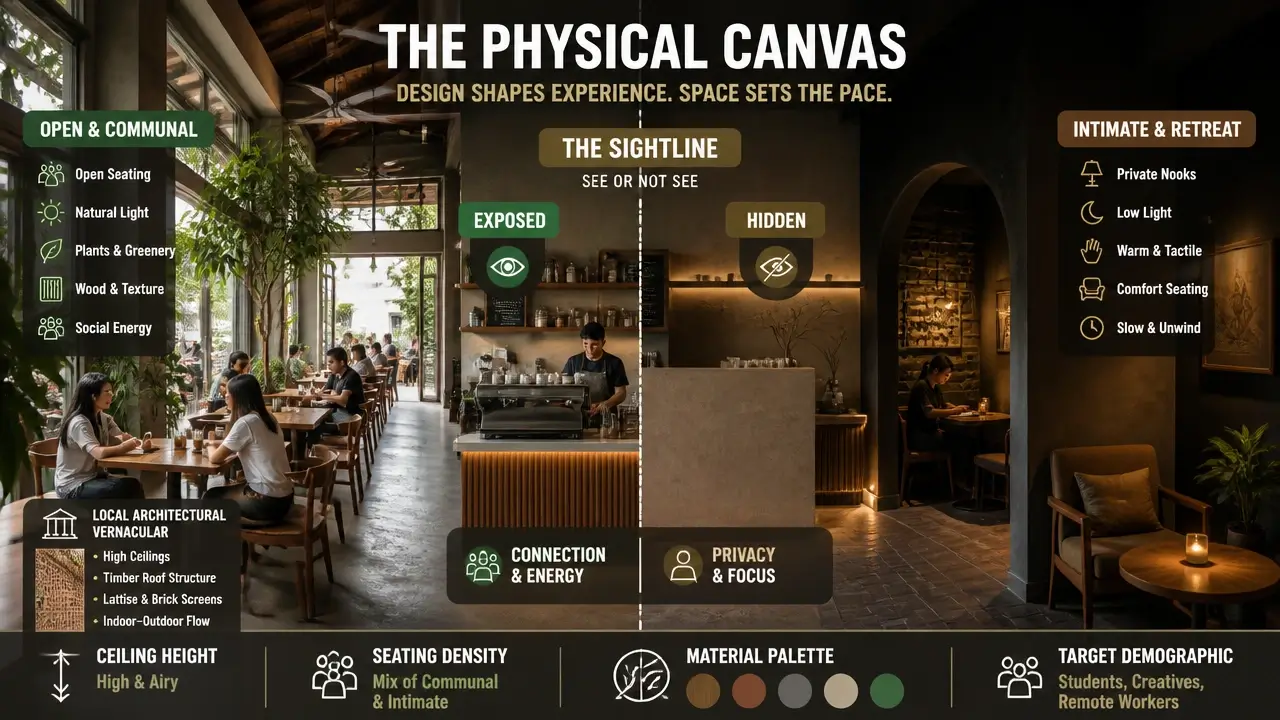
Thoughtfully designed café spatial design is the first sentence of coffee visual language, and you read it before you order, before you smell the espresso, before you even reach the counter. The moment you step through the door, your brain is already parsing ceiling height, seating density, material choices, and light sources, assembling a verdict about what kind of place this is and how long you’re meant to stay. That verdict takes about seven seconds. The space earns it or loses it in silence.
The Layout as Handshake
Open floor plans with long communal tables say one thing clearly: you’re welcome to stay, spread out, and talk to strangers. The space is designed for social gravity, the kind of place where a laptop worker and a first-date couple end up two feet apart without it feeling strange. That layout codes for collaboration, lingering, and a café philosophy that wants to be a neighborhood living room.
Intimate nooks with low ceilings, booth seating, and warm directional lighting say the opposite. They’re designed for withdrawal, for the person who wants to disappear into a book or a difficult conversation. The architecture isn’t being inhospitable. It’s being specific. It’s telling you: we built this for escape, not performance.
Neither is better. Both are intentional. The layout is the handshake, and a handshake tells you what kind of relationship you’re walking into.
Biophilic Design vs. Industrial Minimalism
The material palette is where the pace of the café gets encoded. Biophilic design (raw wood surfaces, abundant live plants, natural light flooding through oversized windows) creates a sensory environment that physically slows you down. Warm materials absorb sound, irregular textures soften the room, and greenery triggers a low-level attention restoration response. Your nervous system reads “forest floor” and downshifts. This is the visual grammar of slow coffee culture: single origins, tasting notes on chalkboards, a barista who wants to talk about the farm.
Industrial-minimalist spaces work the opposite mechanism. Polished concrete, exposed steel, neon signage, and hard acoustic surfaces keep stimulation high. The room doesn’t let you settle into a stupor, it keeps you alert, which is exactly right for a high-throughput specialty hub where the menu runs to forty customization options and the line moves fast. The material palette isn’t decoration. It’s pacing architecture.
The Sightline Principle
Where the counter sits (and what it exposes) is one of the most loaded decisions in café spatial design. A counter that puts the espresso machine front and center, barista in full view, workflow visible from every seat, is staging a performance. It codes the relationship as educational and theatrical: watch how this is made, ask questions, this is the show. Specialty coffee shops that lead with craft almost always use this layout. The machine is the altar. The barista is the priest. You’re the congregation.
A counter tucked behind a partition, or a service window that delivers drinks without revealing the process, codes as transactional. That’s not a criticism (fast-casual coffee operates on efficiency, and hiding the kitchen removes friction from the customer experience). But it changes the relationship entirely. You’re not invited to understand the process. You’re invited to receive the product.
The sightline is a design choice that answers the question: Is this place about coffee, or is it about you getting coffee?
Seth Boor, Principal Architect and Co-Founder of Boor Bridges Architecture (the firm behind Ritual Coffee, Sightglass Coffee, and Mazarine Coffee in San Francisco) captures exactly this tension between scale and intimacy:
“In all our projects we try to balance the cozy and giant, heroic spaces versus more human spaces. Sightglass on 7th was going to be their production space and once we peeled stuff away we fell in love with the character and scale and industrial aspect of it. We wanted it to be about roasting and less about the retail space. On 20th, the space we had didn’t have as much character to it on its own. We wanted more polish and finish to the space, because it wasn’t a production roastery, it was a neighborhood roastery. We wanted the scale to come down to a more human level.”
Reading the Room: A Traveler’s Checklist
- Ceiling height: High ceilings create drama and energy, they signal a destination, an event. Low ceilings create intimacy and containment, they signal a refuge.
- Seating density: Tightly packed seating prioritizes throughput and social buzz. Generous spacing between tables prioritizes comfort and dwell time.
- Material palette: Warm organics (wood, linen, terracotta, plants) signal slow appreciation. Hard industrials (concrete, steel, glass, neon) signal speed and stimulation.
- Counter placement and visibility: Open sightline to the machine = craft theatre. Hidden or partitioned service = transactional efficiency.
Four data points. Thirty seconds. You’ll know the café’s philosophy, its target customer, and its intended pace before you’ve seen the menu.
Local Vernacular as Cultural Layer
There’s one more dimension that sits underneath all of this, and it’s easy to miss if you’re only reading the universal grammar of café design. Local architectural vernacular adds a layer of cultural storytelling that no interior designer can fully import from elsewhere.
A café built inside a Kyoto machiya (a traditional wooden townhouse with a narrow street frontage, deep interior garden, and tatami-adjacent proportions) is communicating something about slowness, craft, and historical continuity that the biophilic design elements alone can’t carry. The building itself is the argument. Conversely, a Berlin café carved out of a former factory conversion brings the weight of post-industrial history into every exposed brick and poured-concrete column. The space carries memory. That memory becomes part of the coffee visual language, a context that tells you this drink exists in a specific place, at a specific moment in that place’s story.
The best café spaces don’t fight their building. They read it, the way a good translator reads a text, and then they let the architecture speak in its own accent.
The Tools of the Trade: Machinery and Ceramics as Status Signifiers
Carefully chosen coffee brewing hardware is the café’s clearest editorial statement (the espresso machine sitting on the bar and the ceramic in your hand both carry meaning before a single shot is pulled). The room told you something about pace and comfort. The equipment zone tells you something sharper: what this café believes coffee actually is.
Start at the machine. In specialty coffee culture, the espresso machine functions as an altar (the physical and symbolic center of the bar). A customized La Marzocco Linea, with its wide stainless-steel chassis and symmetrical twin-group format planted front-and-center, broadcasts professional mastery and volume capability. It says: we take extraction science seriously, and we do it at scale. That’s a different sentence entirely from what a Modbar says. The Modbar hides its mechanics under the counter, leaving only tap wands visible above the surface. The visual effect is architectural restraint, the barista becomes the focus, not the machine. It signals transparency through minimalism, and it quietly repositions the counter as a stage for conversation rather than a showcase for hardware.
Go further back in the machine taxonomy and the philosophy shifts again. A lever-type Faema E61 (bulky chrome profile, visible gauges, the physical ritual of pulling the lever) speaks old-world craft and romance. It tells you the café values the hands-on relationship between barista and extraction. A pressure-profiling machine covered in PID screens and flow controls reads like a laboratory instrument. It says: we’re experimenting with extraction curves, and we want you to know it. That’s a machine for cafés chasing competition-circuit flavor profiles and serving customers who already know what “pressure profiling” means.
Then there’s the absence of visible equipment entirely, a ghost setup with only a tap tower breaking the counter surface. That silence is its own statement. It says the café prioritizes uncluttered aesthetics and guest interaction over barista theatre. No altar. Just conversation and coffee.
| Category | Example | Visual Cues | Implied Philosophy | Typical Café Branding | Sensory / Guest Impact |
|---|---|---|---|---|---|
| Espresso machine | La Marzocco Linea | Large stainless chassis; front-and-center; symmetrical twin-group | Precision, reliability, professional mastery | High-volume serious specialty | Signals consistency; guests expect dialed-in shots |
| Espresso machine | Modbar | Under-counter system; visible taps/wands only; minimal surfaces | Transparency through restraint, design purity | Minimalist, architectural, design-led | Uncluttered visual field; barista workflow feels elevated |
| Espresso machine | Lever-type Faema E61 | Vintage chrome; bulky mechanical presence; visible levers and gauges | Craft, ritual, old-world tradition | Heritage, nostalgic, artisanal | Evokes hands-on extraction; reads as authentic and time-tested |
| Espresso machine | Pressure-profiling machine | PID screens, pressure dials, flow controls; lab-like frame | Experimentation, control, sensory exploration | Experimental, competition-style, geeky specialty | Signals custom extraction; appeals to enthusiast customers |
| Espresso machine | Traditional commercial 2-group | Mid-to-large footprint; brushed stainless, boiler-heavy | Workhorse efficiency, service speed | Busy neighborhood staple, high throughput | Communicates capacity; operationally reassuring over fashionable |
| Glassware | Cortado glass | Small, straight-sided, transparent; low profile | Precision, portion awareness, contemporary specialty | Clean, modern, minimalist | Makes layering visible; conveys control |
| Glassware | Fluted tasting glass | Tall, narrow, ribbed; delicate and highly transparent | Sensory focus, tasting-room seriousness | Experimental, cupping-adjacent, high-concept | Concentrates aroma; frames the drink as a tasting exercise |
| Glassware | Clear espresso demitasse | Small transparent cup; showcases crema | Transparency, performance, inspection | Specialty, detail-oriented, modern classic | Lets guests judge crema and color; “presented, not hidden” feel |
| Ceramic | Thick-walled demitasse | Heavy porcelain or stoneware; substantial rim; opaque | Tradition, durability, comfort | Classic café culture, reassuring | Retains heat; feels weighty and premium in hand |
| Ceramic | Thin china cup | Fine, light walls; elegant profile; often white | Refinement, precision, elegance | Upscale, formal, classic European | Heightens aroma clarity; communicates finesse and restraint |
| Ceramic | Handmade stoneware cup | Irregular glaze, visible texture, earthy tones | Craft, locality, intimacy | Artisan, independent, slow coffee | Feels personal and tactile; suggests small-batch care |
| Ceramic | Matte black specialty cup | Dark, sculptural, visually subdued | Minimalism, design-consciousness | Fashion-forward, modern specialty | Shifts attention to form over liquid color; reads as curated |
Now move the cup itself into focus, because the vessel is doing more work than most people realize.
The Cortado glass (small, straight-sided, transparent) makes the equal-parts ratio of espresso and milk immediately visible. You can see the balance before you taste it. That’s intentional. It announces intensity and smoothness in the same glance. Fluted tasting glasses go further: their narrow profile concentrates aroma and their ribbed surface slows you down. A café that serves filter coffee in a fluted tasting glass is telling you, without a word, to treat this like wine. Swirl it. Smell it first. This is a tasting, not a caffeine delivery.
Ceramic thickness is where the physics and the experience lock together. Thick-walled demitasses (heavy stoneware or porcelain) retain heat through the short, fast window of an espresso. The mass of the wall acts as a thermal buffer, keeping the shot temperature stable from first sip to last. Thin, fine china does the opposite: it releases heat quickly, which for a pour-over served at a lower temperature is actually the goal. Rapid cooling opens up fruit notes and floral aromatics that a heat-retaining vessel would suppress. The cup isn’t just a container, it’s a temperature management tool that shapes what you taste.
Professor Charles Spence, Professor of Experimental Psychology at the University of Oxford and Head of the Crossmodal Research Laboratory, has documented exactly how far this effect reaches:
“The colour of the cup, for instance, has been shown to prime notions of sweetness (e.g., pink cup) or acidity (e.g., yellow or green cup) that may carry over to influence the tasting experience. Meanwhile, the shape and surface feel of the drinking vessel have also been shown to exert a profound influence over the perceived aroma/taste of coffee. Given that the various sensory attributes of the drinking vessel can exert such a striking influence over the drinking experience, the challenge moving forward, is to optimise the design of the receptacle in order to enhance the multisensory tasting experience for the consumer.”
That’s not abstract theory, it means the matte black cup that looks cool on Instagram may actually be muting your perception of the coffee’s sweetness. The café that chose handmade stoneware with an irregular glaze isn’t just being artsy; that tactile surface and earthy tone are priming you toward warmth, intimacy, and craft before the liquid ever touches your tongue.
The Art on the Cup: Latte Art, Liquid Aesthetics and Photography
Coffee liquid aesthetics function as the most immediate diagnostic layer in coffee’s visual language: every surface, every texture, and every shade of brown is a live readout of what happened upstream. The crema on your espresso, the sheen on your microfoam, the clarity of your pour-over: none of it is decoration. It’s data. Once you know how to read it, a beautiful cup and a technically correct cup stop being separate ideas.
Crema, Microfoam, and Latte Art as Diagnostics
Latte art is the most visible signal in milk-based drinks, but its real job isn’t to look good, it’s to prove that the microfoam holding it together was made correctly. A symmetrical rosetta or swan requires microfoam with a specific texture: seamless, glossy, and so fine-grained it resembles wet paint under light. That texture only happens when a barista’s steam wand technique is precise (the right angle, the right depth, the right duration). Get any of those wrong and the milk either scalds into macrofoam (large, uneven bubbles that break apart on the surface) or stays flat and watery. You can’t pour a clean tulip into either of those.
So when you see a tight, well-defined pattern sitting on the surface of your flat white, you’re not just looking at someone’s artistic talent. You’re looking at proof that the milk was stretched correctly, that the temperature was managed, and that the pour was controlled. The art is the receipt.
Crema tells a parallel story on the espresso side. Fresh beans extracted at the right pressure and temperature produce a thick, hazelnut-coloured froth with reddish-brown streaks running through it (what baristas call tiger striping). That marbling happens because different compounds in the shot extract at slightly different rates, and the visual result is a crema that looks almost layered. Pale, thin crema with a broken dark ring around the edge? That’s under-extraction or stale beans. A dark, bitter-smelling foam that collapses immediately? Over-extraction or beans that were ground too fine.
The contrast between microfoam and macrofoam is worth slowing down on, because it’s the single fastest quality gate for any milk drink:
- Microfoam: Seamless, reflective surface with no visible bubbles. Integrates with the espresso rather than sitting on top of it. Holds its structure long enough to pour a pattern.
- Macrofoam: Visible bubbles, uneven texture, dry or frothy feel. Sits separately from the liquid. Collapses or separates within seconds.
One of those is a technical achievement. The other is hot milk with air in it.
The cultural weight latte art now carries didn’t arrive by accident. “Latte art” was formally codified by the Oxford English Dictionary, a signal that the practice had crossed from barista subculture into mainstream vocabulary. What accelerated that shift was institutionalisation through competition. The World Latte Art Championships turned a barista’s pouring skill into a standardised, judged discipline, with scoring criteria that cover symmetry, contrast, and visual complexity. What started as a café-floor flourish became a measurable metric of craft. That matters because it tells you something about how coffee’s visual language evolves: an aesthetic practice earns credibility when it gets a rulebook.
To see how microfoam texture and tiger striping actually look in motion (the kind of detail that’s genuinely hard to describe in words) this close-up demonstration is worth your time:
Filter Coffee Appearance and Photography’s Role
Filter coffee appearance works on a completely different visual register, but the diagnostic logic is the same. A well-made pour-over or batch brew has a clean, translucent body (dark amber when held to light, similar to a strong tea). That clarity means the filtration was even, the grind was consistent, and the extraction didn’t pull the bitter, muddy compounds that come from over-grinding or uneven water distribution. A murky, opaque brew that looks more like runoff than tea is telling you something went wrong in the grind or the pour.
Light-roast single origins show this most dramatically. The translucent body isn’t just an aesthetic choice, it’s the visual signature of a coffee that was processed and roasted to preserve origin character rather than mask it. Opacity, in that context, is a sign that something upstream obscured what the bean was trying to say.
Then there’s the photograph. Instagram turned latte art into a cultural ambassador for specialty coffee in a way that no amount of industry marketing could have engineered deliberately. A well-lit overhead shot of a rosetta in a ceramic cup, posted by someone who genuinely loved what they were drinking, reached people who’d never set foot in a specialty café. The visual language of coffee traveled faster than the coffee itself.
That’s genuinely useful, and worth being honest about its limits. A perfect photograph documents a moment, not a taste. The light can be right, the pattern can be symmetrical, the ceramic can be beautiful, and the espresso underneath can still be bitter, the milk can still be scalded. Photography captures the surface layer of coffee’s visual language, which is real and meaningful, but it’s one layer.
What the photograph doesn’t capture, and what the industry sometimes forgets when it leads with liquid aesthetics, is that consumers aren’t just buying the cup. They’re buying the room it came in, the chair they’re sitting in, the sound behind the conversation. The liquid is the most intimate part of the experience, but consumer data keeps returning the same finding: the physical environment carries equal weight in how people judge a café. The most beautiful latte art in the world, served in the wrong room, doesn’t close that gap.
The Graphic Identity: Packaging, Colour, and Café Walls
Coffee’s graphic identity code is the first thing that sells you on a roaster, before you smell the bag, before you read the tasting notes, before you even walk through the door. The packaging, the colour palette, the mural behind the espresso bar (these aren’t decoration layered on top of the product). They’re the product’s first dialect, and most of us are already fluent in it without realising it.
So when the bag looks like an album cover or the wall feels like a gallery opening, that’s not marketing noise. That’s the café’s visual language doing exactly what it was designed to do: tell you what kind of coffee experience you’re about to have.
Three Packaging Archetypes That Signal Different Coffees
The packaging taxonomy breaks into three distinct archetypes, and each one broadcasts a different philosophy about what’s in the bag.
- Minimalist Archivist: stark (white or kraft paper, clean grids, monochrome typography, maybe a single-origin farm name in a quiet sans-serif). The message is transparency. Nothing is hidden, nothing is embellished. This packaging says the coffee doesn’t need a costume.
- Maximalist Art House: neon palettes, psychedelic patterns, illustration that feels closer to a festival poster than a food product. This isn’t chaos. It’s a deliberate signal that the roaster is playing with experimental processing, pushing fermentation boundaries, chasing unusual varietals. The louder the bag, the more likely the coffee inside is doing something unexpected.
- Retro Character: mid-century mascots, chunky display fonts, warm earthy tones. It projects approachable nostalgia. This is the neighborhood roaster, the community anchor, the place your parents might actually enjoy. The visual language is saying: we’re not intimidating, we’re familiar, come in.
How Colour Codes Map to Flavour Profiles
Many roasters have quietly built a subliminal colour code that maps bag labels to flavour wheels.
- Pink and purple tones signal floral, berry-forward naturals (Ethiopian Yirgacheffe, Guji, Sidama).
- Deep browns and burnt oranges point toward nutty, chocolaty washed coffees (Brazilian cerrado, Colombian Huila).
Process stamps work the same way. A bold Washed stamp cues brightness and clarity (clean acidity, defined structure). Natural means heavy, fruity, sometimes winey body with the kind of sweetness that comes from the cherry drying on the seed. Honey sits in between: sweet, complex, textured, with a body that feels like something between the two.
These aren’t arbitrary icons. They’re shorthand for the entire processing chain, how the coffee was fermented, how the mucilage was handled, what microbial activity shaped the final cup. A trained eye reads a process stamp the way a sommelier reads a vintage on a label. The information density is real.
Kylee Clancy, Senior Coffee Buyer at Verve Coffee Roasters in Santa Cruz, California, describes exactly this alignment in the design of Verve’s Wilder Blend:
“Wilder Blend’s packaging is a direct reflection of what’s happening in the cup, with explosive notes of watermelon gummy, pineapple guava and orange sherbet, the coffee delivers a candy‑like sweetness layered with tropical acidity and electric aromatics that linger long after each sip. That unapologetically loud, boundary‑pushing profile inspired a visual identity that feels just as vibrant and unexpected. Bold, playful colors and high‑impact design elements mirror the blend’s layered character, capturing its sense of experimentation, energy and joyful intensity before the bag is even opened.”
Custom Murals and the Café as Brandscape
The same logic that drives packaging design extends to the walls. Custom murals, local artist commissions, thematic paintings (these aren’t aesthetic wallpaper). They’re the café’s graphic identity code scaled up to room size.
A roaster who commissions a local artist to paint a 12-foot mural of the Ethiopian highlands isn’t just decorating. They’re making a statement about supply chain awareness, community investment, and the kind of customer they’re trying to attract. A café that rotates gallery shows every six weeks is telling you something about how they think about their space, not as a coffee delivery mechanism, but as a cultural node.
The mural is also the most shareable element in the room. It’s the background of a thousand Instagram posts, the thing that gets tagged before the latte art does. Which means the visual language of the café interior is doing marketing work every time someone photographs it, but it’s only credible marketing if the aesthetic is genuine, if the mural actually reflects the same values the packaging communicates.
When the graphic identity is coherent (when the bag, the stamp, the colour palette, and the wall art are all saying the same thing) you’re not looking at decoration. You’re reading a brand that knows exactly who it is. And that coherence, more than any single design element, is what makes the coffee visual language land before a single shot is pulled.
The Sonic and Literary Atmosphere
Café ambient aesthetics don’t stop at what you can see. The music playing overhead, the dog‑eared paperbacks stacked on a shelf, the chalk‑scrawled poem above the counter (these are just as deliberately chosen as the tile pattern on the floor or the color of the espresso machine). They’re the auditory and intellectual layers of coffee visual language, and once you start reading them, you can’t stop.
Music as Acoustic Architecture
Think of a café’s playlist the way you’d think of its ceiling height. Both shape how long you want to stay, how loud you want to talk, and how much of your attention you’re willing to surrender to the room.
Low-tempo, instrumental music (ambient jazz, slow classical, wordless electronica) signals that this is a space for focus. The café is telling you: slow down, stay a while, order a second cup. That’s not accidental. Research consistently links slower background music to longer dwell times and higher average spend. The playlist is a business decision dressed as an aesthetic one.
Flip it to upbeat, genre‑eclectic selections and the room shifts gear entirely. The energy climbs, conversation flows faster, tables turn quicker. That’s the social café model, designed for throughput and buzz, not quiet mornings with a notebook.
What the Sound Source Signals
The source of the music is itself a visual cue.
- A wall‑mounted record collection with a visible turntable tells you the owner spent a Sunday afternoon choosing these albums.
- A DJ booth in the corner signals a café that blurs into a cultural venue by evening.
- Complete silence (rare but intentional) says the space trusts ambient sound to carry the mood on its own.
Each of these is a prop in the larger set design. The vinyl crates aren’t just storage. They’re a declaration of taste, the same way a bag of single-origin beans on the counter is a declaration of sourcing philosophy. Both are asking you to trust the curation.
The Literary Café as a Design Genre
The historic Viennese coffeehouses (Café Central, Café Hawelka) weren’t just places to drink coffee. They were where writers, philosophers, and artists did their thinking out loud, and the design reflected that: marble tables built for long sessions, newspaper racks, unhurried service that never made you feel like you were occupying real estate.
That template didn’t disappear. It evolved into a recognizable design genre: exposed bookshelves, reading lamps positioned for actual reading, typewriters used as sculptural objects, mismatched chairs that reward settling in. These aren’t nostalgic accidents. They’re deliberate signals that this café values a slower rhythm and an intellectual register.
Hayashita, owner of Haden Books café in Omotesando, Tokyo (a space that fuses a specialty coffee bar with a curated bookshop) puts it plainly:
“Books, words, music, in many ways, they’re like trips to another time, and place. But we sometimes need the right atmosphere for it; a place conducive to [that].”
The word, conducive, is doing serious work. The books aren’t decoration. They’re permission, permission to slow down, to think, to stay. The café’s physical design creates the conditions for a different kind of presence.
Where Text Becomes Visual
Handwritten menus aren’t just functional, the handwriting style itself communicates warmth, impermanence, and craft. A chalkboard quote from Baldwin or Pessoa above the brew bar merges typography with atmosphere. Wall poetry turns a blank surface into an invitation to read rather than scroll.
These are words functioning as design elements. The choice of font, chalk colour, spacing, and content all carry meaning the same way a mural does, except the medium is language, and the message is we think about things here.
How Ten Aesthetic Elements Build a Café’s Identity
Coffee’s visual language isn’t a checklist you complete, it’s a system where each element calibrates the meaning of every other one. Get the interplay right, and a café feels inevitable. Get it wrong, and even the best espresso can’t save the experience.
Aesthetic Elements Working Together, Not in Parallel
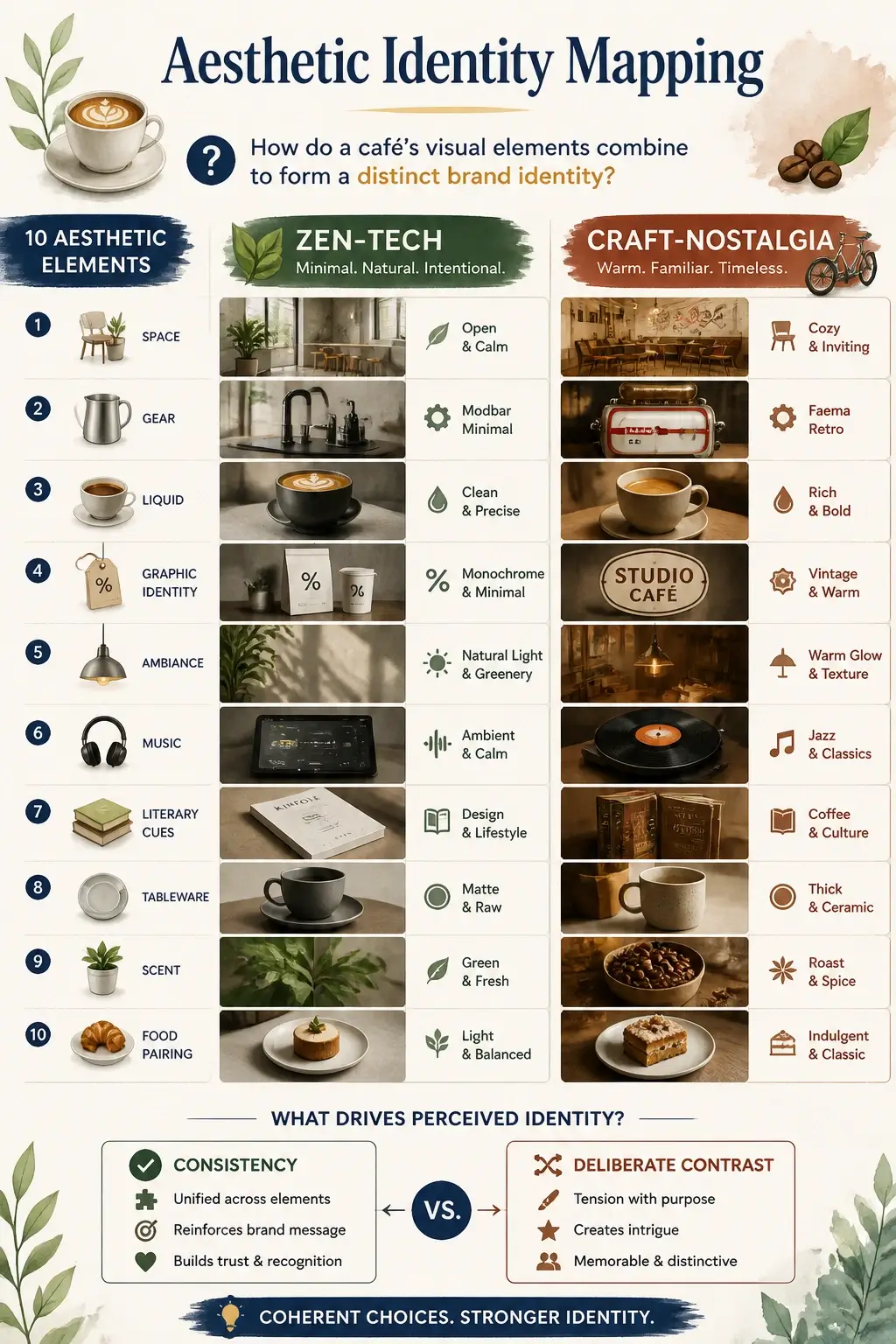
Cohesive café identity emerges from interplay, not inventory. A minimalist Modbar recessed into a concrete counter, paired with biophilic shelving and monochrome single-origin packaging, doesn’t just look clean, it builds a zen‑tech identity where every element reinforces the same core message: precision without performance. Nothing is there to impress you. Everything is there to work.
Flip the palette entirely. A restored Faema E61 gleaming under warm tungsten light, thick ceramic cups with a matte glaze, and a mid‑century mural of a roaster’s hands, that’s a craft‑nostalgia identity. The machine is the hero. The cup is a prop from the same era. The mural contextualizes both. None of those three elements is doing its job alone.
What makes either model land isn’t consistency for its own sake, it’s that the elements are in conversation. When the music tempo matches the visual rhythm (spare jazz in the zen‑tech space, warm Americana in the craft‑nostalgia one), and the cup weight matches the machine’s ethos, the brand becomes something a guest can feel before they’ve tasted anything.
Deliberate contrast works too, but only when it’s controlled. An industrial space with unexpectedly delicate glassware creates productive tension, it signals that the owner knows the rules well enough to break one. What doesn’t work is accidental contrast: a specialty‑forward menu printed in Comic Sans, or a carefully sourced natural process served in a paper cup with a generic sleeve. Those breaks don’t read as eclectic. They read as unconsidered.
The infographic below maps how these five dimensions (space, gear, liquid, graphic, and ambiance) combine into recognizable identity models:
The Owner‑Consumer Value Gap Nobody Talks About
The visual language also works inward. A café’s aesthetic identity isn’t just a signal to guests (it’s a filter for staff, regulars, and community). The kind of barista who wants to work behind a Modbar in a silent, light‑filled room is a different person from the one who wants to pull shots on a vintage Faema while Coltrane plays. The visual environment recruits the team that reinforces it.
But here’s where the data gets uncomfortable for the industry.
The dominant belief inside specialty coffee (what you might call the third‑wave ideology) is that bean provenance, roasting precision, and barista craft are the core of the experience. Everything else is atmosphere. Most owners operate from this assumption so completely that it’s rarely questioned.
A 2023 study published in the Journal of Tourism and Cultural Change, “exploring the coffee shop experience model in the Vietnamese context”, put numbers to that assumption, and the result is a 47.4 percentage‑point crack in the foundation. 95.7% of café owners and managers identified product quality as the primary driver of the experience. Consumers? Only 48.3% weighted it that way. Meanwhile, 48.0% of consumers placed equal importance on the physical environment, the visual language, the ambiance, the layout.
That’s not a rounding error. That’s a structural misalignment between what the industry invests in and what the market actually values.
The third‑wave ideology is, empirically, a supply‑side ideology. On the demand side, the visual language accounts for half of the value judgment. Industry thought leaders talk about authenticity, education, and the ethics of sourcing, and those things matter. But consumers, in aggregate, want excellent coffee in a space that feels good to be in, at a price that doesn’t sting. The visual environment isn’t a bonus layer on top of the product. It’s a co‑equal pillar of satisfaction.
Sarah, a specialty coffee industry professional quoted in Perfect Daily Grind‘s analysis of Gen Z consumers, puts the tension precisely:
“The irony is that Gen Z also cares about sustainability and fair trade, which are core pillars of specialty coffee. But if you can’t deliver those values in a package that feels relevant to them, in an environment they find appealing, with drinks they want to order, then that alignment becomes meaningless.”
The values are shared. The visual delivery of those values is where the connection either happens or doesn’t. A beautifully sourced coffee served in a space that feels indifferent to the guest communicates indifference, regardless of what the origin card says.
This tension isn’t new. Albania’s density of 654 coffeehouses per 100,000 inhabitants and Seoul’s 900 % rise in café count aren’t anomalies of modern consumer culture. The 1674 “Women’s Petition Against Coffee” in England (a protest against the coffeehouses pulling men away from domestic life) is evidence that coffee’s social spaces have carried heavy visual and social coding for centuries. The designed third place isn’t a third‑wave invention. It’s a return to what coffeehouses have always been: environments where the physical experience and the product were inseparable from the start.
The Visual Language’s Next Chapter
Future coffee design trends are already rewriting the grammar you’ve just learned, and the rewrites are coming from three directions at once: technology that layers new information onto physical objects, sustainability aesthetics that turn ethics into beauty, and an overdue reckoning with the one story the visual language has never told.
Sensorial Branding and the Augmented Café
Sensorial branding is the practice of synchronising every perceptible detail (colour temperature, plateware texture, ambient light, sound) to a single coherent emotional signal, and it’s moving from boutique experiment to mainstream expectation.
The most visible edge of this shift is augmented reality on packaging. Point your phone at a bag of single‑origin Ethiopian and the flat paper surface opens into a short film: the farm, the elevation, the hands sorting cherries at the wet mill. The information was always there in the tasting notes. AR makes it felt rather than read. That’s a fundamentally different cognitive experience: the difference between knowing a place exists and briefly standing in it.
Digital menu boards are doing something quieter but equally interesting. Static chalkboards can’t respond to context. A well‑programmed digital board shifts its palette and its featured drinks as morning light gives way to afternoon: warm amber tones and filter coffee at 7 a.m., cooler blues and espresso‑forward drinks by 2 p.m. The menu stops being a list and starts behaving like a room.
Virtual coffee tasting is where sensorial branding faces its hardest test. When the tasting moves to a screen (and subscription boxes, remote brewing classes, and live‑streamed cuppings have all accelerated that shift) the café can no longer rely on the physical environment to carry half the emotional load. The visual presentation of the drink itself has to do everything: the pour, the vessel, the light, the colour of the liquid. Cafés developing a fluent screen‑side visual identity right now are building for a channel that’s only going to grow.
Supply‑Chain Storytelling Fills the Blindspot
The supply‑chain visual storytelling is the most underdeveloped frontier in coffee design, and arguably the most consequential one, because the silence is conspicuous once you notice it.
Walk through everything you’ve learned to read: the machine as precision signal, the ceramic as tactile philosophy, the crema as freshness proof, the mural as emotional brandscape. Now ask: where are the people who made all of this possible? The answer, almost universally, is nowhere. The visual language of specialty coffee is extraordinarily sophisticated at the consumption end and almost completely mute at the production end.
That gap isn’t accidental, it reflects how the supply chain has historically been structured, with roasters and cafés closest to the consumer and farmers furthest from the story. But it is a gap, and the most forward‑thinking operators are starting to fill it deliberately.
Reusable cup programs are already doing a version of this, turning the act of bringing your own cup into a visible, branded gesture (a status signal that says I know where this ends up). Compostable packaging designed to be genuinely beautiful makes the same argument: that environmental responsibility doesn’t require aesthetic sacrifice. Café builds using reclaimed timber, repurposed factory fittings, and materials with documented histories are making the same point in three dimensions, the space itself has a provenance.
But the deeper move is connecting the cup back to the soil. Farm‑level QR codes on packaging that link to producer economics (real numbers, not marketing copy) turn a purchase into a transparent transaction. Photographic essays on café walls that show actual harvest conditions, actual wages, actual faces do something that no amount of tasting‑note poetry can, they make the producer economics visible and therefore real.
This isn’t just an ethical correction. It’s the next genuinely new visual vocabulary in coffee culture. Every other element of the visual language (the machine, the art, the packaging) is a refinement of an existing grammar. Closing the supply‑chain loop is a new sentence structure entirely.
The enthusiast who can already read the current visual language is positioned to spot this wave early, and to demand it. Because once you understand that every visual choice in a café is a deliberate communication, the absence of the origin story stops reading as neutral. It starts reading as a choice, too.
Key Takeaways on Coffee Visual Language
- Visual cues calibrate taste expectations before you sip, making design a functional part of the coffee experience.
- Café owners overvalue product quality while customers assign equal weight to the physical environment.
- Latte art is a diagnostic tool: a clean pour proves the milk was steamed to the correct microfoam texture.
- The color and texture of your cup prime your palate for sweetness, acidity, or warmth before tasting.
- Most café visuals erase the farmer; closing that supply-chain storytelling gap is the next design frontier.
Frequently Asked Questions About Coffee Visual Language
Q: Did Jackie Chan actually say coffee is a language in itself?
A: Yes, and the article uses his quote to introduce coffee visual language—the idea that a café’s design, equipment, and liquid appearance form a grammar you read before tasting. It’s not just a metaphor; it’s a functional system that sets expectations.
Q: Why do café owners and customers disagree so sharply on what makes a great coffee experience?
A: A 2023 study found 95.7% of owners prioritize product quality, but only 48.3% of customers do. Nearly half of customers value the physical environment equally. Owners often overlook that the space itself is a co-equal pillar of satisfaction.
Q: Can the color of a coffee cup actually change how the coffee tastes?
A: Yes. Research shows pink cups prime sweetness, while yellow or green cups suggest acidity. The cup’s color, shape, and texture influence your perception before you sip, so a matte black cup might mute sweetness compared to a white one.
Q: How do coffee bag colors predict the flavor inside?
A: Many roasters use a subliminal color code: pink and purple often signal floral, berry-forward naturals; deep browns and oranges point to nutty, chocolaty washed coffees. It’s a visual shorthand that lets you guess the cup profile before reading the label.
Q: What does the placement of the espresso machine tell you about a café?
A: A machine front and center with full barista visibility stages craft as theatre, inviting questions. Hidden or partitioned service signals transactional efficiency. The sightline is a design choice that defines whether the café is about coffee or just getting you a drink.
Q: What’s the one visual clue that instantly reveals a barista’s milk-steaming skill?
A: Look at the milk’s surface. Microfoam is glossy, seamless, and holds a pattern; macrofoam has visible bubbles and collapses quickly. A clean latte art pattern proves the barista achieved the precise texture needed for a quality drink.
References
- Turning a commodity into an experience: the sweetest spot in the coffee shop – Business Perspectives
- Applying the DART co-creation model to coffee shop experiences – Emerald Insight
- We Interview Boor Bridges Architecture, San Francisco’s Cafe Design Masters – Sprudge
- The influence of cup colour and shape on coffee taste perception – ScienceDirect
- Coffee Design: Verve Coffee’s Wilder Blend Pays Homage To The California Central Coast – Sprudge
- Tokyo Coffee At Haden Books: A Little Pocket Hideaway In Omotesando – Sprudge
- Coffee culture unravelled: exploring the coffee shop experience model in the Vietnamese context – Taylor & Francis Online
- What Does Gen Z Want From Specialty Coffee? – Perfect Daily Grind