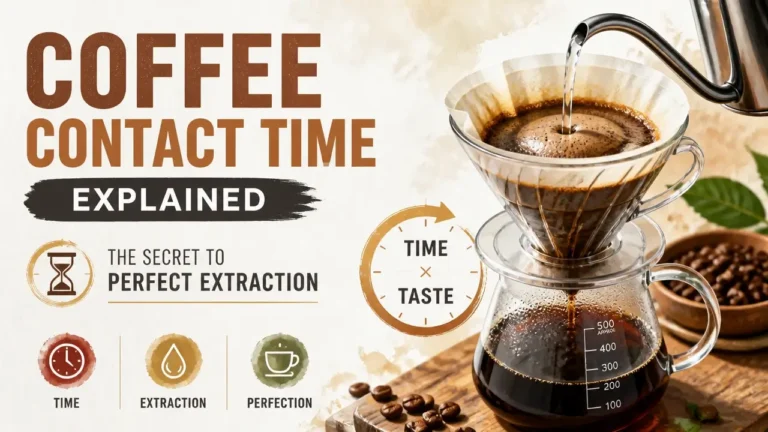

Precise coffee contact time is the hidden variable most brewers overlook, and the one that controls everything. While grind size and water temperature get the glory, it’s how long water actually touches the grounds that decides whether fruit acids brighten your cup or tannins drag it into bitterness.
Immersion methods like French Press forgive a wandering timer. Percolation methods like V60 punish it. Nail the contact window and extraction yield lands exactly where flavor lives: short enough to stay sweet, long enough to develop depth.
What Contact Time Actually Means
Contact time is the total duration water physically touches your coffee grounds, from the moment water first hits the bed to the moment it stops, whether that’s final drawdown through a filter or a plunger press separating grounds from liquid. It sounds simple. It’s not, because you can’t set it the way you’d set a kitchen timer.
Think of it this way: contact time is a symptom, not a setting. Every choice you make before you pour (grind size, water temperature, dose, pour pattern) combines to produce a contact time as its output. When a recipe says “aim for 3 minutes,” it’s not telling you to press a button and wait. It’s telling you to adjust your other variables until 3 minutes is what naturally appears.
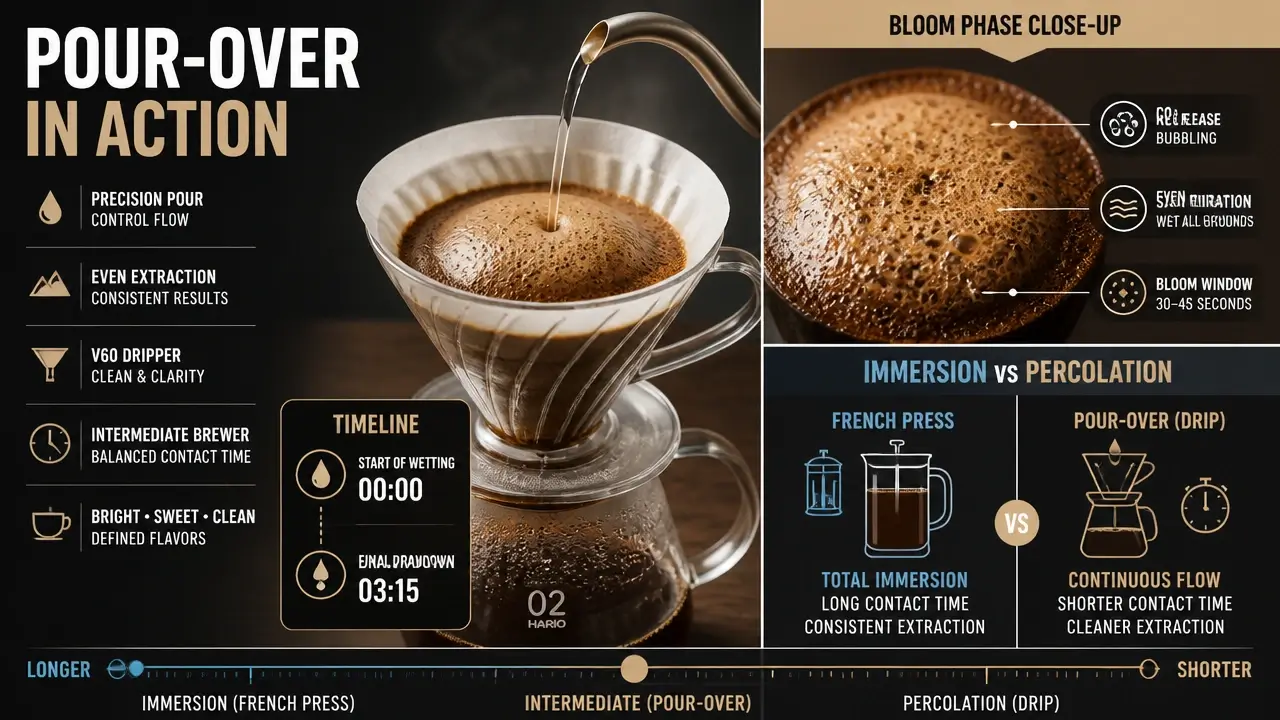
The physical meaning of “time” also changes depending on how you’re brewing. In immersion brewing (French press, AeroPress, cupping) all the water sits with the grounds for the full duration. Time here is straightforward: it’s a soak. You control it fairly directly by deciding when to press or pour off.
Percolation brewing (pour-over, drip, Chemex) works differently. Fresh water is constantly moving through the bed, and contact time is really the average duration any given water molecule spends touching grounds before it exits. That’s governed almost entirely by how fast water flows through the bed, which depends on grind resistance and your pour rate. You’re not managing a soak; you’re managing a flow.
Espresso makes the dependency crystal clear. No espresso machine has a “shot time” dial. You adjust the grind finer or coarser, and that changes bed resistance, which changes flow rate, which produces a longer or shorter shot. The 25–30 second window you’re targeting is the result of getting everything else right, not the cause of it.
Corrochano et al., reviewing coffee extraction science in Trends in Food Science & Technology, put the interdependency plainly:
“During coffee extraction, the process parameters are interdependent. It is, therefore, difficult to adjust any single factor without subsequently impacting others. For instance, in espresso, changing the grind size distribution will change brewing pressure, thus affecting flow rate and contact time.”
That’s the core insight this whole article is built on. Once you stop treating contact time as an input to dial in and start reading it as a reflection of your other decisions, you stop chasing numbers and start understanding what those numbers are actually telling you.
The Extraction Clock: Why Time Tastes Like Something
Sequential extraction turns coffee contact time into a flavor sequence: water pulls different compounds out of the grounds in a fixed order, and where you stop that sequence is exactly what ends up in your cup. It’s not random. The chemistry runs on a predictable schedule, and time is the only thing controlling where you get off.
Here’s the core of it: soluble coffee compounds don’t dissolve at the same rate. Some are light and eager (they jump into the water almost immediately). Others are heavier, more tightly bound to the cell structure, and need longer exposure before they release. Water doesn’t care about your flavor preferences. It just works through the queue.
The queue goes roughly like this:
- Fruit acids and light aromatics go first. These are the bright, citrusy, sometimes floral notes that make a well-extracted cup feel alive. They’re highly soluble and fast-moving.
- Sugars and Maillard compounds come next (the caramel, chocolate, and toasty notes that give a cup body and sweetness). These take more time to pull out and are the reason a slightly longer brew often tastes richer.
- Tannins and heavy organic matter arrive last. These are the compounds responsible for bitterness, astringency, and that dry, coating feeling at the back of your throat. They’re the ones you don’t want too much of.
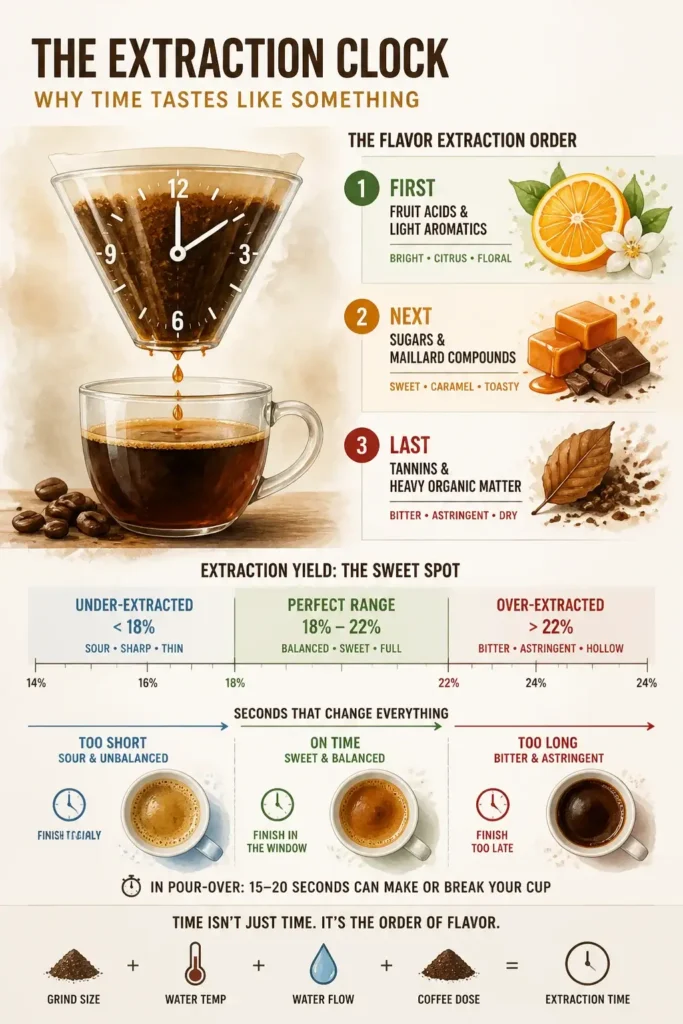
That sequence is why a short brew tastes sour. Stop too early and you’ve captured mostly fruit acids (bright, yes, but unbalanced). Without the sugars and Maillard compounds to round things out, the cup tastes thin, sharp, sometimes salty, and finishes fast. That’s under-extraction, and it’s not a flavor profile, it’s an incomplete one.
Go too long and the tannins take over. The cup turns bitter, hollow, and harsh. The sweetness that was there gets buried under astringency. That’s over-extraction, and more time didn’t make it better, it just kept pulling compounds you didn’t want.
The target window that captures enough of the good stuff without crossing into the bitter territory lands between 18–22% extraction yield, meaning 18–22% of the dry coffee mass has actually dissolved into the water. Below that range, you’re under-extracted. Above it, you’ve gone too far. Strength is a separate variable controlled by your coffee-to-water ratio, but extraction yield is what determines whether what’s in the cup is balanced or broken.
What makes this feel high-stakes in practice is how little time it takes to move between those states. In a pour-over, a 15–20 second difference can shift a cup from bright and sweet to drying and flat. You’re not talking about minutes, you’re talking about the gap between a good brew and a frustrating one measured in the length of a phone notification.
That’s the real weight of coffee contact time. It’s not a setting you dial in once. It’s a timer running through a flavor sequence, and every variable in your brew affects where that timer stops.
How Grind Size Shapes Contact Time
Grind size controls coffee contact time more directly than any other variable you can reach for, and it does so through two separate mechanisms working at the same time. Make the grind finer and you increase total surface area: more coffee cell wall exposed to water means faster dissolution of solubles. But you also pack the coffee bed tighter, which forces water to fight harder to get through. That resistance is what stretches your brew time.
Those two effects pull in the same direction, which is why grind size hits so hard. A coarser grind opens up the bed, water moves through faster, and contact time drops. A finer grind closes it down, water slows, and contact time climbs. In percolation brewing (pour-over, drip, espresso) the coffee bed is acting as a porous medium, and its resistance to flow is the engine driving your extraction clock.
To master these dual mechanisms, it helps to cross-reference your particle dimensions against The Complete Coffee Grind Size standard benchmarks.
The Permeability Mechanism, Not the Exit Holes
Here’s where a persistent misconception gets expensive. A lot of brewers blame slow drawdown on their dripper design (not enough holes, holes too small). The holes are just exits. Water has already spent almost all of its transit time fighting through the coffee bed long before it reaches them.
What actually governs flow is the permeability of that bed, a product of grind size, particle shape, and how the grounds pack together. The dripper’s exit geometry is essentially irrelevant to your brew time.
This isn’t just barista folklore. A peer-reviewed study published in Royal Society Open Science applied a Forchheimer-type (Darcy-based) formulation to model water flow through packed coffee beds, then validated it with X-ray imaging. The findings are unambiguous: finer grinds create smaller pore spaces and dramatically lower permeability, multiplying hydraulic resistance through the bed. The resistance imposed by the dripper’s exit holes was several orders of magnitude smaller than the resistance of the bed itself. The bed is the bottleneck. Always.
That single insight redirects your attention where it belongs (grind quality and bed preparation) and away from equipment variables that simply don’t move the needle.
Espresso and Pour-Over: The Same Physics, Different Windows
The practical stakes look different depending on your brew method, but the underlying mechanism is identical.
In espresso, you’re working inside a 20–30 second window. Professor Chahan Yeretzian, Head of the Coffee Excellence Centre at Zurich University of Applied Sciences (ZHAW), puts it plainly:
“When extracting espresso in a cafe setting, a finer grind size is needed to create more pressure inside of the portafilter. This helps to create more resistance to result in a proper extraction. However, in theory, if you grind finer then you will increase pressure and extraction yield, but ultimately there is a maximum extraction yield. If you grind too fine, the water flow rate will decrease because there is too much resistance, and it can often result in channeling.”
Channeling is the failure mode where water finds the path of least resistance through the bed rather than permeating it evenly, a direct consequence of permeability becoming so low that pressure differentials exploit weak spots in the puck. Coffee contact time stops being uniform across the bed, and extraction quality collapses with it.
Pour-over operates on a gentler scale, with a 3–5 minute starting window, but the grind-to-permeability relationship is the same dial. Grind too coarse and water races through before meaningful extraction. Grind too fine and you’re waiting four minutes for a drain that should take two, pulling bitter compounds the whole time.
Where Carbon Dioxide Fits In
One variable that genuinely does affect early drawdown (but gets conflated with grind size) is CO₂ retention in very fresh beans. Freshly roasted coffee off-gasses carbon dioxide, and during the bloom phase that gas creates back-pressure inside the bed, temporarily slowing water penetration. This is real, and it can make a fresh bag behave differently than the same beans two weeks later.
But it’s a secondary effect. CO₂ dissipates quickly, and once the bloom settles, permeability, controlled by grind size, resumes full command of your contact time. If your drawdown is consistently off, look at your grinder before you look at your roast date.
Grind size is the loudest lever because it’s the most direct way to reshape bed permeability. But it isn’t the only hand on the clock, and the next one is one most experienced brewers don’t think about until something feels wrong.
Temperature’s Hidden Pull on Flow Rate
Water temperature does more than tweak extraction chemistry, it physically changes how fast water moves through your coffee bed, and that shift alone can alter your brew time even when you haven’t touched the grinder.
Most brewing guides frame the 195–205°F (91–96°C) range as a chemistry question: hotter water pulls more solubles, cooler water pulls fewer. That’s true. But there’s a mechanical effect running underneath that chemistry, and it’s almost never mentioned.
Viscosity: Why Hot Water Moves Differently
Viscosity is just a fluid’s internal resistance: how hard it pushes back against flowing. Think of cold honey versus warm honey. Water works the same way, just at a scale you can’t see. Hotter water is thinner, less resistant, and moves through tight spaces faster.
The numbers behind this aren’t small. According to the IAPWS Formulation 2008 for the Viscosity of Ordinary Water Substance, the dynamic viscosity of water drops from 1.0016 mPa·s at 20°C (room temperature) to 0.2987 mPa·s at 93°C (near-boiling), roughly a 70% reduction. That’s not a rounding error. That’s the fluid becoming fundamentally easier to move through a packed bed of coffee grounds.
How a 10°F Difference Changes Your Cup
Here’s the practical version: brew the same coffee, same grind, same dose, same pour, but swap 195°F water for 205°F water. The hotter brew will run noticeably faster. Lower viscosity means lower flow resistance through the coffee bed, which shortens contact time, which changes what gets extracted and in what ratio.
Researchers publishing in Foods (MDPI, 2023) put the mechanism directly:
“Higher water temperatures (T) increase the components’ solubility and reduce water viscosity [1]. Temperature influences water viscosity and density [1], which might change uneven pressure and flow distributions in the coffee puck [2] and, in turn, influence the component mass transfer rate.”
That phrase “uneven pressure and flow distributions” is doing real work. It means temperature doesn’t just speed up the average flow, it can change where water moves through the puck, which feeds directly back into coffee contact time consistency.
The Misdiagnosis Most Brewers Make
This is where the blindspot bites. You raise your brew temperature to fix a sour, underdeveloped cup. The brew runs faster. You assume your grind shifted (maybe humidity, maybe a new bag) and you dial finer to compensate. Now you’ve changed two variables when only one was actually the cause.
The reverse happens too: a colder pour can slow your flow enough that it mimics a grind that’s too fine. The bed isn’t tighter. The water is just thicker.
Once you understand that viscosity is a real, measurable force acting on coffee contact time (independent of grind size, dose, and technique) you stop chasing phantom grind problems and start asking the right question first: did anything change about my water temperature today?
Brew Time Ranges for Every Method
Proven brew time ranges give you a starting checkpoint, not a finish line, and the numbers only make sense once you know why they’re different for each method. A French press sits for four minutes and tastes fine. A V60 that runs four minutes usually tastes like a wet ashtray. Same coffee, same water, completely different outcome. The physical mechanism behind each method is what explains that gap.
The table below lays out the working ranges and the reason each one exists:
| Method | Typical Brew Time Range | Physical Reason (Why It Differs) |
|---|---|---|
| V60 | 2:15–3:30 | Percolation: fresh water moves continuously through the bed. Grind size, pour rate, and filter resistance all govern how long water stays in contact with the grounds. |
| French Press | 4:00–8:00+ | Immersion: grounds steep fully submerged. Extraction slows as the water approaches saturation (the coffee bed isn’t fighting a moving solvent). |
| AeroPress | 1:00–3:00 | Immersion + pressure-assisted percolation: full saturation during the steep, then pressure forces the brew through quickly. Short times work because contact is already intense. |
| Espresso | 25–35 sec | High-pressure percolation through a compact puck: fine grind, pressure, and a tightly packed bed create rapid extraction. Small changes move the time fast. |
The core mechanical difference is this: percolation keeps introducing fresh solvent, so the concentration gradient between water and grounds stays steep the whole time: extraction never slows down on its own. Immersion is the opposite. Once the water around the grounds approaches equilibrium, extraction rate drops off naturally. That’s why a French press can sit four minutes without going bitter, but a V60 running long almost always does.
Researchers publishing in Electronics (MDPI, 2020), correlating espresso quality with machine parameters against Specialty Coffee Association of Europe thresholds, put it plainly:
“The espresso percolation time must be optimal to achieve the equilibrium of its hundreds of chemical compounds. Espressos brewed too quickly have a lighter body and higher acidity. Conversely, a too slow coffee brewing leads to a bitter and dry coffee.”
That same logic scales across every method — espresso just makes the stakes visible in 30 seconds instead of 3 minutes.
One timing detail that trips people up: pre-infusion counts as coffee contact time. Whether you’re blooming a V60 or using a pump pause on a machine, that phase is active extraction. What matters isn’t which convention you pick for starting the timer (first drip, first pump, or first pour) it’s that you pick one and stick to it. Inconsistent timer starts turn your brew log into noise.
These ranges also shift with the coffee itself. A dense, high-altitude bean resists extraction more than a low-grown one. A light roast needs more time to open up than a dark roast that’s already structurally fragile. Treat the numbers as a calibrated starting point, then let your palate and your next section’s diagnostic lens do the rest.
Brew Time as a Diagnostic Tool
Brew time diagnostics work best when you stop treating a number as a finish line and start treating it as a symptom report. The time your brew takes doesn’t tell you what to do, it tells you what happened, and paired with what you taste, it points directly at the fix. That pairing is the whole protocol.
Here’s the shift in workflow: taste first, time second. Before you even look at your timer, take a sip. Is it sour and thin? Bitter and dry? Balanced? Now look at the time. The flavor tells you which direction you’re off; the time confirms why.
Interpreting these temporal deviations accurately allows you to systematically diagnose extraction flaws before the cup cools.
Grind Adjustment Rules That Actually Hold
Once you have both data points, the fix becomes mechanical. These aren’t rules to memorize, they’re the logical output of understanding what contact time does to extraction sequence:
- Espresso under 20 seconds, tastes sour → grind finer. Water moved too fast, acids extracted, sugars didn’t follow.
- Espresso over 30 seconds, tastes bitter → grind coarser. Water stalled too long and pulled past the good stuff.
- Pour-over under 2:30, tastes weak or sour → grind finer or slow your pour. The bed drained before extraction caught up.
- Pour-over over 3:30, tastes bitter or dry → grind coarser. Resistance is too high and you’re over-extracting the tail end.
The logic is always the same: time deviation + flavor character = extraction position. You’re just reading where in the extraction curve you landed.
Dose and Bloom as Secondary Levers
Grind adjustment is the loudest lever, but it’s not the only one. Dose adjustment matters more than most brewers realize, especially in espresso. If you increase coffee mass while keeping water fixed, you’re adding bed resistance, which slows flow and increases contact time independent of grind size. This means if your shot is running slightly fast and you don’t want to go finer (maybe you’re already at the edge of your grinder’s range), adding a half-gram can close the gap.
Bloom technique is where unintentional time variation quietly creeps in. Fresh, high-CO₂ beans bloom aggressively: if you don’t give them a consistent 30–45 seconds to off-gas before the main pour, the gas escaping during extraction creates channeling and uneven drawdown. That variability shows up as inconsistent brew times from session to session even when you haven’t changed anything else. Even bloom, same every time, removes one more moving part from the system.
The same logic applies to pour technique. An uneven or rushed pour disturbs the bed, creates high-resistance spots, and makes your time drift in ways that have nothing to do with grind or dose. Smooth, consistent technique is what makes your time readings trustworthy in the first place.
Once mass and slurry volume are calibrated, you can finally lock in your perfect recipe with mathematical precision.
Time Stability as a Quality Signal
Here’s the diagnostic power that goes beyond fixing individual bad cups. Track your brew time every session (not to chase a target, but to watch for drift). If your V60 drawdown has been running 2:45 for two weeks and today it jumps to 3:20 without a deliberate change, something in your system moved. Likely candidates: grind size drift from burr wear, a filter that wasn’t seated flush, or a new bag of coffee with different density behaving differently in the bed.
You caught that problem before you even tasted it. That’s brew time diagnostics working at its highest level: not a taste-linked target, but an early-warning system for your entire process.
Scott Rao, coffee consultant, and author with over 25 years in the industry, puts the underlying principle plainly:
“Data and feedback are crucial to becoming a better coffee professional. Just because you pull three shots in a row that are all 30 seconds doesn’t necessarily mean it’s the same shot. We can look at the data and use it as feedback to make us better.”
Three identical times can hide three different shots: different channeling patterns, different temperature curves, different dose distribution. Time stability across weeks is often more meaningful than nailing a single ideal number, because it tells you the whole system (grinder, kettle, technique) is under control. Coffee contact time becomes less of a target and more of a mirror.
The video below shows a barista working through exactly this process in real time: diagnosing a shot that runs too fast, adjusting grind, and watching how the time responds. The feedback loop is faster than any recipe can describe.
Video: Stop Chasing Shot Time: You’re Dialing In Espresso Wrong
Beyond Fixed Rules: The Search for a Predictive Model
No clean, universal formula exists yet (not in practitioner guides, not in technical writing, not anywhere in the public domain) that takes your coffee mass, grind size, and temperature and spits out an exact brew time before you’ve touched a kettle. That gap is real, and it’s worth understanding why it’s so stubborn.
The physics aren’t a mystery. Darcy’s Law (Q = kAΔp / (μL)) describes exactly how water moves through a porous bed. Flow rate equals permeability times cross-sectional area times pressure difference, divided by viscosity times bed depth. Every variable in coffee contact time lives somewhere in that equation. The problem is k, the permeability coefficient. It shifts with every coffee you open. Roast level changes how brittle the bean is, which changes how your grinder fractures it, which changes the particle shape distribution in the bed. Bean density varies by origin, altitude, and processing method. Ambient humidity causes fines to clump differently on a wet morning than a dry afternoon. A predictive model built on one bag of light-roasted Ethiopian washed would give you nonsense numbers the moment you switch to a dense, dark-roasted Brazilian natural.
The authors of the peer-reviewed review Computer Percolation Models for Espresso Coffee in Applied Sciences (MDPI, 2023) put it plainly:
“The chemical and physical aspects in coffee extraction are complex, thus a complete description of such a process by a mathematical model is challenging.”
And these are researchers building computational models, not hobbyists eyeballing a stopwatch. If the academic community hasn’t closed this gap, a kitchen-ready formula isn’t arriving soon.
Within enthusiast communities, the hunger for something more precise is real. Brewers have explicitly asked for a “grams per second” rule: a simple ratio linking coffee mass to expected brew time. It’s a reasonable thing to want. What the community gets instead are heuristic time bands: 2:30–3:30 for percolation, 3–5 minutes for immersion. Useful guardrails, but not the precision people are reaching for.
Here’s the reframe worth sitting with: the absence of a formula isn’t a failure of the field. It’s a signal about the nature of coffee contact time itself. It’s a system output, not a system input. It emerges from the interaction of grind size, water temperature, permeability, bean density, roast level, and equipment geometry: all at once, all influencing each other. A single equation would have to hold all of that still simultaneously, and those variables simply don’t cooperate.
What this means practically is that the brewer who waits for a predictive model is outsourcing their skill to a tool that doesn’t exist yet. The brewer who internalizes why contact time shifts (who understands that a coarser grind lowers bed resistance and speeds flow, that hotter water drops viscosity and moves faster, that a denser bean produces harder particles that grind differently) that brewer already has the model. It lives in their head as a causal map, not a calculator.
That’s the real progression in coffee brewing: from following time targets, to understanding what drives them, to reading a deviation and knowing exactly which variable moved. The timer stops being a goal and becomes a diagnostic. You’re not chasing a number anymore. You’re watching the system tell you something.
Key Takeaways on Coffee Contact Time
- Your brew time reflects your choices; it’s not a timer you set.
- Grind size controls contact time the most — it alters surface area and flow resistance simultaneously.
- Hotter water flows faster through the bed because viscosity drops, shortening contact time.
- Extraction follows a fixed order: acids first, sugars, then tannins; timing decides which dominate.
- Taste your brew first; time then confirms if grind or technique needs adjustment.
- No calculator predicts your exact brew time — learn to read the variables instead.
Coffee Contact Time FAQs: Expert Insights
Q: Is the 30-second rule for espresso a myth?
A: It’s a guideline, not a rule. Espresso time emerges from grind, dose, and pressure — you don’t set a timer. A 30-second shot can taste perfect or awful, so always taste first. The window is a symptom, not a target.
Q: How does a metal filter change coffee contact time compared to paper?
A: Filter resistance is negligible; the coffee bed itself governs flow. Metal filters let more fines pass, which can slightly compact the bed and extend drawdown, but the difference is minor compared to grind size adjustments.
Q: Does a longer bloom actually help, or is it wasted time?
A: A longer bloom releases more CO2, reducing gas pockets that cause channeling. This can make subsequent flow more even and slightly faster, so those extra 15 seconds often improve consistency rather than just delaying the brew.
Q: Why doesn’t cold brew over-extract even after 24 hours?
A: Cold water’s low temperature drastically slows extraction, and immersion reaches saturation equilibrium, halting further dissolving. The same compounds extract, but at a snail’s pace, so bitterness rarely appears even at extreme steep times.
Q: Can humidity really alter your brew time without changing grind size?
A: Yes, moisture causes fines to clump together, creating larger, more porous channels in the bed. This lowers flow resistance, leading to faster drawdown — identical grind, dose, and technique can suddenly produce a noticeably shorter brew.
Q: If you can’t predict exact brew time, what’s the point of timing?
A: Timing tracks system drift, not a fixed recipe. When your usual 3-minute V60 suddenly runs 3:30, something changed — grind shift, bean age, or water temp. The number catches problems before your palate does.
References
- Coffee extraction: A review of process parameters – sciencedirect.com
- A model for the permeability of coffee pucks – royalsocietypublishing.org
- The relationship between grind size and coffee extraction – perfectdailygrind.com
- IAPWS Formulation 2008 for the Viscosity of Ordinary Water Substance – iapws.org
- Influence of Water Temperature on Coffee Extraction – mdpi.com
- Correlating espresso quality with machine parameters – mdpi.com
- Changing Espresso Extraction with Scott Rao – baristamagazine.com
- Computer Percolation Models for Espresso Coffee – mdpi.com