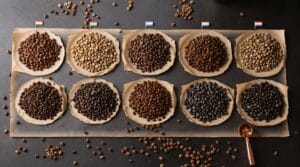

Cheap drip coffee makers have one real enemy: neglect of the basics. Nail your coffee-to-water ratio, bloom the grounds to push out trapped CO₂, and swap tap water for filtered, suddenly the machine matters far less than you thought.
The rest is fine-tuning. Control water temperature, rinse your paper filter before brewing, run a weekly vinegar cleaning cycle, and throw in a pinch of salt to knock back bitterness. Five moves. Dramatically better cup.
What you actually need before improving your drip coffee
The right essential supplies make cheap drip coffee taste dramatically better (and the short list is whole bean coffee, a hand grinder, filtered water, an unbleached paper filter, and a kitchen scale). These five things address the four biggest variables that a budget machine cannot fix on its own: bean freshness, grind consistency, water chemistry, and dose accuracy. Get these in place first, and the machine’s limitations stop mattering as much.
Here is why each one pulls its weight.
Whole bean coffee is the single highest-leverage purchase on the list. Once a bean is ground, it starts losing its volatile aromatic compounds almost immediately: CO₂ bleeds out, oils oxidize, and the flavor flattens. Grind within 15 minutes of brewing and you are working with a completely different ingredient than pre‑ground coffee that has been sitting in a bag.
While a basic hand grinder is a great starting point, serious enthusiasts eventually upgrade to professional coffee grinders for ultimate precision and speed.
A hand grinder (even a $25–$35 entry‑level burr model) gives you something blade grinders never can: consistent particle size. Blade grinders chop randomly, so you end up with a mix of dust and chunks in the same batch. The dust over‑extracts and goes bitter; the chunks under‑extract and go sour. A burr grinder crushes beans between two abrasive surfaces set at a fixed gap, so every particle comes out roughly the same size. Aim for a medium‑coarse texture: it should look like coarse sand, not powder and not pebbles.
Filtered water from a Brita or similar pitcher removes chlorine and dials back excess minerals that compete with coffee flavor. Tap water is fine for drinking, but chlorine especially binds to coffee’s aromatic compounds and flattens the cup before it even brews.
An unbleached paper filter and a kitchen scale round out the kit. The filter catches fine particles and oils that can muddy the flavor. The scale (or a reliable tablespoon set if you are not ready to go full kitchen‑nerd) makes sure you are hitting the same dose every single time, which is the only way to diagnose what is working and what is not.
That is the whole foundation. Nothing here is expensive or hard to find, and every item does a specific mechanical job that your machine simply cannot do for you.
The Right Coffee-to-Water Ratio Fixes Most Bad Cups
The single most fixable coffee-to-water ratio problem is also the most overlooked one: most people are eyeballing it. The proven starting point is a 1:16 weight‑based ratio (15 grams of coffee for every 240 ml of water) and that one number alone will make your cheap drip coffee maker taste noticeably better before you change anything else.
Here is why the weight matters. Coffee grounds are inconsistent by nature: some are fine, some are coarse, some are denser than others. Volume measurements like scoops treat all of them the same, which means your ratio shifts every single brew. Weight does not lie. A gram is a gram regardless of the roast or grind size.
No scale? That is fine. The reliable approximation is 2 level tablespoons of coffee per 6 oz (roughly 180 ml) of water. The key word is level: a heaped tablespoon can add 30–40 % more coffee without you realizing it.
Once you have got that baseline dialed in, adjusting is simple:
- Too weak or flat: Increase your coffee dose by 5 % (about 0.75 g per cup if you are weighing, or a slightly fuller tablespoon if you are not).
- Too bitter or harsh: Drop it by 5 % in the same way.
Move one variable at a time. If you adjust the ratio and the grind on the same day, you will not know which one fixed it.
Even with the ratio perfectly set, though, you can still pull an uneven cup. If the water rushes through the grounds before they have had a chance to fully saturate, some coffee extracts too fast and some barely extracts at all: and that is exactly what the bloom step is designed to prevent.
Blooming your grounds fixes uneven extraction
Targeted pre‑wetting called the bloom saturates all your grounds with roughly ¼ of your total brew water, then holds for 30–40 seconds before the rest flows through. That pause is not just a ritual: it is doing real mechanical work. Fresh coffee is loaded with CO₂ trapped inside the bean during roasting, and if you pour all your water straight through without giving that gas a way out, it creates tiny pockets of resistance that water routes around instead of penetrating.
Think of it like trying to water a dry, compacted flower bed with a single hard blast from a hose. The water finds channels and runs off the edges. But if you first give it a slow, even soak and let the soil settle and open up, the next pour goes straight down and reaches every root. The bloom is that first soak.
Here is how to do it on a standard drip machine:
- Pause the machine early. Start the brew cycle, then pause it just as water begins hitting the grounds (or if your machine has a pre‑infusion setting, use it).
- Pour just enough water to wet everything. You are aiming for about ¼ of your total brew water. Every ground should look damp, not pooling.
- Wait 30–40 seconds. You will often see the bed swell and bubble slightly: that is the CO₂ venting. That is exactly what you want.
- Resume the cycle. Let the remaining water flow through grounds that are now fully open and ready to give up their flavor evenly.
If your machine does not pause easily, you can replicate the bloom manually: before you start the machine, use a small kettle or even a measuring cup of hot water to pre‑wet the grounds yourself, wait out the 30–40 seconds, then start the brew cycle normally.
James Hoffmann on V60 brewing techniques, 2007 World Barista Champion and author of The World Atlas of Coffee, has spent considerable time testing exactly what happens during this window:
“A number of experiments conducted by James Hoffmann on V60 brewing techniques found that swirling during the bloom, rather than stirring, provided better tasting results. His videos recommend that brewers swirl until the slurry looks completely mixed, with no dry clumps.”
With a drip machine you cannot swirl the basket mid‑cycle the way you can a pour‑over, but the principle holds: you want zero dry clumps when the bloom period ends. If you can gently agitate the grounds with a spoon during those 30–40 seconds to make sure every particle is wet, do it. It is a small move that closes the same gap Hoffmann is pointing at.
Video:
A proper bloom ensures the water can penetrate evenly (but there is a catch). If the water temperature coming out of your machine is too low, even perfectly bloomed grounds will not extract fully. You will get a flat, sour cup and wonder what went wrong. That is the next variable worth controlling.
Mastering manual agitation and saturation physics through this bloom technique naturally bridges the gap toward refining your technique with a dedicated pour over coffee maker.
Fix Your Cheap Machine’s Sour Coffee Problem
Check your machine’s actual brew temperature
Measurable, correctable water temperature is the fastest upgrade you can make to a cheap drip setup, and a basic kitchen thermometer tells you exactly where you stand. Run one full brew cycle, hold the thermometer probe in the stream coming out of the showerhead (or catch a cup mid‑cycle and test immediately), and read the number. If it lands between 195–205 °F, you are in good shape. If it reads 170–180 °F, which is common in budget machines, you have two practical moves.
The first is to pre‑heat your water in a kettle before it goes into the reservoir. Bring it to around 200 °F, pour it in, and start the cycle immediately. The machine’s heating element will not have to work as hard to get the water up to temperature, so it arrives at the grounds closer to the ideal range.
The second move is a hot‑water top‑off after the cycle finishes. Brew your normal pot, then add a small pour of kettle‑hot water directly into the carafe to bring the final temperature back up. It sounds rough, but it works: you are compensating for heat lost during the drip process, not diluting the flavor in any meaningful way.

Neither fix requires buying a new machine. A kitchen thermometer runs a few dollars and gives you a real number instead of a guess. Check it once, and you will know exactly which fix your setup needs.
When thermal regulation proves impossible to salvage despite your best efforts, upgrading to one of the best coffee makers remains the definitive solution for extraction consistency.
Use the right water, not just any water
Filtered or spring water is a straightforward swap that removes two problems at once: chlorine and mineral imbalance. Tap water in most cities carries enough residual chlorine to interfere with the flavor compounds in coffee, it does not take much to push a balanced cup toward flat or metallic.
But the part most guides skip is water hardness and pH. These are not abstract chemistry concerns. Water that is too hard (high mineral content) over‑extracts the bitter compounds. Water that is too soft under‑extracts and goes sour. The difference between the two can shift your cup’s total dissolved solids by roughly ±5 %, which is enough to tip the balance from bright and clean to either harsh or weak.
Filtered water (a simple pitcher filter works fine) hits a middle ground that most tap water does not. Spring water is a reliable alternative if you want to skip the filter step. Either one gives your grounds a neutral, consistent medium to work with, which means the temperature and ratio work you did in the earlier steps actually shows up in the cup the way it should.
Good Filter Choice Keeps Your Coffee Clear
Stale, papery, or gritty flavors in your cup almost always trace back to two overlooked maintenance points: what your water is leaving behind inside the machine, and what your filter is adding to the brew. Fix both, and you have removed the two most common sources of off‑flavors that cheap drip coffee makers quietly introduce, no upgraded beans required.
Weekly cleaning makes your machine taste neutral.
Stale oil and mineral scale build up inside your machine the same way grease builds up in a kitchen drain: slowly, invisibly, and with real consequences. Old coffee oils turn rancid and coat the internal tubing. Hard water deposits narrow the water path and drop your brew temperature. Neither shows up dramatically. They just make every cup taste a little flatter, a little more bitter, a little “off”, than it should.
The fix is straightforward. Once a week, run a 50 % white vinegar + 50 % water solution through a full brew cycle. The mild acidity in that solution dissolves mineral buildup and cuts through rancid oil residue. Then run two plain‑water flushes back‑to‑back: this clears out any vinegar taste before it ever touches your coffee.
If you are in a hard‑water area, add a monthly descaling cycle on top of the weekly vinegar run. Scale accumulates faster than you would expect, and once it is thick enough to affect the heating element, you are fighting a temperature problem you cannot solve from the outside.
Rinse your paper filter before brewing.
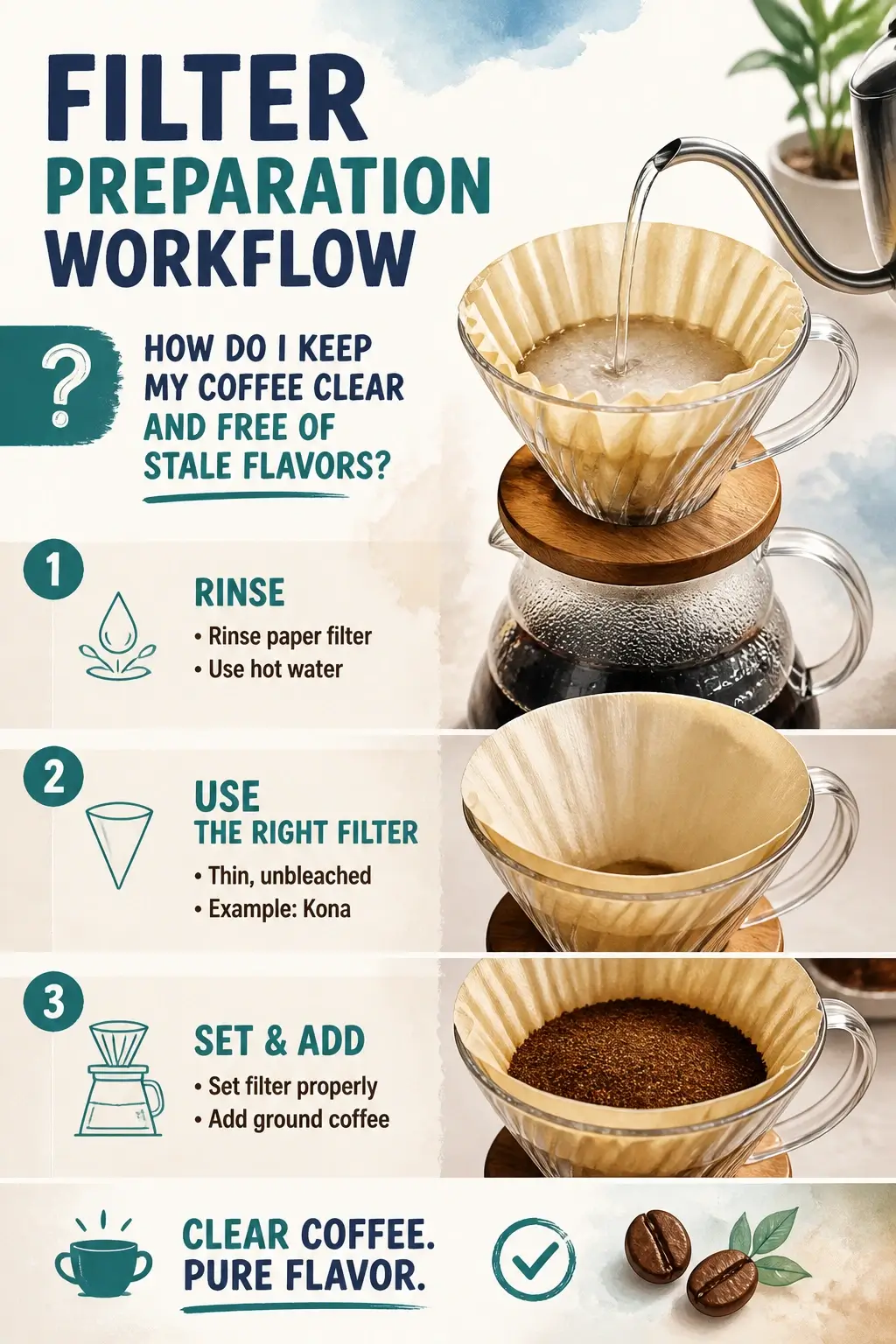
Filter preparation is the step most people skip because it feels unnecessary: until they taste what it fixes. An unrinsed paper filter carries a faint but real papery taste that bleaches and wood pulp leave behind during manufacturing. It is subtle, but it sits right on top of the flavors you are trying to taste.
The fix takes about ten seconds. Before you add any coffee, place the filter in the basket and pour hot water through it. Let it drain, then dump that water out of the carafe. That is it. The filter is now flavor‑neutral and slightly pre‑warmed, which helps keep your brew temperature stable from the first drop.
For filter selection, a thin, unbleached option (Kona’s filters are a good example) does two things at once. Unbleached means less chemical processing, so there is less residue to rinse off in the first place. Thinner means water flows through more evenly, without pooling or slowing in spots that cause uneven extraction.
One thing worth knowing: the belief that cheap drip brewers are inherently bad‑tasting is more assumption than fact. When you pair a well‑prepped, thin unbleached filter with dark‑roast beans, a slightly finer grind, and a 1:16 ratio, even a budget machine can produce coffee that is genuinely nuanced and flavorful. The machine is not the ceiling, the maintenance is.
Add a Pinch of Salt to Fix Bitterness
Fine table salt directly targets sodium‑sensitive taste receptors, suppressing perceived bitterness at the neurological level: keep the dose at ≤ 0.5 g per quart of brewed coffee and you get a smoother cup without a single extra calorie.
Here is what is actually happening: your tongue does not just taste bitter: it signals bitter through specific receptor channels. Sodium ions from the salt interfere with those channels, essentially turning down the volume on bitterness before the signal ever reaches your brain. You are not masking the flavor with something sweet. You are cutting the bitter signal off at the source.
The amount matters more than people think. A quarter teaspoon is already pushing 1.5 g, way past the threshold where you would start tasting the salt itself. You want somewhere between a small pinch and a large pinch, closer to what you would barely see between two fingers. Drop it straight into the carafe after brewing, then stir gently until it is fully dissolved. Give it ten seconds of slow stirring and it is done.
This works especially well when your cheap drip coffee maker taste‑better goals keep hitting a wall on bitterness: even after dialing in your ratio and bloom. Some machines just run hot and pull bitter compounds no matter what you do upstream. The salt trick is your last line of defense, and it costs almost nothing.
One thing worth knowing: this does not fix sourness. Sour and bitter are two completely different extraction problems. Salt only quiets the bitter receptors: if your cup tastes sharp or acidic, that is an under‑extraction issue and no amount of sodium will touch it.
Still Tastes Off? Here’s How to Fix Your Drip Coffee
Stubborn flavor issues in drip coffee almost always trace back to one of five root causes: over‑extraction, under‑extraction, stale beans, a dirty filter setup, or bad water. The good news is that each one leaves a specific fingerprint in the cup: and once you know what you are tasting, the fix is obvious.
Bitter or sour? Check your extraction first.
Extraction issues in drip coffee split cleanly into two directions, and your tongue tells you exactly which way you have drifted.
- Bitter or harsh means over‑extracted. The water pulled too much from the grounds: past the good stuff and into the harsh, astringent compounds that live deeper in the cell walls. Coarsen your grind one step so water moves through faster, or back off the coffee dose by a half tablespoon. Either change gives the water less to work with.
- Sour or weak means under‑extracted. The water moved too fast or there was not enough coffee to slow it down, so it grabbed the bright, acidic compounds up front and left before reaching the balanced, sweeter ones underneath. Go finer on your grind, or add a bit more coffee. Both changes increase contact and resistance, which gives extraction time to finish the job.
One variable at a time. Change the grind or the dose (not both) so you can actually hear what the adjustment is telling you.
Bland, gritty, or chemically off? Look beyond the grind.
- Bland or flat almost always means stale beans. Coffee goes flat because CO₂ (the gas that carries aroma and carries flavor compounds into the cup) escapes within days of roasting. Once it is gone, no technique brings it back. Buy whole beans, check the roast date (not the “best by” date), and grind within 15 minutes of brewing. That single habit does more for flavor than any other change on this list.
- Sediment or gritty texture usually points to the filter. A thick or low‑quality paper filter can tear under pressure, and an unrinsed filter carries paper‑pulp flavor straight into the cup. Switch to a thinner, quality paper filter and rinse it with hot water before you add grounds. The rinse also pre‑heats the filter basket, which helps temperature stability during the brew.
- Off‑flavors that taste chemical, metallic, or just wrong: that is your water. Hard water carries minerals that compete with extraction and can shift the entire balance of the cup. Chlorinated tap water adds its own flavor on top of that. Water hardness or pH can shift extraction balance by up to 5 % TDS, which is enough to push a well‑dialed brew toward sourness or bitterness without you changing a single thing about your grind or ratio. Filtered or spring water removes that variable entirely. It is one of the cheapest upgrades you can make to a budget machine.
By the time you have worked through this list—the right supplies, a measured ratio, a proper bloom, temperature and water quality, a clean filter and machine, an optional pinch of salt, and this troubleshooting checklist—you have addressed every lever that controls what ends up in your cup. A budget drip machine with good inputs and sound technique consistently produces coffee that punches well above its price tag. That is not a workaround. That is just how extraction works.
Real Talk: What Most People Miss About Making Cheap Drip Coffee Taste Good
Q: Why does CO2 trapped in coffee grounds actually matter, and what happens if you skip the bloom?
A: CO2 creates invisible pockets of resistance inside the grounds that water routes around instead of penetrating. Skip the bloom and you’re essentially pouring water through a partially blocked filter—some grounds over-extract fast while others barely extract at all. That’s why blooming for 30-40 seconds isn’t ritual; it’s letting trapped gas escape so water can reach every particle evenly and pull balanced flavor.
Q: If I’m using filtered water, why do I still need to worry about mineral content and pH since the filter removes chlorine?
A: Pitcher filters remove chlorine and some sediment, but they don’t strip out dissolved minerals or adjust pH. Water hardness directly shifts your total dissolved solids by roughly 5 percent—enough to flip a balanced cup into either over-extracted bitterness or sour under-extraction. A basic pitcher filter is a start, but it’s not a complete water solution, especially in hard-water areas.
Q: What’s the actual difference between salt suppressing bitterness versus just adding sugar, and why does the dose matter so much?
A: Salt interferes with sodium-sensitive taste receptors at the neurological level, literally turning down the signal bitterness sends to your brain. Sugar masks flavor by adding sweetness on top. Go above 0.5 grams per quart with salt and you’ll taste the sodium itself, which trades one off-flavor for another. It’s a precision tool, not a sledgehammer.
Q: Why do budget drip machines specifically run too cold, and is pre-heating water in a kettle actually fixing the machine or just compensating for a design flaw?
A: Cheap machines have undersized heating elements that can’t maintain 195-205°F through a full cycle. Pre-heating isn’t a workaround—it’s reducing the heating load so the element can actually reach target temperature and stay there. You’re not bypassing the problem; you’re giving the machine realistic conditions to work with.
Q: If I dial in my ratio and bloom perfectly but my machine still pulls bitter coffee, what’s actually happening chemically?
A: Even perfect technique can’t override water temperature. If your machine hits 170°F instead of 200°F, the water moves too slowly and over-extracts bitter compounds before it ever exits the grounds. That’s why a cheap kitchen thermometer is non-negotiable—it tells you whether you’re fighting a technique problem or a hardware limitation that no amount of grinding adjustments will fix.
Q: Why does rinsing a paper filter before brewing actually improve temperature stability, not just flavor?
A: A dry filter acts as an insulator, slowing heat transfer from the hot water into your grounds. Rinsing pre-warms the filter and removes that barrier, so thermal energy reaches the coffee faster and more consistently. You’re not just cleaning it; you’re optimizing the thermal transfer path.