

Anaerobic fermentation doesn’t forgive sloppy gear. The wrong tank, a leaky one-way pressure-release valve, or a single temperature spike past 20 °C can collapse weeks of careful work into a batch of off-flavors.
The good news: you don’t need a brewery budget to get it right. Whether you’re comparing stainless steel against a GrainPro bag or dialing in a pH/Brix meter for the first time, the variables are knowable, and controllable.
By mastering these parameters and utilizing proper sanitation techniques, you can effectively eliminate fermentation defects and achieve a much cleaner cup.
For an even deeper dive into specific processing techniques and batch timings, you can follow a structured carbonic maceration protocol to ensure your flavor profiles remain consistently exceptional.
Reliable anaerobic fermentation starts with four pieces of gear
Successful anaerobic fermentation locks four interdependent components into place before the first cherry goes in: a CO₂‑purged container that eliminates headspace oxygen, a one-way pressure‑release valve that lets fermentation gases escape without letting air back in, a temperature logger tracking conditions continuously, and a pH/Brix meter confirming that microbial activity is moving in the right direction. Without all four working together, you don’t have anaerobic fermentation — you have a sealed bucket with unpredictable biology inside. Think of it less like a recipe and more like a controlled environment: every component exists to keep one specific variable from going rogue.
Here’s why each one earns its place on the list.
The CO₂‑purged container is your first line of defense. Oxygen is the enemy of the flavor compounds you’re trying to build. The moment O₂ is present in meaningful concentrations, acetic acid bacteria wake up and start converting ethanol into acetic acid, the same compound that makes vinegar sharp. A small amount of acetic character can add complexity, but in an uncontrolled oxygen environment, it overwhelms everything else. Purging the headspace with CO₂ before sealing drops oxygen to near zero and lets the lactic acid bacteria dominate from the start.
The one-way pressure‑release valve solves a physics problem. As lactic acid bacteria metabolize sugars, they produce CO₂ as a byproduct. That gas has to go somewhere. Without a relief valve, pressure builds until either your seal fails or fermentation slows because the bacteria are working against their own exhaust. A properly installed valve bleeds excess pressure out while keeping the seal intact, oxygen stays out, CO₂ finds its exit.
Your target parameters are specific, and they’re not arbitrary:
- Temperature: 15–18 °C
- Headspace oxygen: ≈ 0 %
- Terminal pH: ≈ 3.8
Temperature is the most underestimated variable. Lactic acid bacteria — the organisms responsible for the clean, fruit‑forward acidity that makes anaerobic coffees distinctive — thrive in the 15–18 °C range. Push above 20 °C and you accelerate microbial activity faster than you can monitor it, which means pH drops quickly and unevenly. Drop below 12 °C and fermentation stalls, leaving sugars partially metabolized and flavor development incomplete. The temperature logger isn’t optional monitoring — it’s the only way to know whether your environment is actually holding that window or just averaging it across swings.
The pH/Brix meter closes the feedback loop. pH tells you where the microbial population is in its work cycle. A reading around 3.8 signals that lactic acid production has reached a stable endpoint — the bacteria have done their job and the environment is now acidic enough to inhibit further microbial activity. Brix tracks sugar concentration, which tells you how much fermentable substrate remains. Together, they let you call the fermentation at the right moment rather than guessing by time alone.
One more thing that doesn’t get enough attention: surface cleanliness. Any residue from a previous batch — oils, dried mucilage, microbial biofilm — introduces uncontrolled biology into your next run. The container you use needs to be compatible with clean‑in‑place (CIP) sanitation, meaning it can be thoroughly flushed and sanitized without harboring residue in seams, threads, or porous surfaces. Off‑flavors that seem to come from nowhere almost always trace back to a surface that wasn’t fully clean before the lid went on.
With these basics secured, the next decision is which tank will give you the best oxygen exclusion while fitting your budget.
Mastering these foundational elements allows producers to replicate the distinct flavor profiles characteristic of Carbonic Maceration Coffee The Complete processing methods at origin.
Anaerobic Coffee Processing Tanks: Stainless Steel, HDPE, or GrainPro?
Anaerobic coffee processing tanks made from stainless steel, HDPE plastic barrels, and GrainPro bags each control oxygen exclusion through completely different physical mechanisms, and choosing the wrong one for your scale or climate will cost you more than money. Stainless steel holds its seal through welded seams and compression gaskets; HDPE relies on impermeable walls; GrainPro uses a multi‑layer barrier film you seal manually. The material doesn’t just affect cost, it determines how much control you actually have over the fermentation environment.
Let’s start with what matters most: oxygen is the enemy in anaerobic fermentation. Any ingress point — a hairline crack, a loose zipper, a corroded gasket — and you’ve shifted from anaerobic to aerobic fermentation without knowing it. Your flavor profile drifts, your pH drops unpredictably, and the batch is compromised before you’ve even checked a reading.
Here’s how each option handles that threat, and what you need to do to prep it properly.
Material properties at a glance:
| Criteria | Stainless Steel Tanks | HDPE Plastic Barrels | GrainPro Bags |
|---|---|---|---|
| Durability | Exceptional — withstands extreme temperatures and pressures over decades | Very strong — puncture‑proof, maintains shape across temperature swings | High‑strength PE with barrier layer, but prone to ruptures and tears with repeated use |
| Seal Integrity | High with proper gaskets; watch for corrosion compromising seals over time | Impermeable walls with excellent seal stability | Hermetic zipper or twist‑tie closure; gas‑tight when intact |
| Cost | Higher upfront, lower long‑term maintenance cost | Higher than bags, but lowest life‑cycle cost — no replacements needed | Very low entry cost (from ~$0.95/unit), but recurring replacement expense adds up |
| Scalability | Best for large capacities and industrial‑volume operations | Scalable across sizes; one‑piece construction handles industrial storage | Limited to ~1 MT per bag; best for small to mid‑size or portable setups |
| Oxygen‑Exclusion Mechanism | Airtight welded seams and gaskets; no active barrier, O₂ ingress risk if seals corrode | Inert, impermeable walls minimize O₂ and moisture passively | Multi‑layer film blocks O₂ and moisture; supports optional CO₂ flush or O₂ absorbers |
Stainless steel is the workhorse for anyone running consistent, repeatable batches at volume. It’s non‑reactive, so it won’t leach anything into your ferment. The CIP‑compatible surface — meaning you can clean it in place with circulating solution — makes sanitation fast and thorough. The trade‑off is cost and weight. But if you’re running more than a few hundred kilos per cycle and you need tight fermentation control, the thermal mass of steel is also an asset: it resists temperature swings naturally, which matters when ambient temps fluctuate overnight.
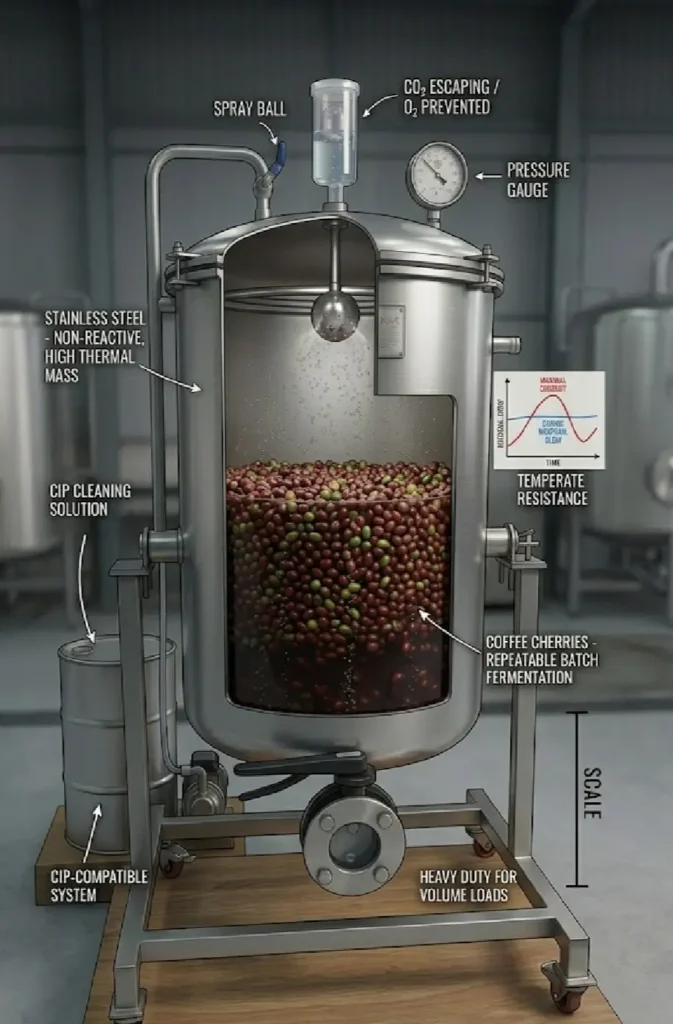
HDPE plastic barrels sit in the middle ground. The material itself is chemically inert and impermeable — water and oxygen can’t pass through the walls. They’re lighter than steel, easier to move, and significantly cheaper to acquire. The weak point is always the lid seal. A worn gasket or a warped rim and your anaerobic environment is gone. Check lid seals before every run.
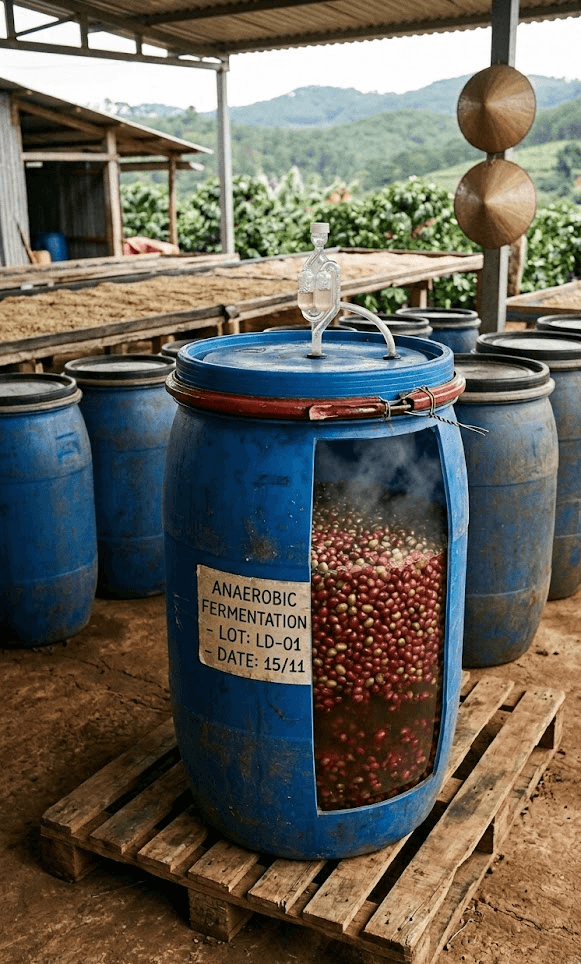
GrainPro bags are the low‑barrier entry point. For small producers, experimental micro‑lots, or field processing where portability matters, they work. The multi‑layer barrier film is genuinely effective at blocking oxygen and moisture when the bag is properly sealed. The vulnerability is physical — a sharp edge, a careless fold, or a repeated‑use fatigue tear can compromise the seal silently. Treat them as single‑use or inspect them obsessively before reuse.

One structural blind spot worth knowing, plastic barrels and GrainPro bags have very little thermal mass compared to stainless steel. That means they respond quickly to ambient temperature changes — a warm afternoon can push your fermentation temperature several degrees above your target range before you catch it. If you’re working with plastic or bags and you need tight temperature control, plan for a water bath or an insulated enclosure from the start, not as an afterthought.
Preparing any tank for fermentation follows the same logic regardless of material:
- Clean first: Remove all organic residue with hot water and a food‑grade detergent. For stainless steel, a caustic wash works well. For HDPE and GrainPro, use warm water and avoid abrasives that scratch the surface — scratches harbor bacteria.
- Sanitize second: Food‑grade hydrogen peroxide (3 % solution) or peracetic acid are your best options. Both break down into harmless byproducts, leave no flavor‑active residue, and are effective against the spoilage organisms that compete with your target fermentation microbes. Let the sanitizer contact all surfaces, then drain — don’t rinse, or you reintroduce contamination risk.
- Test the seal before you load: Pressurize the tank lightly with CO₂ — enough to feel resistance — and watch for pressure drop over 5–10 minutes. For bags, run your hand along the seams while pressurized and feel for airflow. Any leak found now costs you nothing. The same leak found on day three of fermentation costs you the batch.
The CO₂ purge step does double duty here: it tests your seal and displaces residual oxygen inside the tank before fermentation begins. For GrainPro bags especially, a short CO₂ flush after loading and before final sealing is cheap insurance.
One optional addition worth trying: if you want to push tropical fruit notes without adding the complexity of precise pH management, you can introduce a small, measured amount of fruit puree or molasses directly into the fermentation soak. This works in both steel and plastic containers because the CO₂‑rich environment drives extraction and suppresses competing organisms. Keep the addition consistent and documented so you can repeat what works.
With your tank cleaned, sanitized, sealed, and tested, the next variable to nail down is the one‑way valve — the mechanism that lets CO₂ escape as fermentation builds pressure, while keeping oxygen permanently out.
A Spring‑Loaded One‑Way Valve Is Your Tank’s First Line of Defense
A spring‑loaded, stainless‑steel CO₂ vent threads directly into your tank lid and does one job with mechanical precision: it lets built‑up fermentation gas push past the check spring and escape, then snaps shut before outside air can travel back in. Think of it less like a lid and more like a one‑way street enforced by physics, pressure from inside opens the gate, atmospheric pressure from outside keeps it closed. Thread that valve with PTFE tape and seal it properly, and you’ve created an environment where CO₂ is the only gas doing anything.
Getting there takes about twenty minutes if you’re organized.
Drilling and threading the port. Check your valve’s spec sheet for the exact port diameter — most stainless‑steel CO₂ vents call for a hole between 3/8” and 1/2”. Drill slowly through the lid with a step bit, deburr the edge so the valve seats flush, and clean out any metal shavings before you touch the tape. A rough edge will compromise the seal no matter how well you tape it.
Sealing with PTFE tape. Wrap the valve threads with two to three tight layers of PTFE tape, always in the direction the threads turn when you tighten. This isn’t just about preventing leaks — PTFE fills the microscopic gaps in the thread path that O₂ molecules are small enough to slip through. One loose wrap won’t do it. Snug, overlapping passes will.
Torquing to spec. Hand‑tight plus a quarter to half turn with a wrench is the general rule, but follow your manufacturer’s torque spec if one is provided. Over‑tighten a valve into a plastic lid and you’ll crack the seat. Under‑tighten it into stainless and you’ll get a slow, invisible O₂ leak that ruins your fermentation profile before you even notice something’s wrong.
Attaching a pressure‑relief hose. If your valve has a barb fitting on the exhaust side — and many do — run a short silicone hose from that barb into a small jar of water. You’ll see bubbles when CO₂ is venting, which gives you a visible, real‑time confirmation that fermentation is active and pressure is releasing normally. No bubbles after 12–18 hours means either fermentation stalled or your valve is stuck closed.
Choosing the right coffee variety can further enhance the flavor profile in anaerobic tanks, so consider the best coffee varieties for anaerobic fermentation when planning your process.
Verifying the seal with a handheld O₂ sensor. Once the tank is assembled and before you load any coffee, do a purge‑and‑check. Run food‑grade CO₂ into the tank for 30–60 seconds through a secondary port or briefly cracked lid, then seal everything and use a handheld O₂ sensor to sample the headspace gas. You’re looking for a reading below 0.1 % O₂. Anything above that means you have a leak path — most likely at the valve threads, the lid gasket, or a drain port that wasn’t fully closed.
A reading under 0.1 % tells you the one‑way valve is holding. Watch the water jar over the next few hours once coffee is loaded: steady, rhythmic bubbling means CO₂ is building and releasing the way it should.
One thing worth flagging here, a well‑sealed valve controls the gas environment, but it doesn’t control the chemistry inside the tank. Many producers assume that once O₂ is excluded, pH will stabilize on its own. It won’t, microbial activity can still push acidity in unpredictable directions depending on temperature, sugar concentration, and inoculation load. The valve is a necessary condition for good anaerobic fermentation, not a sufficient one. Pairing it with continuous pH monitoring is what actually gives you consistent cup results.
With the tank sealed and verified, the next variable that needs attention is temperature, because even a two‑degree drift inside the tank can shift your fermentation timeline by hours and your flavor profile by more than you’d expect.
Accurate temperature monitoring keeps your fermentation from running wild
Precise temperature monitoring in a sealed anaerobic tank depends on pairing a waterproof probe‑type logger — either a Thermocouple or a PT100 — with a sealed feed‑through that lets the probe reach the bean mass without breaking your oxygen barrier. Think of the probe as your only set of eyes inside a completely closed system. Once that lid is on, you can’t crack it open to check conditions without undoing the whole fermentation environment you’ve worked to build.
The difference between a Thermocouple and a PT100 comes down to speed versus accuracy. A Thermocouple responds faster to temperature changes, which sounds appealing, but it drifts more over time. A PT100 is slower to react but holds its calibration tighter across the 15–18 °C range you’re targeting — which matters more here, because anaerobic fermentation is a slow, steady process, not a rapid‑fire one. For most setups, the PT100 is the better call.
Here’s how to set it up without compromising your seal:
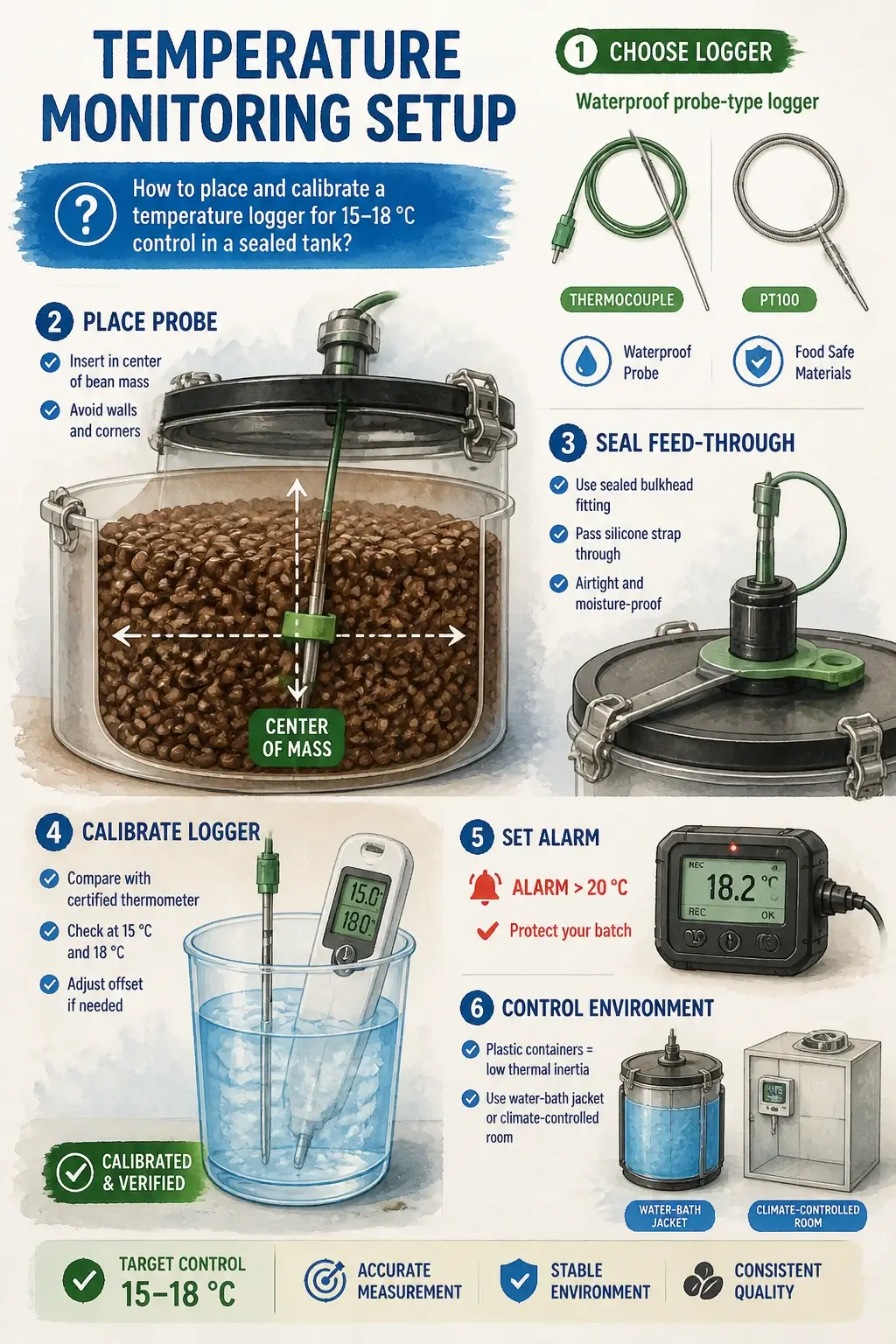
- Probe placement: Push the probe into the center of the bean mass, not against the tank wall. The wall temperature can read 2–3 °C cooler than the core of the ferment, especially when ambient temperature fluctuates. Center placement gives you the real number.
- Securing the probe: Use a silicone strap looped around the probe cable to hold it at depth. Route the cable out through a sealed feed‑through — a small compression fitting threaded into a spare port on the lid. Tighten it until the cable is gripped firmly but not kinked. This is the same principle as a cable gland on an electrical enclosure: the fitting compresses around the cable to create an airtight seal without cutting the wire.
- Calibration before you close up: Before sealing the tank, submerge both your probe logger and a certified reference thermometer in the same ice‑water bath (0 °C) and then in a warm‑water bath near 18 °C. If your logger reads more than ±0.5 °C off the reference at either point, apply the offset correction in the logger’s software. Skipping this step means every reading you take during fermentation is systematically wrong — and you won’t know it until the batch tastes off.
- Alarm threshold: Set your high‑temperature alarm at 20 °C, not 18 °C. That 2‑degree buffer gives you time to intervene before the fermentation tips into the runaway zone where lactic acid bacteria and wild yeasts start producing off‑flavors you can’t dial back out.
One structural blind spot worth knowing, plastic containers have almost no thermal inertia. Metal holds temperature like a flywheel — it absorbs heat slowly and releases it slowly, smoothing out ambient swings. Plastic does neither. If your tank is HDPE or food‑grade plastic, a single warm afternoon in your fermentation room can spike the internal temperature by several degrees before your alarm even triggers. The fix is to pair the logger with an external water‑bath jacket around the tank, or run the whole setup inside a climate‑controlled room. The water bath works on the same principle as a bain‑marie in cooking — the surrounding water absorbs ambient heat fluctuations before they reach the ferment, keeping the internal environment stable even when the room isn’t.
With temperature now locked and monitored, the next layer of control is chemical — tracking how the fermentation is actually progressing through Brix and pH readings.
How a Brix/pH Meter Tells You When Fermentation Is Done
A food‑grade Brix/pH meter with a detachable probe gives you the two chemical signals that matter most in anaerobic fermentation — sugar concentration and acidity — without breaking your tank’s sealed environment. Think of it as the difference between guessing and knowing: the Brix reading tells you how fast the microbes are eating, and the pH tells you how far the fermentation has gone. Together, they replace the guesswork that turns good batches into expensive mistakes.
The probe goes in through a sealed port in the tank wall. The double‑O‑ring seal around it does two jobs at once — it keeps oxygen out and keeps the probe from wiggling loose under the slight pressure that builds inside an active fermentation. Getting that seal right is the mechanical half of the job. Calibrating the meter correctly is the analytical half. Both matter equally.
Pick and seat the Brix/pH sensor correctly
A well‑chosen food‑grade sensor with a detachable probe threads into a standard bulkhead fitting on your tank wall, so you never have to crack the lid to take a reading.
The “detachable” part isn’t a convenience feature, it’s a contamination barrier. A fixed probe forces you to open the tank every time you want to rinse or inspect the tip. A detachable probe lets you pull it, clean it, and reseat it without exposing the liquid to outside air. For anaerobic work, that distinction matters every single time you take a measurement.
When you seat the probe, the double‑O‑ring seal is what stands between a tight system and a slow oxygen leak. One O‑ring compresses against the fitting; the second sits just behind it as a backup. Run your finger around the fitting after hand‑tightening — if you feel any give or hear a faint hiss during active fermentation, the outer ring isn’t seated. Snug it down a quarter‑turn at a time until both rings are fully compressed.
The sensor tip needs to sit fully submerged in the liquid, not hovering in the headspace gas. The electronics housing, on the other hand, needs to stay completely above the liquid line. Getting this wrong in either direction costs you: a tip in the gas reads the CO₂ atmosphere, not the ferment; electronics in the liquid means a dead sensor. Most bulkhead fittings let you adjust insertion depth before you lock the seal — set it before you tighten, not after.
Calibrate daily and know when to stop
Daily calibration keeps your readings honest, and the procedure is straightforward once you build it into your morning routine before the first reading of the day.
For the pH meter, you need two standard buffers: pH 4.0 and pH 7.0. Start with the 7.0 solution, zero the meter to that reference point, then confirm accuracy with the 4.0 buffer. The reason you use two points instead of one is that pH electrodes don’t drift uniformly — the slope of the response curve changes as the electrode ages, and a single‑point calibration misses that. Coffee ferments typically run between pH 3.8 and 5.0, so you want your calibration bracket to straddle that range.
For the Brix meter, mix a sucrose solution at a concentration you’ve measured by weight — say, 10.0 g of table sugar dissolved in 90.0 g of distilled water for a 10.0 % solution. Rinse the prism, apply a few drops, and adjust until the reading matches. If it’s off by more than 0.2 %, clean the prism thoroughly and repeat. Residue from a previous reading is the most common culprit.
Now, the stop criteria. You’re looking for two things to happen together:
- pH reaches approximately 3.8 — this is your primary signal. At this acidity, the microbial activity has produced enough organic acids to define the flavor profile you’re after. Going significantly below 3.8 pushes into over‑fermented, vinegary territory.
- Brix stabilizes for at least 2 consecutive hours — when the sugar reading stops dropping, the microbes have run out of easily available fuel and fermentation has effectively stalled.
Here’s where it’s worth being honest about what the data can and can’t tell you: there’s currently no solid cupping evidence that links a specific Brix value — say, 8.2 versus 9.1 — to a predictable flavor outcome. The science simply hasn’t mapped that relationship yet with enough precision to be actionable. So don’t chase a Brix number as your primary target. Use it as a rate‑of‑change indicator. When it stops moving and pH hits 3.8, you’re done. If pH is still dropping and Brix is still falling, you’re not — regardless of what the absolute number reads.
Visual cues back this up: the CO₂ bubble rate through the airlock will slow noticeably as fermentation winds down, and the liquid’s color often deepens slightly. Neither replaces the meter readings, but both confirm what the numbers are telling you.
Even the best anaerobic setup will fail you eventually, here’s how to fix it fast
Troubleshooting an anaerobic fermentation comes down to four pressure points: gas exclusion, pH management, temperature control, and pressure relief. Each one has a clear failure signature, and — more importantly — each one has a corrective action you can take mid‑batch without dumping the tank and starting over. Let’s walk through them in the order they’re most likely to bite you.
Gas exclusion and pH drift are fixable without opening the tank
Incomplete gas exclusion is the silent killer. Your fermentation looks fine from the outside, but if oxygen is sneaking in through a loose port or a micro‑crack in the seal, you’re not running anaerobic fermentation — you’re running a slow aerobic decay. The fix starts with a portable O₂ sensor held near every seal, valve, and lid joint. If you read above 0.1 % oxygen anywhere in the headspace, don’t guess at the source — work systematically from the lid down. Re‑purge with CO₂ through the inlet port, reseal any suspect connections with food‑grade silicone tape or fresh gaskets, and check the reading again before you walk away.
pH drift is the other early‑warning signal most producers catch too late. If your pH climbs above 4.0 during fermentation, the microbial balance is shifting in the wrong direction — lactic acid bacteria are losing ground, and you risk off‑flavors that no roast profile will hide. The first thing to check isn’t the coffee — it’s the sensor. A fouled pH probe reads high even when the ferment is healthy, so rinse and recalibrate before you add anything to the tank. If the reading holds above 4.0 after a clean sensor confirms it, add food‑grade citric acid in small increments — think 0.1 g per liter, stir gently, wait 15 minutes, and recheck. Don’t chase the number aggressively. Small corrections compound.
Temperature spikes and over‑pressurization need immediate mechanical checks
Temperature control failures move fast. A spike above 20 °C accelerates fermentation kinetics exponentially — the microbes work harder, CO₂ production surges, and you lose the slow, controlled flavor development that makes anaerobic processing worth the effort. When you see the temperature climbing, check the insulation first. A gap in your foam wrap or a missing section of reflective barrier can bleed enough ambient heat into the tank to cause a 3–4 °C swing on a warm day. If insulation is intact, look at your thermostat — a probe that has shifted away from the tank wall reads ambient air instead of the actual ferment temperature. For persistent spikes, a water‑bath jacket circulating chilled water around the tank is the most reliable correction. It’s a bigger investment, but it gives you thermal mass that insulation alone can’t provide.
Over‑pressurization is the failure that gets people’s attention fastest — usually because the valve starts hissing or the tank lid starts flexing. Before you panic, check whether the one‑way valve is blocked. Mucilage, a small coffee fragment, or mineral buildup from your water source can seat itself against the valve opening and stop CO₂ from venting. Clear it carefully without fully opening the tank. If pressure is still climbing after the valve is confirmed clear, route excess gas through a secondary relief line — a simple barbed fitting connected to a water‑filled jar that lets gas bubble out without letting oxygen back in. It’s the same principle as a homebrew airlock, and it gives you a visual confirmation that the system is breathing correctly.
One more thing worth saying here: a lot of producers go into anaerobic processing convinced that the complexity justifies a significant price premium. In practice, boutique roasters often move anaerobic lots at the same specialty price tier as their other single‑origins. The real return on this equipment investment isn’t a higher price tag — it’s the consistency that comes from running a controlled, repeatable process. Fix the failures, tighten the system, and let the cup quality make the argument for you.
Scaling these operational adjustments across multiple fermentation vessels requires careful financial planning detailed within our comprehensive equipment investment guide.
Real Talk: The Hidden Failure Points Nobody Warns You About
Why does a PT100 sensor beat a Thermocouple for anaerobic coffee, even though Thermocouples are faster?
Thermocouples respond quicker to temperature swings, which sounds great until you realize anaerobic fermentation is a slow, steady 15 to 18 °C process, not a rapid-fire operation. A PT100 holds its calibration tighter across that narrow range, which matters infinitely more than speed. You’re not chasing temperature changes—you’re preventing them. A drifting Thermocouple reading high or low by 0.3 °C compounds into flavor shifts you can’t undo by day three.
What actually happens if your one-way valve gets blocked mid-fermentation, and can you fix it without dumping the batch?
Mucilage, coffee fragments, or mineral buildup can seat against the valve opening and stop CO₂ from venting. Pressure builds, fermentation stalls or accelerates unpredictably. You can fix it without opening the tank: route excess gas through a secondary relief line—a barbed fitting connected to a water-filled jar. It’s the same homebrew airlock principle. Bubbles confirm the system is breathing again.
Why does pH climbing above 4.0 during fermentation mean you’re losing, not winning?
When pH climbs, lactic acid bacteria are losing ground to competing organisms. Off-flavors develop that no roast profile will hide. Before you panic, rinse and recalibrate your pH probe—a fouled sensor reads high even in healthy ferments. If the reading holds above 4.0 after calibration, add food-grade citric acid in tiny increments: 0.1 g per liter, wait 15 minutes, recheck. Small corrections compound; aggressive chasing ruins the batch.
Can you really use the same HDPE barrel or GrainPro bag across multiple ferments, or are you just delaying disaster?
Technically yes, but obsessive inspection is non-negotiable. GrainPro bags suffer repeated-use fatigue tears silently—a sharp edge or careless fold and your seal is gone without warning. HDPE barrels are tougher, but worn gaskets and warped rims are the weak point every single time. If you’re reusing, inspect the seal before loading. One micro-crack found during post-fermentation cleanup costs you nothing. The same crack found on day two costs you the batch.
Why does the article say there’s no solid cupping evidence linking specific Brix numbers to flavor outcomes?
The science hasn’t mapped that relationship with enough precision yet. You can measure Brix down to 0.1 % and still not predict whether 8.2 versus 9.1 produces better cup quality. That’s not a weakness—it’s honesty. Use Brix as a rate-of-change indicator instead. When it stops dropping and pH hits 3.8, you’re done. Chase the number itself and you’re flying blind.
What’s the real reason plastic containers need a water-bath jacket but stainless steel doesn’t?
Plastic has almost zero thermal inertia. Metal absorbs heat slowly and releases it slowly—a flywheel effect. A single warm afternoon can spike HDPE or food-grade plastic internal temperature several degrees before your alarm triggers. Stainless steel resists ambient swings naturally because of thermal mass. If you’re using plastic, a water bath circulating around the tank absorbs those fluctuations before they reach the ferment. It’s not optional if you need tight control—it’s essential.
If you are looking to master these variables for cleaner profiles, we have a comprehensive guide on Anaerobic Washed & Honey Processing that breaks down how clarity and sweetness are built from the tank up.