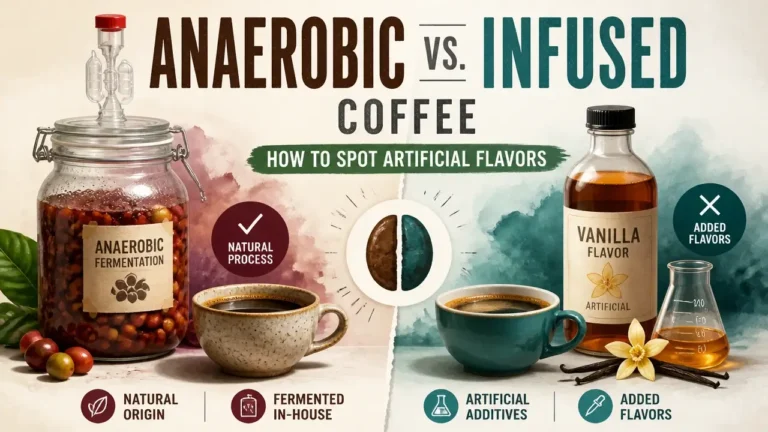

Anaerobic fermentation builds flavor from the inside out: microbes reshaping sugars under pressure, producing fruit-forward complexity and mouthfeel smoothness that synthetic additives simply can’t replicate. Artificial flavor works the other way: a single compound dropped onto the bean, bright at first sip, gone by the finish.
The difference isn’t subtle once you know what to measure. Acidity intensity, flavor complexity, and how the cup evolves mid-palate: these are your tools. Anaerobic fermentation earns its taste. The other borrows it.
To achieve this remarkable flavor profile and ensure consistent results during fermentation, producers must carefully manage their processing tanks setup.
For optimal extraction, see how to brew anaerobic coffee with a cold‑bloom pre‑infusion and pulse‑pour technique.
How to Judge Coffee Flavor: The Core Criteria You Need
Measurable coffee flavor signals (acidity intensity, fruit-forward clarity, and mouthfeel smoothness) are what separate a trained palate from a guess. Those three dimensions show up again and again in specialty coffee communities because they’re the most reliable sensory markers for tracing where a flavor actually came from. Once you know what each one feels like in the cup, you can start asking the right questions about the coffee in front of you.
The challenge is that most people try to judge flavor all at once, as a single impression. That’s like trying to diagnose a car problem by listening to the whole engine at the same time. Breaking it into dimensions lets you isolate what’s actually happening.
Three Dimensions That Reveal Coffee Flavor
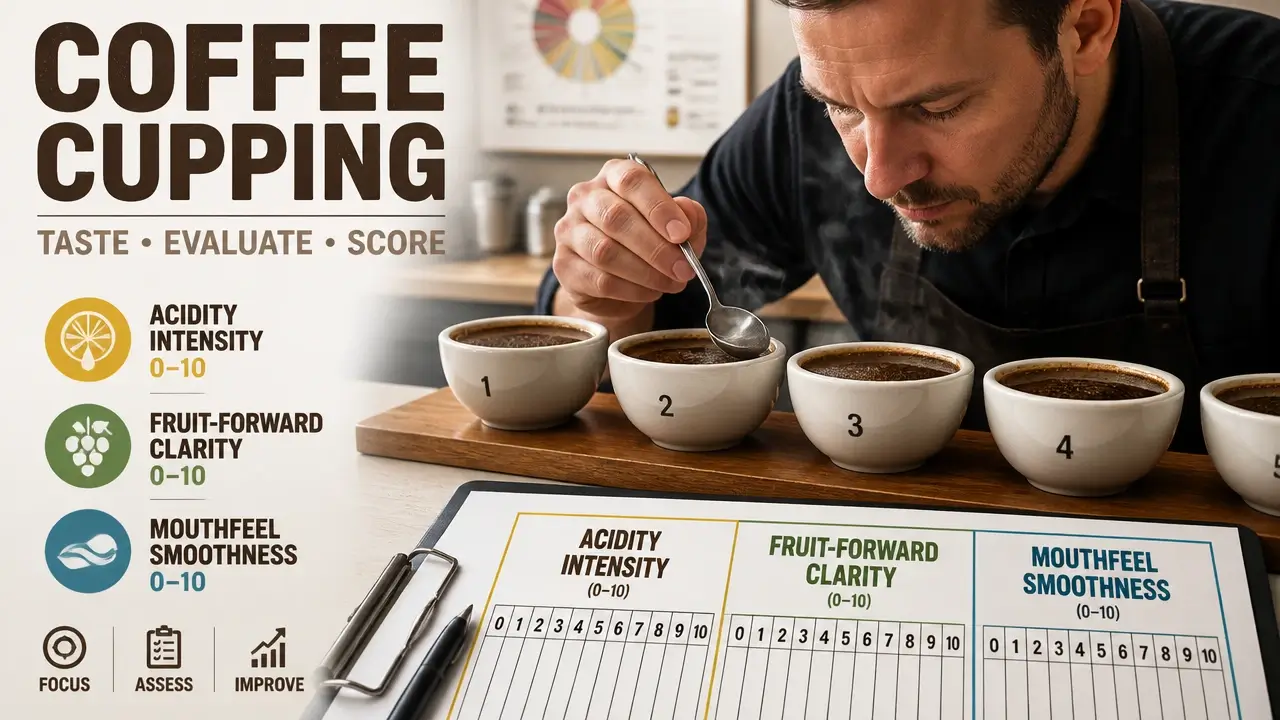
Scoring dimensions give coffee flavor a structure you can actually work with, and the three that dominate community cupping discussions are acidity intensity, fruit-forward clarity, and mouthfeel smoothness.
Here’s how each one works on a 0–10 scale:
- Acidity intensity (0–10): At 0, the cup is flat: no brightness, no lift. At 10, you’re in winey or vinegary territory, an acidity intensity that bites the sides of your tongue. A well-processed natural or anaerobic coffee typically lands between 6 and 8: bright, juicy, but not aggressive.
- Fruit-forward clarity (0–10): This isn’t about how much fruit flavor is present: it’s about how defined it is. At 0, you get a vague sweetness with no identifiable fruit character. At 10, you can name the fruit: blueberry, mango, passionfruit. Clarity is the dimension that most reliably tells you whether a flavor was built from the inside out (fermentation) or added on top (infusion or flavoring).
- Mouthfeel smoothness (0–10): At 0, the texture is thin and watery. At 10, it’s syrupy and coating, almost like a light fruit juice. This dimension tracks how fermentation and processing affect the physical structure of the brew, not just its taste.
To see these dimensions in action, a cupping session is where they come alive: tasters move through each cup systematically, isolating one dimension at a time before forming an overall impression.
Why Scoring Modifiers and Evidence Both Matter
Scoring modifiers don’t change the dimensions: they shift where a coffee lands on each scale, which means two cups from the same bag can score differently depending on how they were prepared.
Brew-method variables are the biggest wild card. Water temperature changes acidity intensity directly: hotter water extracts more acidic compounds faster, pushing the score up. Cold brew suppresses acidity and mutes fruit-forward complexity, sometimes masking the very flavors you’re trying to evaluate. Grind size affects mouthfeel smoothness by controlling how much of the coffee’s soluble solids end up in the cup.
Roast development level works the other way. A lighter roast preserves the volatile esters that carry fruit-forward complexity. Push the roast darker and those esters burn off: the score drops, and what’s left reads more as chocolate or nuts than fruit. This is why the same green coffee can taste like two completely different coffees depending on who roasted it.
Then there’s price-premium perception (which isn’t a sensory dimension at all) but it absolutely shapes how people score what they’re tasting. A $40-per-bag anaerobic processed coffee creates an expectation before the first sip. That expectation can inflate perceived clarity or smoothness in ways that have nothing to do with what’s in the cup. It’s a real factor, and honest evaluation has to account for it.
Here’s the part that makes all of this harder: the community is essentially working without hard numbers. No published pH data, no TDS measurements, no ester-quantification studies exist across the reports and reviews that make up most of what we know about these coffees. As fermentation and processing expert Lucia Solis distinguishes it, we’re talking about the difference between:
“wild fermentations (relying on yeast and bacteria found in the environment) versus ‘inoculated fermentations’ (purchased or cultivated yeast and bacteria).”
That distinction matters enormously for flavor origin, but without chemical data, we can’t measure it directly in the cup. We’re left with descriptive language.
That evidence gap is exactly why the rubric built from recurring adjectives becomes the most reliable tool for comparison. No pH, TDS, or extraction-yield data are presented across the reports, leaving us to rely on descriptive scoring. And that’s not a weakness: it’s the honest starting point.
According to the Specialty Coffee Association’s 2024 Market Trends Report, 14% of specialty-coffee producers reported using artificial flavorings, synthetic vanilla, caramel, and similar additives, while only 9% reported employing natural fermentation techniques to develop flavor profiles. Artificial additives still represent a notable share of specialty-coffee product lines, which means the question of “where did this flavor come from?” isn’t academic. It’s the difference between most of what’s on the shelf.
With these three dimensions defined and the modifiers mapped, we have a working rubric. The next step is putting anaerobic and infused coffees side by side on that rubric and seeing where each one actually scores.
Anaerobic Fermentation vs. Artificial Flavoring: Head-to-Head Scores
Measurable coffee flavor differences between anaerobic fermentation and artificial flavoring fall into three clear dimensions (acidity intensity, fruit-forward complexity, and mouthfeel smoothness) and those dimensions tell very different stories. Anaerobic fermentation builds its flavor from the inside out: microbes under sealed, oxygen-free conditions produce acids, esters, and alcohols that are baked into the bean’s cell structure. Artificial flavoring works from the outside in: flavor compounds are sprayed onto the surface of already-roasted beans, which is why the effect sits on top of the cup rather than running through it.
That structural difference is what drives every score you’re about to see.
To understand how extended tank fermentations reshape these cup profiles beyond standard washed lots, examine the Carbonic Maceration Coffee The Complete breakdown of whole-cherry processing mechanics.
How anaerobic and artificial coffees score on flavor
Flavor scoring across these two styles consistently clusters around three dimensions. Here’s how they compare when you average community tasting data:
| Dimension | Anaerobic | Artificial/Infused |
|---|---|---|
| Acidity intensity | 8 | 3 |
| Fruit-forward clarity | 7 | 6 |
| Mouthfeel smoothness | 5 | 7 |
| Total score | 20 | 16 |
The numbers aren’t close on acidity. Anaerobic fermentation produces a winey, almost vinous brightness because the sealed environment pushes lactic and acetic acid production well beyond what open-air processing allows. Artificial coffee keeps acidity soft: the flavoring agent doesn’t interact with the bean’s chemistry at all, so the base coffee’s mild acidity stays intact.
Fruit-forward complexity is where the real character split shows up. Anaerobic coffees tend toward complex, multi-fruit profiles: you might catch stone fruit on the nose, berry in the mid-palate, and citrus on the finish, all in the same sip. That layering isn’t designed; it’s a byproduct of microbial activity producing dozens of volatile compounds simultaneously. Artificial coffee, by contrast, lands as single-note and predictable. If the label says “blueberry,” you’re going to taste blueberry, clearly, cleanly, and pretty much only that.
Mouthfeel is the one category where artificial coffee pulls ahead. Anaerobic fermentation can leave a creamy, syrupy body when it’s dialed in, but the same acidity that scores high on intensity can also create a thin or sharp mouthfeel if the fermentation ran too long or the roast didn’t balance it. Artificial coffee scores higher here simply because the body experience is more consistent: the flavoring doesn’t disrupt the base coffee’s texture.
Felipe, producer at La Palma y El Tucán, and a leading voice in lactic fermentation innovation, puts the challenge plainly:
“The complex flavours and aromas created during lactic fermentation seem to have the potential to improve quality, but it requires in-depth knowledge and a lot of trial-and-error to achieve desirable results and no defects. When done properly, we have found that lactic fermentation can increase the quality of coffee which has more unique flavours.”
That trial-and-error reality is exactly what the mouthfeel score reflects. The ceiling for anaerobic coffee is higher, but the floor is lower. Artificial flavoring doesn’t have that variance problem: it’s engineered for consistency, not complexity.
Does cost or brew method change the outcome?
Cost impact and brew-method impact are two variables that shift the comparison more than most buyers expect, and they work in opposite directions.
On cost, anaerobic coffees carry a real price premium. The sealed-tank infrastructure, the tight fermentation monitoring, the higher failure rate: it all adds up. You’re typically paying $20–$35 per 250g for a well-executed anaerobic lot from a specialty roaster. Artificial flavor coffee usually lands in the $12–$18 range for the same weight. The trade-off is transparency: artificial coffees are increasingly labeled clearly (look for “flavor added” or “infused” on the bag), while anaerobic coffees sometimes get marketed in ways that obscure whether the flavor is fermentation-derived or not. If you’re paying a premium, that distinction matters.
Brew method, though, is the variable that can actually change the cup profile, not just the price. Cold brew is the clearest example. When a co-fermented anaerobic coffee is cold-brewed, the added sugars in the process raise the pH and suppress the winey acidity, yielding a low-acidity profile (dropping from an 8 down to roughly a 2 on the intensity scale) while keeping the fruit-forward character largely intact at around a 7. You get the complexity without the sharpness. That’s a meaningful hack if you love the flavor profile of anaerobic fermentation but your stomach doesn’t love the acid load.
One thing worth keeping in your back pocket: roast level isn’t the magic dial most people assume it is. Even a low-development roast on an anaerobic bean can retain harsh acidity if the fermentation was aggressive. Brew temperature, grind size, and the origin’s baseline acidity are equally decisive. The roast just sets the table: the fermentation already wrote the menu.
Which coffee should you choose?
Smart coffee choice maps directly to your taste persona, and once you know which persona you are, the right brewing method, roast, and grind become obvious. This isn’t about one coffee choice being better than the other. It’s about understanding what your palate is actually asking for, then giving it exactly that.
The “gimmick” label that follows artificially infused coffee around? It only sticks for a subset of drinkers. Research consistently shows that a meaningful share of enthusiasts genuinely prefer the funk and intensity of naturally fermented coffees (not because they’ve been marketed into it) but because their palates are wired for it. The decision hinges on personal palate, not marketing hype.
Which persona fits your palate?
Persona-driven coffee recommendations split cleanly into two camps: Acidity-Sensitive Drinkers who want a soft, low-acid cup, and Flavor-Intensity Seekers who chase bold, complex fruit. Knowing which one you are cuts through every marketing claim on every bag.
Acidity-Sensitive Drinkers want smoothness above everything else. The fruit notes are welcome, but not if they come with a sharp, mouth-puckering edge. For this persona, a cold-brew preparation is your best friend: it suppresses acidity structurally, not by masking it. Keep your water at 85 °C if you’re doing a concentrate first, go with a coarser grind, and reach for a low-development roast. That combination scores roughly a 2 on acidity, a 7 on fruit presence, and a 9 on smoothness. Artificial flavor works well here too: the flavor is consistent, the acidity is predictable, and the prep is forgiving.
Flavor-Intensity Seekers want the full experience: bright acidity, layered fruit, and that unmistakable fermented complexity that makes you stop mid-sip. For this persona, hot brewing is the move: it opens up the volatile aromatics that make naturally fermented coffee worth the price. Use 85 °C water (cooler than a standard pour-over to avoid scorching the delicate esters), go finer on the grind to extend extraction, and stick with a low-development roast that preserves the origin character. That setup scores around an 8 on acidity, a 6 on fruit, and a 4 on smoothness, which is exactly what this persona wants.
The science backs this up. A study published in PMC (National Library of Medicine) found that controlled post-harvest fermentation generates complex volatile precursors (including furfuryl acetate and 2-methylpyrazine) that produce deep, multi-dimensional fruity aromas with measurably higher sensory scores. These aren’t flavors sitting on top of the coffee. They’re built into the bean’s chemical structure during fermentation. For Flavor-Intensity Seekers, that integration is the whole point.
The real trade-offs between both styles
Trade-offs between anaerobic and infused coffee come down to three things: prep time, cost, and flavor complexity, and each one cuts differently depending on your persona.
Here’s how they stack up side by side:
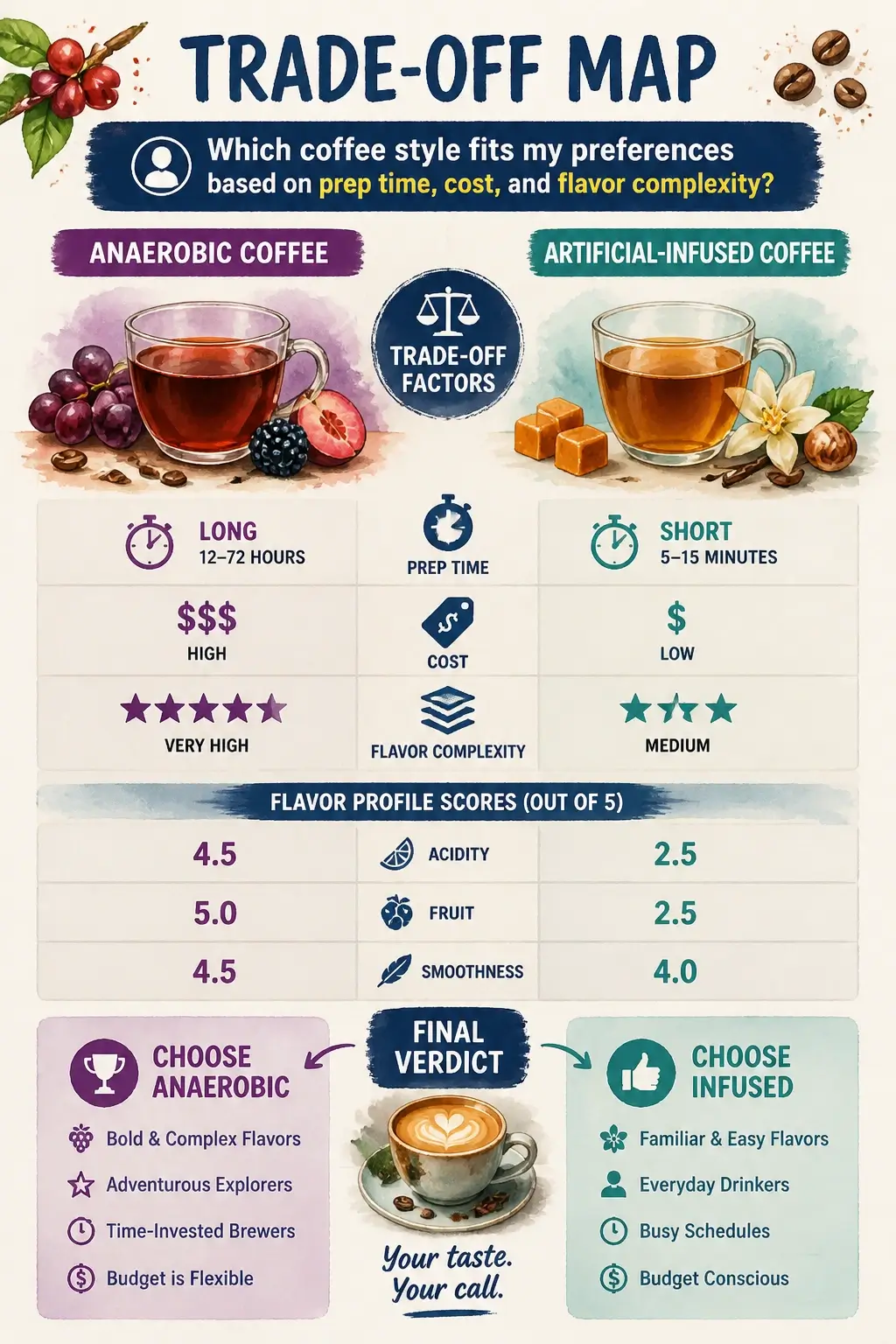
- Prep time: Anaerobic coffees, especially brewed hot with a finer grind, demand more dialing-in. The variables are real: grind size, water temp, and brew ratio all interact. Infused coffee is more forgiving. You can pull a decent cup without obsessing over parameters.
- Cost: Anaerobic processing is labor-intensive at the farm level. You’re paying for controlled fermentation, careful sorting, and a smaller yield. Infused coffee is cheaper to produce and usually cheaper to buy, which isn’t a knock on quality, just a reflection of how the flavor gets there.
- Flavor complexity: This is where the gap is widest. Anaerobic fermentation builds flavor from the inside out: the volatile compounds are integrated into the bean’s structure. Artificially infused flavors are applied after the fact. The cup can taste great, but the complexity has a ceiling.
The final verdict is straightforward: if you want a silky, low-acid cup, cold-brew an anaerobic coffee or a high-quality artificial infusion, both will get you there. If you want a bright, funky experience with real depth, hot-brew an anaerobic with cooler water and a coarser grind, and let the fermentation do what it was designed to do.
By applying the rubric from the previous section and knowing your own taste persona, you can reliably spot whether a cup’s fruit comes from natural fermentation or added flavor, and pick the style that actually matches your palate.
Producers managing these elevated processing overheads rely on rigorous thermal and time parameters detailed inside the comprehensive carbonic maceration guide.
Real Talk: What Most People Miss About Coffee Flavor
Why does cold brew actually change anaerobic coffee’s flavor score, not just mask it?
Cold water raises the pH of your brew, which chemically suppresses lactic and acetic acid extraction. It’s not a sensory trick—the acids literally aren’t pulling into the cup at the same rate. That’s why an anaerobic coffee drops from an acidity intensity of 8 down to roughly 2, while fruit notes stay intact around 7. The fermentation flavors don’t disappear; they just express differently without the sharp edge.
Can you actually taste the difference between wild fermentation and inoculated fermentation in the cup?
Honestly, not reliably without lab data. Wild fermentations rely on environmental yeast and bacteria, while inoculated ones use purchased cultures. Both can produce complex fruit notes, but wild fermentations tend toward funkier, more unpredictable profiles. The problem is we’re scoring by descriptive language alone—no pH measurements or ester quantification studies exist across most community reviews. You’re identifying fermentation method through flavor pattern recognition, not direct sensory detection.
Why does roast level matter less than most coffee guides claim when dealing with anaerobic beans?
A low-development roast preserves volatile esters that carry fruit complexity, but aggressive fermentation can lock harsh acidity into the bean regardless of roast depth. Brew temperature, grind size, and the origin’s baseline acidity are equally decisive factors. The roast sets expectations, but fermentation already determined the flavor ceiling. This is why two people roasting the same anaerobic lot differently can end up with completely different cups.
What’s the actual cost breakdown explaining why anaerobic coffee runs $20–$35 per 250g?
Sealed-tank infrastructure at the farm level, tight fermentation monitoring to prevent spoilage, careful sorting post-fermentation, and a higher failure rate all add up. You’re not just paying for flavor—you’re paying for the controlled process and the unsuccessful batches that get composted. Artificial flavor coffee costs less because the flavor application happens post-roast at scale, with zero risk of batch failure.
If artificial flavor scores higher on mouthfeel smoothness, why isn’t that the main recommendation for most drinkers?
Because consistency isn’t complexity. Artificial coffee hits a predictable smoothness ceiling around 7, while anaerobic fermentation can reach 8 or 9 when dialed in properly. The trade-off is risk—anaerobic can also dip to 3 if fermentation runs too long or extraction gets away from you. For acidity-sensitive drinkers, cold-brewing an anaerobic coffee actually solves this: you get smoothness near 9, acidity near 2, and fruit clarity around 7. That beats artificial on all three fronts.
Why do community cupping sessions isolate one flavor dimension at a time instead of forming one overall impression?
Trying to judge acidity, fruit, and mouthfeel simultaneously is like diagnosing engine problems by listening to the whole motor running. Breaking it down dimension-by-dimension lets you identify exactly where a flavor comes from and whether it’s consistent with the processing method. One taster might perceive fruitiness that’s actually just high acidity; another might miss complexity masked by acidity sharpness. Isolation prevents perceptual cross-contamination and builds comparable data across different cups and tasters.