

Black coffee is a brutally honest drink, it hides nothing. Every variable you touch, from bean origin and roast date to grind size and water mineral content, lands directly in the cup with nowhere to hide.
Master the fundamentals in the right order and the process clicks into place: fresh beans, a consistent grind, clean water at the right temperature, a reliable coffee-to-water ratio, and a brewing method that fits how you actually live. Get those right, and every cup becomes repeatable.
Fresh Beans Set the Ceiling for Your Black Coffee
Fresh, high-quality beans are the single biggest variable in black coffee flavor, and roast date, origin, and proper storage are what separate a cup that sings from one that just exists. Here’s why that matters so much: black coffee is roughly 98% water, which means the dissolved solids from your beans are doing almost all the flavor work. If those beans are stale or low-quality, no amount of technique saves you.
Think of it like cooking with produce. A tomato picked last week and left on a warm counter isn’t going to taste like one picked this morning. Coffee works the same way. Right after roasting, beans are full of volatile aromatic compounds: the stuff that makes a cup smell and taste alive. Those compounds start escaping the moment roasting ends. By the time you’re four to six weeks out from the roast date, a meaningful portion of that character is just. gone.
The practical rule is simple: look for a “roasted on” date on the bag, not a “best by” date. Best-by dates are often set 12 to 18 months out and tell you almost nothing useful. A roasted-on date tells you everything. Aim to use your beans within 2 to 4 weeks of that date for the most intense aroma and flavor.
Origin shapes what’s in the cup once you’ve got fresh beans in hand. Different growing regions produce distinctly different flavor profiles because of soil chemistry, altitude, and processing methods, not marketing. A few reliable landmarks:
- Ethiopian beans tend toward floral and fruit-forward notes: jasmine, blueberry, bergamot.
- Colombian beans often lean chocolate and caramel, with a mild, balanced body.
- Guatemalan beans frequently show dark chocolate and brown sugar with a heavier mouthfeel.
None of these are guarantees, roast level and processing method can shift any of them, but origin is a reliable starting point when you’re learning what you like.
Once you’ve found beans you enjoy, storage is where most people quietly lose quality without realizing it. Heat, light, moisture, and oxygen are the four enemies. An airtight container kept in a cool, dark cabinet does the job. The freezer is controversial, it works if you’re storing an unopened, vacuum-sealed bag long-term, but the repeated temperature cycling from daily opening degrades the beans faster than room-temperature storage would.
Specialty coffee expert Raul Rodas, founder of Paradigma Coffee in Guatemala City and 2012 World Barista Champion, puts it plainly:
“We can control the environment at origin, skipping freight transportation, for example. We typically roast current harvest coffee, which helps maintain the flavours.”
That’s the part most people don’t think about. Every link in the chain between the roaster and your cup is an opportunity for the bean to lose something. Shorter chain, fresher bean, better cup. When you buy from a local roaster or a specialty retailer with visible roast dates, you’re cutting that chain down to its shortest possible length, and that’s the highest ceiling you can set before you even touch your grinder.
Choosing unadulterated, premium beans is essential if you are seeking the healthiest coffee options available for daily vitality.
A Better Coffee Grinder Starts With Understanding Particle Size
A well-calibrated coffee grinder controls grind size, and grind size controls everything that happens when hot water meets your grounds, whether you’re using a blade grinder, a hand grinder, or anything in between. Here’s the short version: water is lazy. It finds the path of least resistance through your coffee bed, and if your particles are uneven (some fine, some coarse) the water punches straight through the gaps and ignores the rest. That’s channeling. The result is a cup that’s simultaneously over-extracted (bitter, harsh) and under-extracted (sour, thin) at the same time.
So before we talk equipment, let’s get the grind-size map straight.
The grind-size hierarchy for common methods
- Coarse — French press. Particles roughly the size of coarse sea salt. The long steep time means finer grounds would over-extract fast.
- Medium-fine — Pour-over. Think table sugar. Fine enough to slow the water down and pull flavor evenly, coarse enough not to clog the filter.
- Fine — Moka pot. Closer to granulated sugar, almost powdery. The pressurized chamber needs resistance to build up and push water through correctly.
That last point is worth sitting with. Leading coffee scientist Chahan Yeretzian, Professor of Chemistry and a leading voice in coffee science, puts it plainly:
“When extracting espresso in a café setting, a finer grind size is needed to create more pressure inside of the portafilter. This helps to create more resistance to result in a proper extraction.”
The same principle applies to your Moka pot at home: grind too coarse, and the water races through without resistance, leaving you with weak, watery black coffee. Grind too fine, and you risk over-extraction or a clogged valve.
Now, about the equipment
A burr grinder, whether electric or manual, works by crushing beans between two abrasive surfaces set at a fixed distance apart. Every particle that exits is roughly the same size because every bean travels the same path. That uniformity is why burr grinders are the standard recommendation.
But a quality electric burr grinder can run $150–$300+, which is a real barrier. Here’s where you have two honest options:
- Manual hand-crank burr grinders: These use the same burr mechanism as their electric cousins, just powered by your arm. A decent one runs $30–$60. Grind time is slower, but the particle consistency is genuinely close to mid-range electric models. If you brew one or two cups at a time, this is the most cost-effective path to a proper grind.
- Blade grinders as a stop-gap: A blade grinder spins a metal blade through the beans like a tiny propeller. It doesn’t grind: it chops. The result is a chaotic mix of particle sizes. That said, a blade grinder isn’t worthless. Short, pulsed bursts (rather than one long run) and shaking the grinder between pulses gets you closer to even. It’s not ideal, but it’s brewable, especially for French Press where coarse-and-uneven is more forgiving than fine-and-uneven.
Even a modest grinder can deliver a brewable grind when you add a simple ingredient that changes how your black coffee extracts, and this is where things get interesting.
The salt-on-grounds hack
Before you brew, sprinkle roughly ¼ teaspoon of kosher salt directly onto your measured grounds. That’s it. Don’t dissolve it. Don’t mix it in aggressively. Just let it sit on top and let the brewing water do the work.
What’s actually happening: salt suppresses bitterness at the receptor level, the same reason a pinch of salt in baking cuts the edge off sharp flavors. In coffee, it doesn’t make the cup taste salty. It rounds off the harsh, over-extracted notes that blade grinders tend to produce because of their uneven particle output. The finer dust particles in a blade-ground batch extract fast and bitter; the salt blunts that without masking the actual coffee flavor underneath. You also get a subtle improvement in mouthfeel: the cup feels slightly fuller, less thin.
This isn’t a replacement for a good grinder. But it’s a genuinely useful bridge when you’re working with entry-level equipment, and it costs almost nothing to try.
Here’s a quick walkthrough of the hack in action, timing and mixing technique matter more than most people expect:
The grind is now dialed in. The next variable, and it’s a bigger one than most people expect, is the water itself.
Your Water Decides Whether Black Coffee Tastes Brilliant or Broken
Filtered water, free of chlorine and balanced in mineral content, is the invisible ingredient that either carries your coffee’s flavor to the cup or quietly destroys it through pH that skews extraction, minerals that compete with acids, or chlorine that simply tastes like a swimming pool. Think of water not as a neutral carrier but as an active participant. It’s the solvent doing all the work, and its chemistry shapes what it can pull out of the grounds and what it leaves behind.
Chlorine is the easiest problem to fix. Municipal tap water is treated with it for safety, but chlorine bonds with organic compounds in coffee and produces off-flavors that no amount of good beans or careful technique can overcome. A basic carbon filter (the kind in a standard pitcher) strips it out in seconds. That one step alone cleans up the baseline.
Minerals are more nuanced. Water that’s too soft (low TDS, under 50 mg/L) lacks the magnesium and calcium ions that physically bond to flavor compounds during extraction. The result is a thin, sour cup, the water simply can’t carry enough. Water that’s too hard (over 200 mg/L TDS) overwhelms the extraction, pulling harsh, bitter compounds alongside the good ones and leaving a muddy, heavy finish.
The Specialty Coffee Association standards target approximately 150 mg/L TDS as the sweet spot, mineral-rich enough to extract fully, clean enough to let sweetness and complexity come through without interference.
pH works the same way. Neutral water, around pH 7, keeps the extraction balanced. Acidic water amplifies perceived sourness; alkaline water mutes it and can flatten a coffee’s brightness entirely. This is the mechanism behind Dr. Marco Wellinger’s acidity research at ZHAW in Switzerland:
“The perceived acidity of a given coffee beverage corresponds to the amount of acids extracted from the coffee minus the amount of alkalinity from the water.”
In plain terms: your water’s alkalinity is actively neutralizing the acids in your cup. Use water that’s too alkaline, and you don’t get a less acidic coffee: you get a flat one, stripped of the brightness that makes a good black coffee interesting.
Once the water chemistry is right, temperature becomes the next lever.
The ideal brewing range is 195 °F – 205 °F (90 °C – 96 °C). That window isn’t arbitrary: it’s where water has enough thermal energy to dissolve the full spectrum of soluble compounds in the grounds without triggering the ones you don’t want.
Here’s how the edges of that range behave:
- Above 205 °F: Water over-extracts. It pulls bitter, astringent compounds (the ones that are soluble at high heat but taste harsh) before you can stop it. Boiling water (212 °F) lands here, which is why “just boiled” is a common mistake.
- Below 195 °F: Water under-extracts. The thermal energy isn’t sufficient to dissolve the heavier flavor compounds, so you’re left with a sour, underdeveloped cup: all the acidity of the coffee, none of its sweetness or body.
Hitting that range doesn’t require expensive equipment. Two practical options:
- Kettle with a built-in thermometer: Gooseneck electric kettles with temperature control cost $30–$60 and hold your target precisely. For pour-over especially, this is worth every dollar.
- Digital probe thermometer: If you already have a stovetop kettle, a $10–$15 instant-read probe gets you there. Bring water to a boil, then let it sit off the heat for 30–45 seconds: that drop typically lands you right in the 200–205 °F zone.
With water chemistry dialed in and temperature controlled, you’ve removed the two most common invisible sources of bitterness and sourness. What’s left is figuring out how much coffee to use, and that’s where ratio and the bloom step come in.
Getting the Coffee-to-Water Ratio and Bloom Right
Precise coffee-to-water ratio sets the extraction ceiling for black coffee, with the golden ratio acting as the calibrated starting point and the bloom as the mechanism that makes even extraction possible. Think of ratio as the volume knob: it controls overall strength. And bloom is what ensures the signal is clean before you turn it up. Get one wrong, and the other can’t save you.
The two work in sequence: ratio first, bloom second. Once you dial in how much coffee meets how much water, the bloom step clears the path so that water actually reaches every ground evenly, rather than getting blocked by trapped gas and punching through weak spots.
The golden ratio gives you a starting number
Measurable, weight-based golden ratio, 1 gram of coffee for every 16 grams of water, is the most reliable starting point for a balanced black coffee. It’s not a rule handed down from on high. It’s the ratio where most coffees hit the sweet spot between too weak (over-diluted) and too strong (over-extracted and bitter).
If you don’t own a scale yet, the beginner shortcut is roughly 2 tablespoons of ground coffee per 8-ounce cup. It’s not as precise, but it gets you close enough to taste what your beans are actually doing.
The 1:16 golden ratio is a general-purpose number, though. Different brewing methods apply pressure, heat, and contact time differently, so the ratio shifts. Here’s a quick reference:
| Brewing Method | Weight-Based Ratio | Weight Example | Volume-Based Shortcut |
|---|---|---|---|
| French Press | 1:12–1:15 | 20g coffee + 300g water (1:15) | 2 Tbsp per 6 oz water |
| V60 (Pour-Over) | 1:16 | 20g coffee + 320g water | 2 Tbsp per 6 oz water |
| AeroPress | 1:10–1:15 | 15g coffee + 150–225g water | 2 Tbsp per 6 oz water |
| Moka Pot | 1:7–1:9 | 20g coffee + 140–180g water | Not commonly used |
Notice the Moka Pot sits at 1:7–1:9. That’s not a mistake: it’s designed to produce a concentrated shot, not a full cup. Trying to apply the standard tablespoon shortcut there would throw off the whole brew.
Start with the weight-based ratio for your method. Once you’ve brewed it a few times and know what your palate is chasing, adjust from there.
The bloom clears the path for even extraction
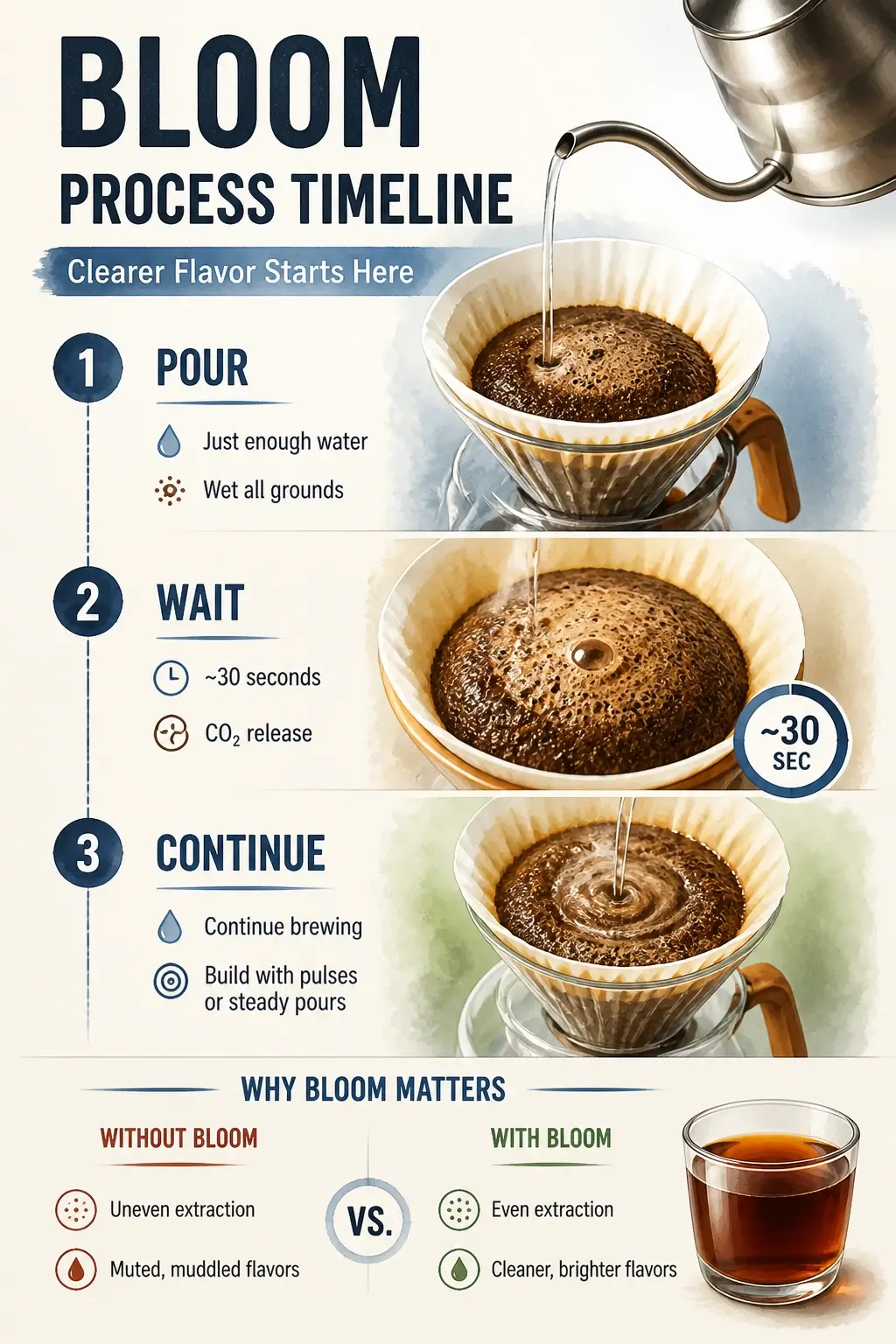
Effective bloom technique works by saturating your grounds with just enough water, roughly twice the weight of your coffee, and then pausing for about 30 seconds before continuing the pour. That pause is doing real work.
Freshly roasted coffee is full of CO₂ trapped inside the bean cells during roasting. When hot water hits dry grounds, that gas releases fast. If you pour all your water at once, the escaping CO₂ creates a barrier, it physically pushes water away from the grounds unevenly. Some grounds get saturated. Others barely get touched. The result is a cup where part of the bed is over-extracted and bitter, and part of it is under-extracted and sour, all at the same time.
The bloom lets that CO₂ escape on its own terms before the real extraction begins. Once the gas is out, water can move through the bed evenly, and that’s where flavor clarity comes from.
One technique detail worth knowing: Coffee expert James Hoffmann, World Barista Champion and author of The World Atlas of Coffee, recommends a specific motion during the bloom:
“In his Ultimate V60 Technique video, James Hoffmann recommends swirling during the bloom, rather than stirring, for better-tasting results.”
Swirling moves the slurry as a single mass rather than agitating individual grounds. Stirring can disturb the bed unevenly and introduce inconsistency right at the moment you’re trying to create uniformity. The swirl keeps things calm and controlled.
One more thing worth testing: your filter choice affects the final cup even when your ratio and bloom are perfect. Paper filters trap the oils that naturally come off the grounds during extraction. That gives you a cleaner, brighter cup, but it can also feel thin, lacking the body that makes black coffee satisfying. Metal filters let those oils through, which adds weight and texture to the mouthfeel. Neither is wrong. They’re just different outputs from the same inputs. Brew the same coffee through both and taste them side by side, your preference will be obvious within a sip.
Each Brewing Method Has a Different Job
Every brewing method shapes black coffee differently, not just in technique, but in the physics of how water meets ground coffee. French press and cold brew work through time and immersion. Pour-over and the Moka pot work through flow and pressure. Knowing which mechanism is doing the work tells you exactly why each recipe is built the way it is.
The four methods below split cleanly into two families. French Press and Cold Brew submerge the grounds completely and let time do the extraction. Pour and pressure methods (V60, AeroPress, and the Moka pot) push water through the grounds, which concentrates flavor faster and gives you more control over body. Start with whichever matches your gear, then read the other family when you’re ready to expand.
French Press and Cold Brew Both Steep
French press is the most forgiving method in the lineup, and that’s not an accident, it’s a product of full immersion. When grounds sit in water instead of having water pushed through them, extraction is slower and more even. There’s no channeling, no flow rate to manage. Time does the work.
Here’s the recipe that holds up:
- Grind: Coarse: think sea salt crystals. Fine grounds will slip through the metal filter and make the cup muddy.
- Ratio: 1:15: 1 gram of coffee per 15 grams of water. For a standard 350 ml press, that’s about 23 g of coffee.
- Water temp: 93–96°C (200–205°F). Off-boil by 30 seconds.
- Steep: 4 minutes. Don’t stir aggressively mid-steep, it disturbs the crust and makes filtering harder.
- Press: Slow and steady. If you feel real resistance, your grind is too fine.
- Pour immediately. Coffee left sitting on the grounds after pressing keeps extracting and turns bitter fast.
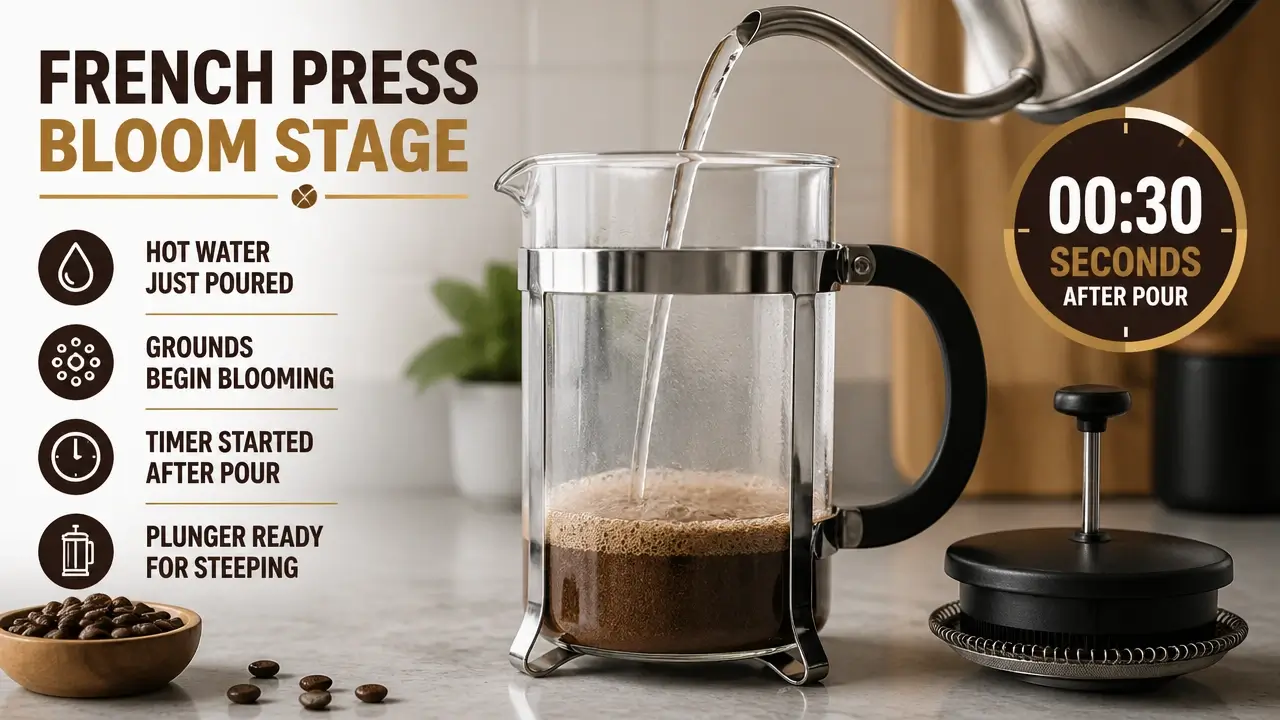
Here’s what a good steep looks like right at the pour stage: notice how the bloom sits on top before the press goes down:
One thing worth knowing about grinders: burr grinders produce a more uniform particle size, which means more even extraction. But if you only have a blade grinder, you’re not locked out. The salt-on-grounds hack (a pinch of salt added to the grounds before grinding) reduces static cling and keeps particles from clumping, which gives you a more even grind distribution. Pulse-grind in 3-second bursts, shake the grinder between pulses, and you’ll get close enough for French Press. Coffee author Scott Rao, one of the most respected voices in coffee science, puts the effective dose clearly:
“0.15g of salt per 100g of brewed coffee yielded the best tasting results, for both espresso and filter.”
That’s a small amount: about a quarter of a flat teaspoon per large French press. It’s not about flavor. It’s about suppressing bitterness by blocking specific bitter-taste receptors on your tongue, while the grind-distribution benefit happens before the water ever touches the coffee.
Cold brew uses the same immersion logic as French press, but trades heat for time. Cold water extracts slowly, which means the harsh acidic compounds that dissolve quickly in hot water never fully make it into the cup. The result is a naturally smooth, low-acid concentrate.
- Grind: Very coarse: coarser than French press. You’re steeping for up to 24 hours, so fine grounds will over-extract badly.
- Ratio: 1:8 to 1:12. At 1:8 you get a concentrate you dilute later. At 1:12 you get something closer to ready-to-drink strength.
- Method: Combine grounds and cold or room-temperature filtered water in a jar or pitcher. Stir to saturate all the grounds.
- Steep: 12–24 hours in the fridge. Shorter = brighter. Longer = deeper, more chocolatey.
- Filter: Pour through a paper filter or a fine-mesh strainer lined with cheesecloth. The metal filter from a French press works in a pinch but will leave sediment.
- Store: Keeps in the fridge for up to two weeks as concentrate, about one week at drinking strength.
The blade-grinder pulse technique matters even more for Cold Brew than for French Press. Because you’re steeping so long, inconsistent particle sizes create a wide spread of extraction: some grounds over-extracted, some under. The salt-and-pulse method narrows that spread enough to make the difference between a muddy batch and a clean one.
V60, AeroPress, and the Moka Pot Use Flow
Pour-over, whether you’re using a V60 or an AeroPress, works on a fundamentally different principle than immersion. Water flows through the grounds once, and that single pass has to do all the extraction work. That’s why grind size, pour speed, and the bloom step matter so much more here than they do in a French press.
V60 recipe:
- Grind: Medium-fine: finer than table salt, coarser than espresso. Think granulated sugar.
- Ratio: 1:16: 20 g of coffee to 320 g of water is a clean starting point.
- Bloom: Pour 2–3x the coffee weight in water (40–60 g) and wait 30 seconds. This releases CO₂ trapped in fresh grounds.
- Coffee expert James Hoffmann, World Barista Champion, recommends swirling during the bloom for better results.
- Main pour: Slow, steady circles starting from the center and working outward. Total brew time should land around 3–3:30 minutes.
- AeroPress variation: Same medium-fine grind and 1:15 ratio, but you flip the full AeroPress upside down (inverted method), steep for 60–90 seconds, then press slowly.
Moka pot is in its own category. It’s not espresso, and it’s not pour-over, it uses steam pressure (roughly 1–2 bar) to push water up through a packed bed of grounds. That pressure changes everything about what ends up in the cup.
A peer-reviewed study published in European Food Research and Technology compared Moka pot and pour-over brewing directly and found that the Moka pot’s steam pressure produces significantly higher concentrations of total dissolved solids, caffeine, and chlorogenic acids than gravity-driven pour-over.
Moka pot recipe:
Mastering pressurized flow and extraction mechanics provides a solid foundation before exploring more unique espresso drinks.
- Grind: Fine: finer than pour-over, but not as fine as espresso.
- Ratio: ~1:7. The basket size largely determines your dose, so fill it level, don’t tamp.
- Water: Fill the bottom chamber to just below the pressure release valve.
- Heat: Medium-low. Leave the lid open. When you hear a steady gurgle, pull it off the heat immediately.
The best pro tips treat black coffee as a system, not a recipe
Most guides hand you a brew method and call it done. What they skip are the small mechanical adjustments (filter choice, salt, concentration) that actually move the needle on flavor.
A pinch of salt and the right filter change everything
The salt trick is simple. A small pinch, stirred into your dry grounds before brewing, suppresses bitterness without making the coffee taste salty. Salt doesn’t add flavor here; it blocks the bitter compounds from registering on your tongue.
Filter choice is the other adjustment. A paper filter is dense enough to catch tiny oily particles, producing a cleaner, brighter cup. A metal filter lets those oils and fine particles pass through, adding weight and texture to the mouthfeel. If you want clarity, go paper. If you want richness, go metal.
Bypass brewing solves strength and hot-water problems at once
Bypass brewing is a concentration trick: brew your coffee stronger than you want to drink it, then dilute it with hot water until it hits the strength you’re after. The practical advantage is control. Instead of trying to dial in the exact ratio every time, you brew a reliable concentrate and adjust in the cup.
This matters even more when your hot-water setup isn’t ideal. A standard electric kettle without temperature control is fine: just let it sit for 30 to 60 seconds after it clicks off and you’ll land close to the 195–205°F target. A microwave works too, though it heats unevenly, so stir the water before you use it.
The equipment doesn’t have to be perfect. The understanding does.
Real Talk: Black Coffee Myths Busted & Edge Cases Exposed
Q: Why does freezing beans sometimes wreck your brew worse than room temp?
A: Freezer works only for unopened vacuum-sealed bags long-term, but daily opening cycles moisture and temp swings that degrade volatiles faster than a cool dark cabinet. You’re trading convenience for flavor loss most don’t notice until side-by-side tasting. Stick to airtight room storage for daily use.
Q: What if your blade grinder gives mostly dust even with pulses—how’s salt actually fixing that?
A: Salt sprinkled on dry grounds before grinding cuts static cling so particles don’t clump into uneven boulders and fines. It hits bitter receptors to blunt over-extracted dust without salting the cup, turning chaotic blade output into something brewable. Test 1/4 tsp per batch.
Q: Why does alkaline tap water flatten even perfect beans instead of just muting acid?
A: Alkalinity neutralizes coffee acids during extraction, stripping brightness and leaving flat dullness—not less sour, just lifeless. Dr. Wellinger’s research shows it’s acid minus water’s buffering, so aim pH 7 with 150mg/L TDS. Carbon filter first, then test.
Q: What happens if you skip bloom on beans over 4 weeks post-roast?
A: Older beans have less trapped CO2 so minimal bloom gas, but skipping still risks channeling from dry spots. Pour steady anyway, but expect thinner clarity since volatiles are already fading fast. Fresh 2-week beans need that 30s pause most.
Q: Why does Moka pot pull more caffeine than pour-over even at same ratio?
A: Steam pressure at 1-2 bar forces higher dissolved solids, caffeine, and chlorogenic acids through fine grounds versus gravity flow. European Food Research study confirms it’s concentrated like weak espresso. Pull off heat at first gurgle to avoid scorching.
Q: How does paper versus metal filter flip mouthfeel without changing strength?
A: Paper traps oils for clean bright sip that feels thin; metal lets them pass for fuller body and texture. Same inputs, different outputs—brew identical batches side-by-side. Neither’s wrong, pick by what satisfies your black coffee craving.