

Thin stainless steel discs sitting between coffee and shower screen – espresso puck screens promise uniform water distribution, fewer channeling events, and cleaner extraction yield. The physics are real. The marketing is louder than the evidence.
What actually happens involves grind size, basket geometry, and a refractometer telling a more complicated story than most reviewers admit. A puck screen can lift extraction balance or quietly push you toward over-extraction, and the difference comes down to one adjustment most baristas skip entirely.
What Is a Puck Screen and How Does It Work?
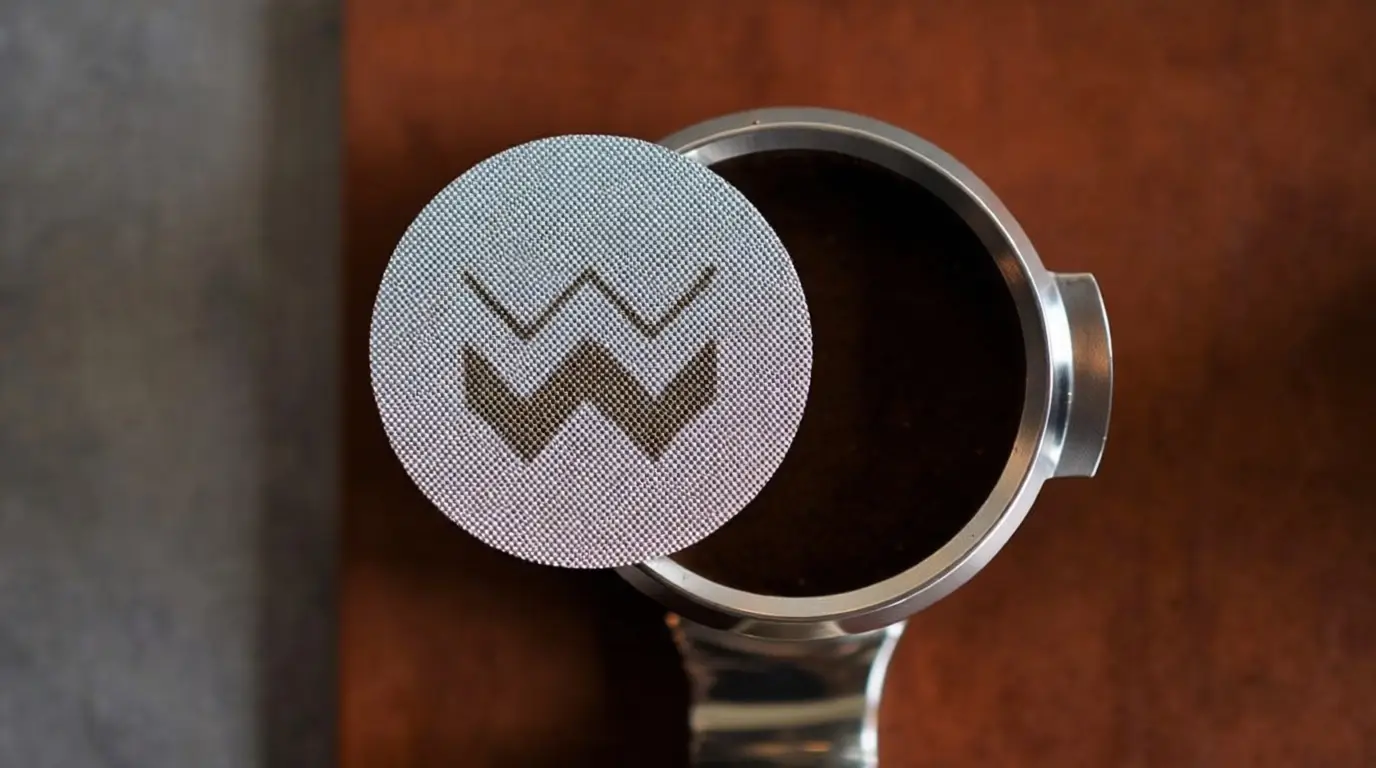
A puck screen is a thin circular disc that sits between your coffee and the group head.
Specifically, the puck screen is a ≈1.7 mm disc of 304 stainless steel, punched through with pores around 150 µm wide, that drops into your portafilter right on top of the tamped puck. It comes sized for the three most common baskets (51 mm, 54 mm, and 58 mm), so it fits flush against the coffee bed without shifting during the shot.
Here’s the job it’s actually doing.
When your machine fires, pressurized water doesn’t arrive as a gentle mist. It hits the puck in concentrated jets from the shower screen above. Those jets can punch straight through softer spots in the coffee bed, creating channels: narrow paths of least resistance where water races through without extracting much. The result is an uneven shot: some grounds get flooded, others barely touched.
The puck screen acts as a secondary shower screen between that incoming water and your coffee. Those 150 µm pores break the pressurized jets apart and spread the water across the full surface of the puck before it begins its journey downward. Think of it like the aerator on a kitchen faucet: the water pressure doesn’t disappear, it just gets redistributed into a more uniform pattern instead of a few strong streams.
That’s the whole mechanism in one sentence: more uniform water distribution across the puck surface means fewer channels, which means more of your grounds are doing actual extraction work.
Scott Rao, coffee author and espresso extraction consultant puts the underlying logic plainly:
Grind distribution is one major thing that separates a good shot from a bad shot. Not necessarily particle size distribution of the grinds, but how the grounds are distributed in the puck. From that perspective, you get good flow rate, you get a better-tasting espresso, and you can get higher extraction with the right profile.
The puck screen is essentially trying to solve that same problem from the water side. Even if your distribution and tamp are slightly imperfect, a well-placed screen gives the incoming water less opportunity to exploit those weak spots and blow a channel straight through.
How a puck screen changes the way water moves through coffee
High-pressure water, hitting an espresso puck without a screen, arrives as concentrated jets that punch straight through the path of least resistance. Think of it like a garden hose blasting a pile of loose soil, the water doesn’t spread evenly. It bores a hole.
A puck screen intercepts those jets before they reach the coffee. The mesh breaks the pressure into a wider, softer spread across the entire puck surface (essentially creating a secondary shower effect that mimics what a well-engineered shower screen does, but from below the group head rather than above).
Here’s why that matters at the puck level.
Coffee grounds are never perfectly uniform. There are always micro-gaps (tiny weak spots where the bed is slightly less dense). Without a screen, those gaps become targets. The pressurized water finds them immediately and carves a channel straight through. The rest of the puck barely gets touched.
Jill Hoff, 2020 Canadian Barista Champion puts it plainly:
Channeling occurs when there are weak spots in your coffee bed. In these spots, water can pass through quickly, inhibiting an even flow through the puck.
That uneven flow is the real problem. When water races through one channel, those grounds get massively over-extracted: bitter, harsh. The grounds that the water barely touched stay under-extracted: sour, thin. Both are happening in the same shot, at the same time, pulling against each other in the cup.
The screen disrupts that sequence early. By spreading the incoming water before it ever touches the puck, it reduces the pressure differential that creates those weak-spot channels in the first place. The entire coffee bed gets a more even saturation front: water reaching the outer edges at roughly the same rate as the center.
Because the water now reaches every grain more evenly, the next question is whether this translates into a measurable extraction gain, and the answer, as we’ll see, is more conditional than the marketing suggests.
What does the data actually say about extraction yield?
Measured extraction yield climbs an average of 3 percentage points in controlled tests when a puck screen is added, a shift that a refractometer reads as roughly 20% more coffee solids dissolved into the cup. That’s not a rounding error. Moving from, say, 19% to 22% extraction yield is the difference between a shot that tastes thin and one that tastes complete.
Let me explain what that number actually means before we get too excited about it.
A refractometer measures TDS (Total Dissolved Solids) in your finished espresso. We then run that number through a formula that accounts for your dose and yield weight, and the output is your extraction yield percentage. Think of your coffee grounds as a library of flavor compounds. Extraction yield tells you what percentage of that library actually made it into the cup. Too low, and you pulled mostly the easy, sour-bright chapters. Too high, and you dragged out the bitter, astringent ones that should have stayed on the shelf.
So a 3-point gain sounds like a clean win. More solids, better flavor. Here’s where we need to slow down.
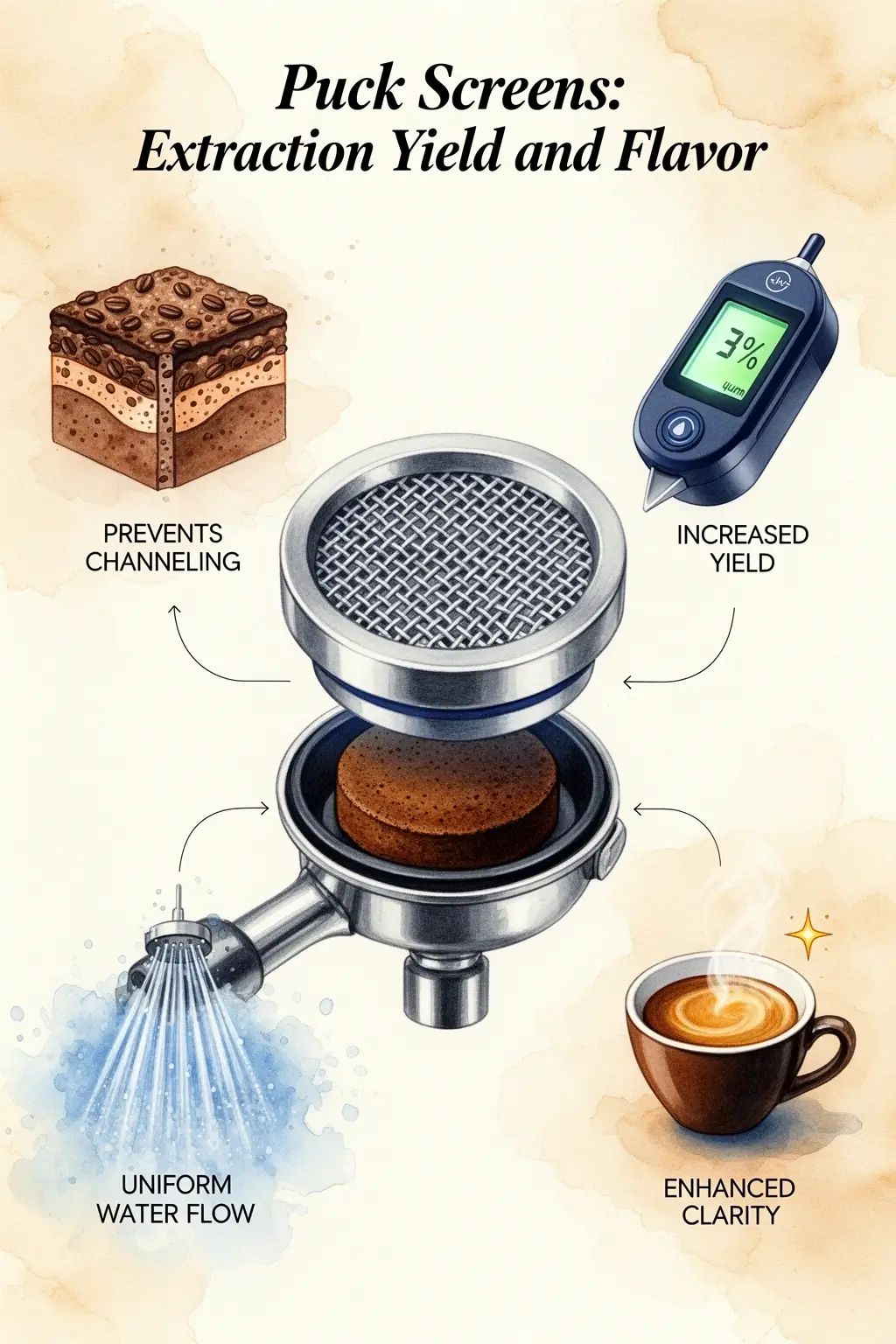
The flavor reports are real, but soft
Anecdotal feedback from home baristas and café users clusters around two observations: richer crema and clearer flavor. The crema point makes mechanical sense, more uniform water contact means more even CO₂ release from the puck, which produces a denser, more stable foam layer. The flavor clarity report is harder to pin down, but the logic tracks: when channeling is reduced, you eliminate the bitter, over-extracted spikes that muddy a shot’s mid-palate: What’s left tastes cleaner, not because the coffee changed, but because the noise was removed.
These are real sensory experiences. They’re just not controlled data.
The 3% number has a serious asterisk
No peer-reviewed study and no multi-machine dataset back that 3-point extraction yield gain. The figure originates from a single-machine, single-recipe test run on a Decent DE1 (a high-end machine with pressure profiling and a level of shot-to-shot consistency that most home setups don’t come close to matching).
Lance Hedrick, former Onyx Coffee Lab barista captured exactly this dynamic in testing a different basket geometry:
Our testing, in addition to a very in‑depth analysis by online coffee guru Lance Hedrick, proved that with an equivalent dose size a Unibasket with its geometry was capable of producing a 22% EY shot in <20 seconds whereas a 19% EY shot on a ‘standard’ basket took closer to 30 seconds.
That 3-point swing (19% to 22%) is the same gap the puck screen data claims. But notice what drove it in Hedrick’s test: basket geometry, flow rate, and time, all tuned together as a system. The screen didn’t do that alone. No single variable did.
This is the part the marketing skips. A puck screen added to an untuned recipe doesn’t automatically push you to 22%. It adds a physical barrier that slows flow. If your grind stays the same, that slower flow means longer contact time, and longer contact time at the same grind can push you past the extraction sweet spot into over-extracted, bitter territory.
The yield goes up. The flavor doesn’t have to.
The screen is a variable inside a system. The data we have tells us what happened on one machine, with one recipe, tuned by someone who knew what they were doing: That’s useful directional evidence: not a universal guarantee.
Puck screen maintenance adds less work than you’d expect.
Daily upkeep on an espresso puck screen pairs a hot-water rinse with an occasional Cafiza soak to keep mesh flow rates consistent and extend screen lifespan. Think of it like a French press filter: let oils and fines build up unchecked, and you’re no longer pulling shots through clean mesh. You’re pulling through a partially blocked membrane that quietly skews every extraction variable you just dialed in.
The good news is that the daily routine takes about ten seconds. Right after you knock the puck, flip the screen under the group head and blast it with a short hot-water flush, or hit it with a quick steam-wand burst. That removes the fresh layer of oils before they polymerize into the mesh. Polymerized coffee oil is the enemy here: once it bakes onto fine stainless steel, it needs chemistry to shift, not just heat.
That’s where the weekly Cafiza soak earns its place. Drop the screen into a small cup of Cafiza solution (same concentration you’d use for backflushing) and let it sit for 15 to 20 minutes. The alkaline surfactants break the oil bonds that hot water can’t touch. For heavy-mesh screens with tighter weave patterns, an ultrasonic cleaner goes a level deeper, using cavitation to pull residue out of pores that soaking alone can’t reach. You won’t need that every week, but it’s worth knowing it’s an option if flow rates start drifting.
Here’s a quick decision matrix so you can match the method to the moment:
| Cleaning Method | Frequency | Effort | Impact on Screen Lifespan |
|---|---|---|---|
| Daily Hot‑Water Rinse | After each shot | Low | Minimal |
| Weekly Cafiza Soak | Once per week | Medium | Moderate |
| Ultrasonic Cleaning | As needed | High | Significant |
Getting the screen out without the fight
Removal is where most people hit friction. The screen sits flush against the puck, and after a 9-bar shot, surface tension and coffee slurry can weld it in place. Fingernails lose. Spoons scratch.
If your screen is magnetic stainless steel (and many of the popular third-party options are, with manufacturers explicitly listing “magnetic stainless steel” in their specs), a neodymium magnet solves this instantly. Hold it over the center of the screen, and it pulls the disc clean off the puck surface without any digging or prying. A strong refrigerator magnet sometimes works; a small rare-earth magnet works every time. It’s one of those hacks that feels almost too simple once you know it.
For non-magnetic screens, the community workaround is a dedicated screen-lifter, a small hooked or cupped tool that gets under the rim. Interestingly, the fact that baristas and home users keep asking for a dedicated tool tells you something real: sticky-screen removal is a common enough failure point: the market hasn’t fully solved it yet. A simple purpose-built lifter would be a genuine add-on worth having. Until then, a small silicone-tipped tool or even a cocktail pick with a flat end does the job without scratching the screen surface.
One dose adjustment you should make from day one
Thicker screens, particularly the 1.7 mm variants, physically occupy space inside the basket. That’s not a flaw: it’s geometry. The trade-off is real: you’ll typically need to pull back your dose by roughly 0.5 g to maintain the same headspace and avoid compression problems at lock-in. Make that adjustment before your first shot with a new screen, not after you’ve already pulled three puzzling extractions wondering why the pressure curve looks off.
When should you use a puck screen?
Grind size, properly recalibrated for a puck screen, is the single variable that determines whether the screen helps or hurts your shot, connecting directly to shot time, extraction balance, and whether you avoid over-extraction or stumble straight into it.
That’s the core of it. The screen adds hydraulic resistance to the puck. If your grind stays exactly where it was before you installed the screen, that extra resistance slows the water down, extends shot time beyond your target window, and the result is a harsher, more bitter cup. The screen didn’t fail you: the calibration did.
So the real question isn’t “does a puck screen work?” It’s “am I willing to do the tuning work that makes it work?”
Grind adjustment is non-negotiable with a puck screen.
Coarser grind size, dialed back specifically to offset the screen’s added resistance, is the only reliable way to keep shot time and extraction balance where they need to be, and skipping this step is the most common reason people report that puck screens made their espresso worse.
Here’s the logic. Before the screen, your grind was calibrated to the resistance of your puck alone. The screen stacks additional resistance on top of that. Water now has to push through the screen’s mesh and your coffee bed. If you don’t open up the grind slightly to compensate, shot time creeps up, sometimes by 5 to 10 seconds, and the longer contact time pulls more of the bitter, astringent compounds that were supposed to stay in the puck.
Think of it like adjusting a garden hose nozzle. If you partially block the end with your thumb (the screen), but keep the same water pressure and the same nozzle setting, the flow slows and pressure builds in ways you didn’t intend. The fix isn’t to remove your thumb: it’s to open the nozzle slightly to rebalance the system.
The adjustment is usually modest. Most users find that moving one to two clicks coarser on their grinder brings shot time back into the 25-to-30-second range. But “modest” doesn’t mean “skip it.” Even a small grind shift changes the extraction curve meaningfully.
If you want to see exactly how this plays out in practice, the tactile process of dialing in grind with the screen in place, this video walks through it step by step in a way that text simply can’t replicate:
The final verdict: real benefit, real conditions, real maintenance.
Maintenance of a stainless steel puck screen is straightforward, but it isn’t optional, and the yield gain the screen offers is real enough to pursue, as long as you go in with accurate expectations rather than marketing promises.
Let’s be honest about the numbers first. A 2022 industry survey found that 12% of professional baristas reported more consistency after adding a puck screen to their workflow, with reductions in channeling and more repeatable extraction times cited as the primary reasons. That’s not a small, dismissible signal, but it’s also not a majority. The screen isn’t a universal upgrade. It’s a conditional one.
The often-cited 3% yield gain sits in the same category. It’s a plausible outcome under the right conditions (uniform water distribution, properly recalibrated grind, clean mesh), but it isn’t a guarantee you can bank on before pulling your first shot. Treat it as a ceiling to work toward, not a floor you automatically stand on.
One claim you can safely ignore entirely: the idea that a stainless steel screen “heats up faster” and improves temperature stability. Users consistently report no noticeable temperature difference at the puck level. The thermal mass of a thin mesh disc is too small to meaningfully alter group head temperature in either direction. This benefit is unverified and, based on real-world feedback, effectively nonexistent.
On the physics side, there’s solid grounding for why the screen reduces channeling when conditions are right: Research modeling pressure drop across porous wire screens (using an integrated Forchheimer equation) shows that screen morphology (pore diameter, tortuosity, and porosity) directly controls how water spreads before it enters the coffee bed. A stainless steel puck screen damps the high-velocity jets from the machine’s shower screen and promotes a more even lateral spread of water, leading to more uniform coffee extraction, which is the mechanical reason channeling decreases. (Source: Wang et al., 2021, Chemical Engineering Science))
That’s the mechanism. It works. But it works because of physics, not because of the screen alone, which means your grind calibration and a clean mesh are what actually activate it.
For removal, a small magnet or a dedicated puck screen lifter makes the process fast enough that it stops feeling like a chore. Rinse the screen after each session, give it a proper backflush soak weekly, and the mesh stays clear. A clogged screen doesn’t distribute water evenly: it just adds resistance without the benefit, which is the worst of both worlds.
So, when does a puck screen actually belong in your routine?
- Use it if you’re pulling shots with an inconsistent puck surface, seeing channeling in your bottomless portafilter, or working with a grinder that produces uneven distribution.
- Use it if you’re prepared to dial back grind size immediately after installation and treat the re-calibration: and the yield gain the screen offers as part of the setup process.
- Skip it if you’re chasing a guaranteed yield boost without adjusting your workflow: the screen won’t deliver that on its own.
- Skip it if the extra cleaning step genuinely disrupts your morning routine in a way you won’t sustain. An inconsistently cleaned screen is worse than no screen.
The espresso puck screen is a legitimate tool. It’s just not a passive one.
Real Talk: Puck Screen Myths Busted and Edge Cases You Need to Know
Q: What if my puck screen makes shots worse instead of better?
A: You’re not adjusting grind size coarser to offset the screen’s extra resistance, so shot time drags to 35+ seconds and pulls bitter compounds. Dial 1-2 clicks coarser from day one to keep time at 25-30 seconds; skip it and you’re over-extracting every time.
Q: Why doesn’t the 3% extraction yield boost happen on my machine?
A: That number came from one tuned Decent DE1 test, not universal truth. Your setup lacks the pressure profiling or basket geometry to match, so yield rises but flavor tanks without recalibration. It’s directional data, not a promise.
Q: How do you get a stuck puck screen out without scratching it?
A: Grab a neodymium magnet if it’s magnetic stainless steel; it yanks the screen clean off the puck in seconds with zero force. Non-magnetic? Use a silicone-tipped hook or cocktail pick under the edge gently. Prying with spoons ruins the mesh.
Q: Does a puck screen really improve temperature at the puck?
A: No, that’s pure myth with zero evidence. The thin 1.7mm disc’s thermal mass is too small to budge group head temps noticeably. Users report no change, so ignore marketing claims pushing faster heat-up or stability.
Q: What happens if you skip cleaning the puck screen for a week?
A: Oils polymerize in the 150µm pores, blocking flow and turning your uniform distributor into a channel-creator. Shots get uneven resistance, extraction skews, and you lose the whole point. Hit daily hot rinses or it clogs fast.
Q: Do I need to lower my dose with a thicker puck screen?
A: Yes, cut 0.5g right away since the 1.7mm screen steals headspace in your basket. Ignore it and you compress the puck too hard at lock-in, messing pressure curves from shot one. Adjust before dialing grind.