
A poorly fitted tamper causes channeling no matter how good your technique is. That’s the part most guides skip — they tell you to tamp at 30 lbs and keep your wrist straight, but say nothing about whether your tamper actually matches your basket, or whether the pressure you’re applying is what you think it is.
This guide covers the three tamper families, how diameter fit prevents edge channeling, what calibrated tampers actually guarantee (and what they don’t), and how to verify a level puck without buying extra hardware.
Why tamper families dictate your pressure uniformity
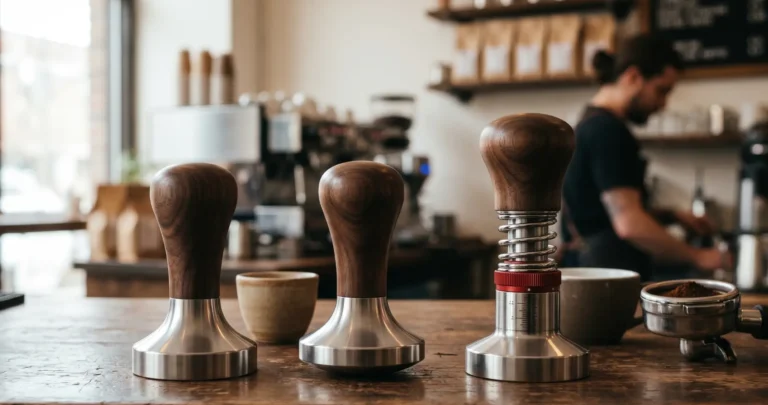
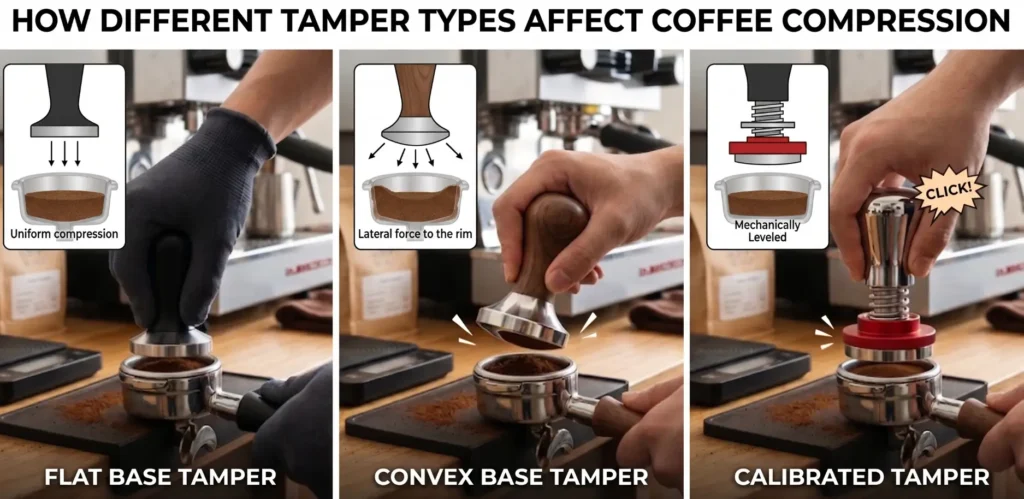
Distinct tamper families control pressure uniformity by leveraging specific geometries like the flat base, convex base, or calibrated tamper to maximize seal efficiency. We need to see how each shape moves the coffee grounds inside the basket. One design pushes straight down for consistency, while another curves outward to help you find the edge without guessing.
- Flat Base: Delivers uniform pressure across the entire coffee bed, making it the standard for high-end extraction where consistency matters most.
- Convex Base: Naturally pushes grounds toward the basket rim, improving seal efficiency for beginners who might struggle to keep the tool perfectly level.
- Calibrated Tamper: Includes a spring-loaded click or leveling collar that guarantees a horizontal puck, removing the guesswork from your downward force.
Each of these options serves a different purpose in your workflow. Accurate espresso tamper functions depend entirely on matching these shapes to your skill level.
Why tamper diameter dictates your basket size fit
Precise tamper diameter establishes the specific gap against your basket size to prevent edge channeling. That spacing stops grounds from sticking to the sidewalls where water would otherwise bypass them later. When Espresso tamper functions align with this clearance, water flows through the coffee instead of around it.
I’ve measured this gap myself, and the math is surprisingly tight. To avoid leaving grounds on the side walls, the tamper must be approximately 0.5 mm smaller than the portafilter basket. If we ignore this spacing, we risk creating a ring of coffee along the edge that ruins extraction consistency.
You can see this mismatch happen when the tool is either undersized or oversized for your machine. An undersized tamper leaves too much room for grounds to cling to the walls, while an oversized one scrapes the metal and creates friction. Both scenarios lead to edge channeling, where water finds the path of least resistance rather than penetrating the puck evenly.
Here are the common basket sizes you’ll encounter on home machines and the corresponding fit we need:
- 51 mm baskets (DeLonghi Dedica) need a 50.5 mm tamper.
- 54 mm baskets (Breville Barista Express) need a 53.5 mm tamper.
- 58 mm baskets (Most prosumer kits) need a 57.5 mm tamper.
A perfect fit eliminates the “ring of coffee” that sabotages even the best technique, but fit alone isn’t enough for consistency. We still need to consider how weight and handle ergonomics influence the pressure we apply after the size is correct.
The data below illustrates the exact clearance required for common portafilter sizes to maintain that 0.5 mm safety margin.
| Basket Diameter (mm) | Recommended Tamper Diameter (mm) |
|---|---|
| 49 mm | 48.5 mm |
| 51 mm | 50.5 mm |
| 53 mm | 52.5 mm |
| 54 mm | 53.5 mm |
| 55 mm | 54.5 mm |
| 57 mm | 56.5 mm |
| 58 mm | 57.5 mm |
| 60 mm | 59.5 mm |
How tamper weight and handle material drive consistency
Physically, consistent tamper weight delivers immediate tactile feedback while reducing wrist fatigue during repeated shots. Accurate espresso tamper functions depend on this balance to translate your arm’s effort into even density. This shift lets you notice uneven resistance before you even pull the shot, saving your wrist from unnecessary strain over time.
Handle material changes how the weight distributes in your hand — not just how it looks. An aluminum handle is light and transfers heat quickly, which matters if you’re pulling back-to-back shots and the portafilter is warm. A walnut or wood handle stays cooler and gives more grip, but adds almost nothing to the mass.
The honest answer: handle material is the last thing to optimize. Get the weight and diameter right first. If two tampers feel identical in hand and one has a walnut handle, take it – but don’t pay a $40 premium for wood alone.
Seeing the wrist position in action clarifies why balance matters more than looks.
Even with the right size, a light or awkward tamper can cause pressure drift, which is why many users seek a calibrated solution.
Why the calibrated tamper struggles with exact 30 lb pressure
Calibrated tamper designs engage a spring-loaded mechanism to click at a target 30 lb pressure while a self-leveling collar physically rests on the basket rim. This physical stop prevents uneven compression by ensuring the base travels a fixed distance into the basket every single time. You get consistency without guessing, which removes the human variance that usually spoils the coffee bed density before water ever touches it.
We often assume the click means the job is done, but there is a hidden gap in how these tools are validated. No widely-accepted method exists for measuring the exact force a calibrated tamper applies; most manufacturers only promise a “click” at an approximate 30 lb. This lack of quantitative pressure standards means you are trusting the internal spring calibration without a way to verify it on your own bench.
No publicly available industry survey provides a concrete percentage; articles note that calibrated tampers are increasingly common in specialty-coffee shops but do not quantify adoption.
When we look at broad espresso tamper functions, this blind spot creates uncertainty for buyers who need repeatable results. Even with the best intentions, a spring can drift over time, or the manufacturing tolerance might vary by a few pounds. That is why relying solely on the tool’s internal mechanism can leave you guessing about the actual force applied to the puck.
Anthony Douglas, 2022 World Barista Champion and Training Manager at Axil Coffee Roasters, notes the geometric advantage of these tools in competition settings.
The outer rim of the calibrated tamper I used in my routine is 58.5mm in diameter, so it sits on the edge of the portafilter basket,” Anthony says. “Because it’s spring loaded, it means you push down on the handle and the base of the tamper goes into the basket to compress the coffee grounds. It helps to maintain a level tamp, so there’s no way that you can tamp unevenly.
This specific geometry ensures the calibrated tamper cannot tilt, directly addressing the leveling issue without extra hardware. However, you still need a way to confirm the puck is truly flat after the fact. You can use a low-tech pressure verification hack known as the “twist-y-twist.” After tamping, rotate the tamper a quarter turn; a smooth, resistance-free twist indicates a level puck, mimicking a self-leveling tamper’s verification without extra hardware. This simple motion tells you immediately if the grounds are even, giving you confidence before you lock the portafilter into the group head.
Why coffee bed distribution needs the Weiss Distribution Tool
Uniform coffee bed distribution requires the Weiss Distribution Tool to execute a specific WDT protocol before the twist-y-twist check validates the surface. This process stabilizes reliable Espresso tamper functions by ensuring the pressure meets even resistance across the entire puck. Without this step, water finds weak spots and ruins the shot before you even press down.
Most home baristas own the needles but lack the map for how to use them. Community guidance on stroke count, angle, and timing is generally absent from manual instructions. A practical protocol is: 10‑12 quick, vertical strokes at a 45° angle, followed by a gentle sweep across the puck; this yields a uniformly distributed bed ready for tamping.
John Weiss, the creator of the technique, notes the origin of the method based on his own trial and error.
Initial struggles with channeling led me to the conclusion that good grinds distribution in the basket was a critical factor in pretty extractions
That’s the root insight – distribution determines where pressure lands, not just how much pressure you apply. A tamper that hits an uneven bed will always produce an uneven puck, regardless of how calibrated it is. Use the twist-y-twist check after tamping to confirm the surface is level before you lock in the portafilter.
How the tamper selection matrix fits your machine basket size
Functional tamper selection matrix aligns your machine basket size with a specific price tier while accounting for technique consistency. This tool stops us from guessing by mapping physical fit before we worry about cost. It ensures the hardware supports your hand pressure instead of fighting against it.
We need to look at the gap between your basket wall and the tamper edge first. If that space is too wide, poor tamper diameter fit forces water to bypass the puck no matter how hard you press. Use this quick reference to match your equipment before you spend a dime.
| Machine Basket Size | Recommended Tamper Shape | Why It Matters |
|---|---|---|
| Standard 58mm | Flat or Convex | Most common; offers flexibility for technique development. |
| Precision 58.3mm+ | Flat (High Tolerance) | Reduces side gap to prevent channeling along the wall. |
| 54mm (Breville/etc.) | Convex | Helps center pressure in smaller, deeper baskets. |
| Variable/Unknown | Adjustable Base | Allows fine-tuning if you swap baskets frequently. |
Once the fit is secure, we can look at what you pay for. I have seen too many people buy expensive tools that do not fix their underlying setup issues. Here is how the costs break down against what you actually get.
- Budget (<$5 Steel): Basic functionality; often too light to provide tactile feedback during the press.
- Mid-Range ($30‑$70 Stainless): Solid weight and ergonomics; best value for building muscle memory without gimmicks.
- Premium ($100+ Calibrated): Limits maximum pressure; useful for consistency but often unnecessary for home workflows.
You might hear that skill overrides hardware every time. While precise espresso tamper functions demand a level base before pressure applies, the physical tools set the boundary for what is possible. Even with perfect technique, an undersized or overly light tamper can cause persistent channeling because the hardware choice materially affects extraction. I want you to succeed, so do not blame your wrist if the metal itself is the problem.
There is also a hidden gap in how we verify our work. While many guides push a single 30 lb target, most home baristas prefer low‑tech verification over expensive calibrated devices. You can get reliable results using the twist‑y‑twist hack to check levelness without buying extra gear. Save your budget for a tamper that fits your basket snugly rather than one that clicks at a specific pressure.
The tamper that fits your basket snugly, sits comfortably in your hand, and gives you enough weight to feel the resistance – that’s the right tamper, regardless of price tag.
Real Talk: Tamper Myths Busted and Edge Cases You Can’t Ignore
Q: What if your tamper fits the standard but still channels on the edges?
A: You’re likely ignoring the ring of coffee left on sidewalls from slight oversize scraping or undersize gaps wider than 0.5mm. Measure your actual basket diameter against the table—mismatches create friction or cling spots where water bypasses the puck entirely, ruining shots despite perfect pressure.
Q: Why don’t calibrated tampers guarantee exactly 30 lb every time?
A: Springs drift over time and manufacturing tolerances vary by pounds, with no standard verification method. You’re trusting a click without bench-testing the force, so puck density wanders. Use the twist-y-twist hack post-tamp to confirm levelness instead of relying on unproven mechanisms.
Q: How does handle material secretly mess with your tamping consistency?
A: Aluminium heats up fast killing grip in long sessions while walnut stays cool but adds perceived weight that tricks your wrist into over-pressing. It’s not just looks—jewellery perception shifts effective mass, causing pressure drift unless you match material to your daily shot volume.
Q: What happens if you skip WDT even with a perfect tamper fit?
A: Dead zones and flow channels form from uneven particle packing, per PLOS ONE studies—water ignores half the puck. Do 10-12 vertical 45-degree strokes first; without it, no tamper saves your extraction uniformity since density variations create runaway paths of least resistance.
Q: Why does a heavy tamper fail on smaller 51mm baskets like DeLonghi?
A: Excess mass overwhelms narrow rims, scraping metal and amplifying friction into edge channeling. Stick to 50.5mm with lighter mid-range steel—budget options lack tactile feedback, but premium calibrated caps pressure too low for tight baskets, forcing inconsistent pucks.
Q: If technique trumps tools, why measure tamper weight at all?
A: Light tampers give zero resistance feel so you can’t detect uneven beds before locking in, breeding wrist fatigue and drift. Weight provides immediate feedback on density—ignore it and your hardware limits repeatability no matter how skilled your arm.