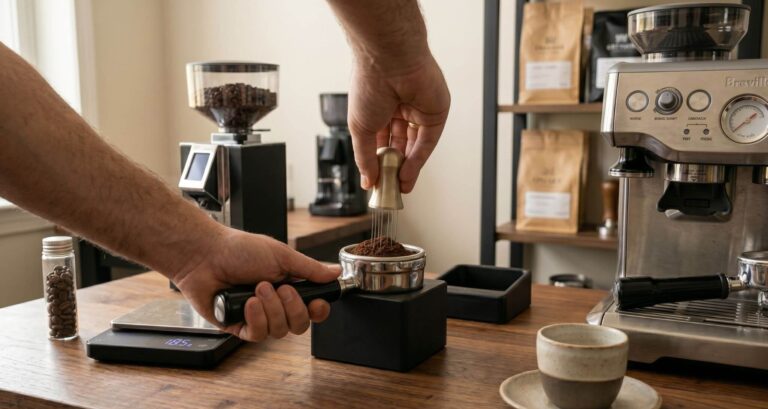

Weiss distribution technique espresso solves a problem most home baristas don’t realize they have. You dial in your grind, you tamp carefully, you pull the shot – and it still tastes off. Bitter on one side, sour underneath. The issue usually isn’t your recipe. It’s what happens between the grinder and the tamper.
What the Weiss Distribution Technique Achieves with a Needle Tool
Manual Weiss Distribution Technique breaks clumps by stirring grounds with a fine-diameter needle tool to form a uniformly dense puck before tamping.
We’re basically raking through the coffee bed to stop chunks from blocking water flow. Every part of the bed needs to offer the same resistance — because when it doesn’t, water finds the weak spots and the shot falls apart.
You don’t need expensive gear to make this work. Three facts are enough to get started:
- Origin: John Weiss introduced the method in 2005 to counteract clumping common in home grinders.
- Cost: It requires nothing more than a thin implement — no powered machinery, no expensive tooling.
- Timing: Stirring must happen before tamping. Once you compress the bed, you can’t fix what’s underneath
The method’s creator, John Weiss, a retired computer scientist and biochemistry PhD, describes the method in plain terms:
“WDT is simply the practice of using any thin but reasonably sturdy implement to stir, or “rake,” a pile of finely ground coffee inside a portafilter basket. This can involve either combing the surface of the pile or driving the needles more deeply through the bed. The goals are to break down any clumps of ground coffee that may have resulted from grinding and to evenly distribute the coffee within the basket prior to compression by a tamper.”
The needle isn’t doing anything exotic. It’s just making sure the puck you tamp is actually uniform – which is the whole game.
Why channeling destroys extraction consistency in espresso
Water is lazy. Under 9 bars of pressure, it doesn’t spread evenly through your puck — it finds the weakest point and punches straight through. That’s channeling.
The channel gets over-extracted. Everything around it stays under-extracted. You end up with bitter and sour in the same cup, and adjusting your grind won’t fix a structural problem in the bed.
You can actually see this when you knock out the puck — one side dense and dark, another side pale and loose.
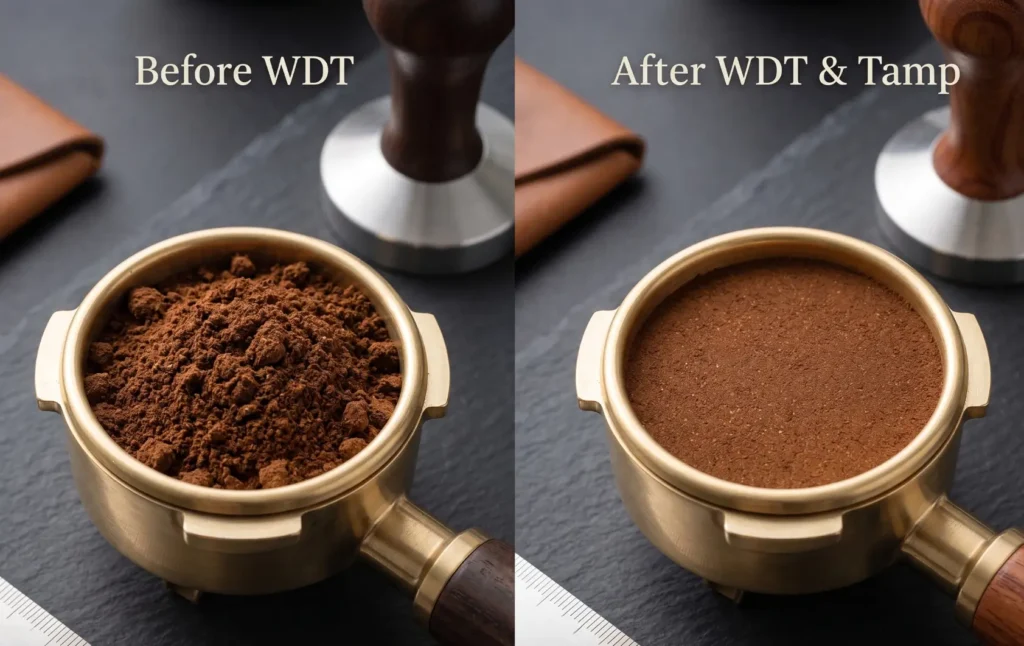
Independent coffee researcher Dr. Robert McKeon Aloe points out that the problem starts the moment you grind:
“When you grind coffee, the particle distribution changes, as does the shape of the coffee grounds. This creates several different layers in the basket, which may not always be ideal for even coffee extraction.”
Those layers are where channeling begins. WDT breaks them up before they cause damage — which is why the technique matters even when your grinder is dialed in.
Correct needle size determines your Weiss Distribution Technique success.
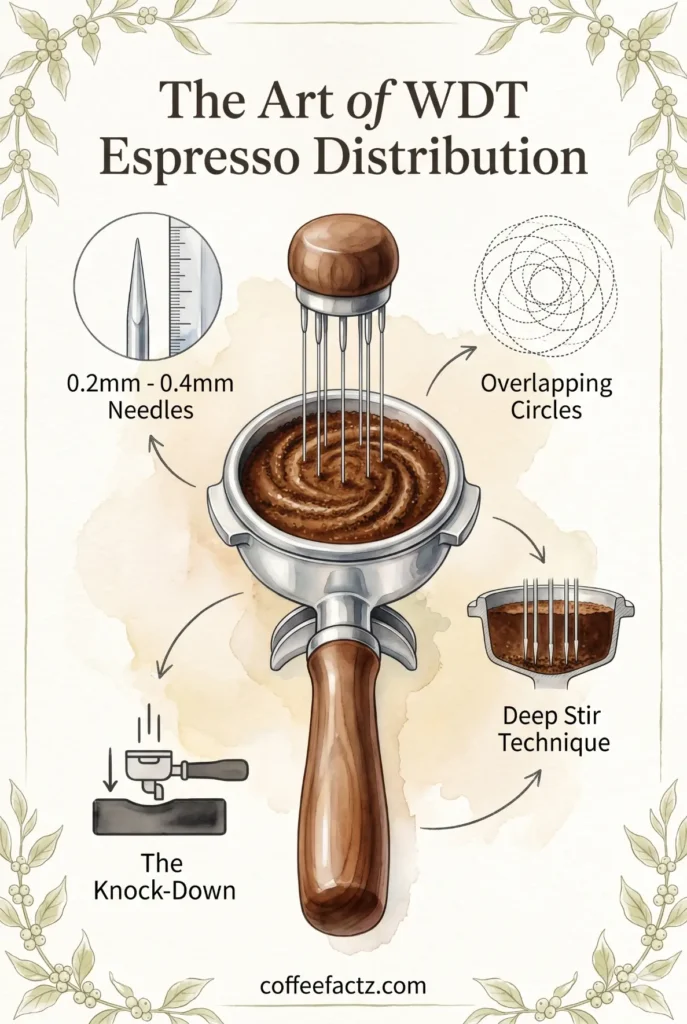
Optimal needle size between 0.2–0.4 mm lets a multi-needle tool move through grounds in overlapping circles without displacing them – eliminating density variations without creating new channels.
Anything thicker than 0.5 mm pushes too much coffee aside. You’re not distributing anymore — you’re excavating.
Here’s what actually matters in practice:
- Tool Configuration: 3 to 15 needles spaced evenly to cover your basket diameter in a single pass
- Dosing: Use a funnel or dosing collar to keep grounds from flying out while you stir
- Insertion: Push needles to the basket floor – clumps sit at the bottom, not just the surface
- Motion: Overlapping circles from edge to center, lifting gradually as you work up through the bed
- Knock Down: A firm tap on a tamping mat after stirring lets everything settle before you tamp
If you’re not ready to invest in a commercial tool, a bent safety pin works. Its geometry naturally creates the overlapping circular motion, which is why this cheap hack consistently outperforms what its price tag suggests.
You can see exactly how this looks in practice below.
The 2022 World Barista Champion Anthony Douglas highlights two things most people overlook – needle spacing and how long you actually stir:
The needles of the WDT tool he used in the 2022 WBC were spaced in a way which meant they distributed the entire surface area of the basket in one spin… spun his WDT tool for just under ten seconds, which he says helps to result in more even distribution, too.
Ten seconds feels longer than you’d expect at the machine. But that time gives grounds the chance to settle into a uniform density before water ever touches them. Rush it and you undo most of the work.
How WDT Improves Shot Time Stability
Consistent shot time stability emerges when evenly distributed grounds give water uniform resistance — sustaining the pressure curve long enough to raise extraction yield and TDS without burning the coffee.
When water can’t find weak spots, it pushes through the entire bed at the same rate. Pressure builds higher and holds longer. More flavor compounds get pulled into the cup before the shot ends.
In practice, baristas commonly report shot time variance dropping by around 30 percent after adopting WDT. The data below reflects what those differences look like across key metrics:
| Metric | WDT Applied | No WDT (baseline) |
|---|---|---|
| Shot-time variance | –30 % (reduction) | 0 % (no reduction) |
| Peak pressure during extraction | +0.5 bar (higher peak) | 0 bar change |
| Pressure sustain duration | +2 s (longer sustain) | 0 s change |
| Extraction yield / TDS | +0.3 % TDS (increase) | 0 % change |
| Flavor consistency rating | Higher (≈8.5 / 10) | Lower (≈6.5 / 10) |
Note: Data compiled from multiple barista reports and limited studies; values reflect typical observed differences rather than absolute measurements.
One thing worth being direct about: most of this data comes from self-reported home barista experience. Peer-reviewed studies with blind taste panels and controlled TDS measurements are still scarce. If you want to know what WDT actually does in your setup, measure TDS across 20–30 shots with and without. That’s the honest test.
The same applies to deep WDT versus surface-only stirring. Many experienced baristas swear by going all the way to the basket floor. The logic is sound, but the statistical backing is thin. Try both and measure – don’t take anyone’s word for it.
Practical Considerations: When WDT Fits Your Routine
WDT adds 15–30 seconds to your workflow. For a home barista pulling one or two shots in the morning, that’s a non-issue. For a café running volume, the calculation changes.
Does WDT fit your time and skill level?
If you’re just starting out, a single needle or bent safety pin is enough. Learn the motion, see the difference in your puck, then decide whether a weighted multi-needle tool is worth the upgrade. Master the technique before spending money on equipment.
For higher-volume settings, Ben Put, co-founder of Monogram Coffee, takes a more pragmatic view:
In our cafes, we have Autocombs, they’re the fastest and most robust and least likely to bend the needles.
At scale, durability matters more than upfront cost. A needle that bends mid-service isn’t just inconvenient — it’s a real problem.
What safety and wear risks should you know about?
Two things worth tracking:
Needle breakage — rare, but it happens. A snapped needle inside the basket that goes unnoticed ends up in the cup. Inspect your tool before each session, use food-grade materials, and replace anything showing wear.
Fines accumulation — aggressive deep stirring pushes more fines to the basket floor. Over time this affects flow resistance and potentially grinder longevity if fines work their way back into the system. Stir with intention, not force.
Real Talk: What Most People Miss About Weiss Distribution Technique
Q: What if your grinder doesn’t clump much, is WDT still worth it?
A: Yes, it’s still worth it because grinding always creates density layers that spark channeling, not just clumps. Those hidden layers drop puck resistance even in fine grinds, so WDT evens them out for tighter shot times. Skip it and you’re gambling on flavor consistency every pull.
Q: How do you know if deep WDT beats surface stirring in your setup?
A: Test both by tracking shot variance and TDS over 10 pulls each way. Deep strokes hit bottom clumps for better uniformity but risk fines buildup; surface is quicker but misses deep issues. Your data wins—most see 20-30% less variance with deep if grinder spits chunks.
Q: Why does needle breakage happen and how do you stop metal in your espresso?
A: Breakage hits from forcing thick needles or deep over-stirs on hard clumps, shedding stainless bits. Stick to 0.2-0.4mm food-grade wires, inspect pre-use, clean after. Rare issue per surveys, but bent safety pins dodge it entirely without losing distribution power.
Q: What if WDT adds too much time to your rushed morning routine?
A: Single needle takes 8-10 seconds max—fits most flows without sweat. If you’re slamming 5 shots daily, grab a retractable multi-tool for speed. Ditch it only if variance doesn’t bug you; otherwise, those extra seconds buy flavor you can’t grind back.
Q: Can too much WDT stirring actually hurt your grinder over time?
A: Yeah, aggressive deep stirring pushes fines to the basket bottom, which cycle back into your grinder burrs and accelerate wear. Limit to 10 seconds, tap out thoroughly, use a dosing funnel. Balance wins—consistency gains beat minor longevity hits for home use.
Q: Why don’t pros always swear by WDT despite the hype?
A: Pros prioritize volume tools like autocombs for speed and zero bend risk under crush. WDT shines for home where clumpy grinders rule, but in cafes, robotic dosers kill the need. It’s your fix for uneven beds, not a universal—match it to your gear reality.