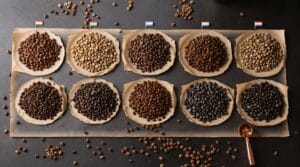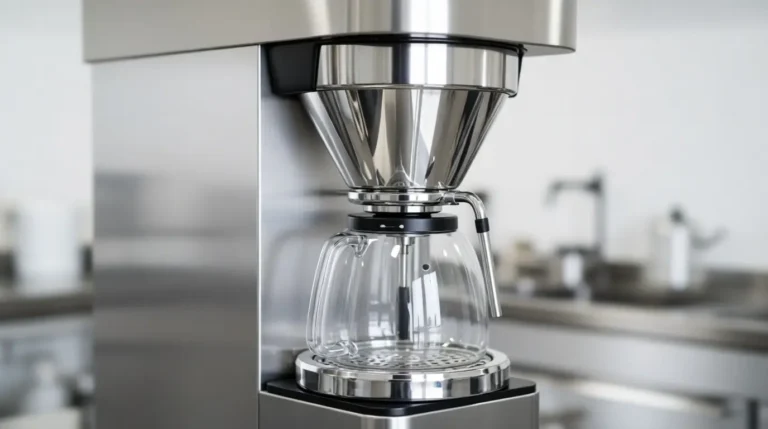

The drip coffee maker dictates extraction quality through precise showerhead temperature control. I see you struggling with inconsistent flavor because most guides ignore how PID controller systems interact with water distribution. We often chase taste without realizing your Thermoblock heating stability decides the chemistry before water even touches the grounds.
This confusion hides the true root cause: saturation uniformity. By dissecting these technical mechanics, you will diagnose extraction failures and choose equipment based on physics, not marketing hype. You gain the absolute logic to override generic recipes and engineer consistent results regardless of bean origin or machine price.
Precise temperature control defines optimal Extraction results.
Strict temperature control regulates the temperature setpoint through the bloom to stabilize Extraction chemistry for coffee within specialty coffee association standards. If the heat drops too low, you get sour, under-extracted liquid; if it spikes too high, Extraction turns bitter. That is why a certified drip coffee maker must hold this window steady from the first second to the last.
You want that water hitting the grounds between 195°F and 205°F. This specific range allows the water to dissolve flavors without burning the bean. Stability here matters more than hitting a perfect single number every time, because fluctuating heat confuses the Extraction process.
- SCA Certification: Brewers must reach 197.6°F within the first minute and stay below 204.8°F throughout the brew.
- Stability Priority: User consensus shows stability across the cycle matters more than peak temperature alone.
- Bloom Sensitivity: Pre-infusion requires steady heat to expand grounds properly before full Extraction.
Prof. William Ristenpart, Professor of Chemical Engineering, founding director of the Coffee Center at the University of California, Davis, notes that the final metrics outweigh the specific path taken to reach them:
“what our research indicates is that what really matters is the final brew strength and final extraction yield at the end of the brew. If Extraction stays consistent in two different brews, it doesn’t matter what brew temperatures were used to achieve them because tasters can’t differentiate them: they taste the same. In other words, Extraction is what matters, not the route you took to get there. So the brew temperature strongly affects how you get there, but the most important thing for coffee brewers to focus on is the final strength and extraction yield.”
This observation confirms why maintaining the temperature setpoint is essential for hitting those final strength targets consistently. Seasoned practitioners emphasize that precise temperature stability and filtered water have a larger impact on extraction quality than showerhead geometry alone. While temperature sets the stage, the way water reaches the grounds is equally decisive.
How showerhead geometry ensures even Extraction
Precise showerhead designs inside a drip coffee maker regulate water flow rate to drive uniform Extraction across the coffee bed. This component acts as the distribution hub, ensuring every gram of grounds receives equal contact during the brew cycle. Without this balance, specific zones over-extract while others remain dry, leaving us with a cup that tastes both sour and bitter.
We often overlook this hardware because it hides inside the brew basket, but its shape dictates everything. High-end models like the KitchenAid spiral or the Ratio SixGo use multi-stream patterns that mimic a manual pour-over. These well-spaced holes prevent the water from rushing through a single path. Instead, the system encourages a gentle pre-infusion that releases CO₂ uniformly during the bloom phase. When the bloom expands evenly, the subsequent water passes through a consistent puck density.
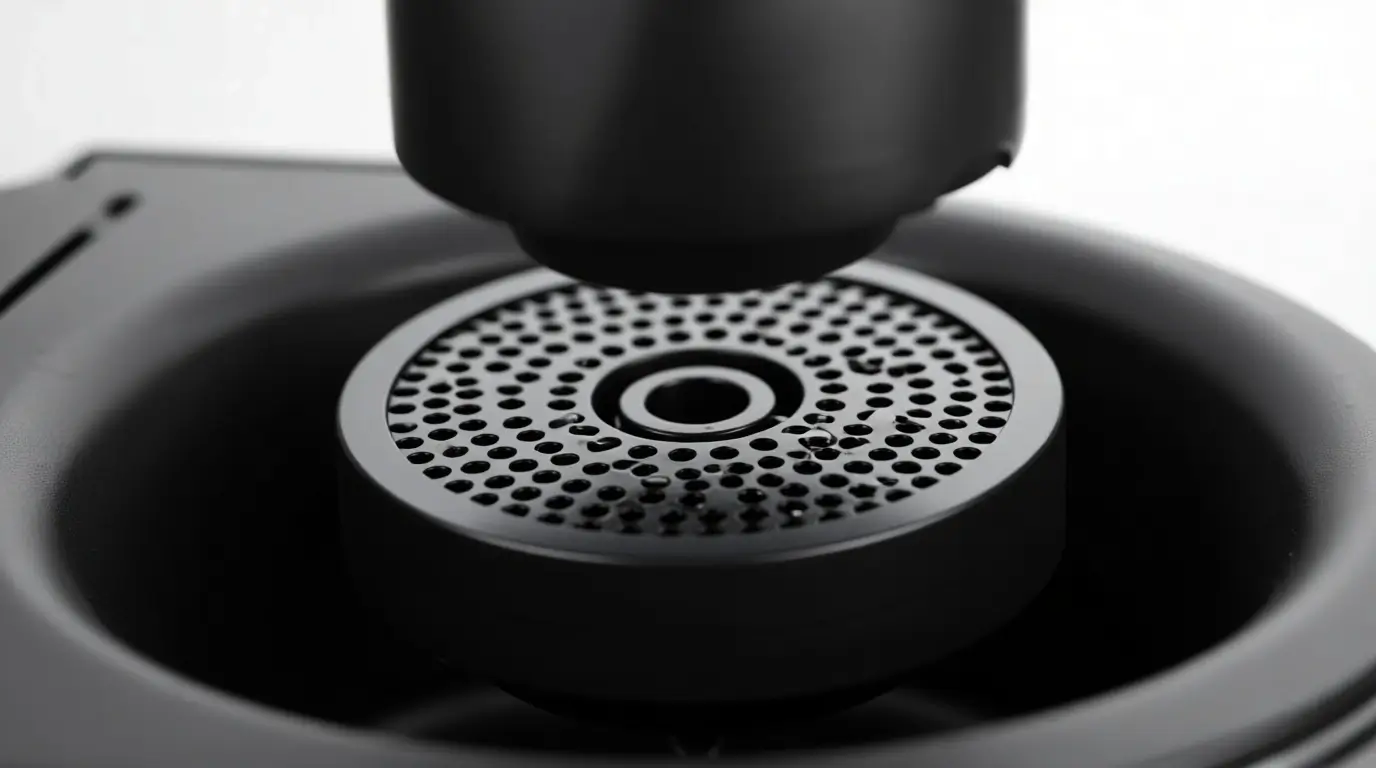
You can see the actual hole pattern in the image above, which reveals why hardware quality matters. Even with perfect temperature settings, uneven water flow can still cause flavor inconsistencies. Some enthusiasts using Ratio machines apply a simple stir-while-brewing technique to reduce channeling further. This manual intervention promotes uniform extraction by mirroring fluid-dynamics principles that the hardware alone might miss.
However, distribution is only half of the equation. We also need to ensure the water stays at the right energy level from start to finish. Carles González, Coffee Competence Manager for Rancilio Group, highlights the level of control required for precision brewing:
“High-quality espresso machines will usually have built-in proportional integral derivative (PID) controls. These are used by baristas to monitor and adjust a number of extraction variables, including brew temperature.”
This observation confirms why maintaining thermal stability is essential for consistency, regardless of the machine type. While the showerhead handles where the water goes, we still need to verify how the system keeps that water hot enough to extract properly.
Why PID and Thermoblock heating define brew consistency
Precise temperature control matter dictates whether a PID controller or Thermoblock heating maintains the temperature stability required for balanced Extraction. I see this distinction as the difference between a system that constantly adjusts its power output and one that simply reacts to heat changes. We need to understand that this mechanical gap directly influences how evenly your grounds extract within your drip coffee maker.
When we look under the hood, a PID controller acts like a smart thermostat. It reads the water temperature hundreds of times per second and adjusts the heating element instantly to stay on target. This allows high-end brewers to meet strict industry standards without drifting. In contrast, Thermoblock heating passes water over a hot metal block. It heats up fast, but it often struggles to hold a steady line when the flow rate changes.
Here is how these two systems compare when we measure their performance against SCA temperature specifications:
| Heating System | Ramp‑up Speed* | Temperature Stability (±°F/°C) | Compliance with SCA Temp. Specs** | Typical Temp. Deviation During Brew Cycle (°C) | Resulting Impact on Flavor Consistency |
|---|---|---|---|---|---|
| PID (PID‑controlled boiler) | 1–2 °C / sec (≈ 2–4 °F / sec) | ±0.2 °F / ±0.1 °C | Fully compliant (meets SCA ≤ 0.5 °C variance) | ≤ 0.3 °C (≈ 0.5 °F) | Very high: repeatable extraction, minimal flavor drift |
| Thermoblock (block‑type heater) | 2–3 °C / sec (≈ 4–5 °F / sec) | ±2 °F / ±1 °C | Often borderline: may exceed SCA tolerance in rapid cycles | 1.5–2.5 °C (≈ 2.7–4.5 °F) | Moderate: noticeable variation in brew strength & flavor profile across shots |
*Ramp‑up speed indicates how quickly the system can raise water temperature from cold‑start to brewing set‑point.
**SCA (Specialty Coffee Association) specification: target brew temperature 195–205 °F (90.5–96 °C) with ≤ 0.5 °C (≈ 1 °F) deviation.
This pursuit of stability drives design choices at the highest level. Mark Hellweg, Ratio Founder and CEO emphasizes the connection between heating power and flow precision:
“We designed the showerhead and bloom cycle to work in tandem to evenly wet the coffee bed… Features a die-cast aluminum 1400-watt heating element, to ensure even water flow through the wide stainless-steel showerhead and over the coffee grounds with precise time and temperature.”
This observation confirms why maintaining the setpoint is essential for temperature stability throughout the entire process. However, we must remember that the machine is not the only variable. Even with a well‑engineered temperature controller, the post‑brew environment can alter the final cup temperature. Thermal carafes do not universally improve flavor for single‑cup brews: they can cause rapid cooling that degrades taste, whereas a glass carafe may retain heat better for small batches.
Now that we see how the heater manages the water, we need to see how that water lands. The real magic happens when this precise heat meets an even distribution pattern.
How Brew Setting and Showerhead Create Consistent Flavor
Ultimately, a precise brew setting commands both showerhead distribution and temperature control matter to drive uniform Extraction.
We need to see this not as separate features, but as a single chain of events inside your machine. When the water lands evenly and stays hot, the chemistry happens exactly as planned.
This synergy starts during the bloom. A well-designed showerhead delivers a gentle pre-infusion that works with stable temperature to release CO₂ without cooling the bed. If the heat drops here, the grounds seal up, and the rest of the water channels through unused coffee. We want every grain to participate in the process.
When these systems fail to sync, you get mismatched results. You might have excellent temperature stability, but a poor showerhead causes over- or under-extraction despite the stable heat. The water finds the path of least resistance, leaving some grounds dry and others muddy. Inside any reliable drip coffee maker, these systems must synchronize to avoid confusing the grounds.
When they work together, the combined effect influences key flavor attributes directly:
- Acidity: Stable heat preserves bright notes without turning them sour.
- Body: Even saturation ensures enough solids dissolve for a full mouthfeel.
- Sweetness: Uniform Extraction prevents bitter compounds from masking natural sugars.
Following flavor profile guidelines becomes possible only when the hardware supports the theory.
Even when both temperature and distribution are optimized, market hype can mislead consumers. We often find that the community prefers affordable, reliable brewers over premium, feature-rich models. Simpler machines like Bonavita or Ninja deliver comparable flavor when showerhead and temperature are well-tuned. You do not need expensive tech to get professional-grade coffee quality: you need consistency.
The infographic below maps how temperature stability and even water distribution interact during bloom, extraction, and flavor development, clarifying the invisible logic for readers.
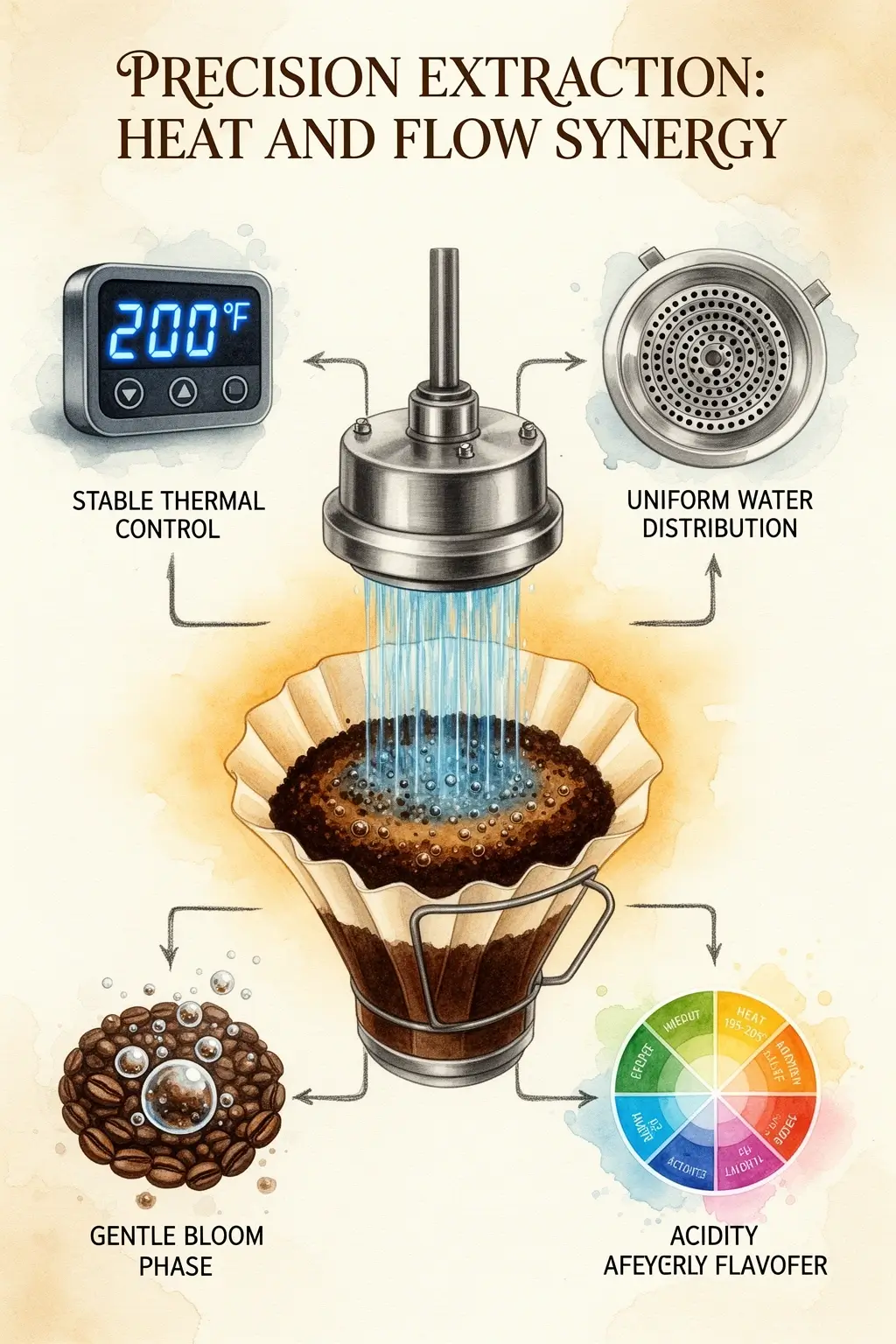
Thermal consistency is the anchor for all of this. Hyunhwa, Head Barista at Nothin Coffee in Seoul, South Korea, explains why fluctuations break the chain.
“Thermal stability in manual brewing means more consistency in your extraction,” he tells me. “Consistency helps to reflect the coffee’s inherent flavours and lets you prepare the best-tasting coffee.” Any significant temperature fluctuations (3°C in either direction is significant enough) can result in either too many or too few compounds being extracted.
This observation confirms why maintaining the temperature control matter is essential for repeatable Extraction. When you know the heat and water flow are steady, you can trust your taste buds. If the cup tastes off, you know the issue lies in the variables you can change, not the machine hiding errors. This clarity lets us diagnose when something is off in your brew.
Fixing Flavor Issues Starts with Temperature and Showerheads
Persistent flavor issues trace directly to unstable temperature control matter, inconsistent showerhead spread, or weak coffee strength during the bloom. When heat fluctuates or water skips spots, extraction breaks down. Your drip coffee maker relies on these systems to maintain balance, so we need to see the link between the symptom and the machine part.
Temperature Control Matter Dictates Extraction and Stability
Unstable temperature control matter often manifests as sharp sourness from low heat or harsh bitterness from excessive warmth. If the water is not hot enough, it fails to pull sugars from the grounds, leaving you with a sour cup. Conversely, water that is too hot scorches the beans, forcing bitter Extraction that overwhelms the palate. To fix sourness, try pre-heating the machine and raising the temperature setpoint. For bitterness, dial back to ~198 °F and check your PID or Thermoblock calibration.
Industry data highlights how common this mismatch is among home brewers.
Data Point: Approximately 30% of surveyed coffee consumers indicated that the acidity or bitterness of their drip‑brewed coffee was “too high” or “under‑extracted,” which industry analyses attribute primarily to sub‑optimal brew temperatures (e.g., below the SCA‑recommended 195‑205 °F). Source: Impact of beverage temperature on preferences
This statistic confirms that maintaining industry standards for temperature stability is the first step in solving most taste complaints.
Showerhead Design Drives Extraction Efficiency and Bloom
Clogged showerhead geometry creates uneven water distribution that leaves dry spots and ruins extraction efficiency. When water finds a path of least resistance, it channels through specific areas while ignoring others. This means some grounds are over-extracted (bitter) while others remain under-extracted (sour) in the same brew.
Research supports the mechanical impact of this design flaw on your cup.
Evidence: The 2019 peer‑reviewed CFD study models drip‑brew beds and shows that non‑uniform water delivery, especially from showerhead geometry, creates channeling pathways where flow is concentrated. These channels over-extract solubles (creating bitter Extraction), while the surrounding bed remains under-extracted, lowering the overall extraction yield (EY) for a given water volume and producing a mixed flavor profile of bitterness combined with sour/weak notes. – extraction uniformity from porous coffee beds
Evidence: This 2023 article demonstrates that regions of higher porosity in a coffee bed receive disproportionately more flow, leading to localized over‑extraction and a reduction in total extraction efficiency. The resulting imbalance alters the brew’s flavor, confirming that channeling driven by water‑distribution design (e.g., showerheads) degrades both yield and taste. – Uneven extraction in coffee brewing
To prevent this, deep clean your head with a vinegar solution or upgrade to a multi-stream model. You should also pay attention to how the bloom timing and duration affect flavor, aiming for a 30‑45 second bloom for light roasts.
Agitation can further help ensure even saturation during this phase. Jens Crabbé, founder of MOK Specialty Coffee suggests a hands-on approach.
“I suggest agitating during the bloom, to make sure the bottom of the coffee ‘cone’ is evenly saturated. This should be done by swirling the filter holder or by making a hole in the coffee cone and stirring after you pour.”
This observation confirms why managing water distribution during the bloom is essential for consistent extraction. Finally, advise using filtered water and a high-quality burr grinder separate from the brewer to eliminate confounding variables like poor grind size or mineral buildup in the paper filter.
Advanced hacks use agitation to refine extraction.
Precise advanced hacks control agitation, bloom, and water temperature to stabilize extraction. We use these manual interventions to ensure hot water contacts every ground evenly. This stability prevents the flow from finding the path of least resistance inside your drip coffee maker.
Seeing the hand motion makes the timing clear.
Jens Crabbé, founder of MOK Specialty Coffee notes the value of this manual movement.
“I suggest agitating during the bloom, to make sure the bottom of the coffee ‘cone’ is evenly saturated. This should be done by swirling the filter holder or by making a hole in the coffee cone and stirring after you pour.”
This observation confirms why introducing agitation supports even saturation during the bloom phase. We can apply similar attention to other variables to lock in consistency.
- Bloom Parameters: Adjust water volume and water temperature based on roast level to manage gas release effectively.
- Paper Filter Prep: Rinse the paper filter with hot water to eliminate taste and stabilize heat before brewing.
- Measurement Precision: Use a scale to monitor brew ratio and adjust flow rate for repeatable results.
- Grind Consistency: Maintain a consistent grind size with a burr grinder to complement water distribution.
Which brewer balances price with reliable temperature design?
Precise brewer choices balance price, design, and capacity against Thermal Carafe retention and burr grinder consistency. Most modern drip coffee maker units fail because they ignore these mechanical links to extract flavor properly. We focus on the hardware that keeps heat steady and water distribution even without wasting money.
How Moccamaster handles showerhead and temperature control
The Moccamaster leads this group by using a copper boiler and spiral showerhead to maintain stability during the brew cycle. This design keeps water near the optimal range while saturating grounds evenly, which sets a high bar for extraction. Other models take different paths to reach similar results. The Fellow Aiden employs PID with adjustable bloom settings, allowing you to tweak how water contacts the coffee initially. Breville Precision Brewer also uses PID but adds customizable flow rates to match specific bean densities.
Thermoblock systems appear in machines like the Bonavita, which holds a 194‑205 °F range without the cost of a copper boiler. While PID controllers generally meet SCA temperature stability specs more consistently, well‑tuned Thermoblocks can still produce excellent cups if the showerhead distributes water well. The Ratio series combines a multi‑stream showerhead with a design that supports stir‑while‑brewing hacks for manual intervention.
Ultimately, the showerhead and temperature‑control system together determine coffee flavor in your daily routine. Selecting a brewer that balances precise temperature, whether PID or well‑tuned Thermoblock, with an even‑flow showerhead delivers the best taste for enthusiasts. You get affordable reliability when these two systems work in harmony rather than competing for attention.
Real Talk: What Most People Miss About Drip Coffee Extraction
Q: What if your showerhead is perfect but bloom fails anyway?
A: It’s usually the temp drop during pre-infusion sealing the grounds tight, blocking full extraction. You’re seeing channeling because CO2 traps force water to skip spots. Fix it by preheating everything and holding steady heat through bloom—stir if needed to break the seal early for even saturation.
Q: Why does Thermoblock beat PID in some machines?
A: Thermoblock ramps faster on small batches without overshoot, keeping you in SCA range where PID might lag. It’s not always inferior; well-tuned blocks match stability on quick brews. Check your model’s flow rate—if it’s low volume, Thermoblock wins for daily consistency without drift.
Q: How come thermal carafes ruin single cups?
A: They cool small volumes too fast post-brew, dropping below optimal serving temp and muting flavors. Glass holds heat better for one-offs since it doesn’t suck energy like insulated walls do. Stick to glass for solos, thermal only for pots you’re sipping over hours.
Q: What if agitation makes coffee worse not better?
A: You’re over-stirring and compacting the bed, creating denser channels for faster bitter pull. Keep it light—a quick swirl or poke during bloom only. Watch your puck post-brew; if it’s uneven, dial back to gentle agitation that spreads without packing.
Q: Why do cheap brewers like Bonavita outperform pricier ones?
A: They nail basic showerhead spread and Thermoblock hold without gimmicks, hitting SCA specs dead-on. Fancy features distract from core physics—pricey models chase adjustability but drift more. Test yours against standards; simple wins if it stays uniform.
Q: How does grind size fake showerhead problems?
A: Inconsistent burr grinds create uneven puck density, mimicking bad distribution by forcing water paths. Even perfect showerheads can’t fix boulders channeling around fines. Always pair with a quality burr—test by swapping grinders to isolate the real culprit.