
Moderate 200mg caffeine drinks sit in a precise sweet spot, enough to sharpen focus without bulldozing the FDA’s 400mg daily ceiling. The problem? That number hides in plain sight, buried across cold brew steeping times, triple-shot lattes, and energy drink labels most people never read.
Monster Original, a 16 oz drip coffee, Celsius, they all flirt with 200mg, but through completely different mechanisms. Know which one matches your tolerance, your schedule, and your second cup habits before you order.
The 200 mg Caffeine Threshold
A single 200 mg caffeine dose is the point where one drink does the work of two to three cups of coffee, and several everyday orders land exactly there without looking like anything extreme. That’s the number that separates “I had some coffee” from “I just took a meaningful stimulant dose in a single sitting.” Once you know what that threshold looks like in the wild, you stop guessing and start choosing.
To make it concrete: two standard 8-oz cups of home-brewed drip coffee, or three espresso shots pulled back-to-back, puts you right at 200 mg. Neither of those feels like a bold move. That’s the point. The drinks that hit this mark don’t announce themselves.
Here’s how the four most common 200 mg caffeine drinks actually stack up:
| Drink Type | Typical Serving Size | Caffeine Range | Key Notes |
|---|---|---|---|
| Drip coffee | 8 oz; most café mugs are 12–16 oz | 70–140 mg per 8 oz | A standard cup sits below 200 mg, but a larger mug clears it easily |
| Cold brew | 8 oz; café servings often 12 oz or larger | ~150 mg per 8 oz; a 12 oz café pour can hit 200–300 mg | The easiest of the four to push past 200 mg: longer steep, higher concentration |
| Triple-shot latte | ~3 espresso shots plus milk; served as 12–16 oz | ~189 mg at 63 mg per shot; stronger shots push it to 200–300 mg | The caffeine is in the shots, not the milk (the latte part is just a disguise) |
| Energy drink | Common cans are 8–16 oz | Varies widely; many products fall at or above 200 mg | Brand-dependent: label-checking is non-negotiable |
So a medium cold brew, a large drip, a triple-shot latte, or a 16-oz can of Monster or Celsius, all of them arrive at or above 200 mg in a single serving. That’s not a coincidence. These are the formats that naturally concentrate caffeine into one go.
Now here’s why the number matters beyond just counting milligrams.
The Health Canada Research Team put a practical ceiling on it:
“The team concluded that 400 mg of caffeine per day (or about three 8‑oz cups of brewed coffee) is a safe dose for healthy adults to consume.”
That 400 mg daily ceiling from Health Canada lines up with the FDA’s own guidance for healthy adults. The European Food Safety Authority adds a more specific caution at the single-dose level: EFSA flags 200 mg as the upper boundary for a single intake before discomfort risk climbs. In other words, one of these drinks gets you to the EFSA single-dose limit. Two of them and you’ve hit the daily ceiling before dinner.
For someone who drinks coffee regularly, 200 mg is manageable. For a casual drinker with low caffeine sensitivity, it can feel like a sudden wave: jitteriness, a racing pulse, a queasy stomach, or that wired-but-anxious feeling where you can’t quite settle. Not dangerous for most healthy adults, but genuinely unpleasant if you weren’t expecting it.
That’s exactly what this article is built to prevent. By the time you reach the end, you’ll know which specific menu items and store-shelf cans deliver a 200 mg caffeine dose (so you can match the drink to your actual energy need, not just grab whatever sounds good and find out the hard way).
The Giant Drip Coffee: 16–20 oz of Wake-Up Call
A large drip coffee is one of the most common 200mg caffeine drinks people order on autopilot, and most of them have no idea how much they’re actually drinking. A 16 oz “Grande”-sized cup typically lands between 200 and 260 mg of caffeine. Step up to a 20 oz “Venti,” and you’re looking at 310 to 360 mg depending on brew strength and roast.
That’s a wide range, and it matters.
Here’s the part that trips most people up: light roast isn’t the “gentle” option. It actually contains slightly more caffeine per scoop than dark roast. The reason is simple: the longer a bean roasts, the more mass it burns off. A dark roast bean is physically lighter, so when you measure by volume (which every café does), you get a bit less caffeine per scoop than you would with a denser light roast bean. The difference isn’t dramatic, but it’s real. Ordering a “light roast large” because it sounds milder is working against you.
The practical rule is straightforward. A medium (12 oz) drip coffee will usually keep you under 200 mg. The moment you say “large,” you’ve almost certainly crossed that line, regardless of the roast, regardless of the café.
So when the barista asks “small, medium, or large?” understand what that question actually is. It’s not just a size choice. For drip coffee, it’s a caffeine dose decision. The large is a 200 mg+ commitment every single time, even when it’s just a plain black house brew with no syrups, no shots, nothing fancy.
Cold Brew’s Deceptive Strength
Cold brew is one of the most misread 200 mg caffeine drinks at any coffee counter (people assume the smooth, mellow taste means less caffeine, but the opposite is true). The process that makes it taste gentle is the same process that makes it hit hard.
Here’s the mechanism. Cold brew isn’t brewed hot and chilled like iced coffee (it’s steeped in cold water for 12–24 hours using a much higher coffee-to-water ratio than any drip method). That long, slow extraction pulls a concentrated dose of caffeine out of the grounds without the acidity that hot water releases. What you get is a dense concentrate that, even after dilution, delivers more caffeine per ounce than a standard cup of hot coffee.
Iced coffee, by contrast, is just regular drip coffee poured over ice. Its caffeine mirrors what you’d get from a hot brew, typically 120–150 mg for a 16-oz cup. Cold brew beats that without even trying.
Starbucks Cold Brew Caffeine vs. Iced Coffee
A Starbucks medium (16 oz) cold brew clocks in at roughly 200–205 mg. Order from a craft shop that steeps at a higher ratio or skips dilution, and you can push past 250 mg in the same size cup. That’s a meaningful gap from the iced coffee sitting right next to it in the same cooler.
The deception is in the flavor. Cold brew tastes smooth (no bitterness, no sharp edge) so your brain doesn’t register it as strong. That smoothness is exactly why it’s easy to drink faster than you should.
Kal Freese, two-time Finland National Barista Champion and co-founder of Taika, puts the risk plainly:
“Most canned coffees are actually too high in caffeine: around 200mg per can. For most people, this much caffeine is counterproductive as it creates too much stimulation.”
Small Size and Caffeine Ratio
Why Cup Size Misleads You
The trap here is that the cup size and the caffeine content aren’t connected the way most people assume. A small 8-ounce cup with three shots crosses 200 mg just as easily as a 20-ounce one. The extra volume in a large cup is mostly milk. The barista isn’t diluting the espresso caffeine content: they’re just adding more foam and steamed milk around the same number of shots. Syrups, whipped cream, oat milk, vanilla drizzle, none of it changes the dose by a single milligram.
This is what makes the triple-shot latte a stealthy option. Someone new to coffee who orders a “large vanilla latte” because it sounds gentle might not realize the barista defaulted to three shots for that size. The drink tastes mild. The caffeine doesn’t.
Energy Drinks Hit Exactly 200 mg on Purpose
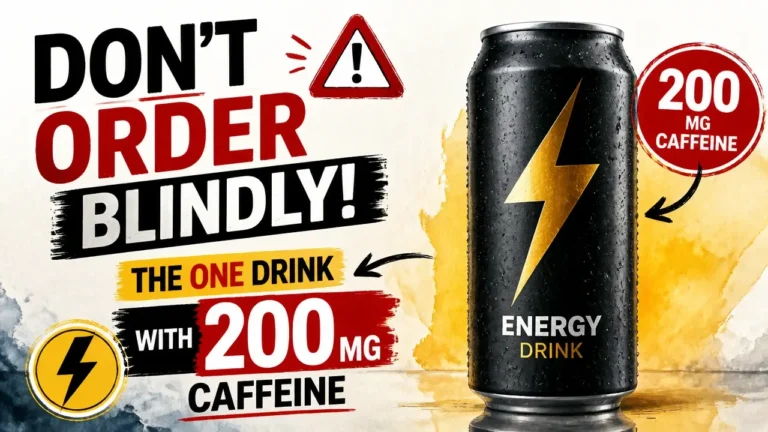
Mainstream energy drinks are the most predictable 200mg caffeine drinks on the market: not by accident, but by design. Monster Original (16 oz) and Celsius (12 oz) are both explicitly formulated to land at exactly 200 mg per can, which means you know what you’re getting before you even flip it over. That’s something a cup of drip coffee, with all its brewing variables, simply can’t promise.
The Consistent 200 mg Energy Drink Can
A well-engineered 200 mg energy drink can does something a coffee shop order can’t: it removes the guesswork entirely. Celsius, Alani Nu, and Ghost all hit that 200 mg mark with enough precision that you could use the can as a measuring tool. Every single time.
But here’s where it gets interesting: that 200 mg on the label isn’t the whole story. Most of these drinks stack additional stimulants alongside the caffeine: taurine, guarana, ginseng. Taurine amplifies how your nervous system responds to caffeine. Guarana contains its own naturally occurring caffeine on top of what’s already listed. What that means practically is that 200 mg from a Celsius or Ghost can often feels stronger than 200 mg from a plain black coffee, even when the number on the label is identical.
The caffeine content is the same. The physiological experience isn’t.
Smart Energy Drink Consumption
An energy drink label is the most useful piece of paper in your hand at a gas station cooler, but most people scan right past it. The first thing worth checking isn’t even the caffeine number (you already know it’s around 200 mg). It’s the sugar content and calorie load. Some cans are completely sugar-free. Others carry 27 grams of sugar, which changes the picture entirely if you’re health-conscious or managing blood sugar.
The fixed dose per can is genuinely one of the format’s strengths. Unlike a cold brew where you might pour a little more, or a drip coffee where a “large” varies by café, a can is a can. That makes it the easiest 200 mg option to track in your daily total.
The flip side of that convenience is that cracking a second can feels effortless, and that’s exactly how people accidentally double their intake without noticing. Two cans puts you at 400 mg, which is the FDA’s full recommended daily ceiling for healthy adults, in just two drinks.
If you’re watching cost alongside caffeine, the math is worth running once. A Ghost energy drink at $2.50 delivers 200 mg, which works out to $12.50 per 1,000 mg of caffeine. Discount-store options can drop that closer to $8 per 1,000 mg, meaningful if you’re buying these regularly.
One approach budget-conscious regulars use: dilute a single 200 mg can with sparkling water and a caffeine-free flavor powder to stretch it across a full liter. Pharmacokinetically, spreading the same 200 mg over a longer drinking window slows absorption and can soften the spike that causes jitters. It’s the same total dose, just delivered more gradually. The one caution worth flagging is that some flavor powders contain unverified caffeine of their own, which can push your daily total up without you realizing it. Stick to mixers you know are caffeine-free, and the 200 mg still counts as 200 mg toward your day.
Safe Caffeine Consumption With 200 mg Drinks
You’ve got the list. Now the real question is how to actually use it (because knowing a drink has 200 mg and knowing how to work that into your day without wrecking your sleep or rattling your hands are two very different things).
Safe caffeine consumption with 200 mg drinks comes down to three things: understanding your daily ceiling, respecting the clock your body runs on, and knowing that your ceiling might be different from your neighbor’s. Let’s work through each one.
Caffeine Half-Life and the 400 mg Daily Ceiling
The 400 mg daily maximum is the number the FDA and most health authorities agree on for healthy adults, and one 200 mg drink gets you exactly halfway there before you’ve even thought about your afternoon pick-me-up.
The math is simple and easy to ignore: two of these drinks in a single day and you’re at the ceiling. Add a mid-morning tea, a soda at lunch, or a second coffee, and you’ve quietly blown past it without ordering anything that felt excessive.
But the number that trips most people up isn’t the daily total: it’s the clock.
Caffeine has a half-life of roughly five to six hours. That means if you finish a 200 mg cold brew at 4 pm, about 100 mg is still circulating in your bloodstream at 10 pm. You might feel fine. You might even fall asleep fine. But that residual caffeine is suppressing the deep, slow-wave sleep your brain needs to consolidate memory and recover, and you won’t feel the deficit until the next morning when you reach for another coffee to compensate.
The European Food Safety Authority (EFSA) puts it plainly:
“According to the EFSA position, the safe intake for adults habitually consuming caffeine is up to 400 mg per day, for pregnant women up to 200 mg, and a single dose in adults should not exceed 200 mg (approximately 3 mg/kg body weight in a person weighing 70 kg)”
That last part matters. A single 200 mg drink isn’t just a convenient round number: it’s the upper boundary for what a single dose should be, full stop.
Now here’s the piece most people never hear about: the 400 mg ceiling is population-level advice. It assumes an average metabolism. But the liver enzyme responsible for breaking down roughly 95% of the caffeine you consume (CYP1A2) doesn’t work the same way in every person.
Genetic variants in the CYP1A2 gene create what researchers call fast and slow metabolizer phenotypes. A fast metabolizer clears a 200 mg dose in about 2.5 hours. A slow metabolizer may still have close to 100 mg active in their system 10 hours later. Research published through Massey University quantifies this gap at up to a four-fold difference in caffeine clearance rates and half-life (meaning the same drink, at the same time of day, can produce wildly different outcomes depending on which version of that gene you’re carrying).
You can find out your CYP1A2 status through consumer genetic testing services like 23andMe. But even without that data, your body has probably already been telling you. If an afternoon coffee reliably keeps you staring at the ceiling at midnight, or if you feel jittery after amounts that don’t bother your friends, slow metabolism is a reasonable working hypothesis. That one 200 mg drink at 2 pm could still be quietly active at midnight, not because you did anything wrong, but because your liver processes caffeine on its own schedule.
Practical Guardrails for Jitter-Free Sipping
Jitter prevention strategies aren’t complicated, but they do require a little intention, especially when the drink in question is delivering a full 200 mg in one sitting.
Here’s what actually moves the needle:
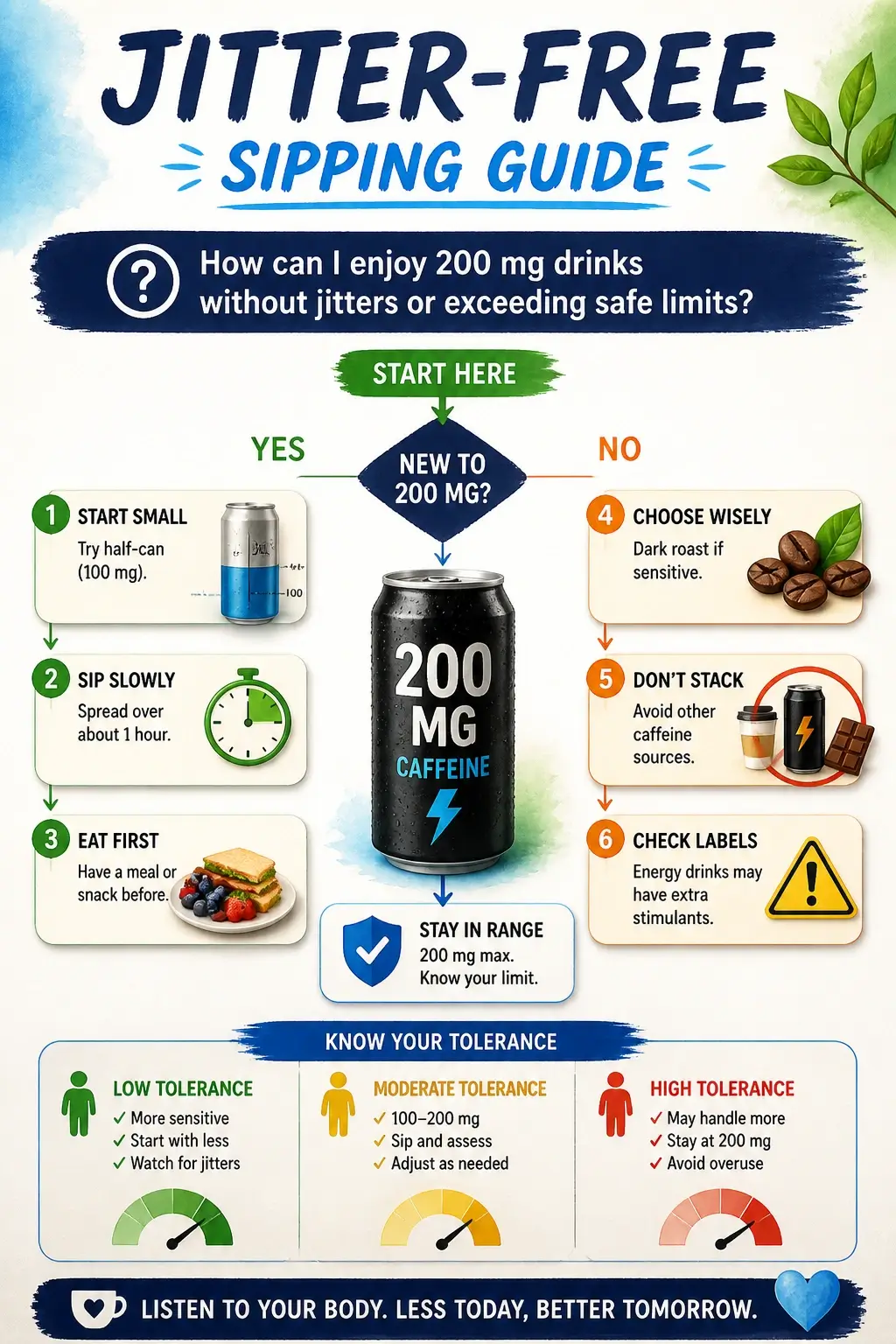
- Sip slowly over 30–60 minutes instead of drinking it in one go. Caffeine absorption rate matters. Spreading the dose out gives your system time to process it incrementally rather than spiking your blood levels all at once. This single habit eliminates most of the jitteriness people associate with high-caffeine drinks.
- Eat something first. Food in your stomach slows gastric emptying, which slows caffeine absorption. A 200 mg drink on an empty stomach hits harder and faster than the same drink after a meal. You’re not reducing the dose: you’re softening the curve.
- Choose dark roast if you’re sensitive. Counterintuitive as it sounds, dark roast coffee typically has slightly less caffeine per gram than light roast because the longer roasting process breaks down some caffeine. If you’re ordering drip coffee and want to stay on the lower end of the 200 mg range, darker roasts give you a small buffer.
- Avoid stacking in the afternoon. This is where most people get into trouble: not from one big drink, but from layering a coffee on top of a tea on top of a soda without tracking the running total. Pick your 200 mg drink and treat it as your primary dose for that window.
- With energy drinks, count everything on the label. Many cans include additional stimulants alongside caffeine (taurine, B vitamins, guarana) that can amplify the effect even when the caffeine number looks familiar. A single 200 mg energy drink is a complete dose. Don’t follow it up with another caffeine source an hour later.
- If you’re new to this range, start with half. A true beginner has no baseline for how their body handles 200 mg at once. Half a can or a small coffee first gives you real data about your own reaction before you commit to the full dose.
Most of the advice you’ll find online splits into two camps: Reddit threads focused entirely on flavor and hacks, and medical sources listing safety numbers with zero practical context. Neither one alone gets you where you need to go. The guardrails above are designed to bridge that gap, giving you the actual mechanics behind each strategy so you can adapt them to your own routine, your own metabolism, and the specific drinks you actually enjoy.
Key Takeaways on 200mg Caffeine Drinks
- A 200mg caffeine dose is the ceiling for a single intake—order anything large and you’ve likely hit it.
- Cold brew’s mild flavor doesn’t save you from its caffeine; it actually makes the 200mg easier to overconsume.
- Your genetics determine whether that 4pm 200mg drink still disrupts sleep at midnight.
- Energy drink labels may promise 200mg, but added stimulants make the experience far more intense.
- Switching to dark roast or milk-based drinks won’t rescue you from the 200mg impact if the dose is already there.
Frequently Asked Questions About 200mg Caffeine Drinks
Q: Why does cold brew’s smooth taste hide its high caffeine hit?
A: Cold steeping pulls out caffeine but not the bitter compounds that alert your palate to a strong drink. Without that sharp taste, your brain doesn’t register it as potent, so you drain a 200mg cup faster than you would a hot, bitter coffee.
Q: How do added stimulants in energy drinks amplify 200mg of caffeine?
A: Ingredients like taurine enhance your nervous system’s response to caffeine, while guarana adds its own naturally occurring caffeine on top. The label may say 200mg, but the combination can feel more intense than an equivalent dose from plain coffee.
Q: If I’m a slow caffeine metabolizer, when’s the latest I can drink a 200mg beverage without wrecking sleep?
A: If your CYP1A2 enzyme works slowly, a 200mg dose at 4pm could leave over 150mg in your system at midnight. To protect deep sleep, try cutting off caffeine by 2pm, giving your liver a full 10 hours to clear most of it.
Q: Is switching to dark roast an effective way to lower caffeine intake?
A: Dark roast beans lose some caffeine during longer roasting, but the difference is modest—likely 5–10% less per cup. If you’re aiming to stay well under 200mg, roast choice alone won’t transform your intake; cup size matters far more.
Q: Does ordering a small cold brew really halve my caffeine dose?
A: Not exactly—a 12oz small cold brew typically has about 150mg versus the 200mg in a 16oz medium. That’s roughly a 25% drop, significant but not a 50% reduction. It keeps you below the 200mg threshold without sacrificing the cold brew experience.
Q: Why does a triple-shot latte feel less intense than a black coffee with the same caffeine?
A: The milk’s creaminess and lack of bitterness create a softer sensory experience, tricking your brain into underestimating the dose. But the three espresso shots still deliver a full 200mg hit; only the taste is gentler, not the physiological effect.
References
- Caffeine in Foods – Health Canada
- Kal Freese on caffeine – Taika
- Espresso Brewing Guidelines – National Coffee Association
- Scientific Opinion on the safety of caffeine – EFSA Journal via Wiley Online Library
- Caffeine clearance rates and CYP1A2 variation – Massey University