
Making macchiato correctly comes down to one thing most people get wrong from the start: proportion. The word “macchiato” means marked in Italian – a small, deliberate dot of milk foam on top of a strong espresso base. It is not a latte in a smaller cup.
What makes this drink worth understanding is that it scales in both directions. You can pull it as a tiny, intense two-sip espresso macchiato, or you can build a fully layered caramel macchiato with vanilla syrup and ice – and both are legitimate versions, as long as you know which one you’re making.
Key Takeaways on Making Macchiato
- A macchiato is espresso marked with a small amount of foam – not a milk drink with espresso added.
- The brew ratio matters more than equipment: concentrate your coffee base regardless of which brewing method you use.
- For traditional espresso macchiato, keep foam to 1–2 teaspoons; for doppio, use 1 tablespoon maximum.
- Microfoam should be dense and velvety – glossy, not dry – and a French press or handheld frother can produce it without a steam wand.
- The caramel macchiato is a latte macchiato style: milk first, espresso poured on top, caramel drizzled last.
- Serve immediately – a macchiato does not hold; the crema breaks down and the foam dissolves within minutes.
Prerequisites: Gear and Ingredients Before You Start
A macchiato does not require a café setup, but it does require the right mental model before you touch anything. The drink is espresso “marked” with a small amount of milk foam – not a milk-forward coffee with a splash of espresso. Getting that distinction wrong before you even heat the water is what turns most home attempts into accidental lattes.
Here’s what you actually need:
Coffee brewer – pick whichever applies to your kitchen:
- Espresso machine (ideal)
- Moka pot (strong stovetop alternative)
- AeroPress (capable of concentrated extraction)
- Strong instant coffee or heavily brewed regular coffee (workable for beginners)
Cup – a small demitasse (2–3 oz) for the traditional version; a standard 8–12 oz cup for the latte macchiato or caramel variant.
Milk or dairy alternative – whole milk produces the richest microfoam, but oat milk and other alternatives froth well with the right technique.
Frothing tool – again, pick what you have:
- Steam wand (espresso machine)
- French press
- Handheld frother
- A jar with a lid
- A whisk
Ingredients at a glance:
- Espresso or concentrated coffee base
- Whole milk or dairy alternative
- Optional: vanilla syrup and caramel sauce for the café-style version
The single most important thing to understand before moving forward is the definition. A macchiato is not defined by size – it’s defined by ratio. A large cup with a small amount of foam is still a macchiato if the proportions are right. A small cup with too much milk is already drifting toward latte territory.
Here’s a look at a clean home macchiato setup before you start brewing:

Step 1: Lock the Golden Macchiato Ratios
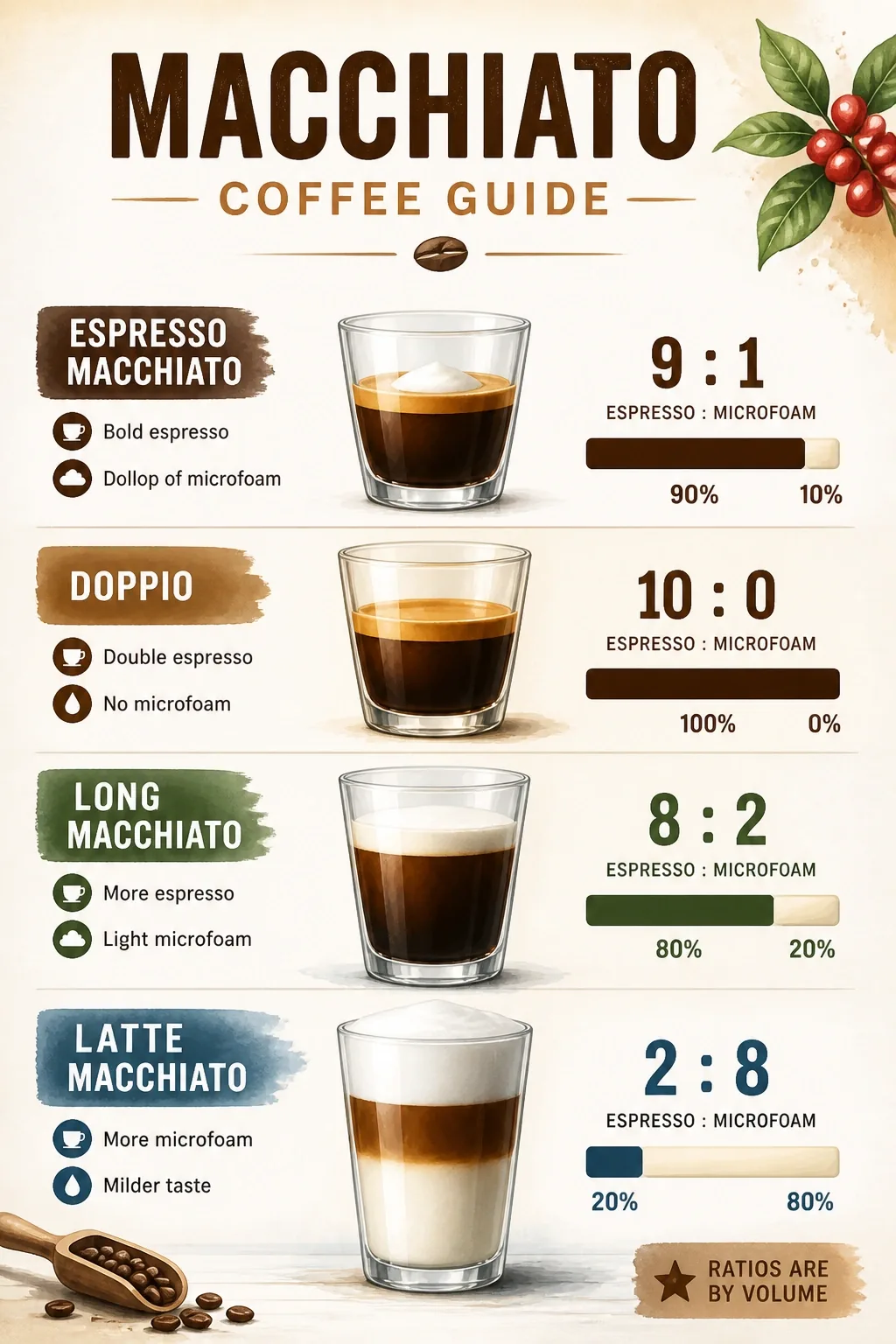
The ratio is not a preference – it’s the boundary between a macchiato and every other espresso drink. Get this right first, and the rest of the process follows naturally.
Quick Reference Card – Screenshot This:
| Style | Espresso Base | Milk/Foam Amount |
|---|---|---|
| Espresso Macchiato (Solo) | 1 shot (~30ml) | 1–2 teaspoons dense microfoam |
| Doppio Macchiato | 2 shots (~60ml) | 1 tablespoon microfoam |
| Long Macchiato (Australian) | Double espresso + splash of hot water | Small amount of microfoam on top |
| Latte Macchiato (Starbucks style) | 1–2 shots poured into milk | 8–12 oz steamed milk base |
What “marking” actually means: You’re not mixing milk into espresso. You’re placing a small, deliberate amount of foam – or in the latte macchiato’s case, pouring espresso into milk – so the two components remain visually and texturally distinct. That’s the mark. The moment you stir it, you’ve made something else.
The contrast with a latte is worth stating plainly: a latte is milk with a shot of espresso incorporated throughout. A macchiato is espresso with a mark of foam. The latte is milk-dominant; the macchiato is coffee-dominant. That single inversion in proportion is what separates them.
Step 2: Brew the Base – Espresso, Moka, Instant, or Regular Coffee
The macchiato’s intensity lives or dies with the coffee base. A weak brew makes the whole drink taste flat and milky no matter how good your foam is. The goal is concentration – a small volume of coffee with enough strength to hold its own against the milk.
Pressurized Extraction Techniques
For an espresso machine, use approximately 18g of finely ground beans and extract a double shot into a demitasse – targeting roughly 36–45g of liquid in the cup. The grind size and extraction pressure matter, but the ratio between the dry coffee dose and the liquid yield matters more than either of them individually. A peer-reviewed extraction study published in Foods found that brew ratio had a larger effect on what ends up in the cup than flow rate, grind level, or temperature – which means controlling dose-to-yield is your highest-leverage variable. For a standard double shot, a 1:2 ratio (18g in, ~36g out) gives you the concentration a macchiato needs.
For a moka pot, fill the basket fully with medium-fine ground coffee, don’t tamp it, and brew on medium heat until you hear the first gurgle. Pull it off the heat immediately. The result is strong, bold, and perfectly usable as a macchiato base – not technically espresso, but close enough in intensity.
Concentrated Soluble and Filtered Alternatives
No machine? No problem – as long as you compensate with concentration.
Regular coffee: Brew it at roughly double the normal strength. Use half the water you normally would, or double the grounds. Weak drip coffee is not a substitute – it lacks the body to support foam and tastes thin. A concentrated pour-over or AeroPress shot brewed with a 1:8 or 1:10 ratio (instead of the usual 1:15–1:17) gets you much closer to what you need.
Instant coffee: Use about two teaspoons dissolved in just 30–40ml of hot water. The result is a small, dark, intense liquid that functions as a reasonable base. It won’t have crema, and the flavor profile is different, but it works – especially for the caramel macchiato variant where vanilla syrup and caramel sauce are doing a lot of the flavor lifting anyway.
Step 3: Froth Silky Microfoam Without a Steam Wand
The foam on a macchiato is not the stiff, dry white cap you see on a cappuccino. It’s dense, velvety microfoam – small, tight bubbles that look almost glossy and feel like warm silk. That texture is what lets it sit on top of the espresso without immediately dissolving into it.
Start by heating a small amount of milk – whole milk or your preferred dairy alternative – until it’s hot to the touch but not boiling. Around 60°C (140°F) is ideal. Overheating burns the milk proteins and kills the sweetness.
Carmen Clemente, the 2022 World Latte Art Champion and co-founder of the World Latte Art & Coffee Center in Milan, notes that producing true microfoam requires not just the right technique but also the right temperature window – typically between 55 and 60°C for drinks served to customers.
Staying inside that temperature range isn’t just about texture – it’s about flavor. Milk heated past 65–70°C starts to taste flat and slightly cooked, which undercuts the sweetness that makes microfoam worth adding in the first place. Pull your milk off the heat the moment it’s hot enough to hold a finger against the outside of the container for just one second.
French press method: Pour the warm milk into a French press – fill it no more than halfway. Pump the plunger up and down rapidly for 20–30 seconds. The milk will roughly double in volume and develop a thick, fine-bubbled foam. Let it settle for 10 seconds, then spoon off the top layer of microfoam directly onto your espresso.
Handheld frother method: Submerge the whisk head just below the milk surface – not at the bottom, not at the top. Run it for 20–30 seconds, moving it slowly upward as the foam builds. You want to incorporate air gradually, not blast it all in at once.
Jar method: Fill a jar about one-third with warm milk, seal the lid, and shake vigorously for 30–45 seconds. Remove the lid and microwave for 15–20 seconds to stabilize the foam. Tap the jar on the counter and swirl gently to break down any large bubbles.
The success indicator is simple: if the foam holds a soft peak on a spoon and has a shiny, creamy surface rather than a dry, airy one, you’ve got it right.
Here’s a visual walkthrough of frothing milk without a steam wand using a French press and handheld frother:
Step 4: Assemble the Traditional Espresso Macchiato
Assembly is where most people accidentally undo good work. The espresso is already in the demitasse, still hot, with the crema – that thin, reddish-brown foam layer – sitting intact on top. Your job now is to mark it, not mix it.
Use a teaspoon to gently place 1–2 flat teaspoons of microfoam directly onto the center of the crema. Don’t pour it in a stream. Don’t tip the frothing pitcher. Spoon it on, carefully, so it lands on top of the crema and stays there as a visible mark.
Do not stir. That mark is the whole point of the drink. The moment you stir it, the espresso and foam combine into a uniform mixture – which is fine if that’s what you want, but it’s no longer a macchiato in any meaningful sense.
For a doppio macchiato, you have a larger base (two shots, ~60ml), so scale the foam up to about 1 tablespoon of microfoam. The ratio stays consistent – the foam is still a small mark relative to the espresso volume, not a thick layer.
Serve immediately. A macchiato is a hot, short drink meant to be consumed in a few minutes. The crema breaks down quickly, the foam starts to dissolve, and the temperature drops fast in a small cup. It doesn’t wait well.
Step 5: Build a Café-Style Caramel Macchiato
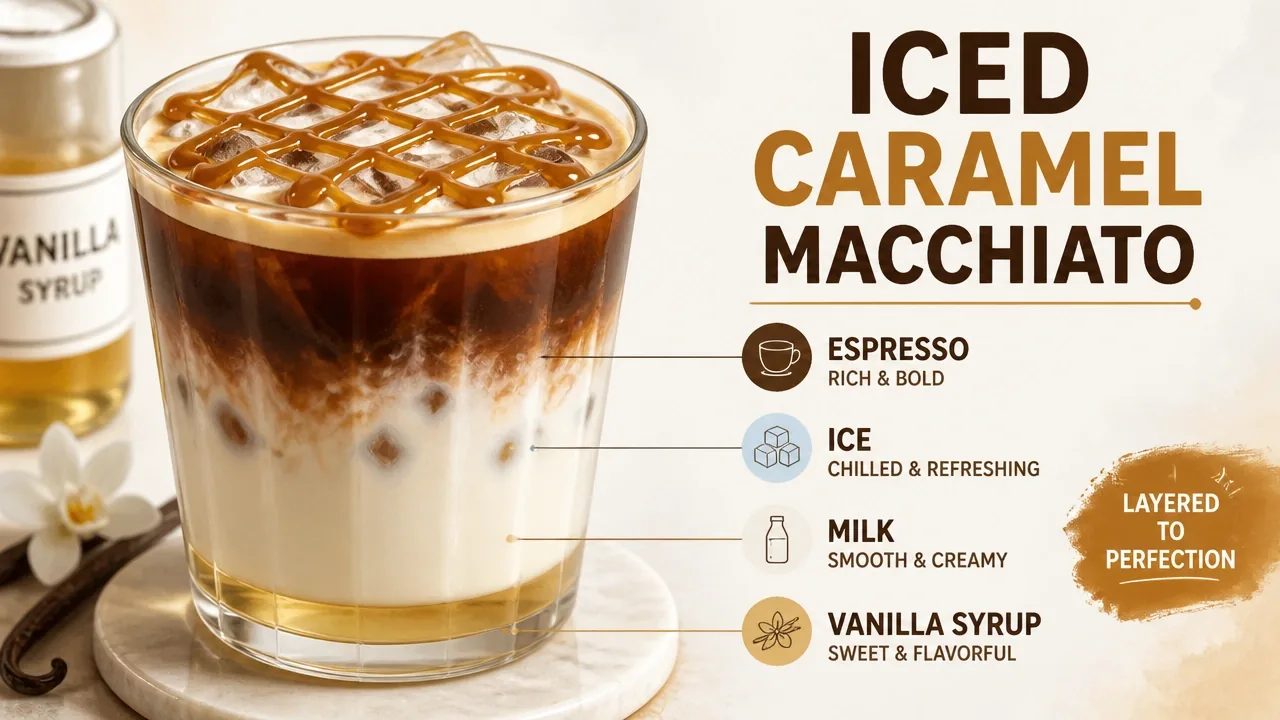
The caramel macchiato Starbucks made famous is technically a latte macchiato – steamed milk “marked” by espresso poured on top, rather than espresso marked by foam. That’s not a criticism; it’s just a different construction, and it’s worth understanding so you can build it correctly at home.
The layering order is what makes it look and taste like the café version:
- Vanilla syrup – add 1–2 pumps (or about 1–2 teaspoons) to the bottom of the cup first.
- Milk – pour steamed milk (or cold milk for the iced version) over the syrup. The syrup will mix in naturally.
- Ice – if making an iced caramel macchiato, add ice now, after the milk.
- Espresso – pour the espresso slowly over the back of a spoon held just above the milk surface. This breaks the fall of the liquid and lets the espresso float as a distinct layer on top rather than sinking and mixing.
- Caramel sauce – drizzle it over the top in a crosshatch pattern (horizontal lines, then vertical lines). This is the visual signature of the drink.
The layering works because of density differences: the cold or lightly steamed milk sits lower, and the espresso – poured slowly enough – floats briefly on top before the drinker stirs or sips through the layers. The spoon technique is the key move. Skip it and the espresso drops straight through, mixing immediately.
This version is larger, sweeter, and milk-forward compared to the traditional espresso macchiato. It’s a completely different experience – but it’s the one most people are searching for when they type “how to make a macchiato at home.”
Troubleshooting: Why Your Macchiato Tastes Wrong
Most macchiato failures trace back to one of four variables: too much milk, too weak a coffee base, wrong foam texture, or letting it sit too long. Here’s how to diagnose and fix each one.
Milk Quantity and Coffee Intensity
If your macchiato tastes too milky or latte-like, go back to the ratio card from Step 1. The problem is almost always volume – too much foam, or foam that’s too wet and liquid. Use a small demitasse for the traditional version, and keep the foam to 1–2 teaspoons maximum. Brewing espresso into a large mug and adding a generous amount of steamed milk is the single most common beginner mistake. The cup size matters because it constrains how much milk you’re tempted to add.
If the drink tastes weak or watery, the coffee base is the culprit. Weak drip coffee cannot carry a macchiato – it lacks the body and bitterness to stand up to even a small amount of milk. Brew concentrated: double the grounds, halve the water, or use the moka pot on medium heat and pull it early. The base should taste almost uncomfortably strong on its own. Once the foam hits it, the intensity will balance out.
Foam Texture, Layering, and Freshness
Dry or stiff foam – the kind that sits in a rigid white dome – happens when you overheat the milk, froth it too long, or use milk that’s been sitting in the fridge for a while. Use fresh milk, heat it gently to the 55–60°C range, and stop frothing earlier than you think you need to. After frothing, tap the container firmly on the counter and swirl it – this breaks the large bubbles and tightens the texture into actual microfoam.
Layers not staying distinct in the caramel macchiato version usually means the espresso was poured too fast or the milk wasn’t cold enough for the iced version. Slow the pour, use the back of a spoon, and make sure the milk layer is well chilled before adding the espresso on top. Don’t stir after assembly – that’s for the person drinking it, not the person making it.
Flat or bitter flavor typically means the drink sat too long before being served. A macchiato is not a drink you prepare and then let sit on the counter while you do something else. The crema breaks down, the foam dissolves, and the flavor turns sharp. Make it, mark it, serve it – in that order, without a pause.
Frequently Asked Questions About Making Macchiato
How to make a proper macchiato?
Brew a concentrated espresso base, froth a small amount of milk into dense microfoam, then spoon 1–2 teaspoons of that foam directly onto the center of the espresso without stirring. The foam should sit visibly on top as a “mark.”
How do I make a homemade macchiato without an espresso machine?
Use a moka pot, AeroPress, or strong instant coffee dissolved in 30–40ml of hot water. The key is concentration – whatever method you use, the coffee base needs to be strong enough to hold its own against even a small amount of milk.
Can you make a macchiato with regular coffee?
Yes, but only if you brew it at roughly double the normal strength. Weak drip coffee won’t work – it lacks the body to support foam and tastes flat. Use half the water or double the grounds to get close to espresso intensity.
What is the difference between a latte and a macchiato?
A latte is milk-dominant – espresso is added to a large amount of steamed milk and incorporated throughout. A macchiato is espresso-dominant – a small amount of foam is placed on top of the espresso and left as a distinct mark. The ratio is essentially inverted.
Why does my foam dissolve into the espresso instead of sitting on top?
The foam is too wet or too light – it hasn’t been frothed into true microfoam. Dense microfoam has tight, small bubbles that give it enough structure to float. Froth longer, use whole milk or a high-fat dairy alternative, and make sure the milk is hot enough before you start.
Does the cup size actually matter for a macchiato?
It matters more than most people realize. A small demitasse (2–3 oz) physically limits how much milk you can add, which keeps the ratio correct almost automatically. Brewing into a large mug invites over-milking and turns the drink into something closer to a latte.
Can I make a caramel macchiato without vanilla syrup?
You can, but the vanilla syrup is what distinguishes the caramel macchiato from a plain latte with caramel drizzle. Without it, the layered flavor profile flattens. If you don’t have vanilla syrup, a small amount of sugar or simple syrup at the bottom still helps the layers behave correctly.
How long does a macchiato stay good after making it?
It doesn’t – not really. The crema breaks down within a few minutes, the microfoam dissolves, and the flavor turns sharper and more bitter as it cools. A macchiato is a drink you make and drink immediately, not one you prepare ahead of time.
References
- Influence of Flow Rate, Particle Size, and Temperature on Espresso Extraction Kinetics | pmc.ncbi.nlm.nih.gov
- Microfoam Milk in Coffee and Latte Art | perfectdailygrind.com